Your phone rings while you're halfway through a client checkout, wiping shampoo from your hands, or checking a chart between appointments. You pick up fast, sound a bit breathless, and the caller hears pressure before they hear competence. That's the problem behind how to make your voice sound great for local business, the goal isn't a “radio voice”, it's a voice that sounds calm, clear, and easy to trust in the first few seconds.
For appointment-based businesses, the voice on the line is part of the service. Callers decide quickly whether the business feels organised, warm, and worth staying with, and that judgement starts long before they hear your pricing or your availability. In California, that matters even more because communication access is already a measurable infrastructure issue, not a side concern, with state reporting showing 5,659 speech-language pathologists serving public schools and about 1 in every 1,034 enrolled students statewide (California case loads report).
That doesn't mean every owner needs clinical support. It does mean voice quality is worth treating as a business skill, especially when callers are booking services, asking for rates, or trying to judge whether your front desk is under control. A strained greeting feels rushed. A grounded one feels like somebody's already taking care of the problem.
Why Your Phone Voice Matters for Local Business
The owner who sounds hurried on the phone usually isn't careless. They're busy, interrupted, and trying to do three jobs at once. The trouble is that callers don't hear the workload, they hear the tone.
A breathless hello can make a salon seem understaffed, a clinic seem disorganised, or a contractor seem hard to pin down. A steady voice does the opposite. It tells the caller that the business can handle pressure without handing that pressure back to them.
California's communication-access data makes that practical reality hard to ignore. The state's relay programme reported almost 1.3 million calls in a single fiscal year and said it had supported more than 750,000 Californians overall to communicate with others, including through speech-related relay services (California relay report). That's a reminder that voice quality isn't just style, it sits inside real-world access and service delivery.
Practical rule: callers forgive a busy schedule faster than they forgive sounding rushed, muffled, or hard to understand.
The first improvement most local businesses need isn't more enthusiasm. It's less friction. Slowing the first sentence, lowering background noise, and avoiding a clipped, defensive greeting can change the whole call. If your phone script is still loose, pairing this with a tighter structure from telephone answering scripts helps, but the voice itself still has to carry calm.
Physical Foundations of a Confident Speaking Voice
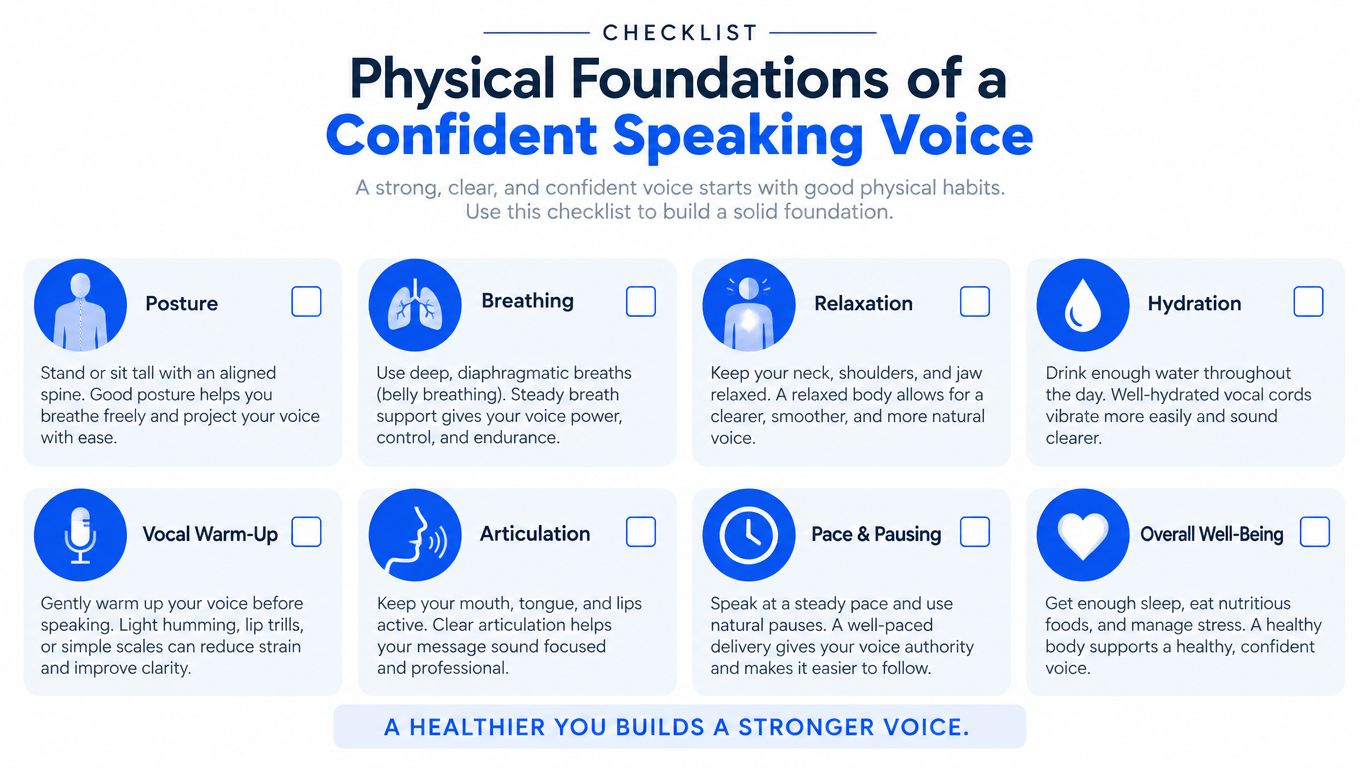
Great phone sound starts before the first word leaves your mouth. If your shoulders are up, your jaw is locked, and your breathing is high in the chest, the voice usually comes out thinner and more strained. That tension is audible, even through a desk phone.
Reset the body before you answer
Sit or stand tall enough that your ribcage can move. Let the shoulders drop, unclench the jaw, and keep your feet grounded if you're on the floor. A shallow inhale right before answering tends to create a tight, anxious opening, while a lower, steadier breath helps the voice feel supported.
A fast reset works well between calls:
- Drop the shoulders: one slow shoulder roll in each direction releases visible and audible tension.
- Release the jaw: let the teeth separate slightly so consonants don't come out pinched.
- Take one quiet breath low in the torso: don't gulp air, just let the breath settle.
- Start with the exhale: begin speaking on a steady stream of air instead of forcing the first word.
That sequence matters because the throat isn't meant to do all the work. When it does, callers often hear strain before content.
Here's a 30-second warm-up that doesn't sound theatrical in a reception area: hum softly for a few seconds, slide from a comfortable low note to a comfortable mid note, then say a short phrase with relaxed lips, such as “Good afternoon, how can I help?”. Keep the volume moderate. The point is to wake up the voice, not to warm up like you're on stage.
If your voice sounds tired after only a few calls, start by changing the body position before you blame the voice itself.
Mastering Articulation and Microphone Technique
A clear voice can still sound unprofessional if the microphone is fighting you. Too close, and plosives jump out. Too far away, and the caller hears room sound instead of presence. Phone audio compresses everything, so the small habits matter more than they do in person.
Use the mic as a tool, not a prop
With a headset or desk microphone, keep the mic slightly off the direct line of air from your mouth. That helps avoid harsh bursts on p, b, and t sounds. If you're on speakerphone, move closer only enough to keep the level even, not so close that every breath becomes part of the call.
The bigger issue is often diction. California vowel research describes a chain shift in which short front vowels are lowered and centralised, which means speech can drift toward a softer, less crisp shape if you're not careful (California vowel analysis). For calls, that means you want clear vowel targets, deliberate mouth opening on /æ/ and /ɛ/, and a pace slow enough that the vowels stay distinct instead of collapsing toward schwa-like blur.
A simple check helps. Record 20 to 30 seconds of scripted speech, then listen for stressed vowels that feel swallowed or too dark. If they are, slow the onset of the sentence, open the mouth a little more on key words, and keep the tongue height stable through the middle of the phrase. That sounds small, but on a compressed phone line, small changes are the whole game.
Make consonants do the heavy lifting
Consonants carry clarity, especially on a noisy line. Crisp final consonants, clean word endings, and short pauses between clauses help the caller follow you without asking you to repeat yourself. Don't rush names, addresses, or appointment times.
The same research tradition on California voice quality also documents a rise in creaky voice, measured through markers such as spectral tilt and periodicity (California voice-quality study). For practical use, that translates to a warning sign. If the ends of your phrases drop into fry, callers may hear less polish and less intelligibility.

Protecting Your Voice During High-Volume Days
A packed day at the front desk can make hoarseness feel normal. It is a warning sign. If your voice keeps tightening, the room may be too loud, your pacing too fast, or your technique too forceful for the load you are carrying.
That matters because voice trouble often hides inside routine work. Canadian clinical guidance says persistent hoarseness shouldn't be treated as normal if it lasts more than 2 to 3 weeks (voice health guidance). It also points to steady voice quality, controlled intensity, less effort, good hydration, and avoiding shouting and throat clearing. For a receptionist or service owner, that is day-to-day operating advice.
Stop treating strain as proof of commitment
If your voice feels rough by mid-afternoon, speaking louder is usually the wrong move. Short pauses, slower pacing, and better room control reduce the need to push. A quieter workspace, a better mic position, and less music or chatter all lower the pressure on your throat.
The same guidance points to the reality of high-voice-use jobs in Quebec, where regular symptoms and diagnosed voice disorders showed up often among occupational voice users. That does not mean every tired voice is a disorder. It does mean a lot of working speakers grow used to symptoms they should address sooner.
Useful test: if reducing effort makes you clearer, the problem is usually load or technique, not personality.
Hydration helps, but it is not a fix by itself. It keeps the instrument usable during the shift. Pair water with pacing, avoid throat clearing where you can, and give yourself small recovery breaks between calls. By the end of the day, your voice should still sound like you.
Matching Your Brand Tone with AI Voice Presets
When you can't answer every call yourself, the business still needs a voice that fits. An AI receptionist becomes part of the brand, so the voice preset should sound like the company you run, not like a random default.
A spa or salon usually needs warmth, ease, and a relaxed conversational pace. A clinic or law office usually needs crisp phrasing, careful pacing, and a tone that feels composed without sounding cold. The right choice depends less on accent novelty and more on whether the voice sounds believable for your actual caller experience.
Heyline lets businesses choose and switch receptionist voices, test the voice in the browser before launch, and adjust pronunciation details for words that need special handling. That matters because local businesses often have names, services, and street references that general systems misread. A test call should feel like a real caller test, not a demo, so check whether the voice handles booking questions, spelling, and handoff moments cleanly.
Compare the voice to the business, not to a trend
A friendly voice isn't always the softest voice. A professional one isn't always the most formal. The best preset is the one that matches how your staff would sound if they were calm, rested, and not being interrupted every 90 seconds. That's especially useful for after-hours coverage, where the caller experience needs to feel consistent even when nobody's at the desk.
Business greeting message examples can help you align the wording with the voice, but the tonal match still has to hold up in a live call. If the voice sounds polished yet unnatural, callers notice. If it sounds warm but slurred, they notice that too. Test for both.
Your Pre-Call and Post-Call Vocal Routine
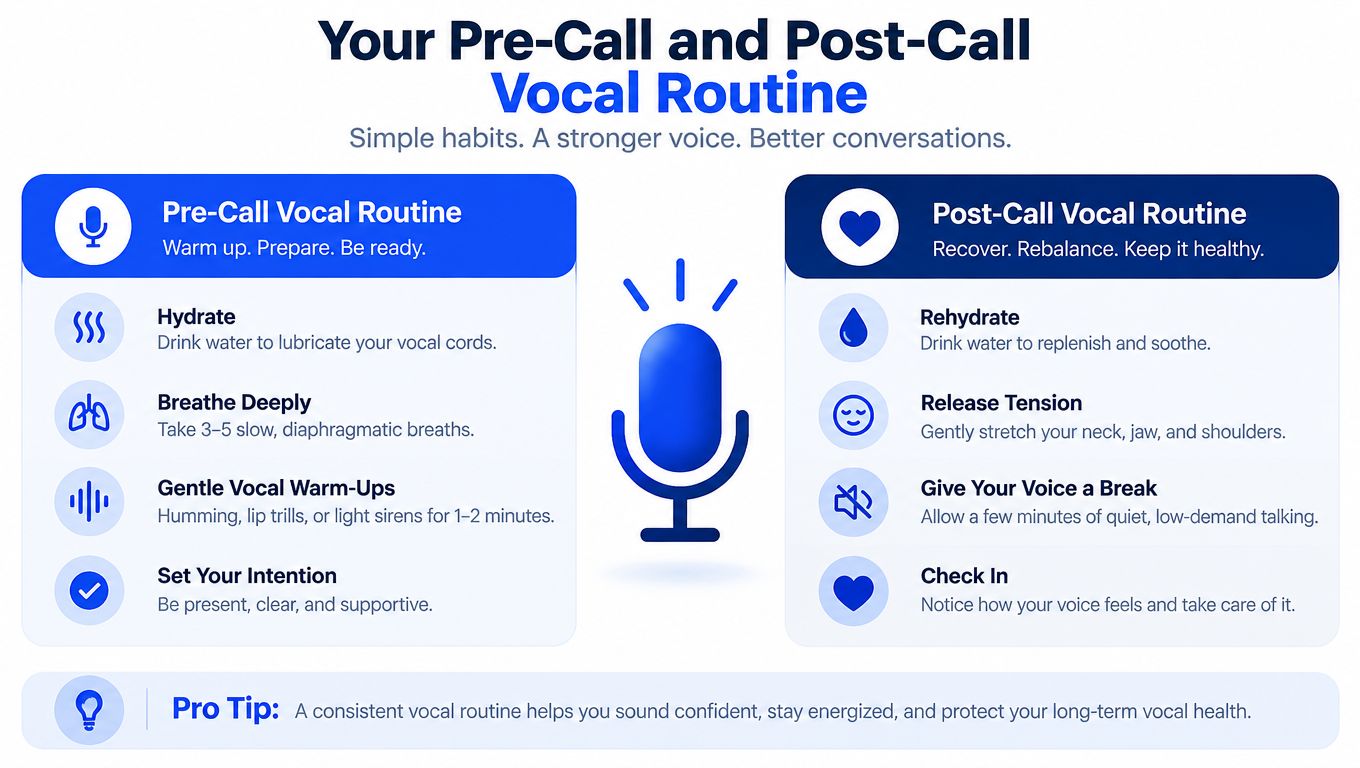
A calm call starts before anyone picks up. Keep the routine short enough to use between rings and simple enough that staff can repeat it without thinking. A steady reset usually does more for voice quality than occasional overcorrection.
- Before the call: drop the shoulders, unclench the jaw, and take one quiet low breath.
- At pickup: slow the first sentence and open the mouth a little more than feels natural.
- During the call: pause before names, times, and next steps so the caller can follow along.
- After the call: exhale, swallow if needed, and avoid jumping straight into a loud side conversation.
- Across the day: keep water nearby and cut background noise where you can.
That rhythm protects clarity and stamina. It also keeps service quality in view, not just sound quality, since the voice carries the customer experience from first contact to booked appointment. For broader habits that support that interaction, see how to improve customer service.
If you want your phone presence to sound calm, clear, and on-brand even when the front desk is busy, Heyline gives local businesses an AI receptionist that answers calls, speaks in a chosen voice, and books appointments straight into the calendar. Visit Heyline to see how a consistent caller experience can support your team when you cannot pick up every ring yourself.