At 6 p.m., your front desk closes, but your phone doesn't. A Spanish-speaking client calls your salon to ask whether an opening is available tomorrow. The caller is ready to book, yet the line goes to voicemail because nobody can answer in Spanish.
Some callers leave a message. Many then search Google again, call the next clinic or salon, and book there. The problem isn't that your staff was rude or careless. You had a coverage gap at the exact moment the caller was prepared to take action.
A bilingual virtual receptionist can help close that gap, but the decision isn't really about adding a language to your phone system. It's about deciding who answers, which language they use, what they can complete, and how reliably they handle the call.
When the Caller Speaks Spanish and the Line Goes to Voicemail
A caller reaches a dental office after work. The greeting is in English, and the caller understands enough to ask for an appointment, but answering detailed questions feels uncomfortable. The caller waits through the menu, hears voicemail, and hangs up without leaving a message.
The practice may never know what happened. There's no completed intake, no appointment request, and no clear signal that language affected the outcome. The caller becomes another missed opportunity in the phone log.
Practical rule: Treat a call that ends at voicemail as an unfinished booking, not just an unanswered phone.
The same scene plays out at salons, aesthetics practices, physiotherapy clinics, legal offices, and home-service businesses. A person may call because they saw an available time online, need to ask about a service, or want to confirm whether a particular provider is available. If the opening exchange creates uncertainty, the caller can move to another local business within minutes.
California's public-sector experience shows that multilingual phone support is established operating infrastructure, not an unusual extra. The state's 2022–2023 Language Survey recorded 14,969 bilingual employees, representing 13.5% of staff in surveyed positions, and reported a 103.8% increase from 2020. Spanish accounted for 11,233 employees, or 75.0% of reported bilingual staff. These figures come from the California language survey and implementation plan.
A peer owner might describe the solution plainly: “We needed someone to pick up when we couldn't, and that person had to handle the whole conversation.” That's the useful starting point. A bilingual virtual receptionist isn't just a translated voicemail greeting. It's a way to keep the caller moving toward an answer, a routed call, or a booked appointment.
What a Bilingual Virtual Receptionist Does
A Spanish-speaking caller reaches your business after seeing an appointment opening online. The bilingual virtual receptionist greets them in Spanish, understands why they called, checks the right calendar, and confirms the next step without switching languages halfway through.
This service provides remote phone coverage in more than one language and handles front-desk tasks according to your rules. Depending on the arrangement, software, trained live agents, or both may answer the call. The work can include collecting details, scheduling an appointment, transferring the caller, or creating a callback request.
For a clinic, the receptionist might handle a Spanish inquiry from a new patient, identify the appropriate provider, check availability, and confirm the visit. At a salon, the caller may need help distinguishing service durations, naming a stylist, and selecting the correct appointment type. Each detail affects whether the caller books or decides to try another business.
The label covers several operating arrangements:
- Monolingual virtual reception handles English calls, while a Spanish-speaking caller may reach voicemail or an employee who is already busy.
- An in-house bilingual receptionist can serve both languages, but one person still has set hours, breaks, holidays, and other front-desk responsibilities.
- Bilingual virtual coverage adds phone capacity outside the physical desk's available hours, provided the service can support the required language from greeting through resolution.
Language support involves more than translating words. A caller may use an informal name for a treatment, change languages during the conversation, request a particular provider, or give a surname that needs careful confirmation. The receptionist must understand the request and apply the booking or routing rules correctly.
For a broader explanation of the underlying model, read what a virtual receptionist is. The practical test is simple: does the caller receive a clear, useful next step in the language they chose?
Three Common Ways Bilingual Coverage Is Built
Not every vendor offering “bilingual answering” provides the same caller experience. You can usually place the proposed service into one of three models.
Single-language fallback
The first model answers in English and treats a non-English call as an exception. The system may detect that the caller needs Spanish, then transfer the call to a bilingual employee, place the caller in a queue, or take a message.
The first thirty seconds often feel uncertain. The caller may hear an English menu, repeat the request, and wait while the system searches for help. This can work when bilingual calls are occasional and the internal team is available, but after-hours and overflow calls expose the weakness. The caller has to wait for a later response instead of completing the booking.
Bilingual routing
The second model identifies the caller's language early and sends the call to an appropriate AI or live agent. The first exchange is more direct because the caller reaches the correct language path without explaining the need repeatedly.
Routing still isn't the same as full service. If the Spanish queue can only take messages while the English queue can book appointments, the business has language availability but unequal outcomes. Ask what happens when the preferred queue is full, the caller switches languages, or the requested provider is served by a different location.
Full live bilingual conversation
The third model keeps the call in the selected language from greeting to completion. The receptionist can answer routine questions, collect intake details, verify the appointment type, book the calendar slot, and route exceptions according to your instructions.
This offers the clearest experience, but it requires more than a bilingual script. The agent or system needs access to the right calendar, current service information, provider rules, and escalation paths. It must also know when not to guess.
California call-centre evidence illustrates why language choice affects service design. In a California Public Utilities Commission report covering 1 July 2004 to 30 June 2005, the RHA call centre recorded 24,455 calls in its online system and 31,883 calls in its phone system. Received calls were 63.08% English, 26.58% Spanish, 2.43% Mandarin, 2.10% Vietnamese, 1.77% Cantonese, 1.57% Korean, 0.93% Hmong, and 0.46% Tagalog, as documented in the California consumer language-access report.
For a local business, the practical lesson is simple. Determine whether the proposal merely detects and transfers, or whether it can complete the booking in the caller's language.
Why Language Coverage Matters for Local Appointment Businesses
Language coverage belongs in your operations plan because the caller decides whether to continue during the opening exchange. A receptionist who can answer only in English may still be polite and competent, but the caller may not feel confident enough to explain the service, provide personal information, or commit to an appointment.
California's public-facing systems show how meaningful language preference can be in phone operations. In the RHA call-centre figures cited above, Spanish represented 26.58% of received calls, while several Asian languages also appeared in the call mix. The point isn't to copy a public-sector call pattern onto every salon or clinic. It's to recognise that your inbound demand may be more multilingual than your front desk assumes.
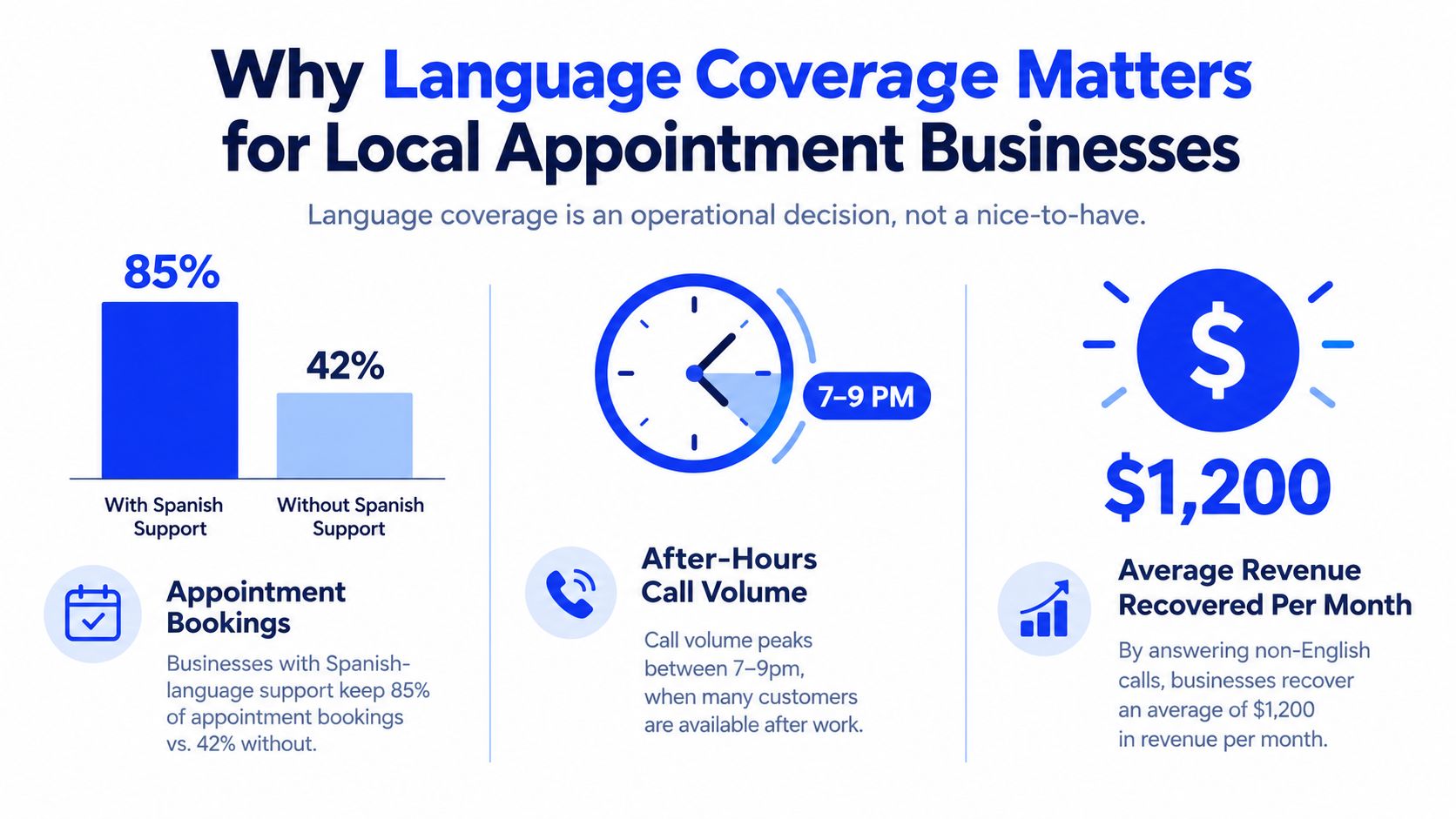
Four operating outcomes are closely connected to the first language exchange:
- Missed calls: A caller who can't get comfortable asking a question may hang up rather than leave a message.
- Booking completion: If the receptionist can answer questions and access the correct calendar, the caller can move directly from interest to a confirmed slot.
- No-show handling: Clear reminders, cancellation instructions, and rescheduling conversations are easier when the caller understands the process.
- Repeat visits: Consistent communication helps clients know what to expect the next time they call.
Consider a dental office where several Spanish-speaking callers ask about appointments each week. If those calls become messages that aren't returned quickly, the practice loses more than a conversation. It loses the opportunity to provide the appointment, explain preparation, and establish trust before the first visit.
California's language-access plan from the Employment Development Department also reflects a broader operational principle: organisations need to track preferred language and plan how callers receive assistance. Coverage alone isn't enough. You need to know whether the caller was understood, routed correctly, and given a usable next step.
The decision point comes early. Language is not a finishing touch added after booking has nearly happened. It can determine whether booking happens at all.
Bilingual Virtual Reception Compared to the Alternatives
A local owner usually chooses among several imperfect options. The right comparison isn't “automated or human”. It's which option gives the caller a dependable path to the right outcome.
| Option | Typical Coverage | Language Quality | Cost per Answered Call | Main Limitation |
|---|---|---|---|---|
| Monolingual virtual reception | English calls during agreed coverage periods | Strong in English, unavailable or limited in other languages | Often predictable for covered calls | A non-English caller may be transferred or asked to leave a message |
| In-house bilingual front-desk staff | Scheduled hours at one location | Can be strong when the employee has the right language and industry vocabulary | Includes staffing, training, and coverage overhead | Breaks, holidays, absences, and busy periods create gaps |
| Bilingual virtual reception | Remote coverage across selected hours, overflow, or after-hours periods | Depends on whether the service provides real conversation or only translation and routing | Varies by model, usage, and included tasks | Quality can differ if the vendor's language path has weaker scripts or limited booking access |
| Hybrid human plus AI | Automated first response with human escalation | Fast handling for routine requests, human judgement for exceptions | Depends on automation and escalation rules | Poorly defined handoffs can make the caller repeat information |
Take a salon as an example. A monolingual service might answer an English call, check a stylist's schedule, and book immediately. A Spanish caller might hear, “Someone will call you back.” That is a quieter form of lead loss because the phone was technically answered.
An in-house bilingual receptionist may deliver the best conversational nuance during working hours. Yet the same person may be helping a client at the desk, handling a product question, or away from the phone when an evening caller rings. A virtual service can extend coverage, but only if it follows the salon's actual rules rather than taking generic messages.
The hybrid model can be useful when routine questions and bookings are predictable, while complex consultations require a person. It needs clear boundaries: what the automated receptionist may answer, when it must transfer, and what information travels with the call.
For the wider role of outsourced call handling, review call-handling services. Compare actual caller outcomes, not just advertised hours.
What to Look for When Choosing a Bilingual Receptionist
A vendor demo should feel like a working shift at your business, not a polished greeting. Prepare realistic calls and score what happens from the first sentence through the final confirmation.
Confirm the language, accent, and vocabulary
Ask: “Which languages and regional varieties can you handle live, and how do you manage a caller who switches between English and Spanish?”
A service may support Spanish in a general sense but struggle with fast speech, local terminology, names, or industry-specific phrases. Test a real scenario, such as a caller asking for a specific dentist or stylist by name. Listen for whether the receptionist confirms the spelling rather than guessing.
Test intake accuracy under pressure
Ask: “How do you verify names, phone numbers, appointment types, insurance details, and preferred providers when the caller speaks quickly?”
A friendly conversation isn't enough if the wrong service, date, or callback number enters your system. Have someone on your team conduct the test call using natural speech, interruptions, and a mid-call language switch.
Verify live calendar booking
Ask: “Can you book directly into our calendar in Spanish, and will you confirm the time zone, provider, duration, buffer, and appointment type before saving?”
Message-taking can preserve a lead, but it still leaves work for your team and delay for the caller. Direct booking is more useful when the service understands your scheduling rules and doesn't create double bookings or place a new client into an unsuitable slot.
Examine routing and warm transfers
Ask: “If the caller needs a specific provider or location, what information reaches the receiving person?”
A warm transfer should carry the caller's language preference, reason for calling, and collected details. If the caller must start again with a different employee, the handoff has created friction rather than removing it.
Check callback ownership
Ask: “If a caller disconnects before booking, who owns the callback, how quickly is it triggered, and in which language?”
A callback process should have a named owner and an understandable status. “We'll get back to them” isn't a process unless someone can see the request, act on it, and record the result.
Demand useful reporting
Ask: “Can we see missed calls, abandoned calls, language split, transfers, bookings, and callback outcomes separately?”
Reporting helps you distinguish a staffing problem from a language-quality problem. Score each finalist on the same page, using categories such as language handling, intake accuracy, booking, routing, callbacks, reporting, and integration. Use a simple rating scale and write down the evidence behind each score.
Integration With Your Website, Calendar, and Phone System
A bilingual receptionist can sound excellent and still fail if the surrounding systems don't pass information correctly. Trace the caller's path from the first question to the saved appointment or completed callback.
Website intake
Your website may contain service names, prices, locations, hours, and preparation instructions. If the phone workflow uses an outdated version, the receptionist may give an answer that conflicts with the page the caller just read.
Ask: “When we change a service or policy on the website, how does the phone knowledge get updated, and can we review the change before it goes live?”
Calendar
The calendar must reflect provider availability, appointment length, buffers, location, and booking restrictions. A Spanish conversation that ends in an English-only scheduling process is still a broken handoff.
Ask: “Can you demonstrate a new appointment, a reschedule, and a cancellation using our real calendar rules?” For Google Calendar workflows, this guide to appointment scheduling with Google Calendar provides useful context on the booking connection.
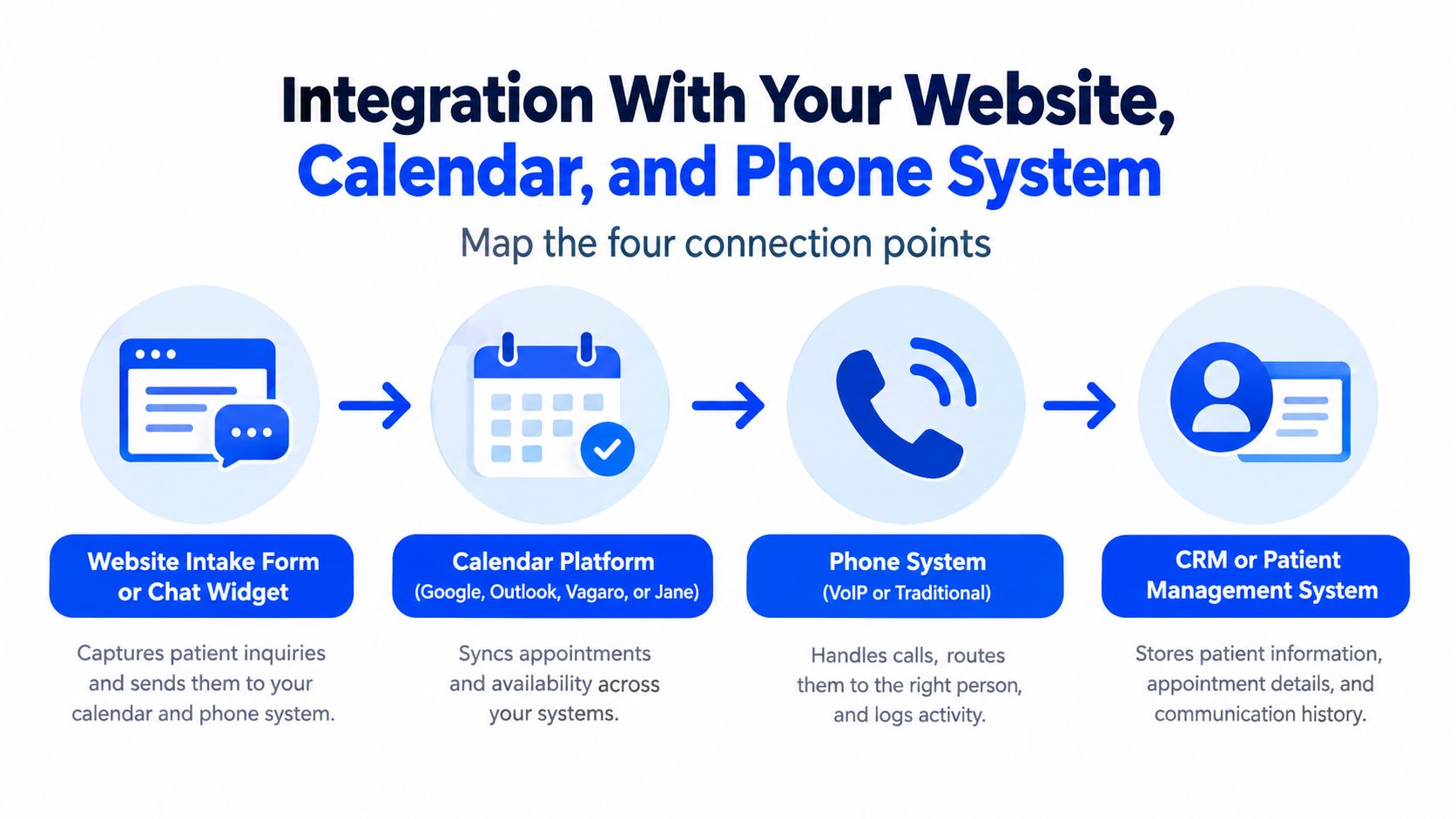
Phone system
Forwarding rules determine which location receives the call, when overflow starts, and where after-hours calls go. A configuration that works during the day may route evening callers to the wrong office or a closed line.
Ask: “Can you test our business-hours, lunch, overflow, weekend, and after-hours rules from an outside number?”
CRM or patient records
Notes need to arrive where your team works. If the receptionist records a Spanish caller's request in a separate inbox, the front desk may miss the information or ask the caller to repeat it.
Ask: “Where are the original notes stored, who can edit them, and how will the receiving staff see the caller's language preference and next action?”
Test the full chain with a real call. Don't accept a demo that proves only that one system connects to another. You need to see the complete path, including failed transfers, calendar conflicts, and callback records.
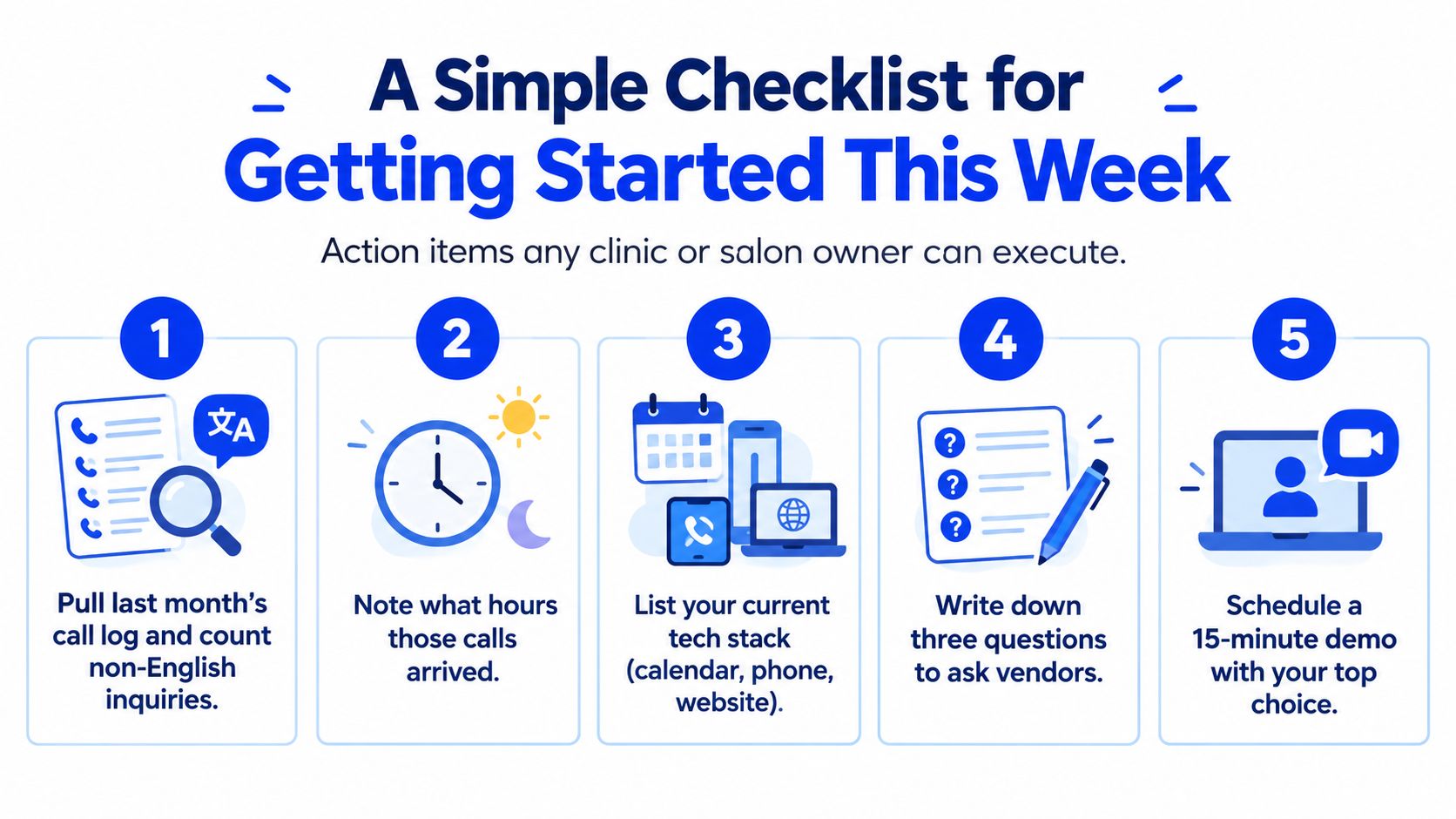
A Simple Checklist for Getting Started This Week
You don't need a perfect language strategy before you begin. You need a clear view of the calls already reaching your business and a test that reflects real working conditions.
- Pull the call log: Review last month's calls and mark inquiries that needed a language other than English.
- Note the timing: Record whether those calls arrived during front-desk hours, lunch, evenings, weekends, or periods of heavy traffic.
- List the languages: Write down the two or three languages your callers use, rather than choosing from a vendor's full language list.
- Choose the operating model: Decide whether you need fallback support, bilingual routing, or full conversation through booking.
- Run live tests: Make one test call in each required language and ask about a real service, a specific provider, and an appointment.
Before choosing a provider, write down the calendar rules, phone-routing rules, callback owner, and information that must enter your records. Then listen to the test call as an owner, not as a technology buyer. Did the caller reach the right language, get a confident answer, and leave with a confirmed next step?
Heyline provides an AI phone receptionist that answers incoming calls, uses information from your business website, and books appointments directly to a connected calendar. If you're comparing bilingual coverage, use Heyline to review the English phone workflow alongside the language support your callers require.