The front desk is helping a client. A colour formula is processing. Someone is checking stock. The phone rings twice, then stops. Ten minutes later it rings again while everyone's hands are full. After closing, three more callers try their luck and get silence, voicemail, or a delayed callback the next morning.
That scene isn't unusual for salons, clinics, law offices, trades, and restaurants. Phone coverage often breaks down at the exact moment a business is busiest. The problem isn't just courtesy. It's lost bookings, slower intake, and callers who move on before anyone gets back to them.
Call handling services exist to close that gap. But many owners still picture them as a simple answering service that takes a name and number. That view is too narrow. The more useful question is this: when a call comes in, how do you recover the revenue behind it?
Some calls need a quick answer and a booked slot. Others need triage, urgency screening, or a warm transfer to a person. The right setup depends on your business model. A salon can automate more than a law firm. An HVAC company may need different rules after hours than a dental practice during lunch rush.
Introduction Why Every Missed Call Matters for Local Businesses
A local service business usually doesn't lose calls because people don't care. It loses them because real work is happening at the same time. A stylist is with a client. A receptionist is checking someone in. A practice manager is handling insurance questions. A contractor is on site and can't pick up. The phone competes with the work that earns the revenue.
That's why high call volume is so hard on appointment-based teams. If your busiest hours also bring your strongest intent callers, every missed ring carries more weight than it seems. Heyline has a useful look at what happens when businesses deal with high call volumes, and the takeaway is simple: “busy” and “available” rarely line up neatly.
What owners usually notice first
Most owners notice the symptom before the system problem:
- Voicemail piles up: Staff promise themselves they'll call back later.
- After-hours enquiries fade out: The next morning starts with a backlog.
- Front-desk stress rises: The person answering calls becomes the bottleneck.
- Booking gaps appear: Empty slots show up even though the phone felt busy all week.
The stakes are larger than many owners realise. An observational study of 85 businesses across 58 industries found that only 37.8% of inbound calls were answered by a live person, while 37.8% went to voicemail and 24.3% received no response at all. In the same study, about 62% of calls were unattended, and 70% of businesses answered fewer than half of their calls. Those findings come from the missed call recovery outcome audit.
A missed call isn't always a minor inconvenience. In many local businesses, it's the first step of an appointment, estimate, consultation, or intake.
The decision most businesses actually face
Owners often ask, “Do I need someone to answer the phone?” That's only part of it.
The better questions are:
- Which calls should be booked immediately
- Which calls should be routed or escalated
- What should happen when nobody on staff can answer
- How much is each missed call likely to cost in your business type
That last point matters more than generic advice admits. The loss attached to a missed call can vary sharply between a haircut, a legal consultation, and a home-service job. So the goal isn't just answering more calls. It's building a recovery system that fits the value and complexity of the call.
What Call Handling Services Actually Do Behind the Scenes
Think of call handling services as an extra front desk layer. Their job isn't only to say hello. Their job is to move a caller to the next useful outcome.
That outcome could be a booked appointment, a routed call, a captured message, a text follow-up, or an escalation to a human. Good systems reduce the awkward middle ground where callers are left waiting, repeating themselves, or wondering if anyone will call back.
The basic workflow
Most call handling services follow a sequence that feels familiar if you've ever watched a strong receptionist work:
Greeting the caller
The system answers with your business name, hours, and a calm opening.Understanding the reason for the call
Is this a new booking, a reschedule, a pricing question, an urgent issue, or a request for a specific person?Taking action
It books, routes, texts, records details, or escalates.Closing the loop
The caller gets confirmation, next steps, or a clear promise of follow-up.
If you've ever used a forwarded business number, you already know forwarding alone doesn't solve much. It moves the ring somewhere else. A proper setup needs routing rules too. That's why it helps to understand how a routing phone number works in practice, especially if different callers need different destinations.
What owners get confused about
Many people mix up four different tools:
| Tool | What it does | What it doesn't do well |
|---|---|---|
| Voicemail | Captures a message | Creates delay and phone tag |
| Call forwarding | Sends the ring elsewhere | Doesn't qualify or book |
| Traditional answering service | Lets a person answer | May stop at message-taking |
| Modern call handling service | Answers, qualifies, routes, and often books | Still needs clear rules and setup |
That distinction matters because call handling quality is measurable, not fuzzy. California's emergency communications system offers a historical benchmark here. The state's official E9-1-1 reporting tracks answered calls, routing outcomes, and related call handling performance as structured operational measures. That long-running framework is described in this overview of California call handling benchmarks. For small businesses, the lesson is simple: answer rate, routing success, and abandonment have been measurable service indicators for a long time.
Practical rule: If a service can answer the phone but can't move the caller toward resolution, it's only solving half the problem.
What “behind the scenes” really means
The unseen work is often where the value sits:
- Rules for business hours and after hours
- Calendar checks before offering times
- Routing by service type or urgency
- Consistent answers pulled from approved business information
- Fallback paths when a call can't be completed normally
The owner hears a smoother phone experience. The caller feels less friction. The business gets fewer dead-end conversations.
Comparing Live Agents Virtual Receptionists and AI Answering
Not all call handling services work the same way. The three models most local businesses consider are live agent services, virtual receptionists, and AI answering.
A caller might ask, “Do you have anything open this afternoon?” or “I need to book a consultation.” The response quality depends on the model you choose, and on how much freedom you want the system to have before a human steps in.
Three models, three strengths
A live agent service usually means a human answers on your behalf, often from a shared service team. A virtual receptionist usually adds more front-desk style tasks and a more branded handling approach. An AI receptionist answers automatically, follows your business rules, and can often handle booking or intake without waiting for staff.
For a fuller definition of the middle category, this guide on what a virtual receptionist is is useful because many owners use that term to mean several different things.
Here's a visual overview before the side-by-side table:
Live Agents vs Virtual Receptionists vs AI Compared
| Feature | Live Agent Service | Virtual Receptionist | AI Receptionist |
|---|---|---|---|
| Who answers | A human operator | A human front-desk style assistant | Software using conversational voice |
| Availability | Depends on plan and staffing | Depends on provider coverage | Can run continuously |
| Consistency | Varies by agent and shift | Usually more consistent than general agent pools | Very consistent once configured |
| Handling simple FAQs | Often yes | Yes | Yes, if business information is accurate |
| Appointment booking | Sometimes limited | Often available | Often available when connected to calendar |
| Complex emotional calls | Stronger | Strong | Better with clear escalation rules |
| After-hours coverage | Usually available at extra cost or as a plan feature | Common | Natural fit |
| Speed during spikes | Can queue if agents are busy | Can queue if reception team is busy | Handles volume without the same staffing constraint |
| Need for human fallback | Built in | Built in | Important for edge cases |
How the caller experience differs
Take a med spa call. The caller asks about treatment availability, price range, and whether they can come in this week.
- Live agent service: the person may answer warmly and collect details well, but they might stop at taking a message if they don't have scheduling access.
- Virtual receptionist: the receptionist may answer in a more branded way and book directly if the provider has calendar access and scripts in place.
- AI answering: the system can answer based on approved information, offer available times, and book during the call if connected properly.
Now switch to a law firm. The caller may need conflict-sensitive intake or nuanced screening.
- A human is often better for the first detailed conversation.
- AI can still help by capturing the first contact, identifying urgency, and routing correctly.
- The smartest setup may combine automation first, then human review.
Some businesses need automation for speed. Others need automation for triage. Those aren't the same thing.
When each model fits best
Live agent service fits best when your callers expect warmth, patience, and human judgement, but your internal team can't cover every ring.
Virtual receptionist fits when you want a front-desk feel without hiring in-house coverage for every hour of the day.
AI answering fits when many calls are repetitive, booking-driven, after-hours, or volume-heavy, and when consistency matters more than improvisation.
One example from the market is Heyline, which provides an AI phone receptionist for local appointment-based businesses. It uses a business's public website information, answers incoming calls in a natural voice, and can book directly into Google Calendar. That makes it a fit for owners who want booking automation without building a custom phone workflow.
The right answer isn't “human or automation.” It's deciding which parts of the call should be automated quickly and which parts deserve a person.
How Pricing Models Work and What Drives Your Cost
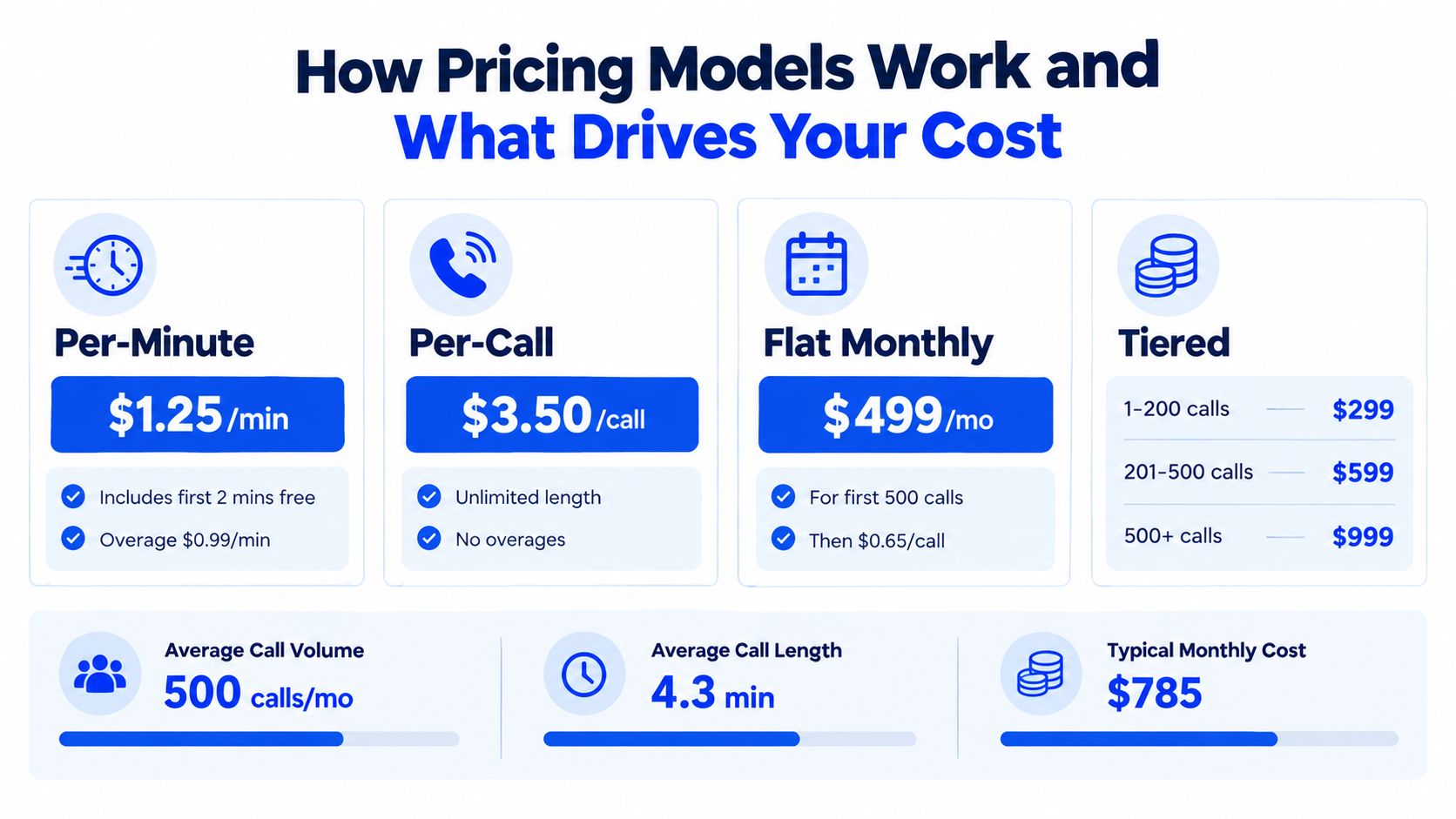
Pricing for call handling services can look simple until the first invoice arrives. The headline number often hides what really shapes your monthly spend: call length, call volume, after-hours coverage, and whether the service books or only takes messages.
The common pricing structures
You'll usually see four models.
| Model | How it works | Best fit |
|---|---|---|
| Per-minute | You pay based on talk time | Lower volume calls with short conversations |
| Per-call | You pay once for each answered call | Businesses with variable call lengths |
| Flat monthly | A fixed fee covers a usage band | Predictable call patterns |
| Tiered | Price changes at call or usage thresholds | Growing businesses with uneven volume |
The right model depends less on what looks cheapest on paper and more on what your calls are like.
What changes the bill
A barber shop and a plumbing company may both receive inbound calls, but their calls don't behave the same way.
A barber shop may have many short booking calls. A plumbing company may have fewer calls, but each call could involve address details, timing, urgency, and dispatch questions. Longer handling usually means higher cost under per-minute plans. More after-hours dependence can also change the value calculation, even if the sticker price is similar.
Watch for these cost drivers:
- Booking access: If the service can book directly, staff spend less time calling back.
- After-hours handling: Night and weekend coverage may carry separate pricing or restrictions.
- Escalation rules: Transfers to staff can add complexity.
- Integrations: Calendars, CRMs, and text workflows may sit inside higher plans.
- Overflow use: A service that only catches peak periods may price differently than one that answers every call.
The cost owners forget to compare against
The fee for the service is only half the equation. The other half is the cost of the calls you fail to recover.
Independent calculator data estimates that a missed call can cost a local service business about $99 to $1,125, with a median near $292, depending on average job value and close rate. That estimate appears in the missed call calculator analysis. The practical takeaway isn't that every business loses the same amount. It's the opposite. A missed call from a salon client and a missed call from a contractor lead can have very different financial consequences.
Cost check: Don't ask only, “What does the service cost each month?” Ask, “What kind of calls are we losing now, and what are those calls worth by business type?”
A better way to judge value
If your team mainly misses routine bookings, automation may pay off quickly because those calls are simple to resolve.
If your team mainly misses high-stakes consultations, emergency jobs, or intake-heavy enquiries, the value may come from triage and routing rather than full automation.
That's why pricing should be tied to call design. Cheap message-taking can be expensive if it leaves appointments unbooked. A higher monthly fee may be reasonable if it shortens the path from first ring to confirmed appointment.
Key Features That Turn Calls Into Booked Appointments
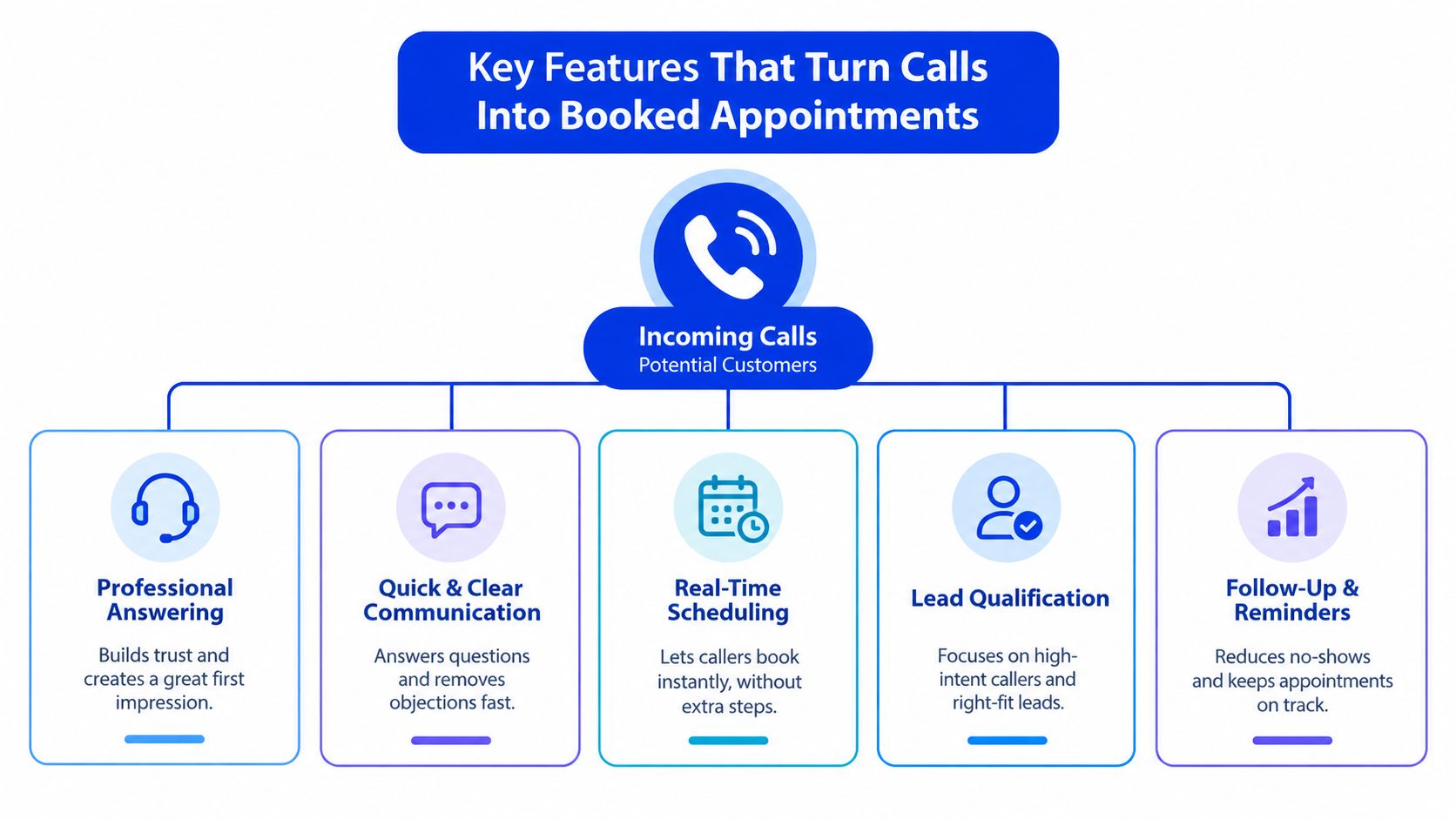
Many services can answer a call. Fewer can convert that call into a confirmed next step.
That's the dividing line that matters for local businesses. If the system only says, “We'll pass along your message,” you still own the delay, the follow-up, and the risk that the caller disappears.
Features that reduce phone tag
A strong booking-focused setup usually includes a small set of practical capabilities.
Calendar-aware scheduling
The system checks availability before offering times, so callers aren't promised slots that no longer exist.Direct booking during the call
Instead of “someone will call you back”, the caller leaves with a confirmed appointment.Smart routing
New client enquiry, existing client support, urgent issue, and simple question don't all belong in the same queue.After-hours coverage
Evening and weekend callers still get a path forward.Instant text-back fallback
If the call can't be completed live, the next step arrives quickly by SMS.
Why scheduling access matters so much
California-focused answering providers make this point clearly. Regional service pages describe live agents syncing with a business's online scheduling system so callers can be booked directly while still on the phone. That approach is described on this California answering service page. The operational difference is huge: message-taking creates follow-up work, while direct scheduling removes it.
For service businesses, the benefit isn't abstract. It means fewer sticky notes, less voicemail backlog, and fewer chances for a lead to cool off.
After-hours isn't a side issue
Some businesses still treat evening coverage as optional. In practice, after-hours and overflow rules often decide whether the lead is saved at all.
A Sacramento-based provider, TeleDirect, positions 24/7 overflow and after-hours answering as important for sectors such as healthcare, law, home services, and property management. That positioning appears on TeleDirect's company page. The reason is straightforward. These businesses don't only need someone to “answer”. They need a system for continuity when staff are unavailable.
If your bookings stop whenever your staff gets busy, your phone system isn't supporting operations. It's interrupting them.
The overlooked feature set
The most underused feature combination is often this one:
- Live or automated answer when possible
- Immediate text-back when a live conversation doesn't complete
- Routing into scheduling or CRM tools
- Tracking booked appointments and qualified leads, not just message count
California-focused materials on missed-call text-back workflows stress exactly that pattern. They argue that a missed call should trigger an immediate SMS, a clear next step, and routing into scheduling or CRM systems. They also stress measuring booked appointments and qualified leads rather than message volume. That shift is outlined in this guide to missed-call text-back workflows in California.
The deeper lesson is simple. Modern call handling services shouldn't be judged by whether they “picked up the phone”. They should be judged by whether they preserved the booking opportunity.
How to Choose the Right Call Handling Service for Your Business
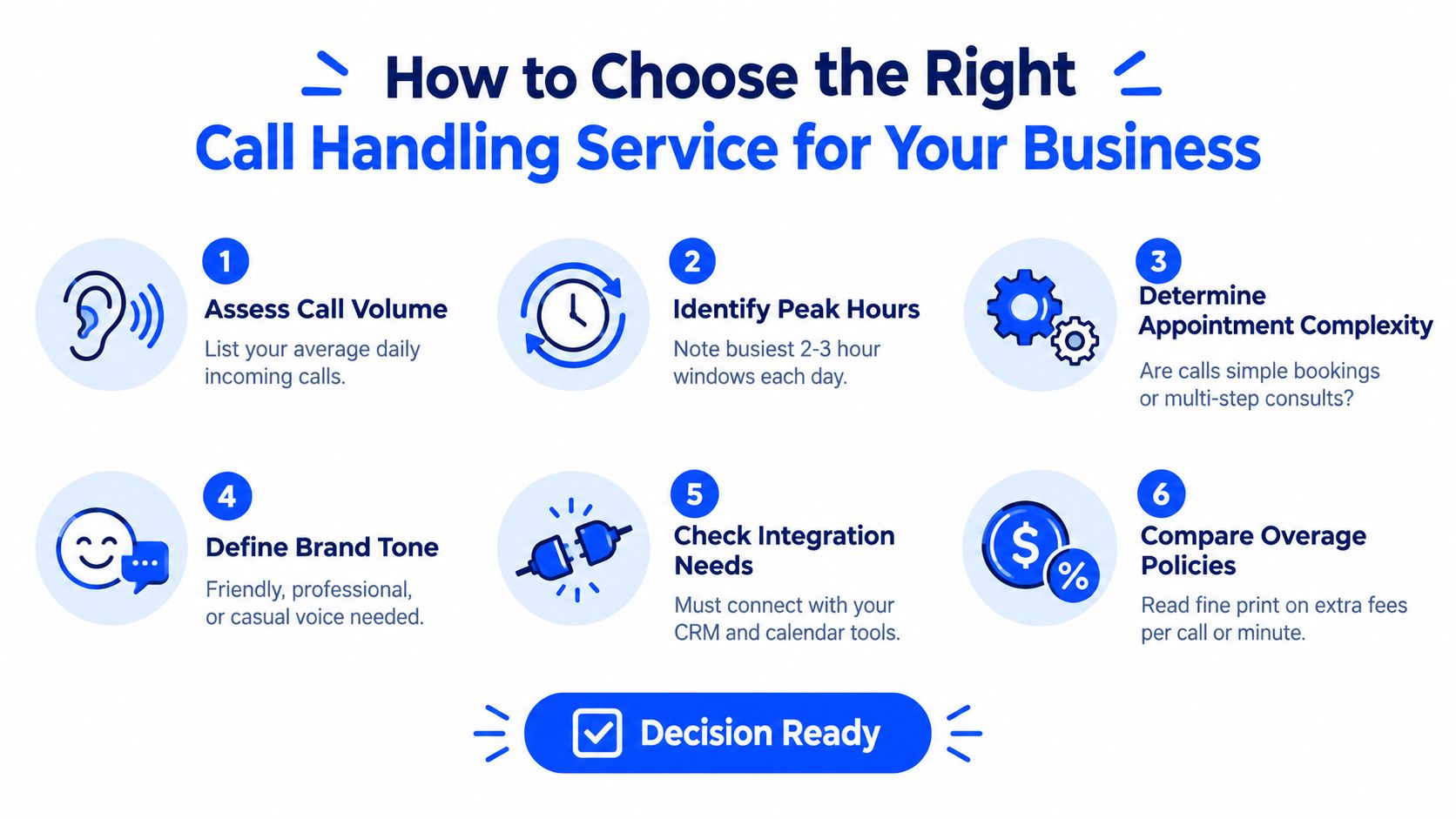
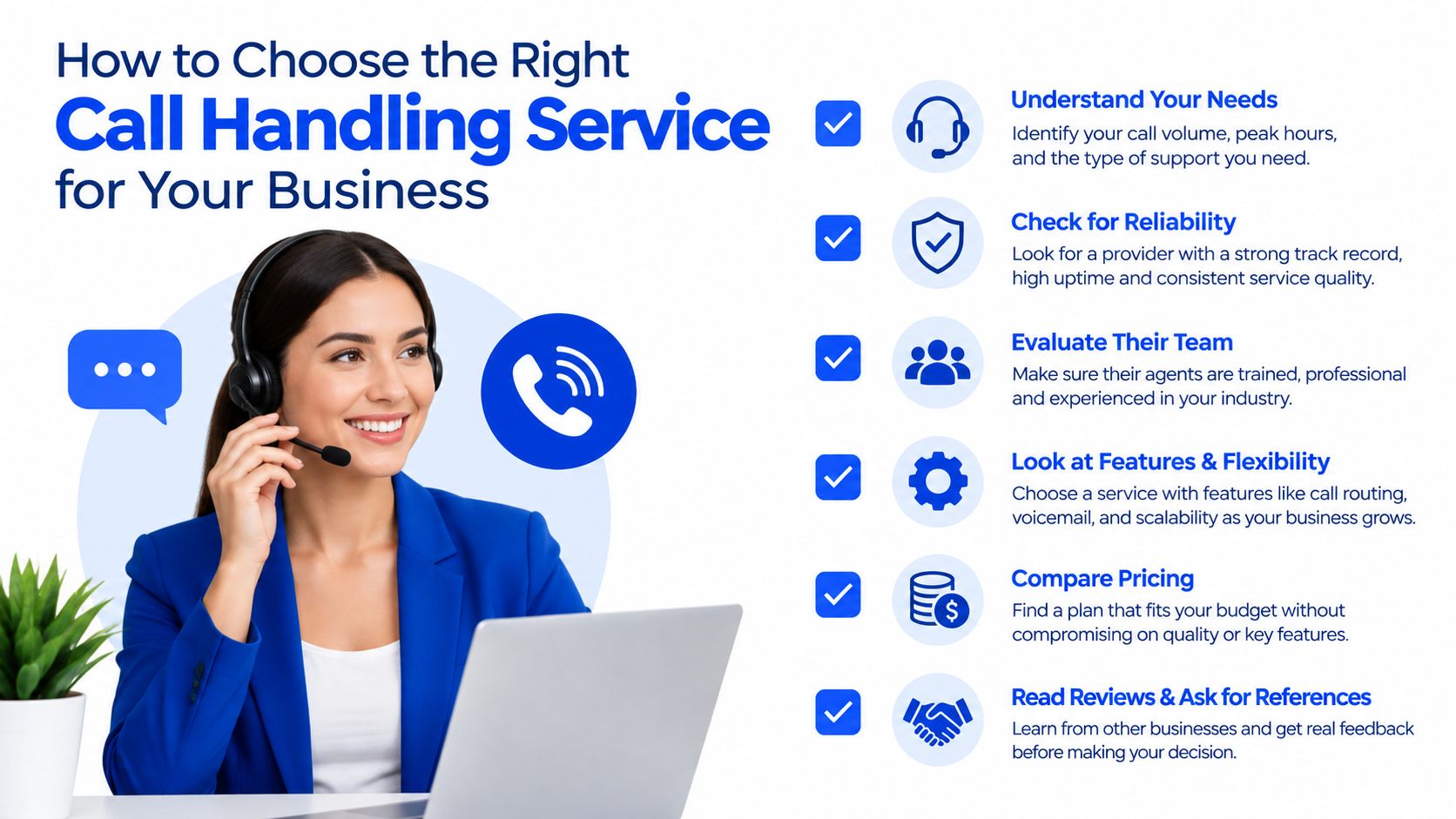
Choosing well starts with your own call patterns, not a feature list.
A clinic, salon, family law office, and HVAC company all need phone coverage, but they don't need the same kind of coverage. The best-fit service is the one that matches your call complexity, customer expectations, and staff reality.
Start with your busiest failure points
Before comparing vendors, write down where calls break.
- Lunch-hour pileups: Calls ring while the desk is partially covered.
- Treatment-room bottlenecks: Staff can't answer without interrupting service.
- After-hours lead loss: Evening callers don't wait until morning.
- Peak-day overflow: Mondays, end-of-month, or seasonal rushes overwhelm the team.
If you know when and why calls fail, you can choose a system designed for that gap rather than buying broad features you won't use.
Match automation to call complexity
This is the most important sorting question.
| Business situation | Better first move |
|---|---|
| Mostly simple bookings and FAQs | More automation |
| Mix of bookings and service questions | Automation with clear routing |
| Sensitive intake or complex qualification | Human-first or fast human escalation |
| Heavy after-hours demand | Always-on answering and text fallback |
A hair salon can often automate much of the booking path. A medical or legal practice may still want automated answering, but with tighter escalation and information boundaries.
Selection rule: Automate the repeatable part of the call. Escalate the judgement-heavy part.
Check setup burden before you commit
Some services assume you'll build flows, write prompts, manage integrations, and keep everything updated. That can work for larger teams, but many local businesses need something simpler.
Look for practical implementation questions:
- Can you test the voice before launch
- Can you edit business knowledge without technical help
- Can you connect your current phone number cleanly
- Can the system read from your calendar
- Can staff understand and manage it after setup
If your business doesn't have an in-house technical lead, ease of setup matters more than fancy diagrams in a sales demo. A system that goes live cleanly often beats a more flexible system that nobody maintains.
Do a live trial, not just a demo
Before going live, test the exact scenarios your callers create:
- A new customer asking for the next available appointment
- A caller trying to reschedule
- Someone asking a question your website answers clearly
- An after-hours caller who needs a next step
- A call that should go to a person immediately
That short test reveals tone problems, knowledge gaps, and weak routing rules faster than any brochure ever will.
Next Steps to Stop Missing Calls and Start Booking More
Most local businesses don't have a phone problem. They have a recovery problem.
Calls come in when staff are occupied, when the office is closed, or when too many things happen at once. Traditional thinking treats that as an answering issue. Modern call handling services treat it as a workflow issue: answer fast, recover intent, book when possible, and escalate when needed.
If you're deciding what to do next, keep it simple:
- Audit your current call handling: Note where calls are missed, delayed, or pushed to voicemail.
- Sort calls by value and complexity: A simple booking call shouldn't wait for manual follow-up if it can be handled immediately.
- Choose the right fallback path: Some calls need booking automation. Others need human escalation.
- Review your tools through a revenue lens: The monthly fee matters, but the bigger question is what happens to missed opportunities now.
- Run a real-world trial: Test during peak hours, after hours, and with common caller questions.
The strongest setup is rarely the one with the most features. It's the one that matches how your business operates on a busy Tuesday, not how it looks on a calm Friday afternoon.
If your current process still depends on voicemail, delayed callbacks, or whoever happens to hear the phone first, there's usually a better option.
Heyline offers an AI phone receptionist for local appointment-based businesses that answers calls, uses your website information to respond to common questions, and books directly into your calendar during the call. If you want a simpler way to turn missed calls into booked appointments without a developer-heavy setup, visit Heyline.