A call answering service typically costs $69 to $149 per month for small businesses on traditional per-call plans, while modern AI receptionists offer flat-rate subscriptions starting around $49 per month with included minutes. Your real cost depends on call volume, service hours, billing rules, and whether the system turns calls into qualified, scheduled appointments.
The popular advice is to compare the monthly fee and choose the lowest quote. That's the wrong starting point. A cheap plan can become expensive when calls exceed the allowance, holiday coverage attracts surcharges, or after-hours callers reach voicemail instead of your calendar.
For a local business, the useful question isn't how much is a call answering service. It's how much you pay for each answered call that becomes a genuine booking, and whether the provider gives your team more revenue than administrative work.
The True Cost of Answering Your Business Phone
The lowest headline rate often produces the highest cost per booked appointment. Traditional providers may advertise a small base fee, then charge according to calls, minutes, transfers, special coverage, or usage beyond the plan. Your bill rises precisely when demand improves, such as after a marketing campaign, during seasonal peaks, or when an emergency service line starts receiving more enquiries.
That creates a poor operating trade-off. You pay more for higher call activity, yet the extra calls may still require manual callbacks, calendar updates, and follow-up from your staff. If the service only takes messages, you've bought a more polished voicemail system rather than a complete intake process.
Stop measuring the wrong output
A phone service creates value in stages:
- Answered: Someone or something picks up.
- Qualified: The caller's need, location, urgency, and contact details are captured accurately.
- Scheduled: The caller receives a confirmed appointment or the right next step.
- Completed: Your team can fulfil the booking without correcting missing information.
A provider that performs only the first stage may look affordable while creating work downstream. A provider that handles all four stages can justify a higher rate, provided the workflow matches your business.
Practical rule: Calculate cost per scheduled appointment, not cost per call. A low rate is irrelevant if your staff still has to chase every promising caller.
After-hours availability matters because prospects rarely organise their needs around your opening hours. A salon enquiry, dental request, legal consultation, or plumbing problem can arrive while your staff is busy, travelling, or unavailable. The operational cost isn't just the unanswered ring. It's the lost chance to capture intent while the caller is ready to act.
Use a service only when it solves a defined coverage problem. If your team already answers every call promptly and books appointments without delays, an answering service may add expense without improving operations. If calls regularly interrupt appointments, disappear into voicemail, or generate manual phone tag, structured intake is an operating investment.
For a broader explanation of call handling options, compare call handling services for local businesses. The important distinction is whether the service protects your booking process or merely transfers the communication burden elsewhere.
Breaking Down Traditional Per-Call Pricing Models
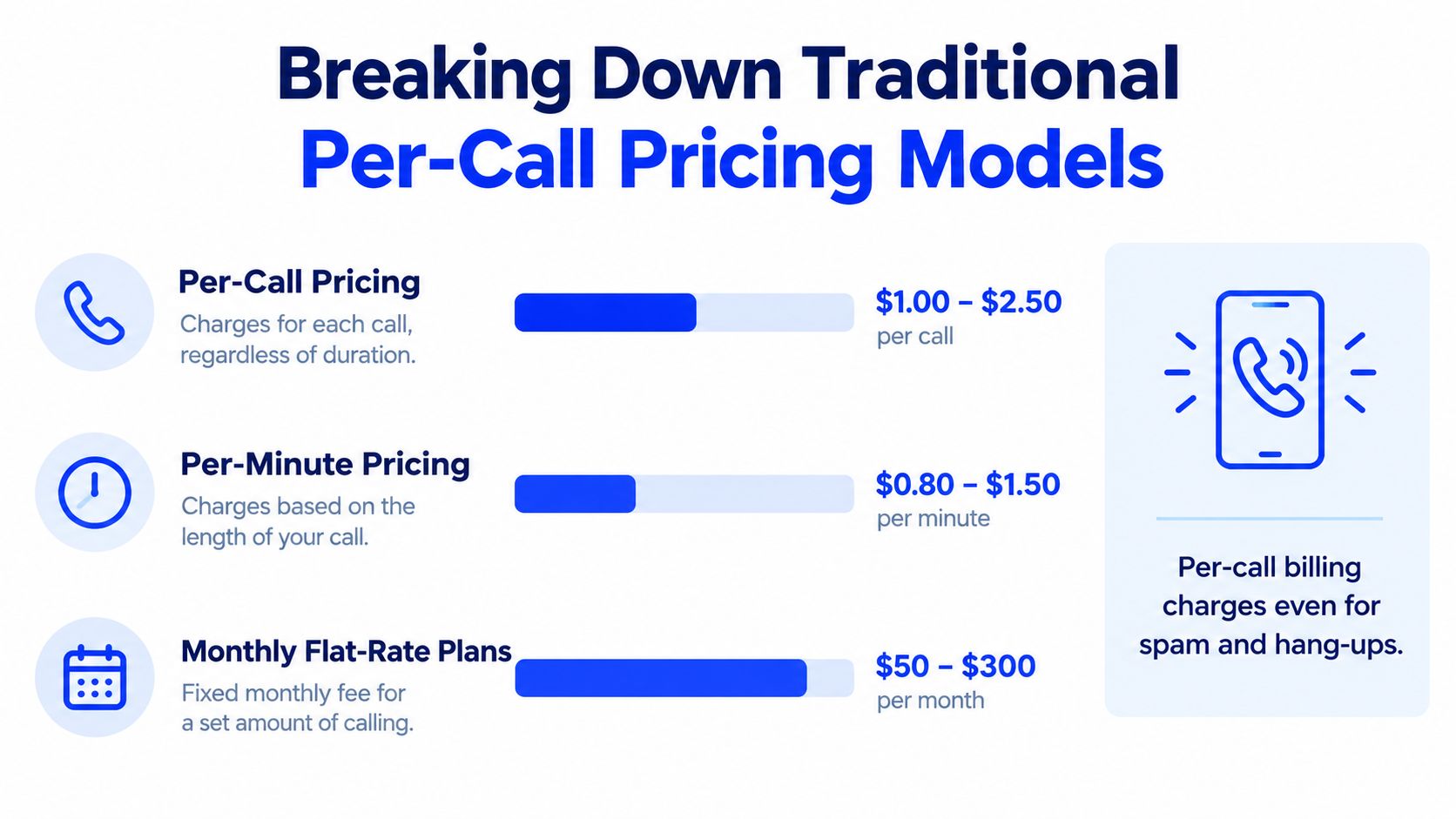
Traditional plans usually charge by call, minute, or a bundle that combines a monthly allowance with overage rates. Each structure rewards a different type of usage, and none should be judged by the base fee alone.
Independent California pricing guides place common answering service costs at roughly $0.70 to $1.62 per call, with typical small-business monthly pricing between $69 and $149, according to this California answering service pricing guide. A separate California guide describes a wider market range of about $0.79 to $1.45 per call, while very small businesses may sometimes see monthly costs as low as $20 on certain plans.
These figures show why simple comparisons mislead. Two businesses can receive very different invoices despite choosing plans with similar advertised rates. Call volume, plan minimums, included usage, and the definition of a billable call shape the result.
Per-call billing
Per-call pricing is easy to describe. You pay a set amount each time the service handles a call, regardless of whether the conversation is brief or involved. That can work for a business with predictable, short calls, but it becomes less attractive when callers need detailed intake or appointment assistance.
Ask the provider what counts as a call. A transfer, hang-up, wrong number, or spam interaction may be treated differently depending on the contract. The billing definition matters as much as the displayed rate.
Per-minute billing
Per-minute pricing links your invoice to talk time. A California comparison places one part of the local market around $0.79 to $1.45 per call, while broader answering plans can use minute-based calculations and different allowances. Before signing, confirm whether the clock includes transfers, hold time, message entry, and wrap-up work.
The calculation is straightforward:
Estimated monthly usage = number of calls × average handling time
Then compare that usage with the included allowance and overage rate. Don't rely on a single quiet month. Review your call history across ordinary periods and known busy periods, because a plan that works during low demand may become costly when callers respond to a promotion or seasonal need.
Flat-rate bundles
A flat-rate plan offers a fixed charge for a defined level of usage or features. Predictability can help with budgeting, but only if the included capacity reflects your actual demand. Underusing the allowance means paying for unused availability, while exceeding it can trigger another tier or additional charges.
The virtual receptionist pricing guide is useful when comparing message taking, transfers, scheduling, and automation as separate operating functions rather than treating every answering service as equivalent.
For a visual explanation of the mechanics, use the embedded overview below.
The right model depends on call consistency. Per-call plans suit simple, stable interactions. Per-minute plans can be more transparent when duration varies. Flat subscriptions suit owners who value predictable spending and need coverage that doesn't become punitive during busy periods.
Comparing Live Agents and AI Receptionist Subscriptions
Live agents and AI receptionists solve the same basic problem, but their costs behave differently. A live service pays people to handle calls, and the invoice generally reflects the volume, duration, coverage window, and complexity of that human work. An AI receptionist uses software to answer conversations, gather information, and complete defined workflows under a subscription or usage structure.
A California comparison lists an AI-powered answering service at $49 per month with 100 minutes included, followed by $0.12 per additional minute. The same comparison places live-agent services in California at approximately $49 per month to $350 or more per month, with estimated effective rates ranging from $1.28 to $5.40 per minute. Those figures come from a California answering service comparison.
| Feature | Traditional Live Agent | AI Receptionist |
|---|---|---|
| Primary cost driver | Agent handling time, call volume, and coverage | Subscription allowance, included minutes, and configured workflows |
| Availability | Depends on selected hours and staffing | Can provide continuous automated coverage |
| Conversation style | Human judgement and flexible intervention | Natural automated conversation within configured knowledge |
| Appointment booking | May require a supported calendar workflow or follow-up | Can book directly when calendar integration is available |
| Busy-period billing | May rise through usage, overages, or extra coverage | Usually easier to forecast when the subscription is fixed |
| Best fit | Complex, sensitive, or highly nuanced conversations | Routine intake, qualification, scheduling, and after-hours coverage |
When live agents earn their cost
Human receptionists remain valuable when callers need empathy, negotiation, nuanced judgement, or unusual problem-solving. A legal intake call may involve questions that require careful escalation. A medical office may need staff to handle sensitive situations. A home service company may want a person to assess an uncertain emergency before dispatch.
The mistake is using live agents for every interaction by default. If most calls ask for opening hours, service areas, availability, pricing guidance, or appointment times, paying human rates for routine tasks can inflate the cost of intake without improving the outcome.
When AI makes more sense
AI is a strong fit when the business needs consistent coverage and repeatable actions. An AI receptionist can greet callers, answer questions drawn from approved business information, collect details, check availability, and schedule an appointment. It can also handle demand outside staff hours without requiring a new shift or manual callback queue.
The financial advantage isn't that every AI plan is automatically cheaper. The advantage is structural. A predictable subscription can make budgeting easier than a live model that adds setup charges, holiday surcharges, and penalties when usage exceeds the allowance.
Review AI receptionist pricing by asking what the plan completes. A service that answers but doesn't schedule may leave the most valuable step to your team. A service that schedules incorrectly can also create operational problems, so test its knowledge, escalation rules, and calendar behaviour before routing all calls through it.
Choose live agents for complexity. Choose AI for repeatability and coverage. Use a hybrid arrangement when routine calls can be automated but sensitive or high-value conversations need human escalation.
Hidden Fees and Compliance Add-Ons to Watch For
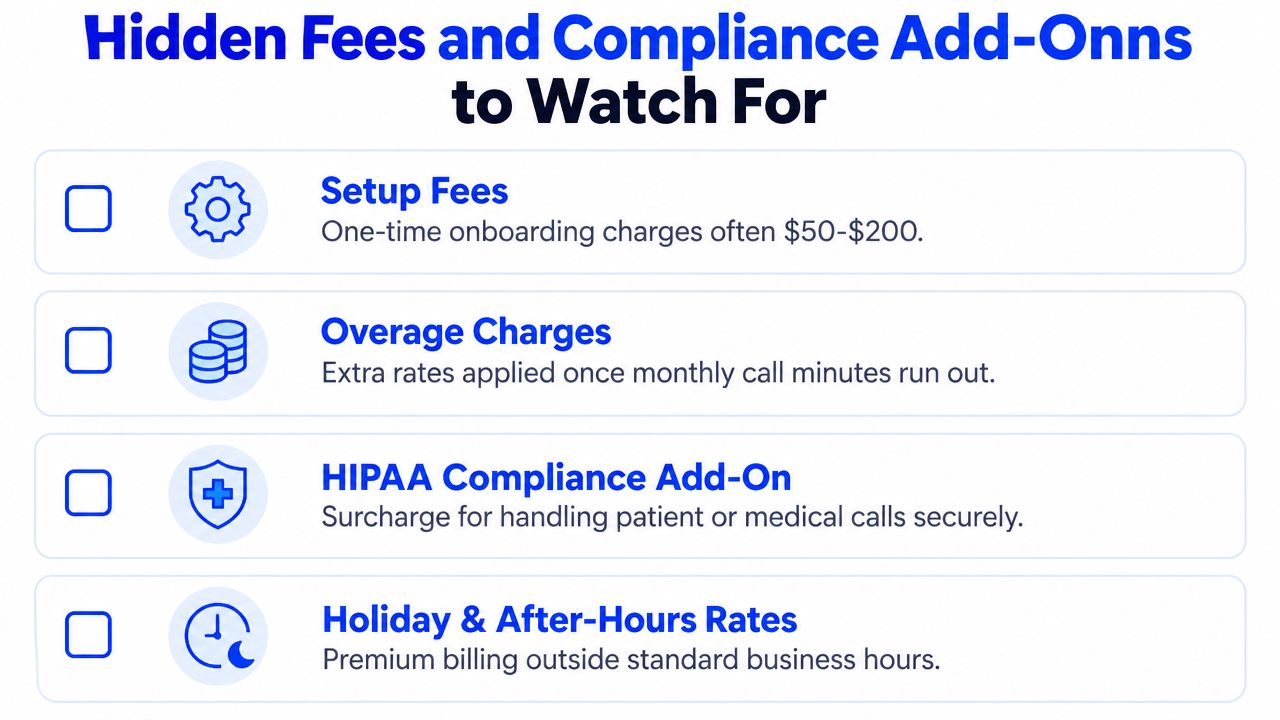
The advertised monthly rate is only the first line of the invoice. Traditional providers may separate onboarding, additional usage, transfers, holiday coverage, after-hours support, bilingual answering, and secure message handling. You need the full commercial model before comparing providers.
A California comparison specifically notes that traditional services may add setup fees, holiday surcharges, and overage penalties. Those charges can turn a seemingly manageable plan into a variable expense that is difficult to forecast during the exact periods when customers need you most.
Audit the contract line by line
Start with the billing definition. Ask whether the provider charges for abandoned calls, transfers, voicemail capture, call recording, or post-call administration. Confirm when the billable clock starts and stops, and whether the provider rounds usage up.
Then inspect the coverage terms:
- After-hours: Check which evenings, weekends, and holidays are included.
- Overage: Request the exact extra rate and the notification process before usage exceeds the plan.
- Setup: Ask whether configuration, scripting, integrations, and training are separate charges.
- Transfers: Confirm whether warm transfers or failed transfers create additional fees.
- Languages: Verify whether bilingual answering is included or priced as an add-on.
California directories identify features such as HIPAA-compliant messaging, bilingual answering, holiday coverage, and 24/7 availability, but they don't clearly quantify how much those additions raise prices. The California answering service directory reinforces the practical point: the relevant measure is not only the monthly fee, but the cost per answered, qualified, and scheduled call.
Pay for operational necessity
A dental, medical, or legal practice may need secure message handling and accurate intake. A salon may care more about calendar access, service selection, and language coverage. A contractor may need urgent routing and clear location details.
Don't buy compliance language as decoration. Ask what the feature changes in the workflow, which staff can access the information, how messages are stored, and what happens when a caller requests something outside the system's authority.
Contract test: If a provider can't show how an add-on improves booking accuracy, caller protection, or operational control, leave it out of the plan.
The cheapest service can cost more when it captures incomplete details or creates corrections for your staff. Evaluate error handling as part of the price. A service that requires your team to call back every qualified lead may have a low invoice and a high labour burden.
Budgeting for Salons, Clinics, and Home Services
A sensible budget starts with the call workflow, not the industry label. A salon may receive many short booking requests, a clinic may handle fewer but more sensitive conversations, and a home services company may need rapid triage while technicians are on site.

Salons, spas, and barbershops
Appointment businesses lose value when callers can't see availability immediately. The right system should answer routine questions about services, hours, location, and booking rules, then place the appointment on the correct calendar.
A salon owner should audit:
- Booking accuracy: Can the system distinguish services with different durations?
- Calendar control: Does it check availability before confirming a slot?
- Staff routing: Can callers select the right practitioner or service?
- Cancellation handling: Does it record the request clearly for staff follow-up?
For these businesses, raw call minutes are a weak success measure. A short call that produces a confirmed appointment can be more valuable than a longer conversation that ends with “someone will call you back.”
Clinics and professional practices
Clinics need stronger controls around information capture and escalation. The answering workflow should make clear which requests can be scheduled automatically and which must go to staff. Patient or client information should be handled through the provider's stated security and compliance processes.
A low advertised rate isn't a sensible saving if staff spend their day correcting intake details. Budget for the complete process, including secure messaging, appointment rules, escalation, and the time required to review exceptions.
Home services
HVAC, plumbing, cleaning, and electrical businesses often operate away from the desk. Their phone system must capture the customer's location, service need, urgency, and preferred availability without relying on a technician to answer while working.
The best fit is a workflow that separates routine requests from urgent situations. Routine jobs can move towards scheduling. Unclear or high-risk calls should reach the appropriate person with a complete message rather than a vague callback request.
Use this simple budgeting test:
- Record your recent call categories.
- Mark which calls require human judgement.
- Identify which calls can be answered and scheduled from approved information.
- Price the workflow, including overages and staff follow-up.
- Compare providers by completed bookings, not minutes alone.
That process gives owners a more honest view of return. It also prevents clinics from buying a salon-style workflow or contractors from paying for features they'll never use.
Lowering Costs Without Sacrificing Caller Experience
Cost reduction shouldn't mean forcing callers through rigid phone trees or asking staff to perform more unpaid follow-up. The better approach is to remove unnecessary human handling while preserving a natural conversation for the caller.
Start by separating repetitive work from judgement-based work. Opening hours, service areas, appointment availability, basic pricing guidance, and booking requests often follow clear rules. Complaints, sensitive situations, unusual requests, and urgent escalation need a defined path to a person.
Build a lean intake workflow
Use these operating decisions before you compare plans:
- Answer every routine call: Don't send predictable enquiries to voicemail when an automated workflow can handle them.
- Book during the conversation: A confirmed calendar slot is more valuable than a message that still needs action.
- Escalate exceptions: Give staff the calls that require expertise rather than making them monitor every ring.
- Review failed bookings: Look for missing information, incorrect calendar rules, and questions the system couldn't answer.
- Track completed appointments: Compare the service against scheduled outcomes, not just answered volume.
Avoid buying capacity you can't use. A plan with a low base rate may become expensive through overages, while a larger allowance may be wasteful if your demand is modest. Ask for transparent usage reporting and set an internal review point before committing to a long-term package.
AI also doesn't need to mean a technical implementation project. For a non-technical owner, the useful standard is whether the system can learn approved business information, connect to the calendar, and go live without constant maintenance. Natural conversation matters because callers want answers, not a maze of numbered options.
The right budget turns the phone from a cost centre into a booking channel.
The final metric is simple: cost per successfully scheduled appointment. Once you measure that figure, headline monthly rates become easier to judge. A higher subscription can be rational if it captures more qualified bookings with less staff intervention. A cheaper service can be a poor decision if it leaves your team with missed calls, incomplete messages, and a backlog of callbacks.
Heyline provides an AI phone receptionist that answers incoming calls, holds natural conversations, and books appointments directly into a connected calendar. Review your current missed-call and follow-up process, then visit Heyline to see whether automated intake can lower your cost per scheduled appointment without sacrificing the caller experience.