A salon owner is finishing a colour consultation when the phone rings. She can't step away, so the caller reaches voicemail. That caller may be asking about an appointment for the weekend, but the salon won't know unless someone listens to the message, calls back, and finds out whether the caller has already booked elsewhere.
That's the quiet cost of treating customer service calls as interruptions instead of opportunities. For salons, clinics, dental practices, law firms, contractors, and restaurants, the phone is often a primary way new customers ask questions and arrange service. A call that isn't answered, qualified, and given a clear next step can become a lost booking.
The practical fix isn't to make every call longer or hire a large reception team. It's to treat each ring as a measurable funnel event, decide what outcome the caller needs, and make sure the right next step happens. That means defining what a successful call looks like, finding where callers drop out, choosing a reception setup that fits your operation, and tracking a short list of useful measures.
Why Every Ring Matters for Local Appointment Businesses
The clinic owner is with a patient when a prospective patient calls. She can't answer, and the caller hangs up. The owner isn't careless. She's doing the work that keeps the clinic running. But without a reliable way to capture that caller's need, the practice may never get another chance to offer an appointment.
Salons face the same trade-off at the chair. A contractor may be on a ladder. A restaurant host may be seating guests. In each case, the phone rings at the exact moment staff have another customer to serve. A missed call can therefore be more than a minor inconvenience. It can be a new customer's first attempt to book, ask about a service, or check whether the business can help.
California's Public Utilities Commission Consumer Affairs Branch recorded 43,779 consumer contacts in 2024, including phone, mail, email, and online inquiries and complaints. The agency documented assistance resolving 9,549 informal complaints, about 21.8% of all contacts. Telecommunications accounted for 9,032 contacts, showing that customer-service requests are a real and measurable channel through which people seek help with essential services. The California Public Utilities Commission's 2024 Consumer Affairs Branch report isn't a study of small businesses, but it reinforces a useful operational point: people call when they need something addressed, not just to make conversation.
A ring is a decision point
A customer service call is part of how a local business acquires, serves, and retains customers. The caller may need information, reassurance, a booking, or a route to the right person. If nobody answers, that intent never reaches the team.
The answer isn't to make owners feel guilty for being busy. It's to build a process that works when they are. That starts with a practical definition of the call, then a clear picture of what must happen between the first ring and a confirmed appointment. After that, owners can compare reception options and choose a few measures to check regularly.
Operating principle: Don't judge your phone line by whether it rings. Judge it by whether the caller gets a clear next step.
What a Customer Service Call Actually Is
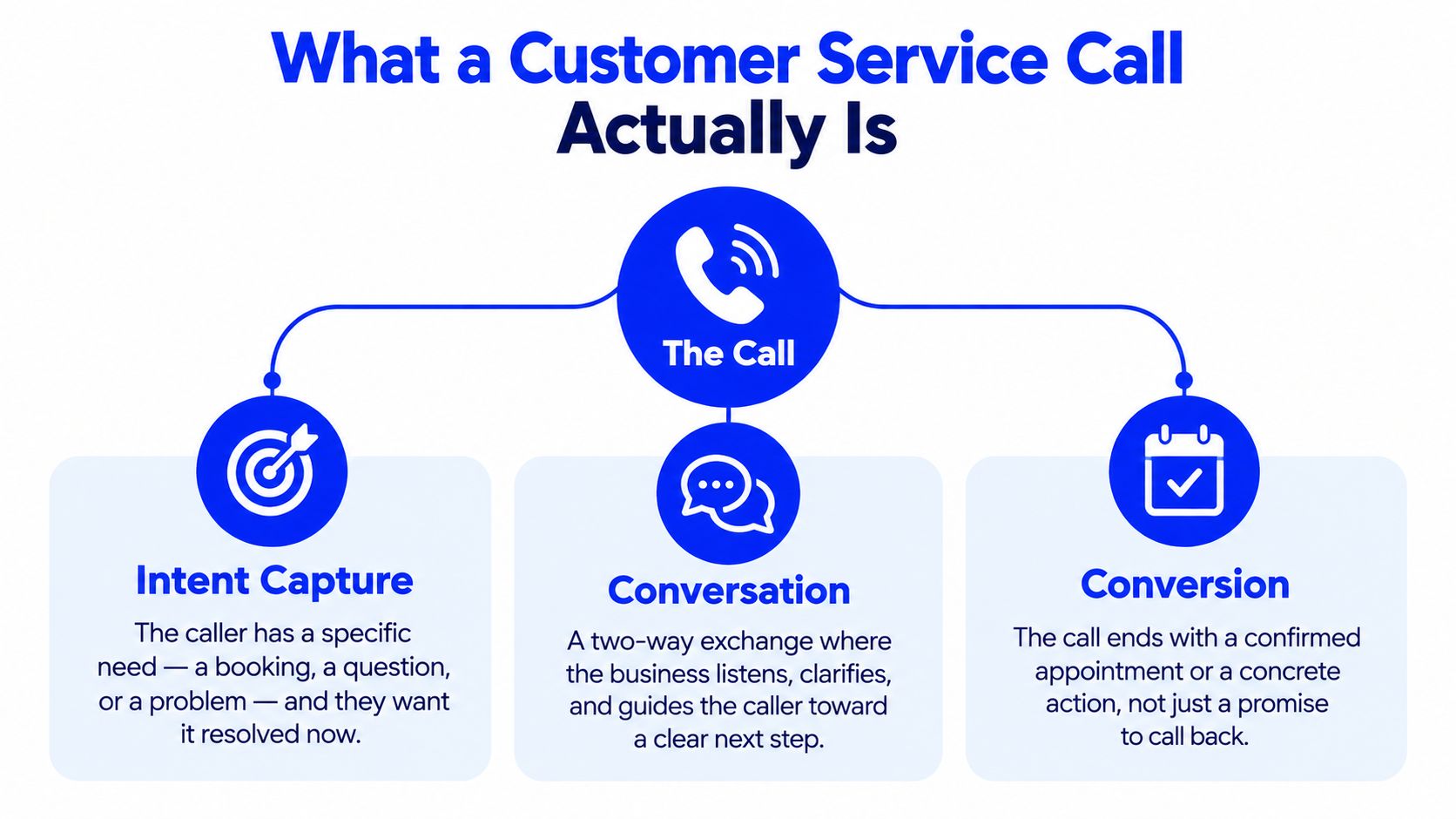
For an appointment-based business, a customer service call is a conversation that turns a caller's need into an outcome. That outcome might be a confirmed appointment, a useful answer, a planned callback, or a referral to someone who can help. If the call ends with “someone will get back to you” and nobody owns the follow-up, it hasn't reached a reliable outcome.
A simple model keeps staff and vendors focused on the same job: intent capture, qualification, and conversion. First, find out why the person called. Next, ask only the questions needed to help them. Then make something happen: book a suitable slot, give an answer, arrange a callback, or route the call to the right person.
Use the restaurant host-stand test
A good restaurant host doesn't pick up the phone and say, “We're busy.” They greet the caller, understand whether the caller wants a reservation or has a question, and either confirm the booking or give a useful alternative. The host then records the reservation so the rest of the team can act on it.
That same discipline works in a dental office, salon, law firm, or home-service company. A caller asking about opening hours needs a quick answer. Someone looking to book a consultation needs a different exchange. A person reporting an urgent clinical issue shouldn't be pushed through the same automated path as someone asking about routine availability.
Automate routine work, not high-stakes judgement
Owners can automate straightforward tasks such as hours, location, service information, appointment requests, and basic intake. But a non-technical owner shouldn't try to automate medical triage, legal advice, or active emergencies as if they were routine bookings. Those calls need clear escalation to a qualified human or the appropriate emergency service.
Your phone line has a maturity level, whether you've named it or not. Voicemail records a message but leaves the next step to staff. A person answering can qualify and route a caller. A booking-capable system can take the request through to an appointment, as long as it checks real availability and confirms the result. The key question is simple: what does the caller leave with?
The Call Funnel and Where Local Businesses Lose Money
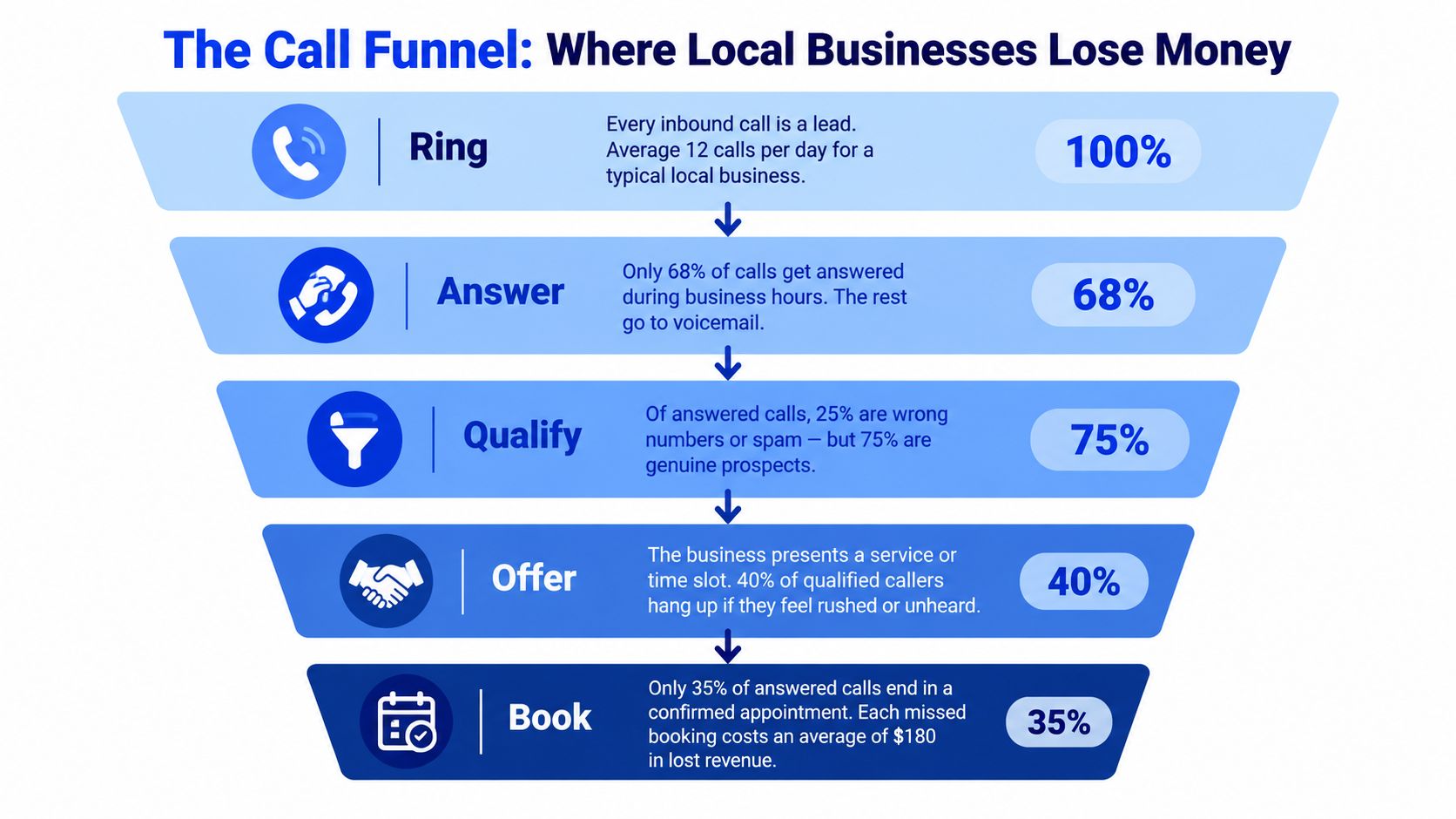
A call has a path: ring, answer, qualify, offer, book. Each stage is an opportunity to help the caller, and each can fail in a different way. If you only count bookings, you won't know whether the problem is missed calls, weak qualification, no suitable slots, or a booking that never gets confirmed.
A 2025 peer-reviewed study examined 425 dental providers listed as accepting new adult Medi-Cal patients in the San Francisco Bay Area. Within three call attempts, researchers reached 358 providers, or 84.2%, while 67, or 15.8%, remained unreachable. Only 265 offices, 62.4%, answered on the first attempt; the rest required further attempts or remained unreachable. Among providers listed in the directory, the probability of being offered a new-patient appointment within three calls was 51.8%. The study of access to new-patient dental appointments in the San Francisco Bay Area shows why being listed and offering a service don't guarantee that a prospective patient can reach the practice and book.
Find the leak before buying a fix
Start by tracing what happens to real calls:
- Ring: Does the call reach a person or a reliable answering path?
- Answer: Does the greeting make it clear the caller has reached the right business?
- Qualify: Does someone identify the caller's need and gather only relevant details?
- Offer: Does the business present a valid service option, appointment time, or next step?
- Book: Does the caller leave with a confirmed appointment or an owned follow-up?
No answer is an obvious leak, but the quieter failures deserve attention too. A caller may hang up after waiting, receive a rushed response, fail to get a suitable appointment offered, or hear a proposed slot that never gets confirmed. Each failure needs a different correction. Better coverage won't fix a calendar that isn't up to date, and a polished greeting won't help if staff don't know how to book.
Log attempt count, caller intent, requested service, relevant eligibility details, and booking outcome. Prioritise callbacks for new-patient inquiries and time-sensitive requests. Record voicemails and abandoned calls as funnel failures, not vague reminders to “follow up later.” For a more structured way to capture and route incoming prospects, consider lead capture software for managing enquiries.
Comparing the Four Ways to Handle Incoming Calls
There's no universal reception setup. A solo salon, a busy clinic, and a legal practice handling sensitive intake have different requirements. Compare options against the same practical questions: who covers the phone, what happens when staff are occupied, how much effort falls back on the owner, and what happens when a call needs human judgement.
The table uses qualitative comparisons rather than promising a conversion rate or cost that will vary by business, provider, and call type.
| Setup | Coverage | Cost per answered call | Conversion | Owner effort |
|---|---|---|---|---|
| In-person staff with overflow voicemail | Limited to staffed hours and available staff | Depends on staffing and how much call handling interrupts other work | Depends on whether missed callers leave details and receive prompt follow-up | High. Staff must monitor messages and return calls |
| Shared answering service | Based on the service plan and routing rules | Varies by provider, usage, and service scope | Can capture messages and route requests; direct booking depends on its capabilities | Moderate. Owners still need to set instructions and complete follow-ups |
| Dedicated receptionist or small call centre | Can provide broader coverage, depending on staffing | Usually reflects dedicated labour and service arrangements | Can handle more nuanced conversations; booking depends on training and calendar access | Moderate. Owners manage procedures, training, and oversight |
| AI receptionist connected to the calendar | Can answer outside normal staffed hours when configured for it | Varies by product and call volume | Can answer routine questions and book when the system has accurate availability | Low to moderate. Owners must set boundaries, maintain details, and review escalations |
Choose the simplest setup that can finish the job
Voicemail is inexpensive to operate, but it doesn't answer questions or reserve a slot while the caller is available. A shared answering service can capture and route calls, but it may leave staff with the booking work. A dedicated receptionist offers a human conversation, at the cost of staffing and management. An AI receptionist can handle routine calls and check a calendar, but only if the business gives it reliable information and sensible escalation rules.
For owners handling a manageable call load, an AI receptionist connected to a shared calendar is a reasonable default to evaluate before hiring more coverage. The value is in completing the booking during the conversation, not just taking a message. Heyline is one option: it can use information from a business website to answer routine questions and book appointments through Google Calendar, with high-stakes or unresolved requests routed for human follow-up.
Don't automate clinical judgement, legal advice, or emergencies to save time. Define which requests can be handled routinely, which need a callback, and which must reach a person promptly. Then test the setup using realistic calls before relying on it.
The After-Hours and Missed-Call Opportunity Most Owners Underestimate
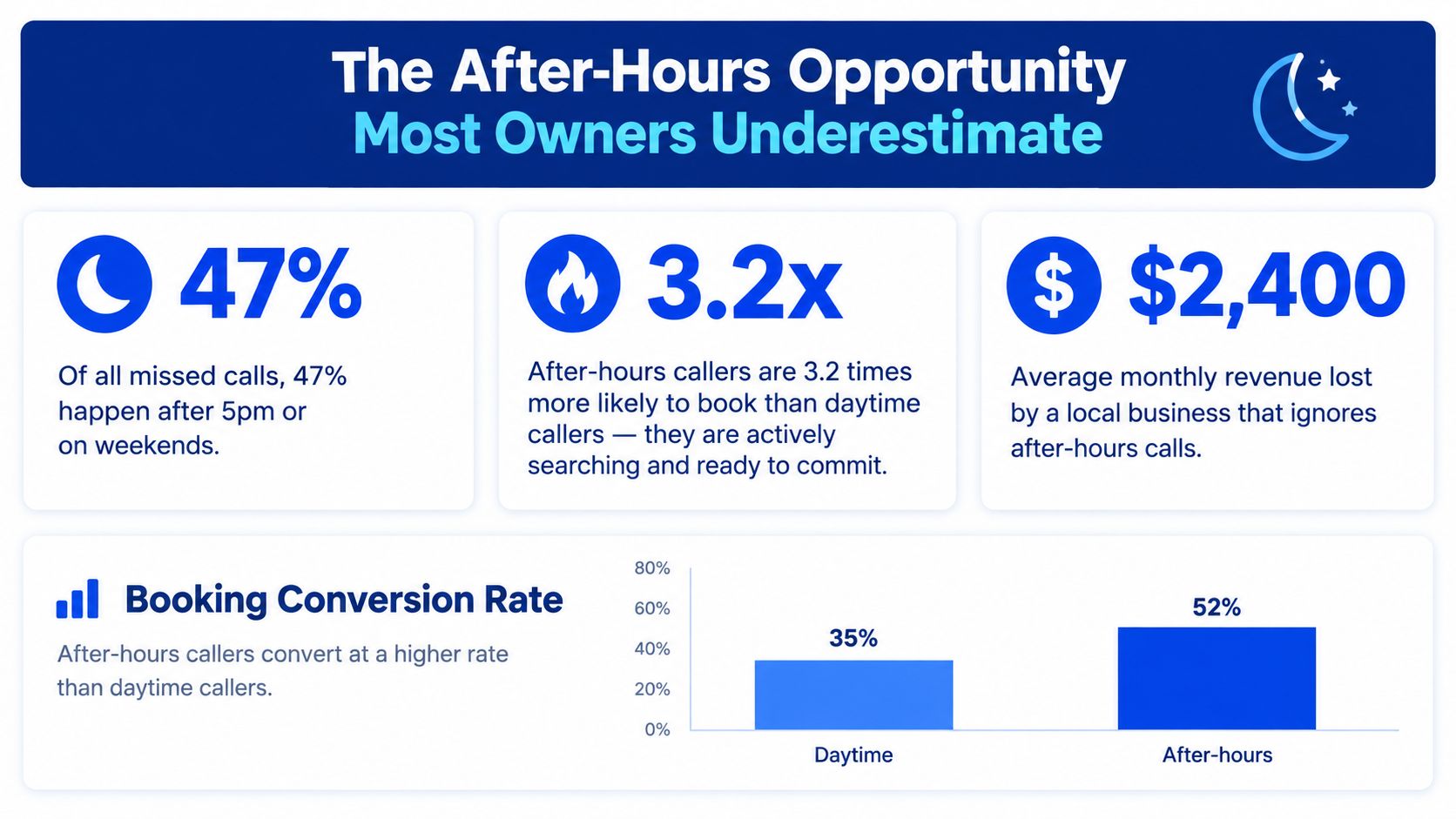
After-hours calls aren't automatically low-value. Someone who calls in the evening or on a weekend may be actively trying to arrange a service while they have time to talk. If the only response is voicemail, the caller can move on before your team opens the next day.
A 2026 small-business call dataset reported that 14.1% of calls arrived after hours, including weekend calls and weekday evenings or early mornings. Of those after-hours calls, 23.6% became a lead or booking, compared with 18.6% during business hours; 17.2% of all leads or bookings arrived after hours. The dataset includes a California segment, but it doesn't provide a California-specific conversion breakdown, so these figures are directional, not a statewide estimate. The 2026 small-business call report supports a useful operational challenge: don't assume that a caller is less serious just because the business is closed.
Decide what should happen before the line closes
After-hours calls need a decision tree, not a blanket voicemail message.
- Routine booking request: If the caller wants a service and the calendar shows a valid opening, offer it and confirm the appointment.
- Request that needs staff input: Capture the caller's name, preferred contact method, reason for calling, and a realistic callback expectation. Put the follow-up in an owned queue.
- High-stakes or urgent issue: Route clinical, legal, safety, or emergency matters according to a written escalation policy. Don't let a routine booking flow imply that an emergency is being handled.
The difference is operational, not cosmetic. A voicemail box may collect the caller's number; it won't tell them whether a useful slot is available. A structured answering and booking process can capture intent, check availability, and make clear what happens next. For teams weighing phone coverage beyond business hours, after-hours answering services and coverage options can help frame the decision.
Set your after-hours rules before turning on automation. Specify which services can be booked, what information must be collected, what the system must never promise, and which situations require a human. Review the results by call time and outcome. If evening callers repeatedly ask for a service you can book safely, leaving those calls to voicemail is a choice to defer potential work.
The Four KPIs That Actually Move the Needle
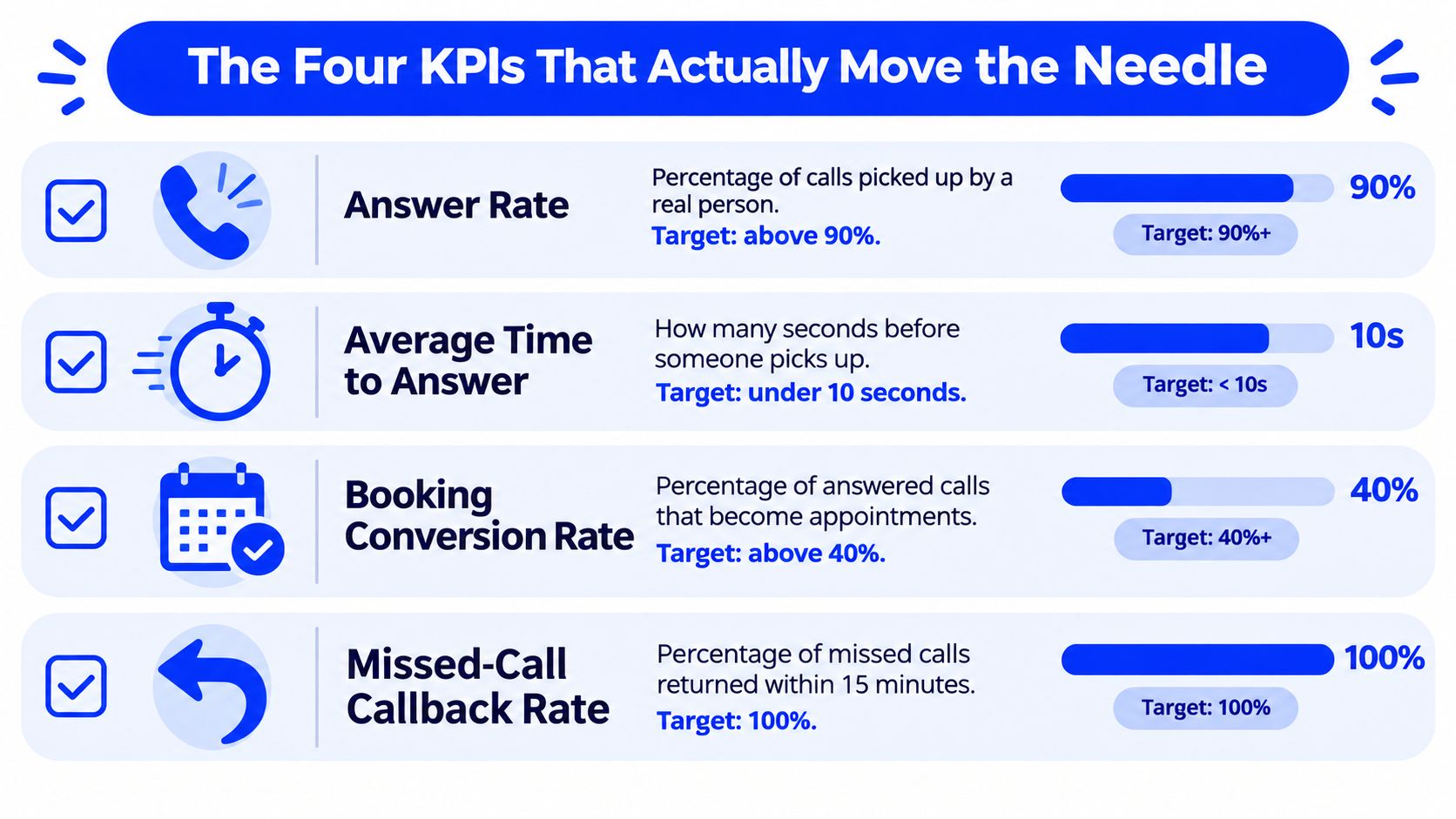
A weekly call review doesn't need a specialist dashboard. It needs a few measures that tell you whether callers are reaching someone, getting a prompt response, booking, or receiving a useful callback. Avoid targets that imply an industry benchmark without evidence. Start with the numbers in your own operation, set a practical improvement goal, and judge changes by whether they produce better outcomes.
The Los Angeles County Medi-Cal dental Fee-for-Service programme received 187,317 member calls during October through December 2023. The Los Angeles County Medi-Cal dental fact sheet illustrates why a daily total can hide the moments when calls arrive faster than available staff can answer. Track calls in 15- or 30-minute intervals, then compare demand with how many people can answer at the same time.
Keep a simple weekly scoreboard
Use these formulas consistently. Decide in advance which calls count, and don't change the definition from one review to the next.
| KPI | Formula | Practical instrumentation |
|---|---|---|
| Answer rate | Calls answered ÷ inbound calls × 100 | Compare phone-system call logs with missed-call records |
| Average time to answer | Total wait time for answered calls ÷ calls answered | Export timestamps or ask your phone provider for queue reports |
| Booking conversion rate | Calls resulting in a confirmed booking ÷ qualified calls × 100 | Record the outcome against each qualified call |
| Missed-call callback recovery rate | Missed calls that become a two-way conversation or booking after callback ÷ missed calls × 100 | Tag the callback outcome, not just the attempt |
Measure outcomes, not activity
Total call volume tells you how busy the line was. It doesn't tell you whether the calls turned into appointments or whether callers gave up. Answer rate highlights coverage. Time to answer points to a queue problem. Booking conversion helps you spot trouble after qualification, such as unavailable slots or a weak offer. Callback recovery tells you whether missed opportunities are being reclaimed.
Review these measures by time of day, not just across the whole week. A good overall answer rate can mask a predictable rush while the team is occupied. Interval-level tracking helps owners adjust routing or coverage around actual demand instead of guessing from daily totals.
Don't copy target percentages from an infographic and treat them as guaranteed standards. Establish your baseline, write down the source for each measure, and set a realistic next improvement based on your own call records. A useful scoreboard fits on one page and gives the team a clear action when a number worsens.
A 14-Day Plan to Fix Your Phone Line Without Hiring Anyone
You don't need a developer to find out why calls are slipping away. You need an honest record of what happens on the line, a small number of fixes, and someone who owns each follow-up.
Week one, diagnose the leaks
For the first three working days, log every inbound call. Record the time, caller intent, whether someone answered, the next step offered, and the outcome. Include missed calls and voicemails. Don't guess why a caller hung up; mark the outcome as unknown until you have evidence.
At the end of the logging period, identify the two biggest leaks. Are calls going unanswered while staff serve customers? Are people getting answers but no suitable appointment offered? Are callbacks delayed or forgotten? Calculate the four KPIs using consistent definitions, then compare the results with your own expectations and service needs.
Week two, make the fix operational
Choose a change that addresses the largest leak. It could be routing overflow calls, adjusting staff coverage during a predictable rush, or setting up a configurable answering system connected to the calendar. Write escalation rules for clinical, legal, and emergency traffic. Use clear telephone scripts for answering business calls to standardise greetings, qualification questions, and callback promises without making every conversation sound identical.
Test the new process with realistic calls before relying on it. Check that appointment types are correct, availability is current, callers hear a clear confirmation, and unresolved requests create an owned callback.
Keep three guardrails in place:
- Human override: High-stakes callers must have a route to an appropriate person.
- Honest availability: Never promise a slot or service the business can't deliver.
- Weekly review: Revisit the scoreboard weekly so the team catches a new leak before it becomes normal.
Fix the weakest part of the call journey first. That's a more practical starting point than hiring before you know where the process breaks.
Heyline provides an AI phone receptionist that answers routine business calls, responds using information from a company's website, and can book appointments through Google Calendar. If missed calls and manual scheduling are leaving callers without a clear next step, visit Heyline to see whether it fits your reception process.