You finish a colour appointment, turn back to the desk, and notice a missed call. There's no voicemail, just an unfamiliar number. You could redial immediately, leave it until closing, or assume they'll try again. None of those choices is a reliable booking process.
Knowing how to call back a missed call means knowing what to check before dialling, how to identify yourself, and how to give the customer an appointment they can confirm. For a California service business, recognition matters just as much as speed.
Why a Missed Call Is a Ticking Clock for Your Business
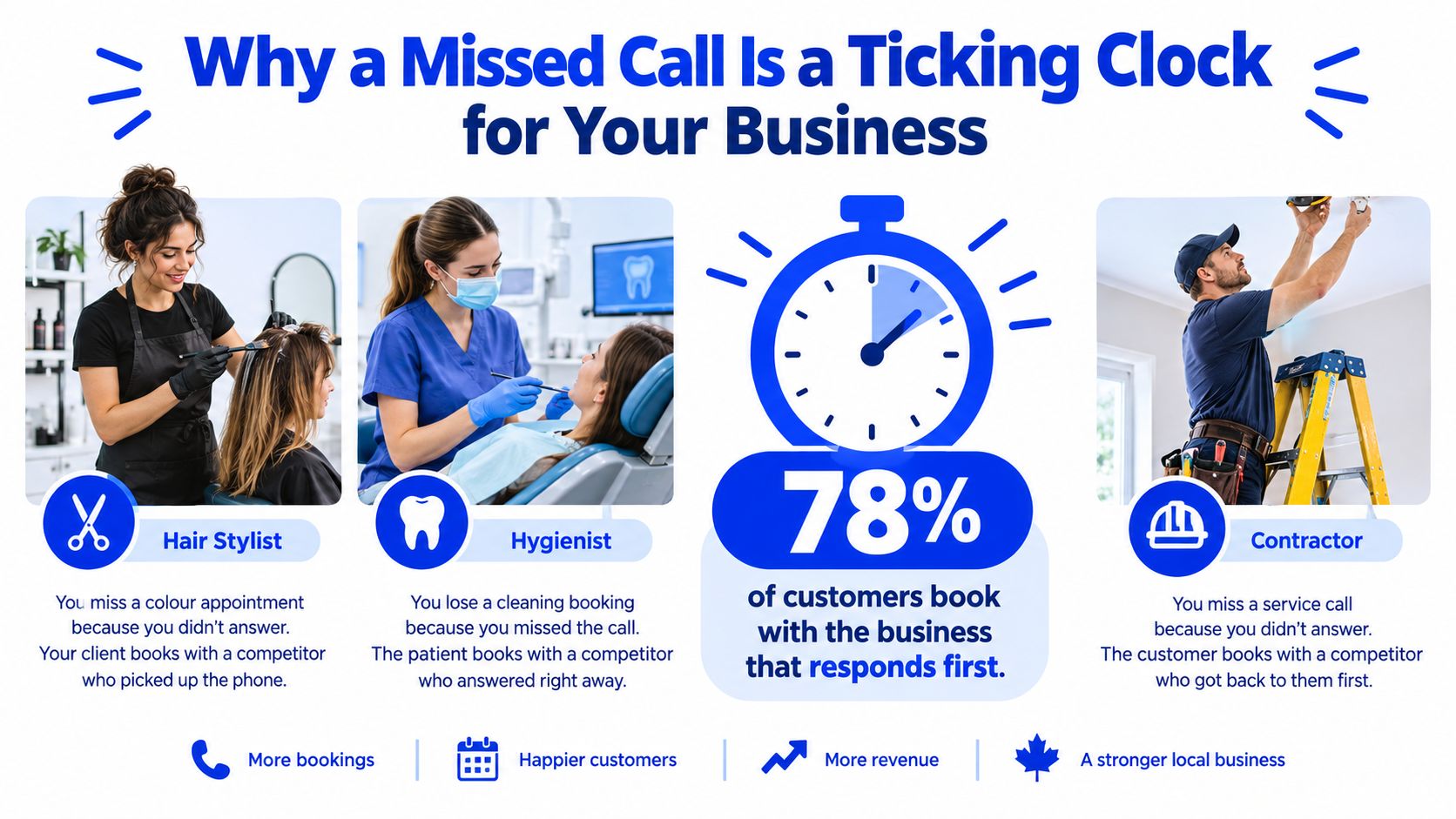
A stylist can't abandon a client halfway through applying colour. A hygienist can't stop treatment to answer a pricing question. A contractor working up a ladder may not even hear the phone. Missing the call is understandable. Leaving nobody responsible for returning it is a management decision.
Consider a prospective salon customer trying to arrange an appointment around work. They call, hear ringing, and disconnect. While you're finishing with your current client, they're free to contact another salon. You haven't necessarily lost the booking, but you haven't given them any reason to wait either.
Your callback arrives in a noisy environment
Californians received 356.2 million robocalls in November 2024, approximately 11.9 million per day, according to the statewide figures cited in this discussion of phone-call screening. That's historical context for caller hesitation, not a measure of callback conversion.
When your business returns a call from an unfamiliar number, the customer may treat it like any other unwanted interruption. They don't know that the person calling is the receptionist they were trying to reach. A fast callback without a recognisable introduction can still go unanswered.
The illustration below captures the practical problem: staff are occupied while prospective customers are still looking for help.
Make prompt contact an assigned task
Don't wait until tomorrow to discover whether someone wanted an appointment today. Assign the callback to a named person as soon as staff can safely respond during appropriate business hours. If everyone is occupied, put the task somewhere visible rather than relying on memory.
Practical rule: The person responsible for a missed call should have the caller's context, access to the calendar, and permission to complete the booking.
There isn't a verified California-specific deadline after which a booking disappears. Treat prompt contact as an operating standard, not a conversion guarantee. Your immediate objective is simple: help the customer recognise your business and take the next useful action.
First Decide Whether You Should Call Back at All
A missed number isn't proof of a legitimate enquiry. Blindly returning every call is the wrong policy, particularly when the displayed number is your only evidence.
California accounted for 15,713 complaints, or 8.7% of reported complaints, in the dataset described by this unwanted-call statistics report, which also warns about caller-ID spoofing. Spoofing means the displayed number may not belong to the person who called. A local area code doesn't authenticate anyone.
Separate recognition from verification
Use these categories to decide what deserves attention:
- Known customer: Check the number against the existing customer record. If something seems inconsistent, use their established contact number rather than assuming the new call is genuine.
- Recognisable local business: Verify the organisation independently. If a caller claims to represent a supplier, insurer, or referring practice, return the call through its official published number.
- Unidentified caller without voicemail: Look for supporting context before redialling. An appointment request through your website or an identifiable message can help establish why they called.
An independent number search is a useful check, not an identity guarantee. Don't rely solely on information supplied by the caller or on the name displayed by your phone.
Use a neutral opening when intent is unknown
An unidentified call doesn't automatically belong in the rubbish bin. It belongs in an unverified queue, where staff can assess it without sharing customer information or making assumptions about the requested service.
Don't open an uncertain callback with a customer's treatment, legal matter, address, or payment details. Establish who you're speaking with first.
For a clinic, even mentioning a sensitive appointment before confirming the recipient is unnecessary. A contractor shouldn't disclose a customer's property details to someone claiming to be their neighbour. A restaurant shouldn't read reservation information to an unverified caller.
If there's no credible context, wait for an identifying voicemail or message rather than repeatedly redialling. If you do return an uncertain call, say only that you're responding to a call received by the business and ask how you can help.
That approach protects legitimate booking opportunities without teaching staff to trust every number on the screen.
Build a Prioritised Callback Workflow in Under 15 Minutes
Start with a shared task list, not a new software project. A sole owner can use a simple worksheet beside the booking calendar. A larger desk team can use its existing customer-management system, provided everyone can see ownership and status.
The operating evidence supports taking missed calls seriously: an analysis of 70 million tracked business calls found 44% were missed overall, while calls lasting more than 30 seconds had a 71% human-answer rate, as reported in this business missed-call analysis. These aren't California-only figures, and the duration finding shouldn't be treated as proof that a longer call will convert.
Capture context before assigning work
Each alert should contain the caller's number, timestamp, call duration, source line, and any voicemail or transcription. Add the assigned staff member and next action. Duration is context, not a reason to dismiss a short call.
Listen to the voicemail before dialling. A transcription can help you scan the queue, but check the audio when a service name, contact number, or urgent request is unclear. Don't guess your way into an appointment.
Prioritising Missed Callbacks by Signal
| Signal in alert | Priority | Target response window | What to confirm first |
|---|---|---|---|
| Explicit booking request | High | Promptly during appropriate business hours | Requested service and caller identity |
| Urgent service request | High, with escalation | As soon as the responsible person can assess it | Nature of urgency and who should handle it |
| Pricing question | Standard | Next available callback block | Service scope and approved pricing |
| General enquiry | Standard | After time-sensitive requests | What decision the caller needs help with |
| Unknown number without context | Verification first | After checking legitimacy | Whether there's a credible reason to return it |
These windows are recommended operating priorities, not statutory deadlines or measured conversion thresholds. An apparent clinical or safety emergency should go to the designated professional process, not the ordinary booking queue.
Check the calendar, then close the record
Open the live calendar before you call. Check the service duration, staff member, location, and any required buffer. Identify two genuine appointment windows, then refresh availability before committing the chosen slot.
Use these final outcomes:
- Booked: Record the confirmed service and appointment.
- Reached but undecided: Note the unresolved question and agreed next action.
- Voicemail left: Record the attempt and follow-up status.
- Wrong number: Correct the record and stop contacting that number.
- Do-not-contact: Apply the restriction wherever staff manage outreach.
A missed call should never remain “handled” merely because somebody dialled it. The record needs an outcome another employee can understand without asking around.
Scripts That Turn a Callback Into a Booking
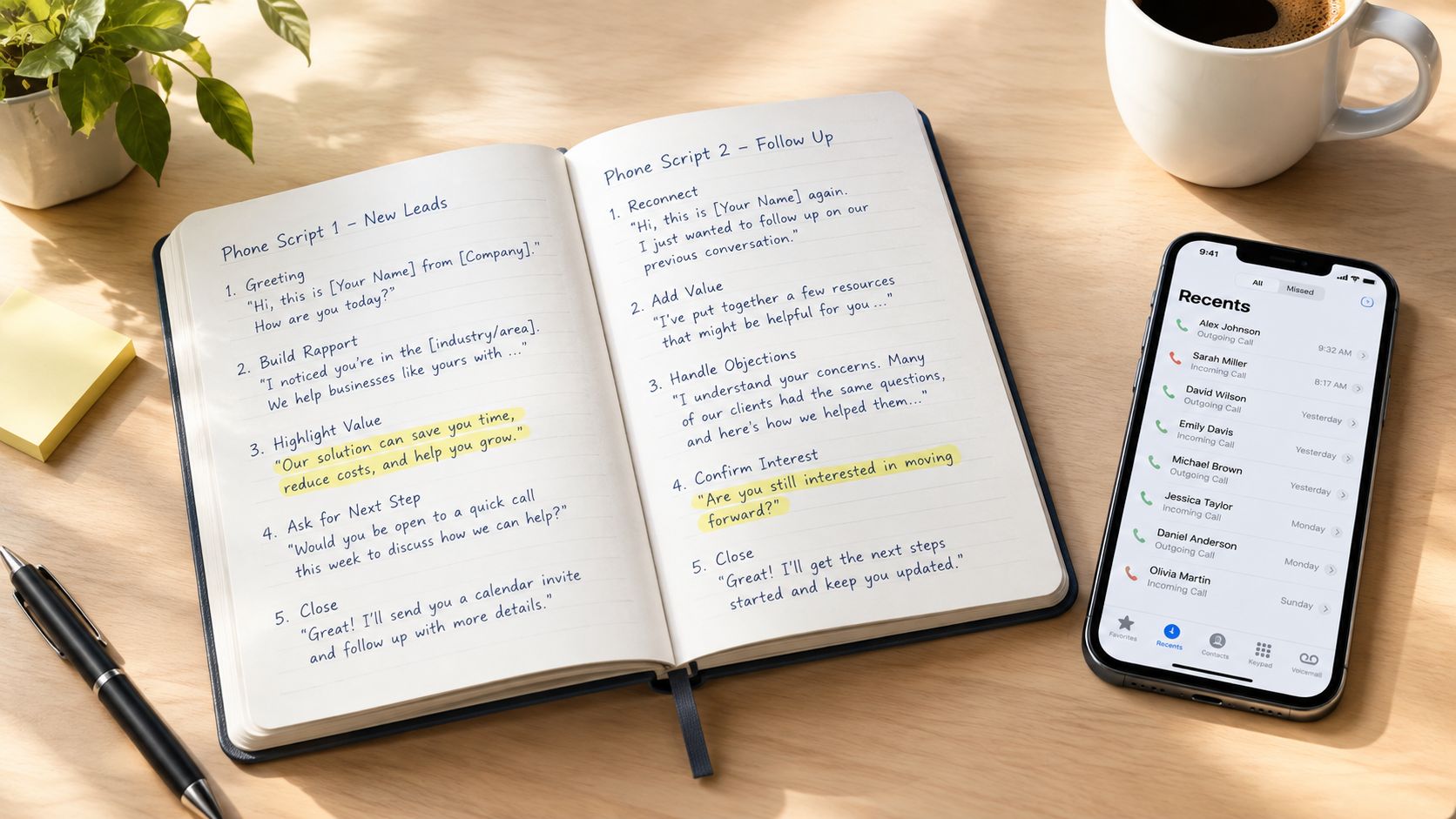
The opening line should answer the customer's immediate question: who is calling? Don't begin with “You called me” or launch into appointment details before introducing the business.
Keep the wording visible beside the phone so staff don't have to improvise under pressure.
When the customer answers
Use this as a template, replacing bracketed fields with verified information:
“Hi, this is [your name] from [business name], returning your call. Is now a convenient time? You mentioned [non-sensitive service]. Are you looking to book that appointment? I've checked our calendar, and we have [available window] or [alternative window]. Which works better for you?”
If there was no message, replace the service line with: “We received a call from this number. Were you trying to reach us?”
Business name first establishes identity. Asking whether it's convenient respects the customer's situation. Confirming the service prevents you from booking the wrong appointment, while specific availability gives them something concrete to choose.
Once they choose, confirm the service, date, time, location, and any preparation instructions. Don't treat “that might work” as permission to book. Ask directly whether they'd like you to reserve it.
For staff who also handle incoming enquiries, keep this wording consistent with your telephone scripts for answering the phone.
When you reach voicemail
Keep the message short enough to understand without replaying it:
“Hi, this is [your name] at [business name], returning your call. We have [available window] or [alternative window], subject to availability. Call our main number, [number], or use the booking option on our website. We're open [business hours].”
Don't name a sensitive treatment or legal concern in voicemail. Don't imply you've held either appointment unless your actual booking policy allows it.
Use the video alongside a staff practice session, then test the script aloud with your own business details.
For awkward moments, give staff language they can use without making promises:
- Price objection: “Let's check what's included so you can decide whether it's right for you.”
- Schedule conflict: “What part of the day works better? I'll check the calendar against that.”
- Silent caller: “Can you hear me clearly? If this isn't a convenient time, we can stop here.”
The script supports a conversation. It shouldn't force a booking when the customer needs clarification.
Follow-Up Sequence That Stays Compliant and Converts
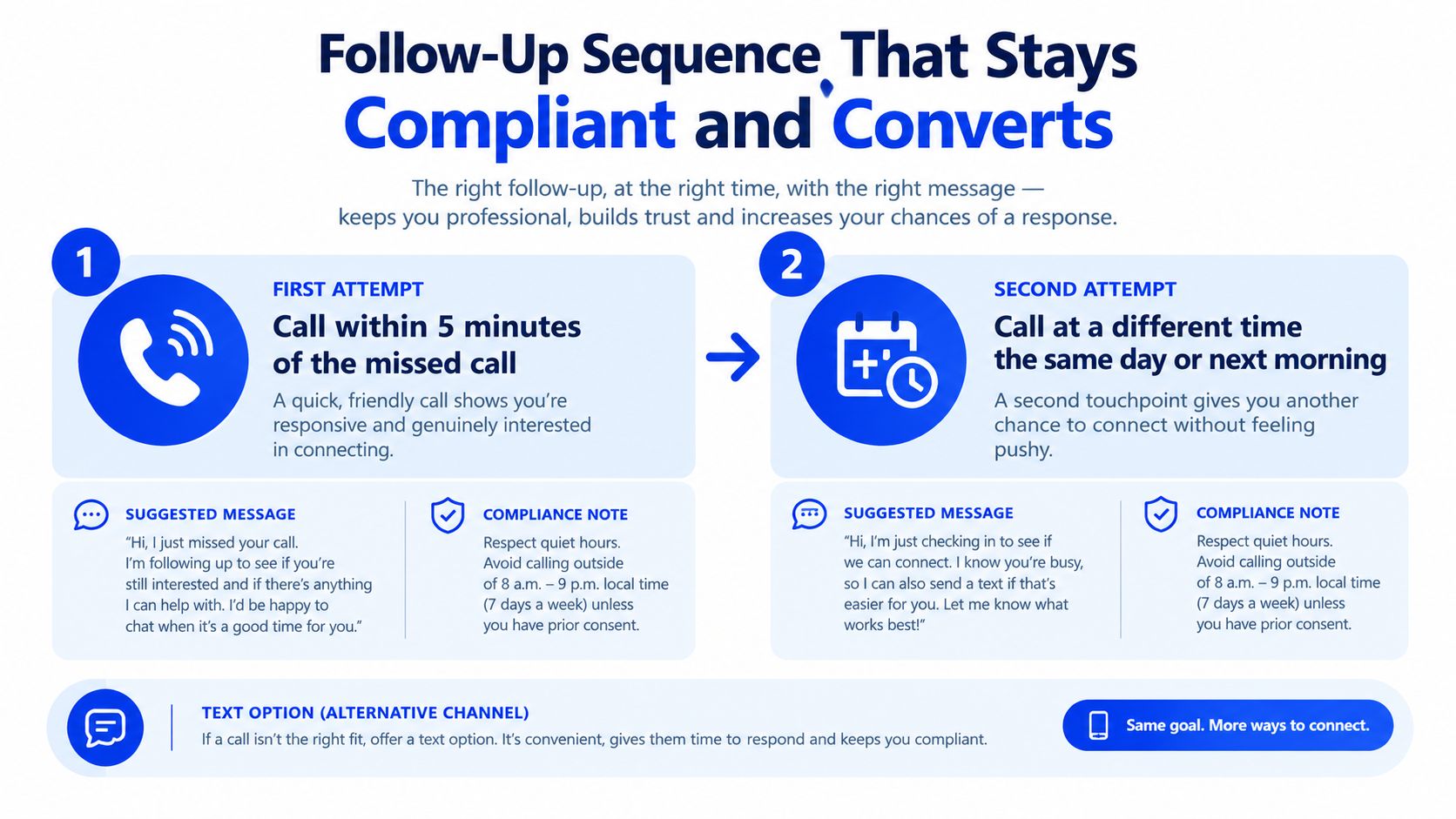
Repeated calls aren't a substitute for a useful message. Adopt a controlled two-attempt sequence so staff know both how to follow up and when to stop.
The first attempt should happen promptly within appropriate contact hours. If unanswered, leave the concise identity-led voicemail. Make the final attempt at a different reasonable time, taking any stated customer preference into account.
The visual below summarises the sequence. Treat timing as a business operating target, not a universal legal requirement.
Permission comes before switching channels
An incoming call isn't blanket permission for promotional texts or emails. Use another channel only when the customer has authorised it and your permissions support the intended message.
A permitted text should include the business identity, a neutral reason for contact, your existing booking route, and a clear way to decline further messages. For example:
“Hi, this is [business name], following up on your call. You can book through [your existing booking link] or call our main number during [hours]. Reply STOP if you don't want further messages.”
Use your real booking address when sending it. Don't request payment-card details, medical information, identity documents, or confidential legal facts by text. Align the wording with your text-message appointment confirmation process, while keeping enquiry follow-up distinct from a confirmed appointment.
Stop deliberately and review automation
After the final unanswered attempt, mark the lead dormant. That isn't the same as do-not-contact: dormant means no further proactive pursuit under this sequence; do-not-contact means honour the expressed restriction.
California privacy expectations require care with personal information and opt-out handling. Predictive diallers also need specialist review: a California Public Utilities Commission decision adopted a 3% abandoned-call rate standard, as described in this callback scheduling and compliance guide. That standard isn't blanket permission to automate a small business's callbacks.
The same guide reports a 13-minute median legal-industry callback time and 26% of firms never responding, neither California-specific. Use those comparisons to examine your process, not to promise a local booking result.
Have the owner review contact permissions and exceptions before enabling automated outreach. A workflow should make respectful follow-up easier, not make excessive contact automatic.
When an AI Receptionist Beats Manual Callbacks
Manual callbacks work when someone is available, understands the enquiry, and can complete the next action. They become fragile when the same receptionist is checking in clients, taking payments, and managing a full appointment calendar.
The reason to consider an AI receptionist isn't to eliminate human judgement. It's to handle routine enquiries while the human team is occupied, so fewer callers need a recovery call at all.
Compare coverage, not sales promises
Research reporting states that 46% of unidentified calls go unanswered, 60% of consumers never call back an unidentified missed number, and 92% believe unidentified calls are fraudulent, according to these findings on unidentified calls and consumer trust. Those figures aren't California-specific or evidence of any particular product's booking performance.
They do support a practical judgement: a recognisable first interaction can be more useful than hoping a customer will answer an unfamiliar return call.
| Operating question | Manual callback model | AI receptionist model to evaluate |
|---|---|---|
| Who handles an enquiry while staff are occupied? | An available person must take ownership | The configured system handles routine intake |
| What happens after closing? | Follow-up waits for staffed coverage | After-hours answering can capture the request |
| Can an appointment be completed? | Staff check and update the calendar | Calendar-connected software can book during the call |
| What needs human judgement? | Staff assess every enquiry | Exceptions need a clear handover route |
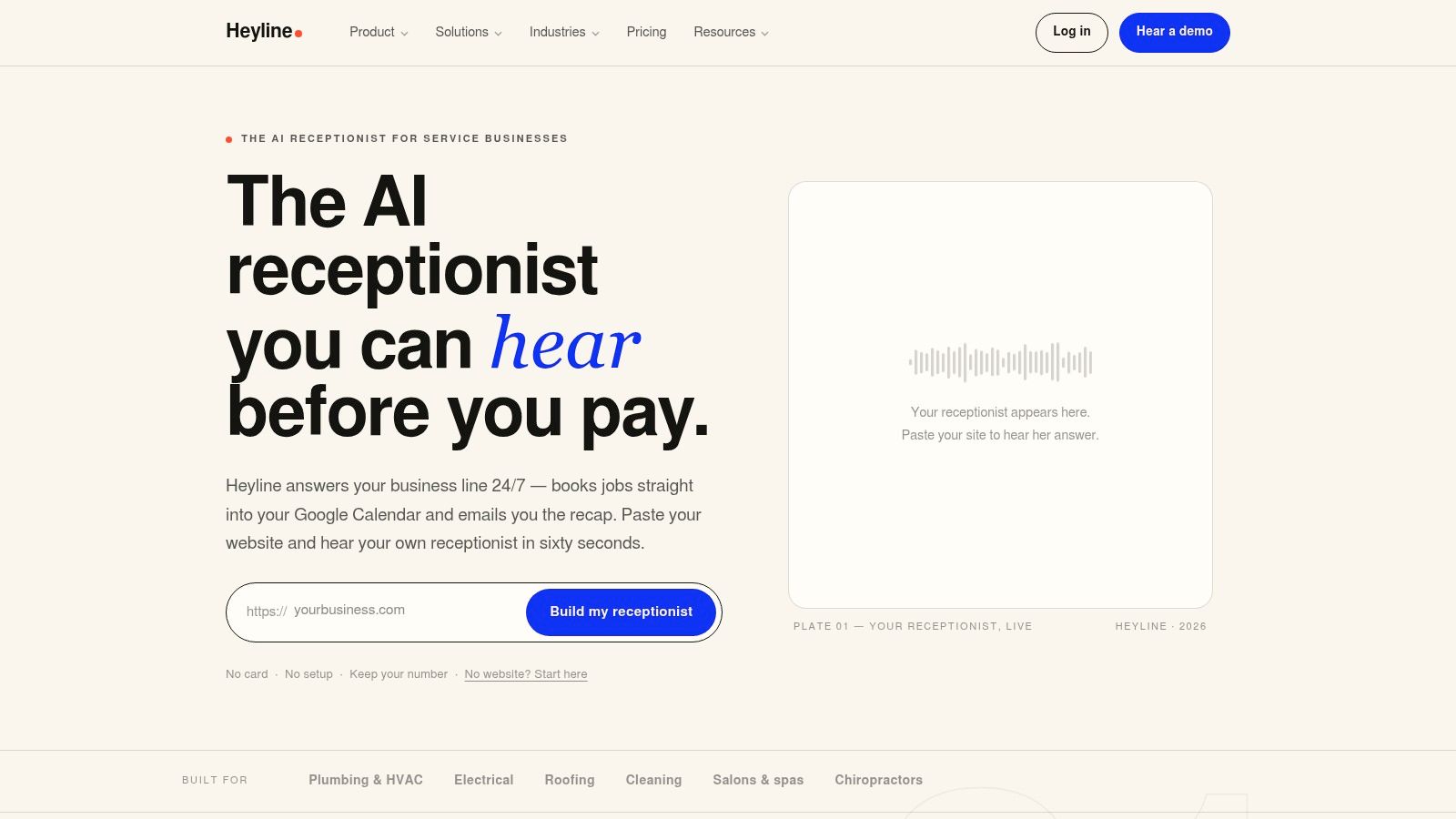
This product screenshot provides a reference for evaluating an owner-facing receptionist service.
Give automation a defined job
Among the options, Heyline answers incoming calls, uses editable business information drawn from the company website, and books against Google Calendar availability. Its call-back to-do and call log provide contact details and enquiry context for human follow-up when a conversation can't be completed.
Evaluate that model alongside improved staff coverage or an answering service. This explanation of an AI receptionist can help you decide which routine conversations belong in automated coverage.
Keep humans responsible for clinical concerns, legal advice, complaints, unusual service requirements, and pricing exceptions. Test ordinary bookings and difficult scenarios before routing live calls.
Judge the result using your own missed-call rate and booking outcomes. No supplied benchmark establishes a guaranteed conversion improvement. Useful coverage is coverage that completes the right tasks and hands over everything else clearly.
Your One-Page Callback Playbook and the Metrics to Track
Pin a short operating sheet beside the phone. It should tell a new employee what to do without requiring the owner to explain the process again during a busy shift.
Keep the desk checklist actionable
- Verify: Check identity and context before returning an uncertain number.
- Assign: Give each legitimate enquiry a named owner and a visible next action.
- Prepare: Review the request and live availability before dialling.
- Speak: Use the appropriate live-answer or voicemail script.
- Finish: Record the outcome, permissions, and any agreed next step.
- Escalate: Hand sensitive or exceptional enquiries to the responsible human.
Include the approved follow-up sequence and escalation contact on the same sheet. Keep it beside the calendar, not buried in a training folder.
Measure the process consistently
Use the callback measures described earlier, with definitions your team won't change from week to week:
| Metric | Working definition |
|---|---|
| Reached rate | Eligible callback leads who had a live conversation |
| Booking rate | Eligible callback leads who confirmed an appointment |
| Median time-to-first-attempt | Middle elapsed time from missed call to initial attempt |
| Voicemail rate | Callback attempts that resulted in a voicemail message |
| Opt-out rate | Contacted leads who requested no further applicable contact |
| Abandoned-call rate | Applicable dialler calls abandoned under the reviewed definition |
Separate legitimate leads from spam and wrong numbers. Distinguish leads from attempts so repeated dialling doesn't inflate the apparent workload or hide weak results.
A falling response time shows faster execution. A rising booking rate shows more appointments within your defined lead group, but review service demand and availability before crediting the workflow alone.
Owner's check: Review unresolved enquiries, not just successful bookings. That's where you'll find unclear ownership, weak handovers, and calendar problems.
The point isn't to promise you'll never miss another call. It's to make sure a legitimate caller doesn't disappear because nobody knew what to do next.
Heyline offers an AI phone receptionist that answers routine enquiries and books appointments into your connected calendar while your staff are occupied. Visit Heyline, test it with your actual services and appointment rules, and check how unfinished enquiries reach your team for a callback.