You pick up the receiver before opening the salon, expecting the familiar hum of the line. Instead, there's silence. You try another handset, reseat the cord, and dial out again. Nothing. If customers use that number for appointments, cancellations, urgent questions, or directions, a dead line can interrupt the day before the first client arrives.
The phrase “no dial tone on landline” can describe several different faults. A damaged handset cord, a shorted extension, a failed DSL filter, a local power problem, a carrier outage, or a transition away from legacy copper can all produce similar symptoms. The quickest repair comes from separating those possibilities in the right order.
Why a Dead Line Costs You More Than Silence
It's Friday evening at a busy salon. The receptionist is preparing the next day's appointments when a regular client calls to move an early booking. The salon's line has no dial tone, so the call never reaches the reception desk. The client may leave a message elsewhere, try a competitor, or assume the business has closed.
That's the operational risk of a silent phone. A landline can carry appointment requests, supplier calls, delivery questions, emergency enquiries, and conversations from customers who don't want to use an online form. For a business that depends on inbound contact, the outage affects access to the business, not just the handset on the desk.

California's outage history shows why owners shouldn't assume every dead line is a household wiring nuisance. During January and February 2017, more than 156,000 wireline voice subscribers experienced lengthy outages, while California regulators reported that 964,003 subscribers, about 2.5% of Californians, couldn't dial 9-1-1 for some period during the event, according to the California Public Utilities Commission outage report. The same report recorded a loss of wireline and wireless communication service for 791,641 customers.
Practical rule: Treat a dead business line as a service-continuity problem until you've proved that it's only a faulty cord.
A no-dial-tone incident can suppress inbound calls, disrupt reservations, and create uncertainty about whether the problem is inside the premises or across the local network. Start with simple physical checks, but move quickly to isolation testing when the business relies on that number.
Checking Physical Connections and Hardware First
Before contacting the carrier, remove every avoidable variable. A single failed phone, loose plug, or damaged filter can make a healthy line appear completely dead.
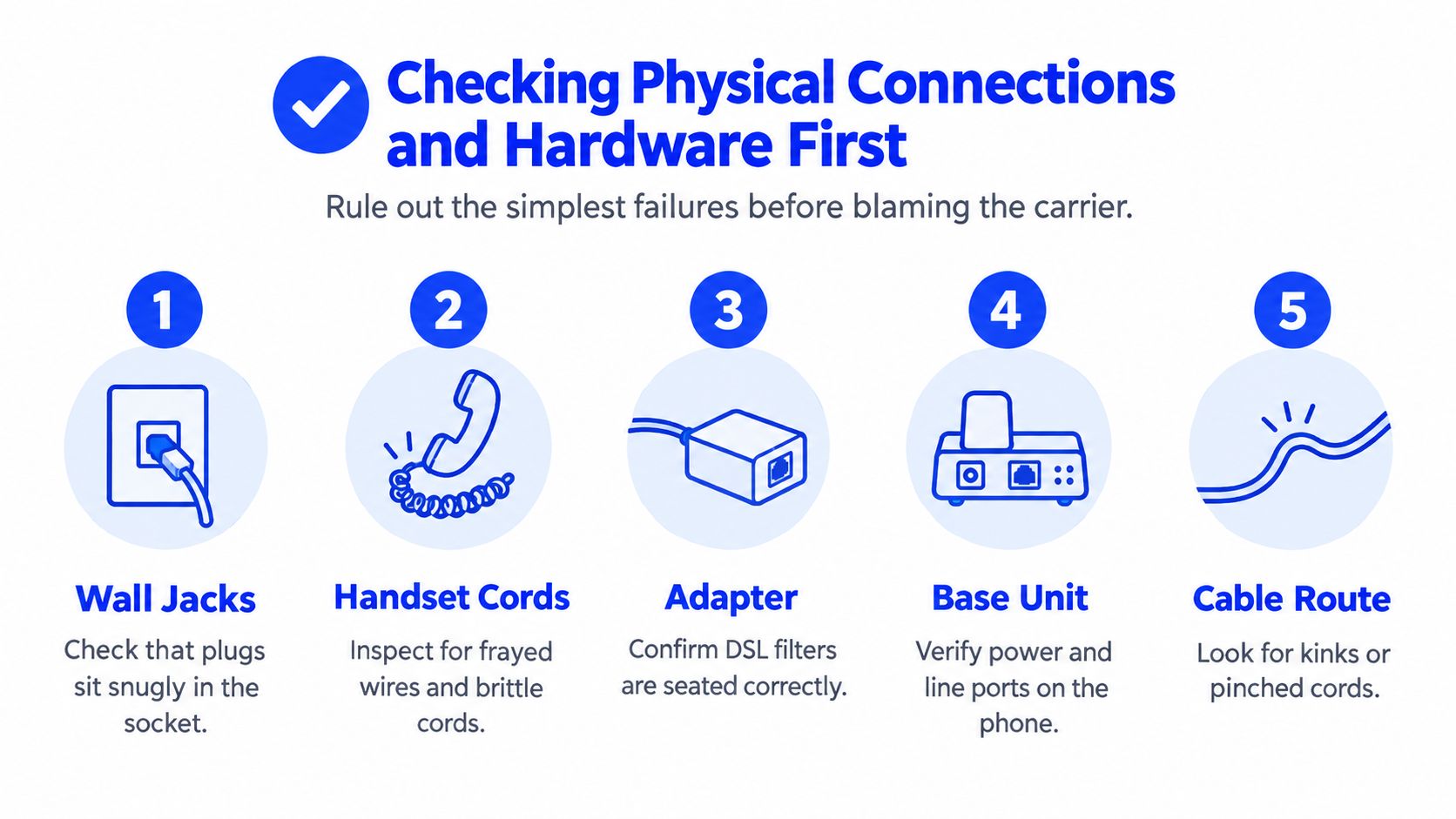
Work through the setup in this order:
Disconnect every handset and accessory. Unplug cordless bases, fax machines, answering machines, alarm panels, and extra phones. A defective device can short the line and remove dial tone from every jack.
Inspect the handset lead. Look for crushed sections, exposed conductors, stretched cable, or brittle insulation. Replace the lead with one you know works, rather than relying on an appearance-only inspection.
Test one ordinary phone. Use a known-working corded handset if possible. Cordless phones can mislead you because their base unit needs electrical power, even when the telephone service itself is available.
Check the wall connection. Push the modular plug firmly into the socket. If the plug feels loose or the jack moves in the wall, the internal contacts may not be meeting reliably.
Remove splitters and filters temporarily. On a line shared with DSL, disconnect the filter or splitter and test the phone directly. A failed filter can block the voice signal while the carrier's line remains active.
The aim is isolation, not repeated plugging and unplugging. If one handset works after all other devices are removed, reconnect the equipment one item at a time. The device that brings the fault back is your likely culprit.
Also inspect the cable route. Vacuum cleaners, chair legs, filing cabinets, and door hinges commonly pinch cords. Don't open a wall socket or repair building wiring while the line is live unless you're trained to do so. If the phone still has no tone with one known-good handset connected directly to the primary jack, continue to the network boundary.
Understanding Power Outages and VoIP Transitions
The word “landline” no longer identifies one technical system. A traditional copper line can receive operating power from the telephone network, so a phone may continue to provide dial tone during a power cut at the property. An IP-based replacement, broadband voice service, or VoIP installation depends on powered equipment such as a modem, router, optical network terminal, or voice adapter.
That difference changes the diagnosis. If the building has lost electricity, check whether the phone equipment has lights, whether the internet connection is active, and whether a battery backup is installed and charged. If the backup has failed, the service can sound like a carrier outage even though the outside plant is functioning.
California's infrastructure is also moving away from the assumptions associated with old copper. CPUC analysis of AT&T California access lines found losses between 55.6% and 71.9% from 2010 to 2017, depending on wire-centre size, and reported that the largest wire centres lost 5,313,115 lines over that period in the cited analysis. These figures appear in the CPUC network examination conclusions and recommendations.
The same record states that wireline accounted for 74% to 79% of total outages in California from 2018 to 2021, while wireless accounted for 21% to 26%. It also records more than 1,000 wireline outages lasting over 96 hours in both 2020 and 2021, compared with 432 in 2018, so a dead line can reflect continuing network exposure rather than a failed home telephone.
If calls are reaching voicemail instead of ringing, that's a different symptom and may require a separate call-routing check. A guide to phone calls going straight to voicemail can help distinguish unanswered calls from a complete loss of dial tone.
Testing the Demarc and Isolating the Line
The demarcation point, often shortened to demarc, is where the provider's network meets your building's telephone wiring. In many premises, it's an outdoor network interface box on an exterior wall. It may also be in a garage, basement, or shared utility area.
Find the customer-accessible section and look for a test jack. It's commonly behind a small cover and may be labelled “Test” or “Telco”. Don't disturb sealed provider compartments or exposed electrical equipment.
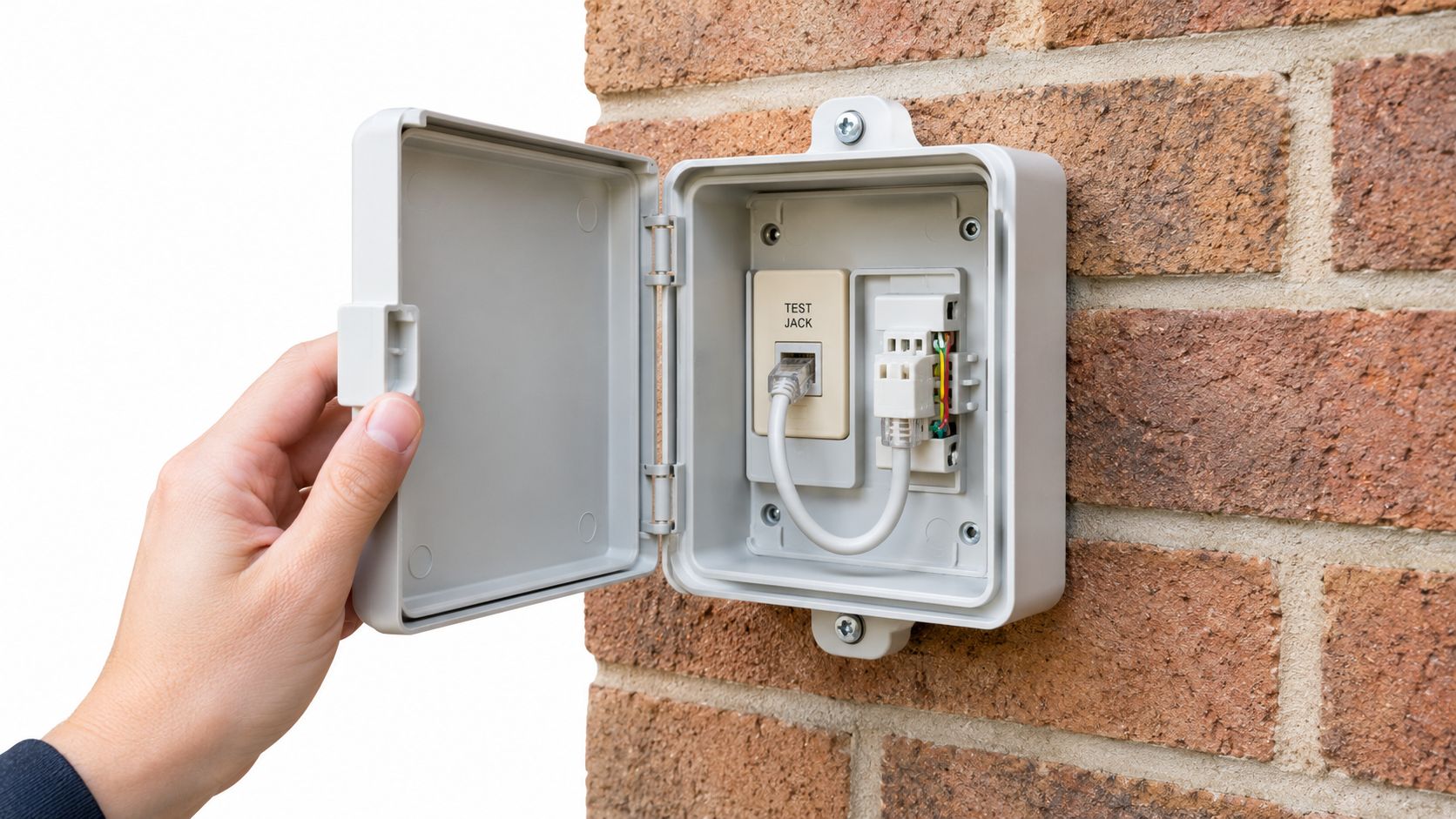
Use this sequence:
- Unplug the premises-side connector from the test jack.
- Wait briefly for the line to release from any connected equipment.
- Plug in a known-working corded telephone.
- Lift the receiver and listen for dial tone.
- Test an outgoing call only if you can do so safely and without disrupting an active business line.
The result divides the repair into two paths:
| Test result | Most likely fault | Next move |
|---|---|---|
| Dial tone at the demarc | Internal jack, cable, handset, or building wiring | Reconnect equipment individually or arrange premises repair |
| No dial tone at the demarc | Provider line, street equipment, network outage, or service change | Report the failure to the carrier |
| Intermittent tone | Loose connection, moisture, damaged cable, or unstable network path | Record when it fails and request line testing |
If the test jack has dial tone, stop blaming the carrier. Reconnect the internal wiring and devices one by one until the fault returns. If the demarc is also silent, your rewiring efforts won't restore service because the fault is beyond the customer-side boundary.
For a business, record the test result, time, affected number, and whether other services are working. That information gives the support agent a useful starting point and helps prevent a routine script from sending you back to the same handset checks.
When to Call a Technician or Report an Outage
The demarc result should determine who gets the next call. A good tone at the demarc points to premises equipment or internal wiring, while a dead demarc points towards the carrier, external cable, network equipment, or a service-level issue.
A technician is appropriate when the provider signal reaches the building but not the rooms that need it. This can happen after renovation, water exposure, pest damage, a pinched cable, or work that disturbed an old jack. A technician can trace each pair, identify the short, and replace damaged sections without making the wiring harder to diagnose.
Carrier support is the better route when the line is dead at the demarc. Check the provider's outage notices, then report the fault directly with the results of your test. California's regulatory framework requires qualifying wireline outage reporting when an interruption lasts 30 minutes or more and meets the state's user-minute thresholds, as described by the CPUC service-quality reporting framework.
The choice is practical:
- DIY checks cost nothing and can resolve a bad cord, filter, or phone quickly.
- A premises technician costs more, but makes sense when the fault is inside walls, across multiple rooms, or connected to complex business equipment.
- A carrier report is necessary when the provider signal doesn't reach the demarc. Replacing handsets won't fix an external line.
- A regulatory complaint may become relevant when a persistent service failure isn't handled through normal support, especially where discontinuance or replacement-service plans affect continued access.
California customers also need to distinguish repair from network policy. Recent coverage reports AT&T citing more than 10,400 copper-theft-related outages nationwide, including 4,000 in California, in a report on rural communities seeking to preserve landline service. That context matters if the same area experiences repeated failures.
A separate transition issue is approaching for some customers. The Los Angeles Times reports that AT&T's filed discontinuance plans cover portions of 360 wire centres and could affect service in areas with 184,000 households starting on or after June 1, 2027, according to its California landline coverage. Treat that as a future transition plan, not proof that today's dead line has already been disconnected.
Restoring Service and Preventing Future Outages
Once dial tone returns, identify the cause before putting every device back into service. If a handset or filter caused the failure, replace it rather than keeping it as an emergency spare. If a cable was crushed or a jack is loose, label the affected connection and repair it properly.
For a business, resilience needs more than one working handset. Keep a charged mobile phone available, document the carrier's fault-reporting process, and know how to forward calls if the provider supports that feature. A secondary answering arrangement can protect appointment intake while the primary number is being repaired, but it won't restore emergency calling or replace the need to report the outage.
Power-dependent voice services deserve their own checklist. Confirm that the router, voice adapter, and any battery backup are accessible, labelled, and tested. A backup only helps if it has capacity and powers the equipment that carries the voice service.
Recovery habit: After every outage, write down whether the tone was present at the demarc, which device failed, and whether power or internet service was affected.
For California operators, track carrier notices and proposed copper discontinuance activity in the service area. The underlying issue may be a repairable local fault today and a replacement-service decision later. Customers who rely on a traditional line should ask the carrier what technology serves the address, what happens during a power outage, and what backup options are available.
Restaurants and hospitality teams can also review phone systems for restaurants when evaluating how reservations and customer enquiries should be handled during staff busy periods. The right arrangement depends on the business, but the diagnostic logic stays consistent: test the equipment, test the demarc, identify who owns the fault, and maintain a separate path for urgent inbound calls.
A silent phone shouldn't silently become a lost booking. Restore the line, document the failure, and create a fallback before the next outage exposes the same gap.
Heyline provides an AI phone receptionist that can answer forwarded calls, respond using information from your business website, and book appointments through a connected Google Calendar. If your landline becomes unreliable, review your forwarding and backup-call options, then visit Heyline to see whether it fits your business.