Dinner service has started, the host is seating a full room, servers are carrying plates, and the phone keeps ringing. Callers want to know whether you have a table, whether the kitchen is still open, how to find the restaurant, what's on the menu, or whether they can place a takeout order. A missed call at that moment isn't just a communication problem. It can be a missed reservation, an abandoned order, or a customer who calls the next restaurant instead.
Restaurants miss a substantial share of incoming calls, with recent industry analyses placing the unanswered-call rate around 43% overall and peak-hour misses commonly between 25% and 60%, depending on the segment and time of day. One analysis of 1,000,000 calls reported a 33% peak-hour miss rate, with 68% of calls clustering around lunch and dinner rushes. Restaurant call analysis from Maple shows why the phone remains a revenue channel, not merely a support line.
The best phone system for restaurants depends on the call workload, existing POS or reservation tools, location count, staffing model, and tolerance for technical setup. The options below are judged on answering continuity, queue and hold handling, reservation or calendar booking, takeout ordering, integrations, analytics, pricing clarity, human escalation, and rollout effort.
1. Heyline
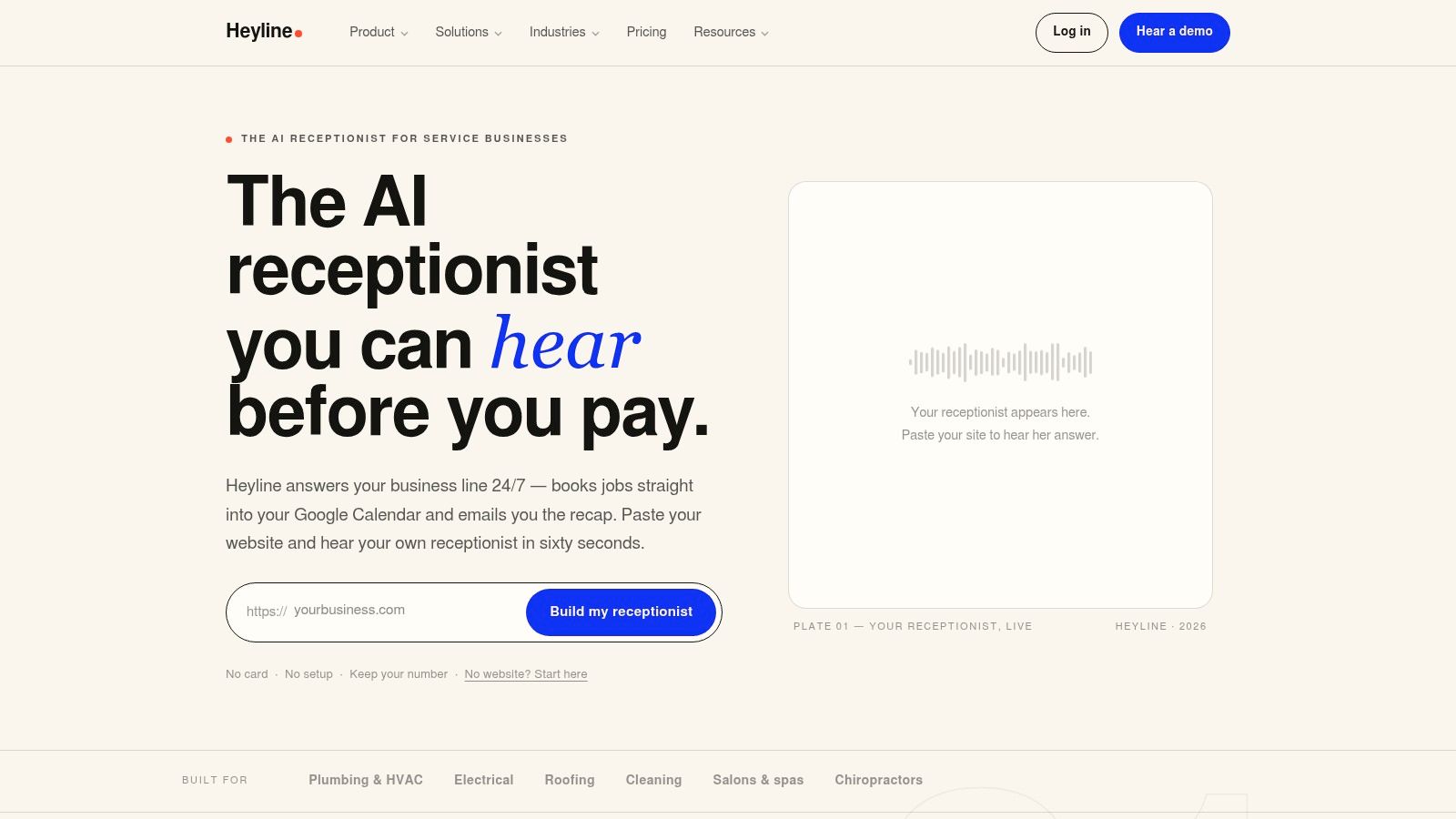
Heyline fits restaurants that need calls answered quickly, reservations handled outside staff hours, and a short path from setup to launch. Its AI phone receptionist can answer around the clock, explain hours and services, and book appointments through Google Calendar.
For a small restaurant, the setup is practical. Paste in the restaurant's website, connect the calendar, test the receptionist in a browser, then launch. Heyline uses the site to capture details such as hours, services, and pricing. Editable knowledge fields let managers correct information or add restaurant-specific instructions. The restaurant can keep its existing number, select a voice that matches the brand, and receive call recaps and transcripts after interactions.
Calendar booking helps with reservations, private dining inquiries, catering requests, and event appointments. The receptionist can check availability during the call, reducing back-and-forth and giving callers a clear next step. Restaurants should verify POS and ordering workflows before relying on it for takeout, since it is not positioned as a full POS-native ordering engine. Confirm how staff handoff works when a caller asks for something outside the configured knowledge.
Where Heyline fits best
Heyline's published tiers include Starter at $99 per month for one line and 200 minutes, Growth at $199 per month for up to three businesses and 500 pooled minutes, and Scale at $499 per month with concierge setup and 1,500 pooled minutes. Extra minutes are automatically added at $10 per 20 minutes, with a user-settable cap. Going live includes a 14-day free trial, while browser testing is available without a card. These figures come from the product plan notes, so confirm current terms before purchase.
Practical rule: Choose Heyline when unanswered inquiries and reservation follow-up are the main problems. Choose another tool, or retain a dedicated ordering system, when takeout orders require deep POS integration.
Usage control is the main trade-off. Minute limits differ by plan, and overages can raise the bill unless the cap is configured. Complex or compliance-sensitive intake needs additional review. Response accuracy also depends on the restaurant's website and knowledge settings, although editable information and optional concierge onboarding make corrections easier.
2. RingCentral
RingCentral is a broad cloud communications platform for restaurants that need more than one phone station and expect administration to become more complex over time. It combines cloud voice with SMS and MMS, team messaging, mobile and desktop apps, visual voicemail, analytics, and optional desk or counter phone hardware.
For a restaurant group, the value is in the routing and management layer. Auto-attendants, IVR, call queues, and reporting can separate reservation calls, takeout questions, vendor calls, and manager escalations. A single-location restaurant can use those tools to keep the host stand from becoming the default destination for every caller, while a multi-location operator can apply consistent rules across sites and monitor performance centrally.
RingCentral is also a reasonable fit when managers need staff access from mobile devices or want a more formal approach to call monitoring and reporting. It's better suited to structured call flows than to a quick, conversational deployment. Reservation booking and POS workflows should be verified directly, because a feature-rich phone platform doesn't automatically mean that it can write bookings or orders into the restaurant's existing systems.
The trade-off for smaller restaurants
The platform's breadth can become overhead. Pricing may run higher than SMB-focused alternatives, and advanced functions can sit behind higher tiers. That means a small restaurant may pay for collaboration, administration, or analytics capabilities it won't use during service.
RingCentral makes the most sense for multi-location restaurants, franchise operators, and teams that need centralized controls. It's less compelling when the owner wants a simple line, a virtual receptionist, and minimal configuration.
3. Nextiva
Nextiva is a practical VoIP choice for an independent restaurant or regional group that wants dependable core calling with a small-business-oriented administration experience. Its toolkit includes auto-attendant functions, call routing, queues, mobile and desktop apps, SMS and MMS, voicemail transcription, analytics, and CRM integrations.
The operational advantage is straightforward setup and support. A restaurant can create a greeting, route calls to the host stand or manager, and let staff answer from mobile or desktop apps when they're away from the counter. Voicemail transcription helps managers scan messages about reservations, catering, or supplier issues without listening to every recording during a rush.
Nextiva also provides restaurant-focused migration guidance, which can matter when the existing number, hardware, and routing rules are all part of the daily operation. The system is a better fit for a restaurant that wants a conventional cloud phone system than for one seeking autonomous ordering or conversational booking.
What to verify before signing
Advanced contact-center functions may require add-ons, and higher-end capabilities can involve additional purchases. Confirm whether your chosen plan includes the analytics depth, integrations, SMS functions, and queue behavior you need. Also ask how reservation or booking software connects, because basic CRM connectivity isn't the same as live table availability.
Nextiva is a good middle ground for independent restaurants, small regional groups, and owners who value guided implementation. It won't be the most specialized option for POS-native phone ordering, but it offers a familiar foundation for routing calls and keeping staff reachable.
4. Dialpad Ai Voice
Dialpad Ai Voice stands out when the restaurant cares about what happens after the call, especially training, quality assurance, and searchable records. Its cloud phone service includes live transcription, AI call summaries, searchable call history, and mobile and desktop apps, with a path toward contact-center features.
That combination changes the manager's workflow. Instead of relying on memory or manually reviewing every interaction, a manager can use transcripts and summaries to identify recurring questions about menu items, delivery areas, reservations, or complaints. A multi-revenue restaurant handling dining reservations, catering, takeout, and curbside pickup may find that searchable call history reveals where staff need better scripts or where callers routinely get stuck.
The system can support queues, auto-attendants, and staff escalation, but it isn't automatically a reservation engine or POS ordering layer. Verify whether the required integrations are native, available through an add-on, or dependent on custom work. Pricing can also become layered when AI, contact-center functions, and integrations are added.
Best use case
Dialpad is strongest for restaurant groups with a manager responsible for call quality and staff coaching. It's less attractive if the immediate problem is that nobody answers the phone and the owner wants a low-maintenance receptionist.
For a restaurant comparing automated call handling options, this guide to 24/7 AI answering services provides useful context on the difference between continuous answering and a traditional phone tree. Dialpad's value is the intelligence and record-keeping around conversations, not just the ability to ring another handset.
5. Zoom Phone
Zoom Phone is most sensible when the restaurant group already uses Zoom Workplace and wants phone service inside the same broader environment. Calls, queues, and auto-attendant functions sit within Zoom's apps, while optional hardware-as-a-service can make desk and counter phone deployment easier to budget.
For a restaurant organization, the benefit is vendor consolidation. Managers already familiar with Zoom can use the same general application environment for phone administration, meetings, and internal communication. Hardware-as-a-service may also help a group standardize devices across locations instead of purchasing and maintaining each phone independently.
The fit is weaker when the restaurant needs specialized reservation or ordering automation. Zoom Phone can route calls and manage queues, but advanced SMS, marketing workflows, and analytics may require third-party tools or broader Workplace entitlements. Pricing and support access depend on the surrounding plan, so compare the complete package rather than evaluating the phone license in isolation.
Choose it for the existing stack
Zoom Phone works best for restaurant groups already standardized on Zoom or businesses that want predictable phone hardware deployment alongside their collaboration tools. It's not the first choice for a single restaurant seeking a conversational AI receptionist or direct POS order injection.
Test the system from the actual host stand and manager devices. A phone system that looks clean in an office can still create friction if staff need to switch between several screens while seating guests and handling calls.
6. Ooma Office
Ooma Office is a budget-conscious option for independent restaurants that want a conventional cloud phone system with minimal configuration. Its entry-level feature set includes a virtual receptionist and ring groups, while the platform also offers conference calling and a straightforward desk phone lineup. The Essentials plan includes unlimited calling to the United States, Canada, Mexico, and Puerto Rico, according to the product plan notes.
The restaurant workflow is simple. A virtual receptionist can greet callers, ring the host stand and manager together through a ring group, and provide a basic fallback when nobody answers. That's enough for many small dining rooms where the primary need is reliable voice coverage, not advanced reservation automation or complex call analytics.
Ooma's published pricing and included features make budgeting easier than quote-led enterprise platforms. Owners can start with the core functions and avoid building a large communications project around a single restaurant line.
Where it falls short
Analytics and advanced queueing are lighter than what larger UCaaS platforms provide. A growing chain may outgrow the administration model if it needs detailed cross-location reporting, skills-based routing, or a contact-center upgrade path.
Ooma is a strong match for independent restaurants, cafés, bars, and small hospitality businesses that need a low-overhead phone foundation. It won't replace a specialized AI ordering system, and it won't provide the same operational depth as RingCentral or 8x8.
7. 8x8 Work
8x8 Work is designed for organizations that need strong administration, call queues, analytics, and room to expand into contact-center operations. Its X Series combines voice, messaging, and meetings, with desktop and mobile applications, physical phone support, and international calling options suited to distributed teams.
For a multi-location restaurant group, 8x8's appeal is operational consistency. Central administrators can manage call flows across sites, while local teams can still receive calls through apps or physical phones. The platform's analytics and queue controls are more relevant when the business wants to understand call handling across several restaurants rather than make sure one host stand rings.
The international angle matters for groups operating across regions or communicating frequently with overseas suppliers. Pooled licensing and broader calling zones can also make the platform easier to evaluate for expansion, although the exact commercial arrangement needs careful review.
Budget and rollout considerations
US pricing is typically quote-based and may not be published consistently. List prices and deal terms can change, so request a written proposal that separates licenses, phone hardware, implementation, support, and any contact-center upgrade.
8x8 is best for multi-site or international restaurant operators with administrative capacity. A single independent restaurant may find the platform excessive unless it already has a clear need for centralized analytics and future contact-center functionality.
8. SoundHound for Restaurants
SoundHound for Restaurants takes a restaurant-first approach to voice automation. Its Smart Answering workflows can handle routine questions about hours, directions, and menus, while supported configurations can take phone orders or send callers to text ordering links. The system is built to manage concurrent calls during the periods when employees are least able to answer.
That focus makes it more relevant than a general-purpose VoIP platform for takeout-heavy restaurants. A caller who wants to place an order can be handled through a restaurant-specific conversation flow instead of waiting in a generic queue. The administration portal lets operators manage knowledge and restaurant-specific behavior, but the exact ordering and POS integration depends on the existing technology stack.
Human fallback requires planning. SoundHound's product notes indicate that restaurants should provision an extra or secondary line for smooth staff escalation. That's a sensible architecture, but it adds another number and another routing decision to the implementation.
The operational question
Before rollout, test modifiers, substitutions, sold-out items, allergy questions, delivery boundaries, and order changes. A system that answers menu FAQs well may still need careful configuration for real order complexity.
A booking or order is only valuable if the restaurant can confirm it, update it, and recover the caller when automation reaches a limit.
SoundHound is a strong candidate for independent restaurants and restaurant groups focused on answering and ordering during rush periods. Teams comparing restaurant-specific automation can also review AI answering services for restaurants to separate general call coverage from deeper ordering automation.
9. HungerRush OrderAI Talk
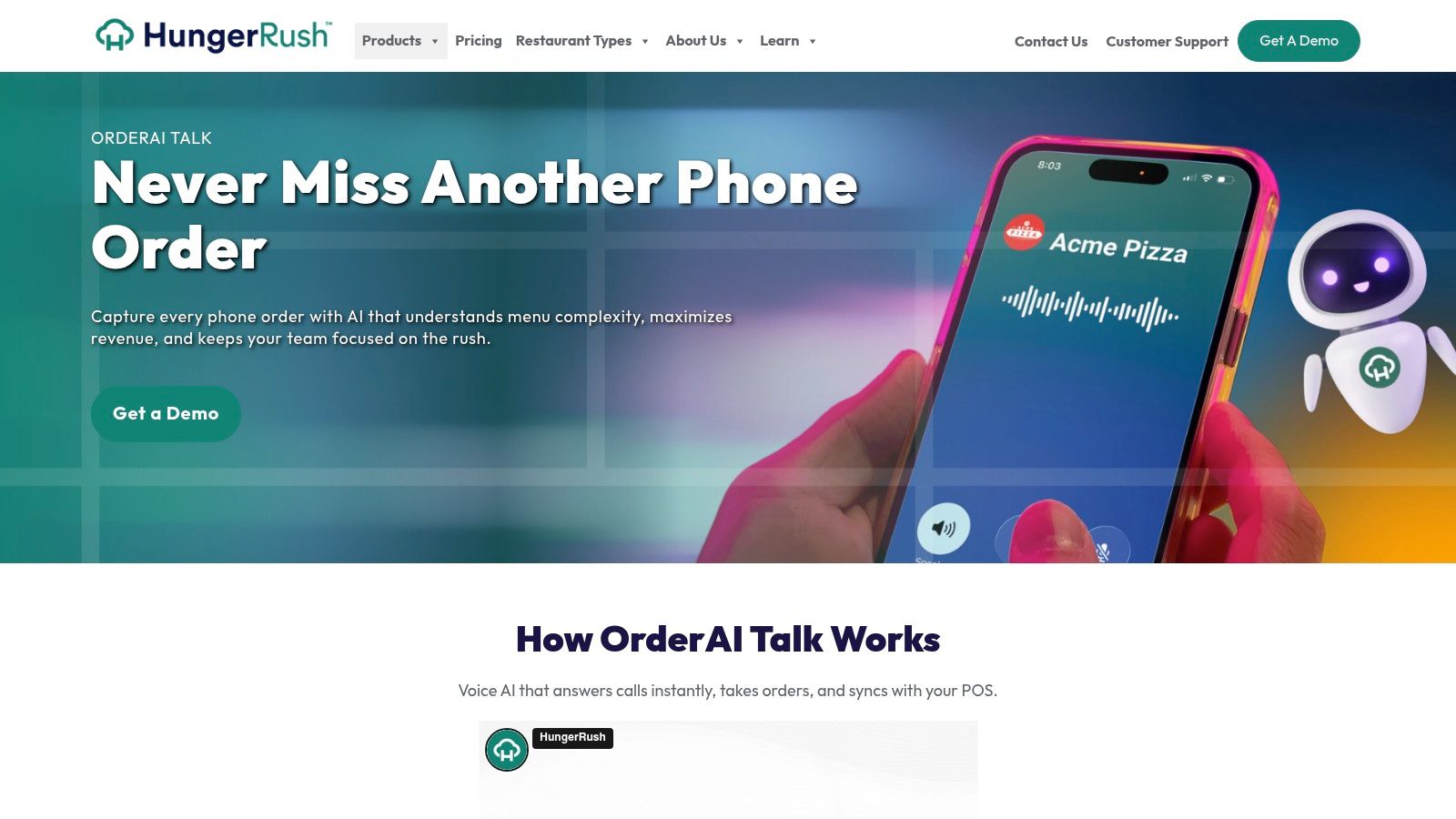
HungerRush OrderAI Talk is a specialized choice for restaurants already using the HungerRush POS ecosystem. It answers takeout and delivery calls, handles phone ordering, and sends orders into the POS with menu items, modifiers, and pricing represented in the existing system.
That tight connection is the main reason to choose it. A pizzeria or QSR using HungerRush doesn't need to build a separate bridge between an AI ordering assistant and the kitchen workflow. The system is designed around high-volume phone ordering, so the important test is whether it accurately handles the restaurant's actual menu structure and order exceptions.
The limitation is equally clear. The best value comes when HungerRush is already the POS. Restaurants running another POS may face integration restrictions, additional work, or a weaker business case. Pricing and terms are quote-based rather than publicly standardized, so the proposal should explain setup, usage, support, integration boundaries, and fallback behavior.
Confirm the handoff
Ask what happens when a caller requests a modification the assistant can't interpret, when an item is unavailable, or when the POS is offline. Also confirm whether staff can see the conversation context or only the resulting order.
HungerRush OrderAI Talk fits pizzerias, QSRs, and takeout-focused restaurants already committed to HungerRush POS. It's not a general restaurant phone system, and reservation-led dining rooms may get more value from a booking-oriented receptionist.
For restaurants comparing automated phone booking with POS-native order capture, this overview of automated phone booking systems helps clarify the difference between calendar booking and order injection.
10. ConverseNow
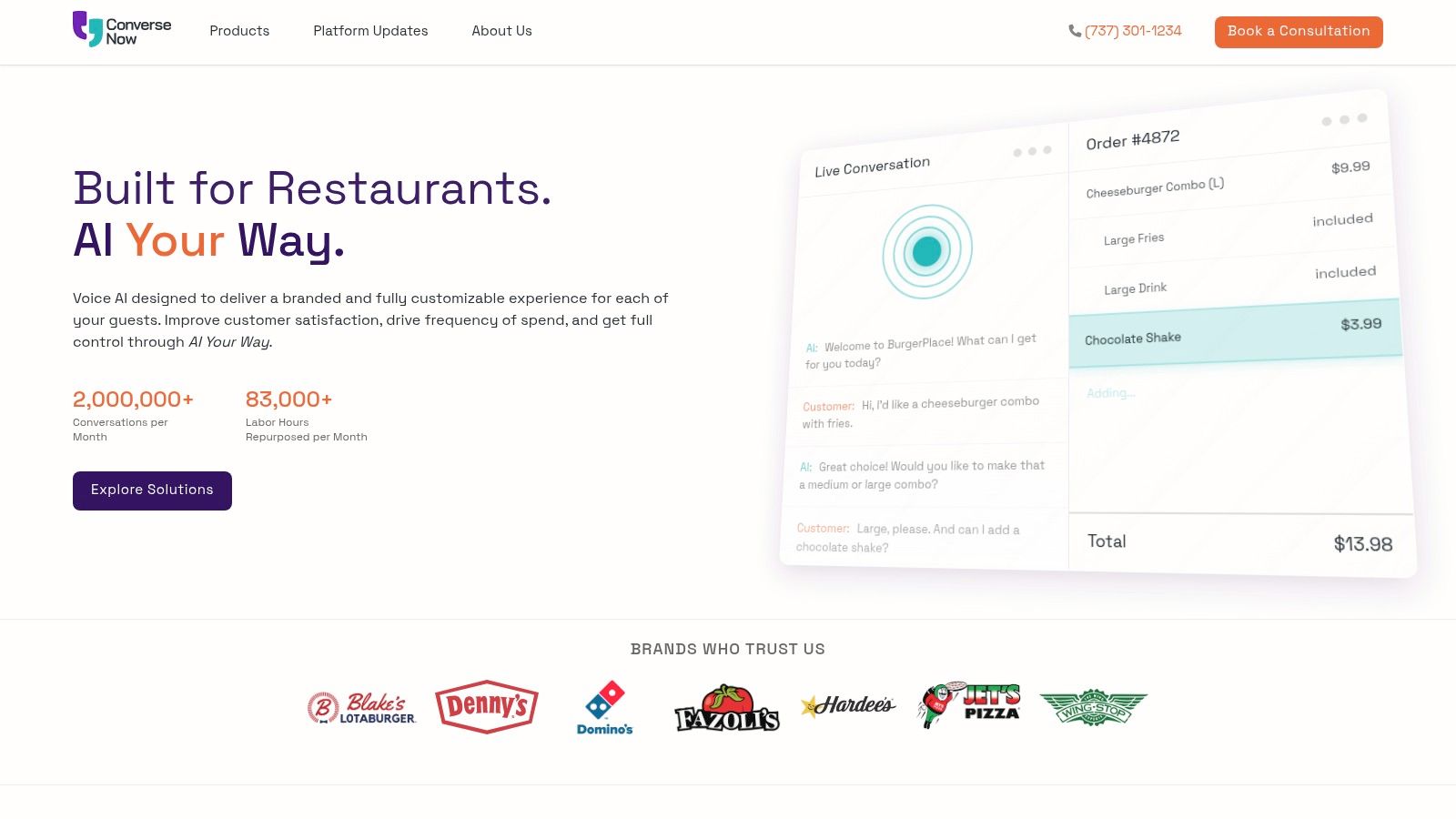
ConverseNow is aimed at enterprise QSRs and high-volume restaurant brands that want voice automation across phone ordering, drive-thru, and kiosk interactions. Its platform supports menu, pricing, and behavior tuning by store or region, with multilingual capabilities for large, varied operations.
The important distinction is scale. ConverseNow isn't a quick virtual receptionist for a single dining room. It's designed for operators with standardized menus, multiple units, dedicated technology teams, and enough call volume to justify a custom deployment. A regional brand can tune behavior by location while keeping control over menu rules and operating requirements.
That level of customization can help during peak-time spikes, especially when the same automation layer needs to support more than one customer channel. It also creates implementation work. Deployment cycles are customized, contracts are enterprise-level, and pricing is provided by proposal rather than a simple public plan.
Who should consider it
ConverseNow fits large QSR brands and multi-unit operators with the resources to manage testing, menu governance, integration work, and ongoing optimization. It's a poor fit for an owner who needs to turn on a phone receptionist quickly without technical involvement.
Before signing, require a pilot plan that covers store-level menu differences, multilingual requests, staff escalation, POS behavior, outage handling, and reporting. Enterprise automation succeeds when the operator owns the operational rules, not when the vendor activates a voice interface.
Top 10 Restaurant Phone Systems Comparison
| Product | Core features / capability | Target audience 👥 | Setup & UX | Price / value & rating 💰 ★ |
|---|---|---|---|---|
| Heyline 🏆 | 24/7 AI receptionist; natural conversation; books to Google Calendar ✨ | Local appointment businesses (salons, clinics, trades, legal) 👥 | 3-step setup (paste site → connect calendar → test); browser test call in ~60s; no dev | Starter $99/mo (200m); Growth $199; Scale $499; free test drive + 14‑day trial 💰 ★★★★☆ |
| RingCentral | Full UCaaS: auto-attendant, IVR, queues, analytics | Single to multi-location restaurants & franchises 👥 | Admin console; richer config; longer setup for advanced flows | Tiered enterprise pricing; strong scale & integrations 💰 ★★★★ |
| Nextiva | Core VoIP, auto-attendant, CRM integrations | SMB restaurants & regional groups 👥 | Easy admin; US-based 24/7 support; straightforward migration | SMB-oriented pricing & support; some add-ons needed 💰 ★★★ |
| Dialpad Ai Voice | Cloud telephony + live transcription, AI summaries, searchable calls ✨ | Restaurants wanting AI-driven QA/training & modern apps 👥 | Simple app-first setup; contact-center features add cost | Competitive entry pricing annually; AI features may cost extra 💰 ★★★★ |
| Zoom Phone | Phone inside Zoom apps; call queues + optional HaaS | Organizations standardized on Zoom (meetings + phone) 👥 | Seamless if on Zoom; entitlement depends on Workplace plan | Bundled with Zoom plans; device HaaS available; variable cost 💰 ★★★ |
| Ooma Office | Budget VoIP: virtual receptionist, ring groups, unlimited calling | Independent restaurants seeking low-cost reliability 👥 | Minimal config; simple admin and desk phone support | Clear published pricing; strong entry-level value 💰 ★★★ |
| 8x8 Work (X Series) | Global UCaaS, robust queues, analytics, CCaaS upgrade path | Multi-site / international restaurant groups 👥 | Enterprise deployment; mature admin tools | Quote-based pricing; good for international scale 💰 ★★★ |
| SoundHound for Restaurants | Voice-AI for FAQs & phone ordering; concurrency-focused ✨ | Restaurants needing peak-time call capture & ordering 👥 | Admin portal for knowledge; may require secondary line for fallback | Published starter pricing for independents; POS integrations vary 💰 ★★★ |
| HungerRush OrderAI Talk | 24/7 phone ordering feeding orders directly into HungerRush POS ✨ | Restaurants running HungerRush POS (pizzerias, QSRs) 👥 | Tight POS integration; designed for high-volume ordering | Best value with HungerRush POS; quote pricing 💰 ★★★★ |
| ConverseNow | Enterprise voice-AI: phone, drive-thru, kiosk; multilingual & regional tuning | Large multi-unit QSRs and enterprise brands 👥 | Custom deployments and implementation cycles | Enterprise contracts/proposals; proven at scale 💰 ★★★★ |
Choose for Your Call Flow, Not the Feature Count
The best phone system for restaurants isn't automatically the platform with the longest feature list. It's the one that answers the calls your staff can't reach, completes the right workflow, and gives a human a clean way to take over when automation stops being appropriate.
For fast, appointment-style booking and natural answering, Heyline is the clearest fit. It's particularly useful for restaurants handling reservations, private dining inquiries, catering appointments, and general questions through a simple calendar-connected workflow. Ooma Office and Nextiva suit independent restaurants that want straightforward calling, basic routing, and manageable administration without building a large communications stack.
RingCentral and 8x8 are stronger choices for multi-location administration, reporting, queues, permissions, and expansion. RingCentral is the broader fit for a restaurant group that wants mature UCaaS features, while 8x8 deserves attention when international operations or a contact-center path matter. Dialpad is the better choice when managers care about transcription, searchable call history, summaries, training, and call-quality review.
Existing technology should narrow the decision quickly. Zoom Phone makes sense when the organization already relies on Zoom Workplace. SoundHound for Restaurants is more relevant when the goal is restaurant-specific answering and ordering during rush periods. HungerRush OrderAI Talk is the natural shortlist option for restaurants already running HungerRush POS and wanting phone orders injected directly into that environment. ConverseNow belongs in enterprise QSR evaluations where phone, drive-thru, kiosk, multilingual support, and regional menu tuning must operate under one automation program.
Missed calls deserve serious attention because they often carry high purchase intent. One restaurant-call analysis reported that a typical venue receives 150 to 200 calls per week, meaning 65 to 86 calls can go unanswered at a 43% miss rate. The industry analysis from Hostie also describes a 2026 summary estimating roughly $73,000 in annual revenue loss per QSR location from missed calls. Treat those figures as directional industry analysis, not a guaranteed result for your restaurant, but use them to justify measuring your own call leakage.
A practical rollout sequence
Start by mapping the top call types. Separate reservations, takeout orders, hours and directions, menu questions, catering, complaints, vendor calls, and requests that must go directly to a manager. Then observe peak-hour volume, abandoned calls, hold behavior, transfer failures, and how often staff must interrupt service to answer routine questions.
Next, confirm the integration boundaries. Ask whether the system can connect to your reservation platform, Google Calendar, POS, ordering provider, SMS tools, and existing phone number. Test special requests, changes, cancellations, sold-out items, modifiers, and human escalation rather than relying on a polished demonstration.
Finally, compare included minutes, overage rules, quote-based costs, hardware, setup fees, support, and outage fallback. Pilot one line or one location first. Review transcripts, completed bookings, order accuracy, staff interruptions, and caller complaints before expanding the system across the restaurant group.
Heyline provides a 24/7 AI phone receptionist that answers naturally, uses your website knowledge, and books available appointments through Google Calendar without a developer-led setup. If your restaurant is losing reservation and inquiry calls during service, visit Heyline to test the receptionist and evaluate whether it fits your call flow.