Sixty-two percent of calls to small businesses go unanswered, while only 37.8% are answered live, according to a 2026 compilation of missed-call data. For a plumbing company, that isn't a harmless service issue. A homeowner with water pouring through a ceiling doesn't wait for a callback. They call the next plumber.
A 24/7 plumbing answering service only creates revenue when it closes the gap between pickup and booking. A vendor can advertise round-the-clock coverage, but if the caller reaches a slow script, receives a vague promise, or never gets placed on a technician's schedule, the call still fails. The operating question is simple: can your service answer, understand, qualify, reassure, and create the right next step while the customer is still on the line?
Why Plumbing Phone Coverage Is a Revenue Problem
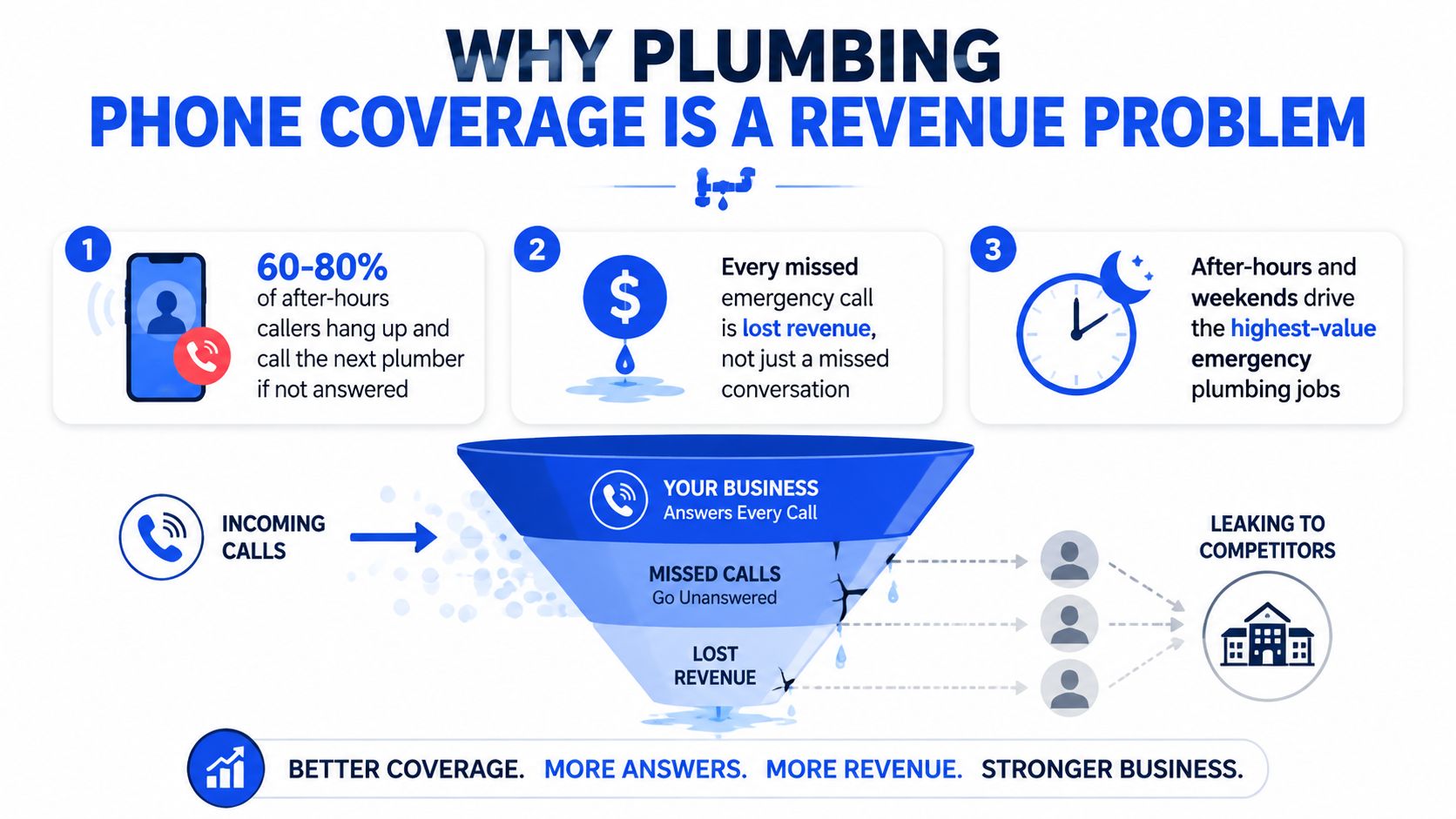
The missed-call problem is especially serious in plumbing because demand doesn't follow office hours. A burst supply line, sewage backup, failed water heater, or overflowing toilet can create immediate damage at night, on weekends, or during holidays. A caller who hears voicemail often treats that as a clear signal to try another company.
The available benchmarks show why owners should treat phone coverage as a revenue channel. One compilation reports that 85% of callers who don't get an answer never call back (Hicira missed-call statistics). A separate analysis of more than 60 million home-service calls reports that 27% go unanswered (CallRail home-service call analysis). These figures describe a structural operating problem, not an occasional bad day.
Treat every ring as a sales opportunity
During staffed hours, a missed call may become a callback if someone notices it quickly. After hours, the caller usually has no reason to wait. The home-service missed-call benchmark roundup reports that 86% of callers who reach voicemail hang up without leaving a message. It also describes a steep relationship between response time and conversion, with response within one minute treated as the baseline, conversion at about 40% by five to ten minutes, and below 5% after thirty minutes.
Those figures make a 24/7 plumbing answering service more than a receptionist substitute. It protects the advertising and reputation work you've already paid for. Search visibility, referral relationships, truck graphics, and local listings all drive people to the phone. If nobody answers, your marketing creates demand for a competitor.
Owners should audit the entire call path, not just the phone bill:
- Pickup: Does someone answer immediately at night and during overflow?
- Qualification: Can the service separate active water damage from a routine repair?
- Booking: Does the caller leave with an appointment or dispatch decision?
- Handoff: Does the technician receive a usable job record?
- Follow-through: Does someone confirm the appointment and monitor exceptions?
High call volume can expose these failures quickly, especially when several technicians are already working. A practical starting point is to review your high-call-volume phone coverage process and identify where calls disappear between ringing, recording, and dispatch.
Operational rule: A call isn't recovered when someone writes down a name. It's recovered when the business owns the next action.
The Three Main 24/7 Answering Options Compared
Most plumbing vendors fit into one of three coverage models. Classify the model first, then judge the promises. “24/7 answering” describes availability, not whether the service can book a profitable job.
An in-house on-call model assigns calls to an owner, dispatcher, or rotating technician. It can work for a small operation with disciplined procedures, but the person answering is often driving, carrying equipment, or working under a sink. Overtime, interruptions, and inconsistent coverage make this model fragile. The technician may understand plumbing perfectly and still miss the call.
A traditional live answering service gives you trained agents who follow a script and represent your business by phone. Human warmth is the main advantage. The weakness is context. An agent who only captures “leaking pipe” and forwards a message hasn't established whether water is actively spreading, whether the main shutoff is closed, or whether the customer needs immediate escalation. Per-minute billing can also make long triage calls harder to manage.
An AI receptionist handles the first conversation continuously, follows a defined intake path, checks approved scheduling rules, and routes exceptions. Its value depends on configuration. A generic voice bot that can't understand plumbing terminology or recognize an urgent description is just a faster version of bad voicemail.
| Model | Cost Per Call | Plumbing Context | Pickup Speed | Booking Conversion | Integration |
|---|---|---|---|---|---|
| In-house on-call | Variable labor and interruption cost | High when the technician answers | Unreliable during jobs | Strong when answered, weak when missed | Usually manual unless staff use the dispatch system |
| Traditional live service | Often tied to call duration or usage | Depends on training and script depth | Generally consistent, but queue delays can occur | Good for clear scripts, weaker when agents only take messages | Ranges from message delivery to direct scheduling |
| AI receptionist | Usually predictable by plan or usage | Strong when trained on approved services and rules | Consistent and immediate | Strong when it books or routes during the call | Can connect to calendars and supported workflow tools |
The comparison exposes the distinction. Pickup speed is the entry requirement. Call-to-booking performance is the decision criterion. Ask every provider to demonstrate a burst-pipe call, a sewer backup, a no-hot-water request, and a routine faucet repair. Don't accept a dashboard showing answered calls without recordings or job records proving what happened next.
How an After-Hours Plumbing Call Should Flow
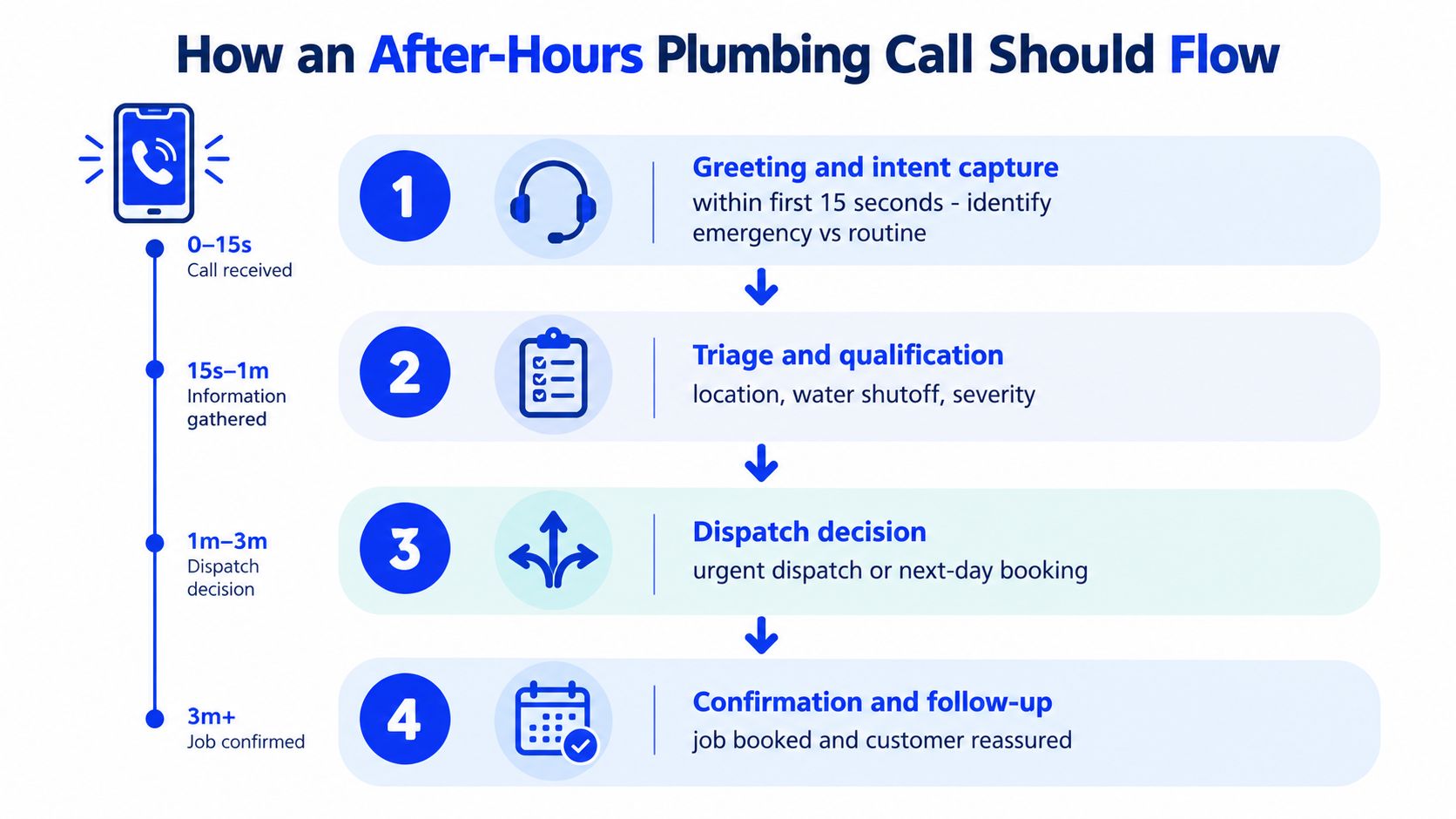
A successful emergency call has four operational beats. The receptionist doesn't need to sound dramatic. They need to sound calm, direct, and competent while moving the caller toward a safe and concrete next step.
Start with intent, not a menu
The opening should identify the company and invite the problem immediately. “Thanks for calling Northside Plumbing. Tell me what's happening” gives a panicked homeowner a clear path. A long menu does the opposite.
Within the first moments, the service should distinguish an active emergency from a scheduled repair. “Water is coming through the ceiling” requires a different route from “my bathroom faucet drips.” The caller should hear acknowledgment before a sequence of questions.
Triage the condition
The next questions should establish severity and immediate safety steps. Ask where the water is coming from, whether it's still flowing, whether the caller has reached the main shutoff, and whether electricity is near the water. Don't let an answering service provide technical instructions beyond your approved protocol. Its job is to identify urgency and follow your escalation rules.
A useful internal transcript might look like this:
Caller: “The pipe above the basement ceiling burst and water is running everywhere.”
Receptionist: “I'm sorry, that sounds stressful. Is the water still flowing, and can you safely reach the main shutoff without standing near electrical equipment?”
Caller: “It's still running. The shutoff is by the front wall.”
Receptionist: “Please shut it off only if you can do that safely. I'm marking this as an active water emergency and checking the on-call dispatch path now.”
That exchange does three things. It acknowledges stress, captures urgency, and avoids pretending that a booking alone resolves the problem.
Gather details the technician can use
Collect the service address, unit or suite, gate instructions, pets, caller name, and a callback number. Capture the description in the caller's words, then add a structured urgency flag. If the property has prior work history, link the caller to the existing customer record rather than creating a duplicate.
The handoff should happen before the caller hangs up. The call handler should either book an available slot, contact the on-call technician, or explain the next approved step. A confirmation message can repeat the address, appointment window, and preparation instructions, while the dispatch board receives the job details.
Use this audit question: Could a technician understand the job from the ticket without replaying the entire call? If not, your service is collecting conversations, not operating a dispatch channel.
Connecting the Answering Service to Dispatch and Calendar
The integration test is more important than the sales demonstration. A service that answers perfectly but sends the lead into an inbox nobody monitors hasn't solved the operational problem.
Start with the destination. Decide whether new calls should create records in ServiceTitan, Housecall Pro, Jobber, another field-service platform, or a shared Google Calendar. The system must receive the caller's name, phone number, address, problem description, urgency classification, preferred timing, and any access notes.
Verify the handoff method
A native integration or real-time webhook can create a job as the call is completed. A CSV export or manually forwarded email introduces another queue, which may be acceptable for non-urgent estimates but is a poor fit for active flooding. Ask the vendor to show the exact record created by a test call, not a sample screenshot.
Your acceptance checklist should include:
- Real availability: The service sees current calendar openings rather than a static schedule.
- Territory rules: The system routes the job toward the correct technician or service area.
- Overnight timing: The calendar handles calls received after midnight without shifting the date incorrectly.
- On-call visibility: Dispatchers can see who is available, who is busy, and who is the backup.
- Two-way confirmation: The customer receives the appointment details, and your team can see whether the message was delivered.
- Duplicate control: A repeat caller doesn't create competing jobs for the same address.
A dedicated routing-number setup should also make ownership clear. Decide which calls go to the answering service, which go directly to a dispatcher, and which overflow to a backup. Put those rules in writing.
Test failure conditions before launch
Don't test only the easy path. Place a routine call, an urgent call, a duplicate call, and a call when no technician is available. Then mark a job complete and check what the customer, calendar, and dispatch board show.
The common failure is silent ownership. The answering service captures the lead, sends a notification, and assumes someone else will act. Your process needs a visible status for new, accepted, dispatched, confirmed, and closed. If a job can sit in “new” without an escalation, it isn't a 24/7 workflow.
AI Voice Versus Human Voice for Emergency Calls
Emergency callers want two things at once: immediate access and reassurance. An AI voice has a natural advantage on availability and consistency. A human has an advantage when the caller's description is emotional, disorganized, or outside the script.
The right decision isn't “AI or humans” in the abstract. It's whether the caller gets a useful resolution without being forced through a system that doesn't understand the situation. The Invoca home-services benchmark report reports that only 55% of callers spoke with a person in its benchmark data, while 60% expected to speak with someone within two minutes. That gap makes fast first response important, but it doesn't make automation automatically acceptable.
A 2026 trade-publication survey of 6,000 consumers found that 85% preferred a real person for local-service calls, 73% prioritized resolution, and one in three said they would hang up immediately on reaching AI (UCall survey coverage). The same source reports that 83% had asked to speak with a real person instead of AI. These findings support a clear position: don't deploy AI as a wall between the customer and help.
| Factor | AI Voice | Human Voice |
|---|---|---|
| Availability | Consistent across nights, weekends, and busy periods | Depends on staffing, queues, and escalation coverage |
| Intake consistency | Follows the same approved questions and rules | Can adapt naturally, but quality varies by agent |
| Plumbing nuance | Strong when trained on your services and terminology | Strong when agents receive thorough plumbing training |
| Emotional reassurance | Calm and consistent, but can fail with unusual phrasing | Better at empathy and improvised conversation |
| Booking and routing | Can book directly when connected to the calendar | May book directly or pass a message, depending on the provider |
A hybrid model is usually the practical choice for high-stakes calls. Let AI answer, identify the emergency, gather the core details, and offer a real slot. Transfer to a human when the caller requests it, the description falls outside approved rules, or the on-call technician needs direct coordination.
Heyline is one example of an AI phone receptionist that can answer incoming calls, use business information from a website, and book appointments through a connected calendar. Evaluate it against the same emergency scenarios as every other provider. The voice matters, but the escalation path matters more.
Calculating the Real ROI of After-Hours Coverage
Vendor dashboards often emphasize answered calls because that metric is easy to display. Owners should calculate captured job value instead.
The basic model is:
Missed after-hours calls × qualified close rate × average ticket = potential captured value
Then subtract the actual answering and integration cost. Use your own call log, not a provider's generic example. Count calls that reached voicemail, no-answer states, or an unmonitored message box. Separate spam and existing-customer calls from new service opportunities.
The verified benchmarks establish the problem, but they don't provide a universal plumbing ticket, close rate, or call volume. Don't import unsupported assumptions into your forecast. Pull those figures from your books, dispatch records, and recorded calls.
Build a conservative worksheet
Create four fields for the previous operating period:
- Missed after-hours opportunities: Count new callers who didn't reach a useful conversation.
- Qualified-call close rate: Measure how often comparable answered calls become booked jobs.
- Average realized ticket: Use completed-job revenue for the relevant service category, not a quoted price.
- Coverage cost: Include usage, setup, transfers, calendar fees, and staff time spent correcting errors.
Run three scenarios using your actual low, expected, and high values. If the expected scenario depends on every caller booking, the model is too aggressive. A credible forecast assumes some calls remain unqualified, some callers decline the appointment, and some booked jobs cancel.
Secondary returns still matter, but keep them separate from revenue. Reduced owner interruptions, cleaner morning dispatch, fewer duplicate records, and less receptionist overload can justify the project even when the direct booking calculation is close.
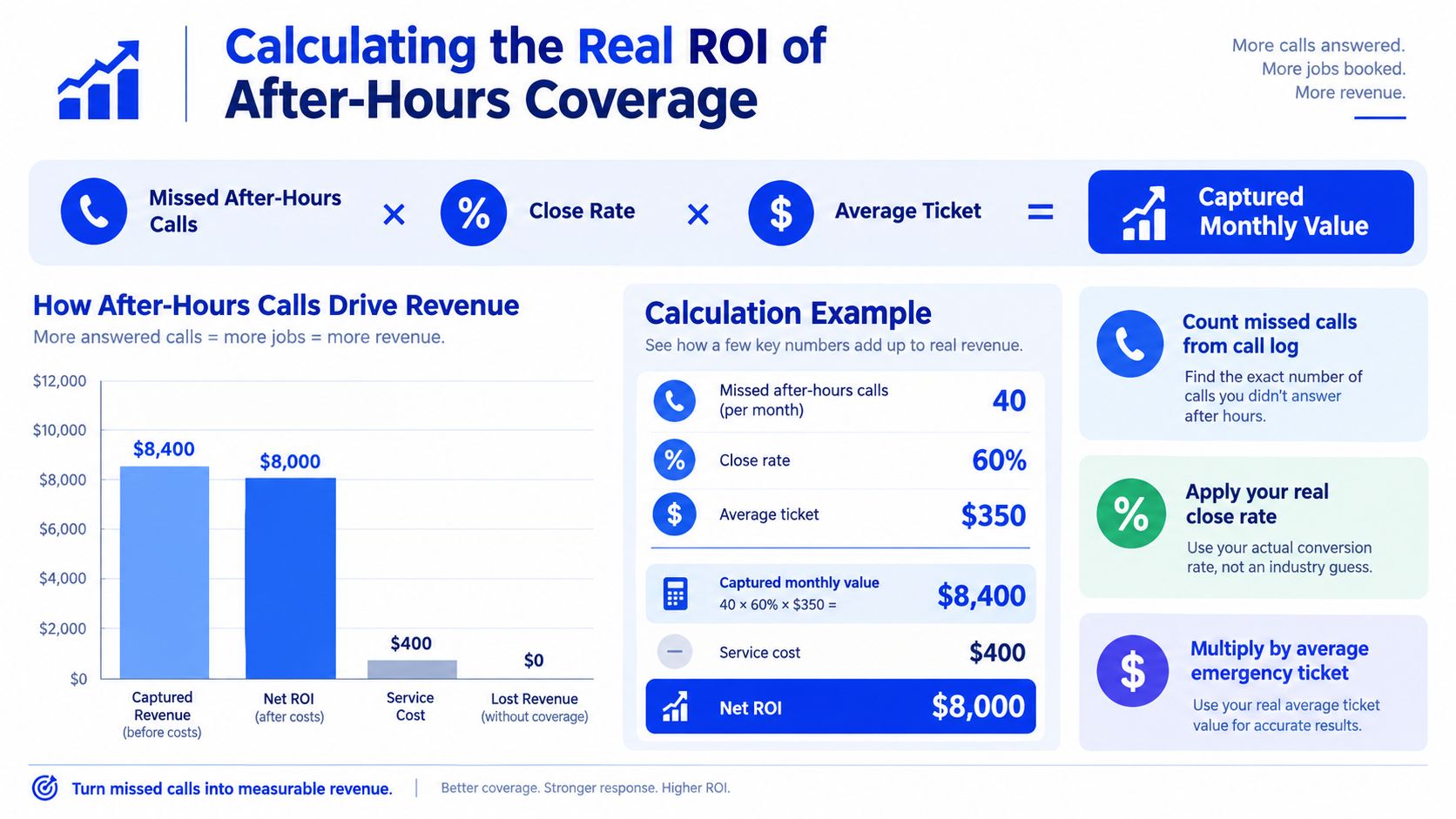
Financial test: Don't ask whether the service answers enough calls. Ask how many additional completed jobs it must produce to cover its full cost, then verify that number in a controlled rollout.
Choosing and Rolling Out Your 24/7 Answering Setup
Choose the coverage model that matches your call urgency, staffing reality, dispatch discipline, and caller expectations. Start by writing the rules before you compare providers.
Define which conditions require immediate dispatch, which can receive a next-day appointment, and which should be screened or declined. Then test each vendor with burst pipes, sewer backups, gas-related safety concerns, water-heater failures, and routine faucet repairs. Require a live demonstration that ends in a calendar booking or escalation, not merely a recorded message.
Use a practical vendor checklist
Ask for evidence of:
- Answering consistency: How does the provider handle nights, weekends, holidays, and overflow?
- Emergency transfers: What happens when the first on-call technician doesn't answer?
- Plumbing intake: Can agents capture shutoff status, active damage, access details, and urgency?
- Message quality: Do transcripts and tickets give technicians enough context?
- Language support: Can the service handle the languages your customer base uses?
- Compliance and privacy: How are recordings, caller details, and access information handled?
- Transparent pricing: Are transfer, usage, setup, and overage charges clearly documented?
Before launch, configure service areas, business hours, on-call rotations, overflow rules, pricing language, escalation contacts, and unavailable-technician behavior. Connect the service to your scheduling or dispatch platform, then test a new job, urgent job, duplicate caller, and no-availability scenario.
Run a one-week controlled rollout
Start with after-hours and overflow calls rather than changing every phone path at once. Review recordings and job tickets each day. Track answered calls, qualified bookings, response time, cancellations, duplicate suppression, technician handoff, and completed revenue.
Correct the script and routing rules before expanding coverage. A one-week pilot should answer five questions:
- Did the service pick up when your staff couldn't?
- Did it identify urgency correctly?
- Did it create usable jobs?
- Did customers receive clear confirmation?
- Did technicians receive the right information at the right time?
Treat the service as an operating channel, not just a phone expense. The best setup is the one that gives callers a fast, credible next step and gives your team a job they can dispatch.
Heyline provides an AI phone receptionist that answers plumbing calls around the clock and can book qualifying appointments into a connected Google Calendar. Visit Heyline to test whether its call flow, scheduling connection, and escalation process fit your after-hours operation.