Fifty-five minutes. That's the average wait researchers in California recorded when they placed Medi-Cal help calls in 2024, according to an analysis released by the Children's Partnership and reported by the Los Angeles Times. A statewide public programme is an extreme case, and no salon or dental office will ever face that queue. The failure behind it is ordinary though. A phone number goes on the website, nobody owns what happens when it rings, and the caller decides the business isn't worth the effort.
The wait is only the visible part. A caller who does get through can still hang up without a time, a price, or anything in writing. Appointment guidelines are the written rules that decide what happens in those calls, in the hours before the visit, and on the afternoon somebody doesn't turn up.
Treat them as a service standard with numbers attached, not as fine print nobody reads.
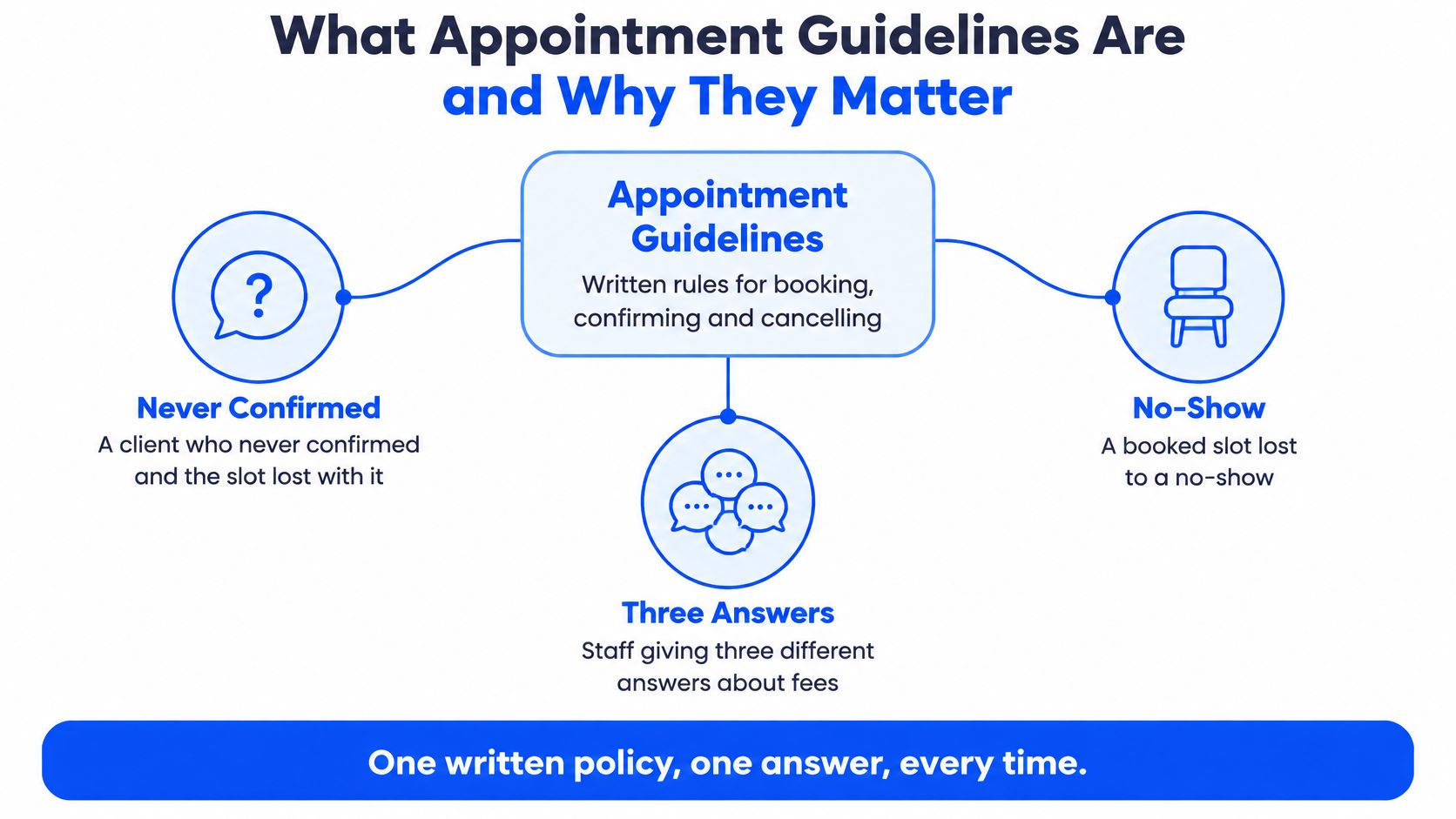
What Appointment Guidelines Are and Why They Matter
A Thursday 2pm slot goes empty. The client booked by phone three weeks earlier, was told "around two", never got anything in writing, rang twice to ask what it would cost and heard two different answers, then decided the whole thing felt unreliable. Nobody in the business can say where it went wrong, because none of it was written down.
Appointment guidelines are the published rules a business sets for how clients book, arrive, cancel and reschedule. They're the service-industry equivalent of a restaurant's reservation policy: the answer to "what happens if" before anyone has to ask it. Written down, they set client expectations, protect staff hours, keep empty slots to a minimum, and give every member of the team the same answer about fees, lateness and short notice.
The cost of skipping that work is measurable. A 2025 study of adults using Medi-Cal provider directories in the San Francisco Bay Area found only a 51.8% likelihood that a prospective patient would be offered a new-patient dental appointment within three calls, according to the California dental-access research. Being listed as available and being bookable turned out to be two different things.
The test I use: could a new staff member answer any booking question from the policy page alone, without walking to a manager's desk?
That gap is what a written standard closes. A guideline that states how quickly staff answer, how many contact attempts are supported, and whether a caller leaves with a confirmed slot turns a directory entry into a booked appointment. What follows sets standards in four areas: booking, arrival and no-shows, cancellation and rescheduling, and the exceptions that break every default rule.
Standard Appointment Guidelines at a Glance
Every appointment-based business makes the same eleven decisions, usually by accident. Here is a working value for each one, plus the condition that should push you off the default.
| Policy area | Common standard | When to adjust |
|---|---|---|
| Booking window | Open 2 to 8 weeks ahead; accept same-day bookings up to one hour before the slot | Extend for low-demand services; automated phone booking often caps at 14 days ahead |
| Slot length and buffer | 15 to 60 minute slots with a 10 to 15 minute gap between bookings | Add 15 to 30 minutes for new clients or complex services |
| Booking confirmation | Confirm date, time, name and callback number, then send a written confirmation | Read back every detail on phone bookings to prevent errors |
| Arrival time | 10 minutes before the slot; a longer runway for first visits | Post separate windows per service type; first visits need time for forms or consultation |
| Phone answer time | Live answer during business hours, never voicemail while you're open | Health plans publish a minute ceiling for a knowledgeable representative; set your own and measure it |
| Late arrival | 5 to 10 minute grace period, then a shortened service or a reschedule | State whether late clients pay full price or forfeit the slot |
| Cancellation notice | At least 24 hours before the appointment | Require 48 hours for long or multi-slot services and peak days |
| Late cancellation fee | 25 to 50% of the service price, or a flat $25 to $50 | Disclose in writing before booking; set waiver rules for emergencies |
| No-show | Full service fee once the grace period expires | Follow up to rebook instead of only charging |
| Rescheduling | Free with the same notice as a cancellation; 1 to 2 moves per booking | Allow more flexibility for returning clients in good standing |
| Waitlist | Offer released slots to waitlisted clients first | Automate waitlist offers the moment a cancellation arrives |
How to use the table
Take the middle column as the safe default if you're starting from nothing, then move the rows that don't fit your service. Healthcare carries regulated timelines that override several of these values, and those are covered in the booking section. High-demand work, the Saturday colour appointment or the pre-holiday deep clean, needs more notice than a business with a half-empty Tuesday. A 90-minute treatment that occupies two staff members is a different risk from a 20-minute cut, which is why the cancellation row shifts for long or multi-slot services.
None of these numbers are laws. They're conventions, and they've survived because they balance two costs: the client's flexibility and the operator's lost hour. A full day of notice leaves room to refill a slot from the waitlist. A fee set at a quarter to half the service price is heavy enough to be felt and light enough that clients rarely turn it into a formal complaint.
One rule per row, one number per rule. "Reasonable notice" fails that test. A stated hour count passes it.
Whatever fee you land on must be disclosed in writing before the client books, on the booking page and in the confirmation message. A charge a client first hears about at the counter is a dispute, and in most places an unenforceable one. Pick one value per row and you have a working policy today.
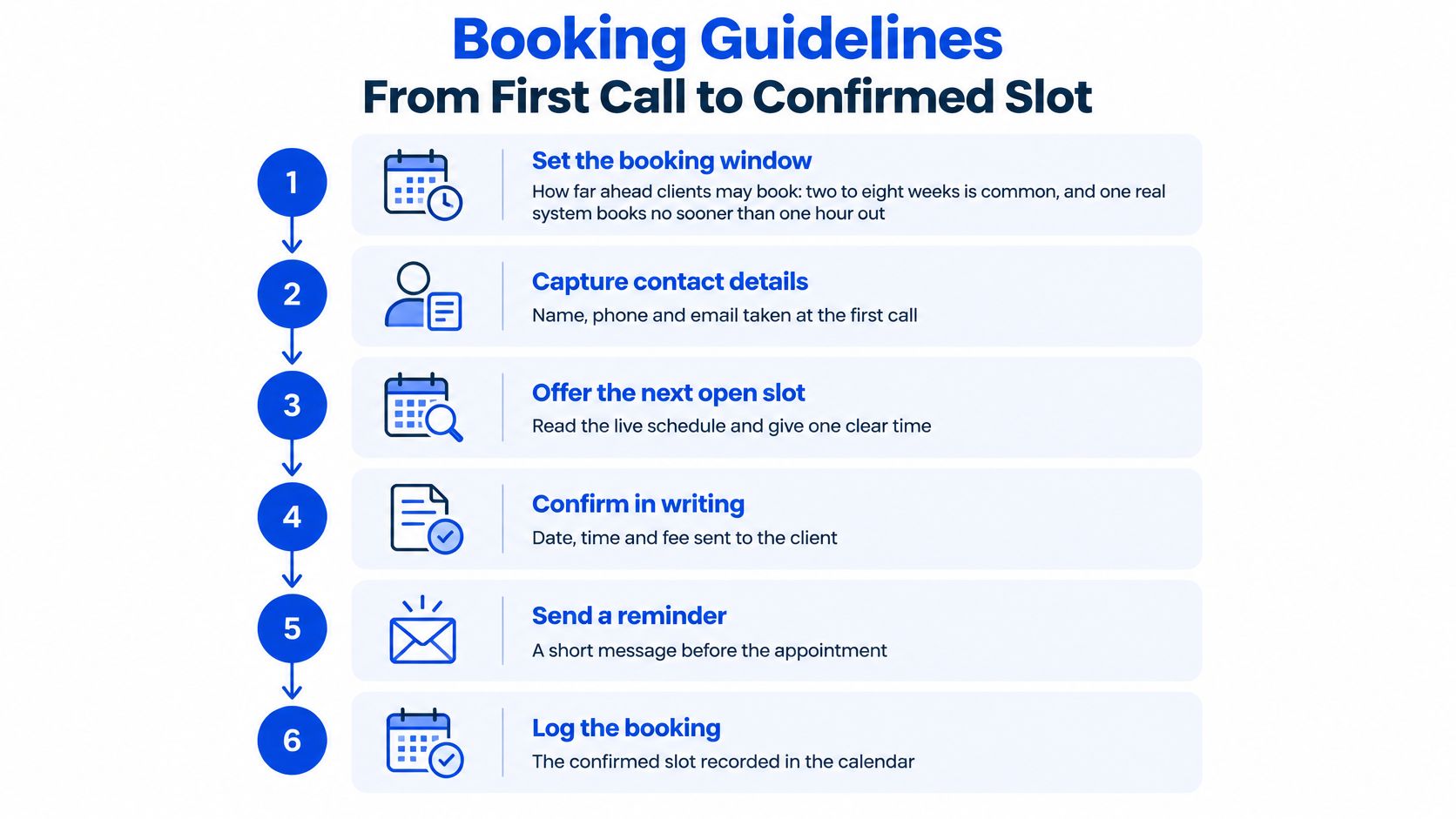
Booking Guidelines From First Call to Confirmed Slot
The first call either produces a confirmed time or leaves the caller to try again elsewhere. Set a clear booking standard, then make each step easy to follow.
Set the booking window. State how far ahead callers can book and how soon before a slot they can make a booking. Heyline books no sooner than one hour from the call and no more than 14 days ahead. For requests beyond that window, it names the last date it can book and records the request as a to-do, not an appointment.
Set appointment length and the gap between jobs. A buffer gives staff time to handle overruns and prepare for the next appointment. Heyline's defaults are a 60-minute appointment and a 15-minute gap; the business can change both.
Ask service-specific intake questions. Collect the caller's name and callback number, then ask the questions the business has set for that service, such as square footage, bedrooms, pets or parking. Ask one question at a time before booking, and include the answers beside the appointment in the recap email.
Check availability before offering times. Check the business's Google Calendar, then offer two or three open times. Busy slots should never be offered twice. If the caller wants a time outside the booking window, record the request as a to-do rather than confirming an appointment.
Read the details back. Confirm the day, time, name and callback number before ending the call. A caller who is already booked can ask to move or cancel their own appointment. Before changing an existing appointment, the receptionist names it and waits for a clear yes.
Send a written recap. The appointment appears in the business's Google Calendar, and the business receives a recap email with the intake answers. For a consistent phone process, use these telephone scripts for answering the phone. Businesses that also let clients schedule an appointment online should keep the booking details and rules clear across both routes.
When the calendar isn't the whole decision
Healthcare appointment rules may set deadlines that a standard calendar flow cannot enforce on its own. California's Department of Managed Health Care requires urgent appointments within 48 hours when prior authorization isn't needed and within 96 hours when it is, non-urgent primary care within 10 business days, and specialty care generally within 15 business days, according to its appointment and access standards. A scheduler must capture the requested service, urgency, specialty and authorization status, then escalate requests it cannot place within the applicable deadline.
The same standards expect telephone triage or screening during and after business hours. In a clinical setting, an automated receptionist should not diagnose or decide urgency on its own.
Arrival Windows, Late Clients and No-Shows
An appointment time is a promise with a start line, and the two aren't identical. The arrival window absorbs what happens before the service begins: forms, insurance checks, a first-visit consultation, the dog that needs moving to another room. A returning client needs a couple of minutes. A first visit needs a runway, which is why the window belongs in the policy by service type rather than as one blanket instruction.
The policy has to name the moment lateness starts, in minutes, and say what happens next. Three responses are defensible, and teams get into trouble when they mix them:
- Shorten the service and charge full price. Workable for a cut or a half-hour consult where the remaining time still delivers the outcome the client came for.
- Charge in full and note it on the file. Common for a first visit, where the preparation and the slot can't be recovered.
- Reschedule and apply the late policy. The cleanest option for anything with a fixed slot cost, such as a two-hour clean or an appointment that blocks a second staff member.
Pick one per service type, publish it, and apply it to the client who has spent thousands with you as well as the one who hasn't. Otherwise it isn't a policy, it's a mood.
Defining the no-show in one sentence
A no-show is an appointment the client neither attended nor cancelled before the start time, which is the definition used in San Francisco behavioral-health reporting guidance cited by the California Department of Health Care Services. The same guidance requires monitoring of office waiting times, telephone answering and return times, and the time needed to obtain different appointment types, plus follow-up procedures for missed appointments. Translated for a private business: attendance is a number you're supposed to watch, not weather that happens to you.
Handle it the same way every time. Wait out the grace period, place one courtesy call or text, then mark the appointment as a no-show with a timestamp rather than leaving it open. Apply the fee you disclosed, then follow up the next business day with a rebooking offer instead of a bill and silence.
Charge and rebook in the same breath. A fee without a next appointment is a fee that ends the relationship.
Measurement is where most businesses stop. Log an event every time something happens to a booking: offered, confirmed, cancelled, rescheduled, missed. With timestamps on those events you can calculate answer latency, booking latency, how often a released slot gets refilled, how much lead time cancellations arrive with, and the no-show rate by service, by day and by staff member. Patterns you can't see become policy arguments you can't settle.
Home-service operators carry a specific version of this problem, and tips on no-shows for cleaning teams covers the dispatch side of it. The cheapest control you own is a reminder. A confirmation message 24 to 48 hours out converts an intention into a commitment, and text message appointment confirmation covers wording and timing in more detail.
Cancellation and Rescheduling Rules That Protect Your Calendar
Notice periods are the easy part. The disputes come from the edges: what counts as notice, who may give it, and what happens when the person on the phone isn't the person on the booking.
Settle what counts as notice
Decide whether notice runs on clock hours or on business hours, then write it down. A cancellation emailed at 11pm on Saturday for a Monday 9am appointment has given you more than a day, but under a strict business-hours reading it hasn't. Business-hours rules feel fairer to the operator and read as a trap to the client. Clock hours are simpler to explain and simpler to enforce, and I'd choose them for anything under three hours of staff time.
Then decide which channels count. Voicemail, email, text, the booking page and a message passed to a receptionist all count. A comment posted on social media doesn't. Without that line, staff adjudicate each case on instinct, and two staff members will adjudicate it differently.
Waivers, first offences and caps
Build in discretion, but bound it. A waiver for a documented emergency, a hospital visit or a death in the family costs you one slot and buys a great deal of goodwill. A once-a-year first-offence pass does the same job with less argument at the counter, and giving staff the authority to grant it removes the queue at the manager's door.
The other cap that matters is the number of free moves per booking. Without one, a small group of clients will shift the same appointment repeatedly, and your calendar will look full while your revenue doesn't. Set the cap as a number, put it in the confirmation message, and make the exception path a transfer to a human rather than a judgement call at reception.
Three process rules that stop disputes
- Name the appointment before changing it. Before any change, whoever is handling the call states which appointment is being moved and waits for a clear yes. Our receptionist does this as a matter of course, and it removes the most common source of "that's not what I asked for".
- Verify the caller owns the booking. A caller may move or cancel only their own appointment, matched against the number on caller ID. Booking on behalf of a partner is fine. Cancelling on behalf of a partner is where confirmation beats convenience.
- Tell the business the moment something changes. When a booking moves or cancels, the office gets an email immediately, so nobody works from a calendar that was right two hours ago.
Fees don't fix attendance on their own. A business that charges for no-shows and still makes rescheduling awkward ends up with clients who pay the fee and never come back, which is a worse outcome than an empty slot. The fee works when the reschedule path is easy, the reminder arrives before the appointment, and the terms are on the booking page rather than in a drawer.
Special Situations That Change the Standard Rules
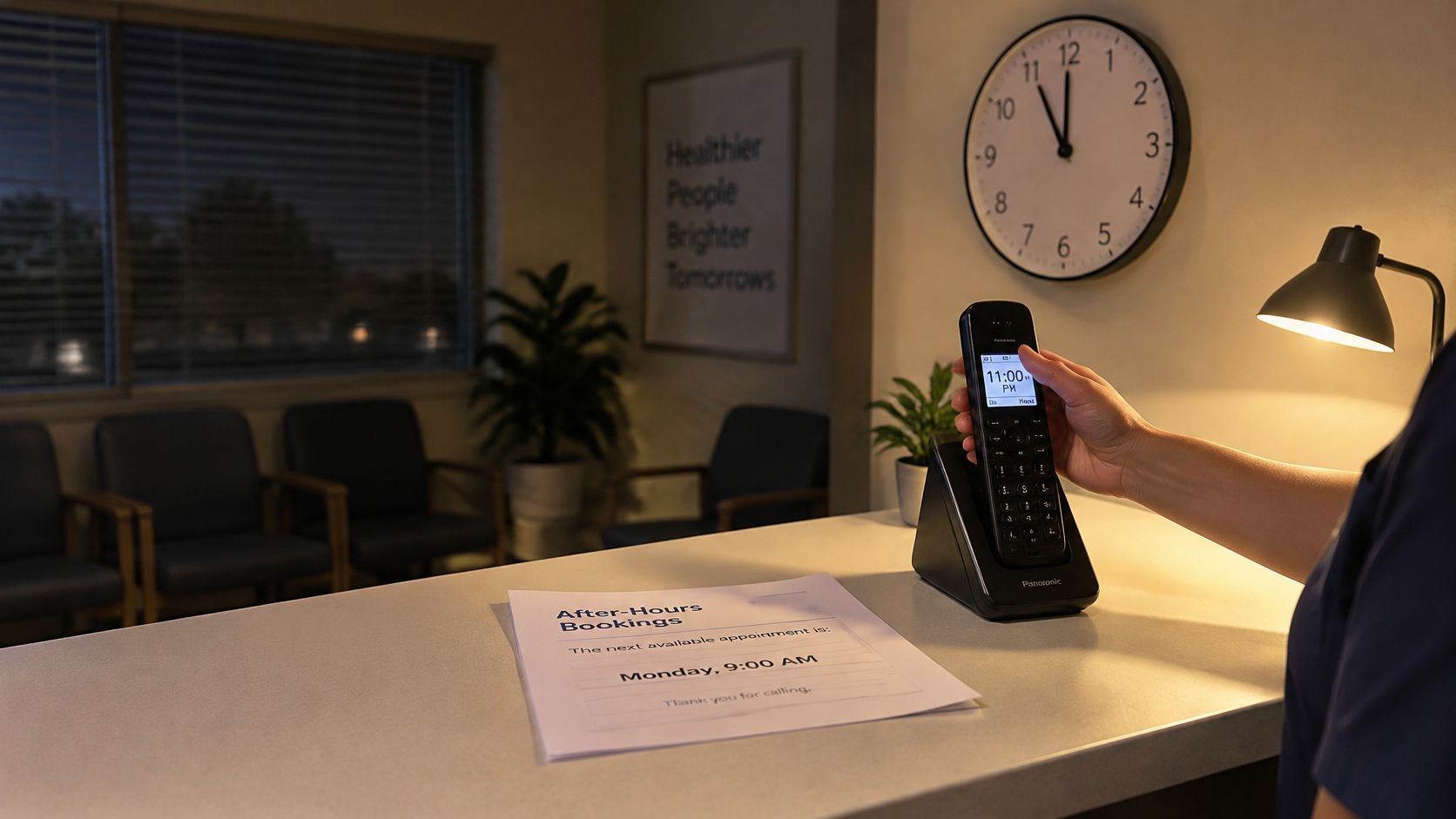
The default rules assume a caller in business hours, booking inside the window, asking for a service you've written down. Most weeks at least one call breaks an assumption. Each exception needs a written response, because the alternative is a staff member improvising at 11pm.
After hours
State whether the phone is answered outside opening hours, and if it is, what the caller can get from that call. Heyline answers calls at 11 PM in the business's timezone, tells the caller when the business opens, and books the first slot inside the actual opening hours. The hour itself isn't the point. The promise is. An after-hours caller should leave either an appointment or a specific callback time, never a vague reassurance that someone will be in touch.
Requests beyond the booking window
A client wanting a date three months out gets a different answer from one wanting next week, and the system has to know the difference. Ours names the last date it can take and records the request as a to-do rather than creating a placeholder appointment. A phantom booking looks like a full calendar and behaves like a lost client.
Rules nobody wrote down
Who attends with the client, what preparation is expected, whether children can come, where to park. If the policy is silent, the request becomes a message for a human and the caller gets a callback instead of a confident guess. Our receptionist won't decide who turns up at the door. If the business hasn't written it down, the question lands with someone who knows the answer.
A short walkthrough of how an automated receptionist handles a call it can't resolve from the policy:
Multilingual callers
Nearly 6.5 million Californians aged five and older, 17.5% of the population, have limited English proficiency, and California hospitals reported that 13.6% of patients preferred Spanish and 2.4% preferred another non-English language in 2023, per the California Health Care Foundation's language access report. The same report found that Medi-Cal language lines can require advance scheduling, administrative routing and waits of up to 30 minutes, and that 85% of surveyed clinics lacked multilingual-staff interpretation training.
The lesson for a salon, dental office or law practice is that "we offer language assistance" is not a policy. The written version says how a caller's preferred language is identified, what the receptionist can handle conversationally, when qualified interpretation is required for clinical or legal detail, and how the appointment is confirmed in that language. Less-served languages, including Indigenous Mesoamerican languages, deserve their own line rather than being folded into Spanish cover.
When the call isn't a booking
Chest pain, an active leak, a client in crisis, a legal matter with a court date this week. These get escalated to a person or to emergency services and the booking flow stops. If the call is clinical, the script should identify potential urgency without diagnosing and route to licensed staff. A routine slot is the wrong output for an emergency, and the consequences are serious enough that the escalation rule belongs on the first line of the policy, not in an appendix.
How to Put Your Appointment Guidelines to Work
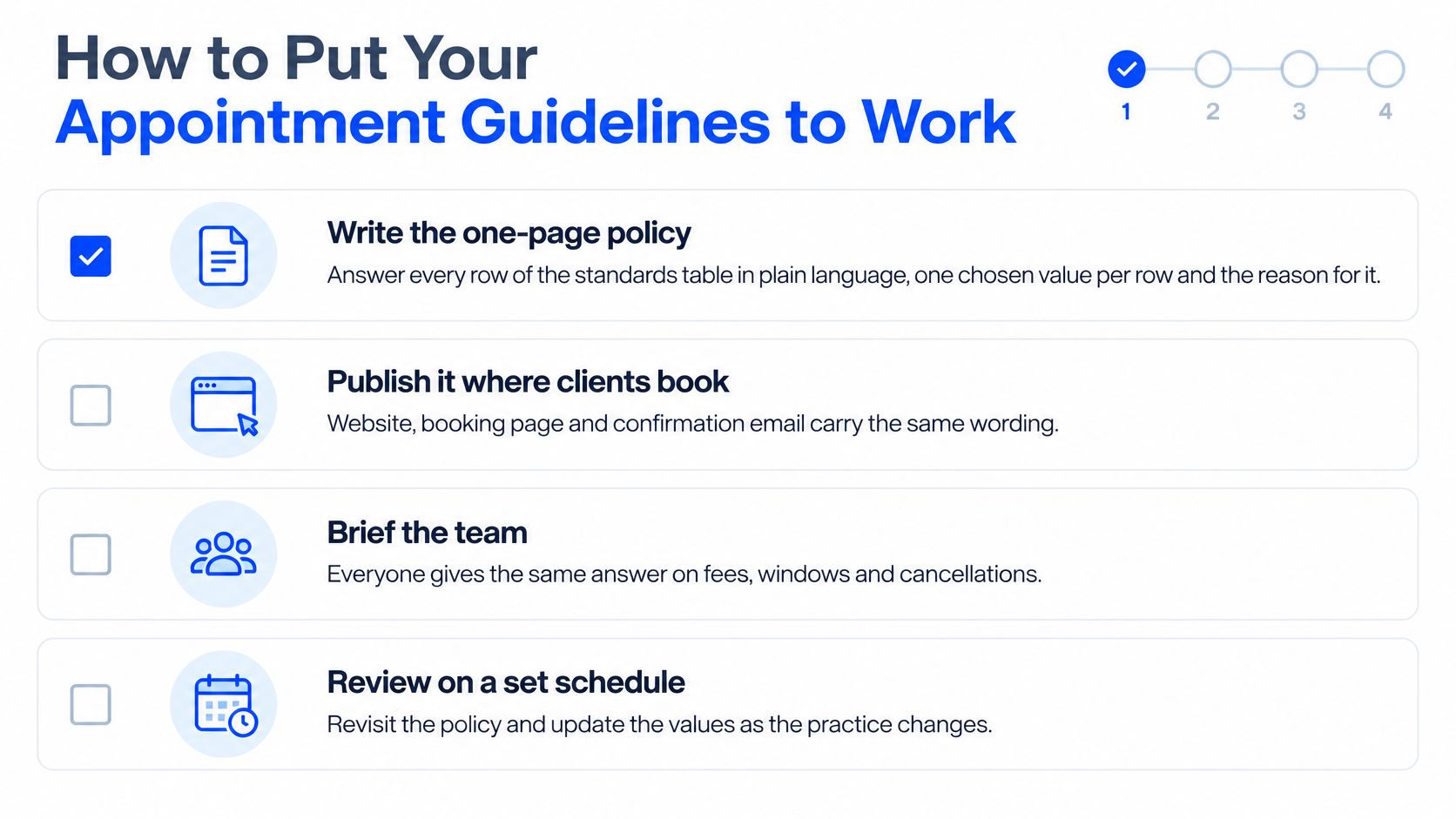
A policy nobody publishes is a document, not a standard. Six steps, each with a target attached.
Write the one-page policy. It answers every row of the table in plain language, one chosen value per row, with the reason beside it. "We ask first visits to arrive early because the intake form takes time to complete" is a line staff can repeat to a client. A number without a reason is often overridden.
Publish it where clients already book. The booking page, the confirmation message and the intake form all carry the same wording, and staff state the fee and arrival window when they take the booking, in one sentence, without being asked. If those four surfaces disagree, the client quotes the friendliest one back at you.
Confirm and remind. Send a written recap at booking, then a reminder a day or two ahead. This is the highest-return change on the list. A dental coordination program at Vista Community Clinic that expanded patient outreach from one day a week to five saw cancellations and no-shows fall from roughly 50% to 13% after six months and to 8.54% after 18 months, per the program report. The outreach design was the variable. Nothing else in the operation changed.
Answer quickly enough to matter. California's Department of Health Care Services requires managed-care call centres to keep waits for a knowledgeable representative under 10 minutes, and in its 2019 assessment 93.89% of 1,752 calls met that standard, per the timely access report. That's a health-plan benchmark, not a rule for a salon or a plumbing company, which makes it useful as an outer bound rather than a target. The same report notes that "care unavailable or inaccessible" accounted for 17.1% of reported health-service issues in 2025, and that 7% involved people not knowing how to access or use services. Speed without a clear next step doesn't fix navigation.
Close the loop on what the booking can't do. State the earliest realistic availability instead of hedging. Capture the callback channel and time the caller prefers. Send preparation and cancellation instructions. Route ambiguity, emergencies, accessibility needs, payment disputes and complaints to a person. Our receptionist puts the appointment straight into the business's Google Calendar during the call and emails a recap afterwards, so the client's version and the calendar's version don't drift apart.
Measure monthly and change one thing at a time. Track time to answer, time from enquiry to booked slot, cancellation lead time, no-show rate, and completed bookings rather than answered calls. Two policy changes in the same month means you'll never know which one moved the number.
Benchmark, then beat your own record. A sub-10% no-show rate is worth chasing. Your own last quarter is the number that decides whether this month's policy worked.
This week
Draft the policy on one page, publish it on the booking page, and brief the team in a single fifteen-minute meeting. Then set a date six weeks out to review the numbers against it. Enforcement comes from reminders landing on time and every staff member giving the same answer, not from the tone of the sign at the counter. If the calendar side is where this stalls, appointment scheduling with Google Calendar covers the mechanics of keeping one calendar authoritative. And before you hand the policy to any automated answering layer, the Lighthouse Legal AI answering test guide is a sensible way to check it says what your team says.
A written policy only holds if the phone gets answered the same way every time, including at 11 PM and during the Saturday rush. Heyline is an AI phone receptionist for local appointment-based businesses: it answers with your services, hours and booking rules, offers two or three real openings from your Google Calendar, reads the day, time and callback number back to the caller, and emails a recap afterwards. You can hear how it handles a call before you decide anything at Heyline.