The bike is listed, the messages are landing, and every one of them is attached to the cell number you've had since university. Maybe it's a Kijiji clear-out, a Marketplace sale, a tutoring side gig, or a salon chair you're renting and taking inquiries for before you have a business line. The obvious fix is to search second phone number free, install an app, and hand out a number that isn't yours.
Then the free tier shows its seams. Ads sit between your messages. A number you haven't called from in a month gets reclaimed. The verification code from a bank, a marketplace, or a delivery app never arrives, and you find out after the number is on a flyer.
This list sorts ten apps by what each one does best: a daily second line, marketplace selling, or short-term privacy. It also draws a hard line between apps that stay free and apps that hand you a trial and then bill you monthly. Canadian number availability is flagged throughout, because several popular free options won't issue a Canadian area code at all. For background on how second lines work, the BubblyPhone second line comparison covers the mechanics.
Numbers stopped being permanent attachments long ago. Local number porting began in California in May 1998, and by the end of 2000 nearly 1.2 million numbers had moved to competitive carriers, according to the California Public Utilities Commission. Treat a second number as a portable, disposable asset and the choices below get much easier.
1. Fongo Mobile
Fongo Mobile is the closest thing on this list to a free Canadian landline replacement. You get a free local Canadian number and free calling across Canada, which makes it a workable voice-first second line for everyday calls.
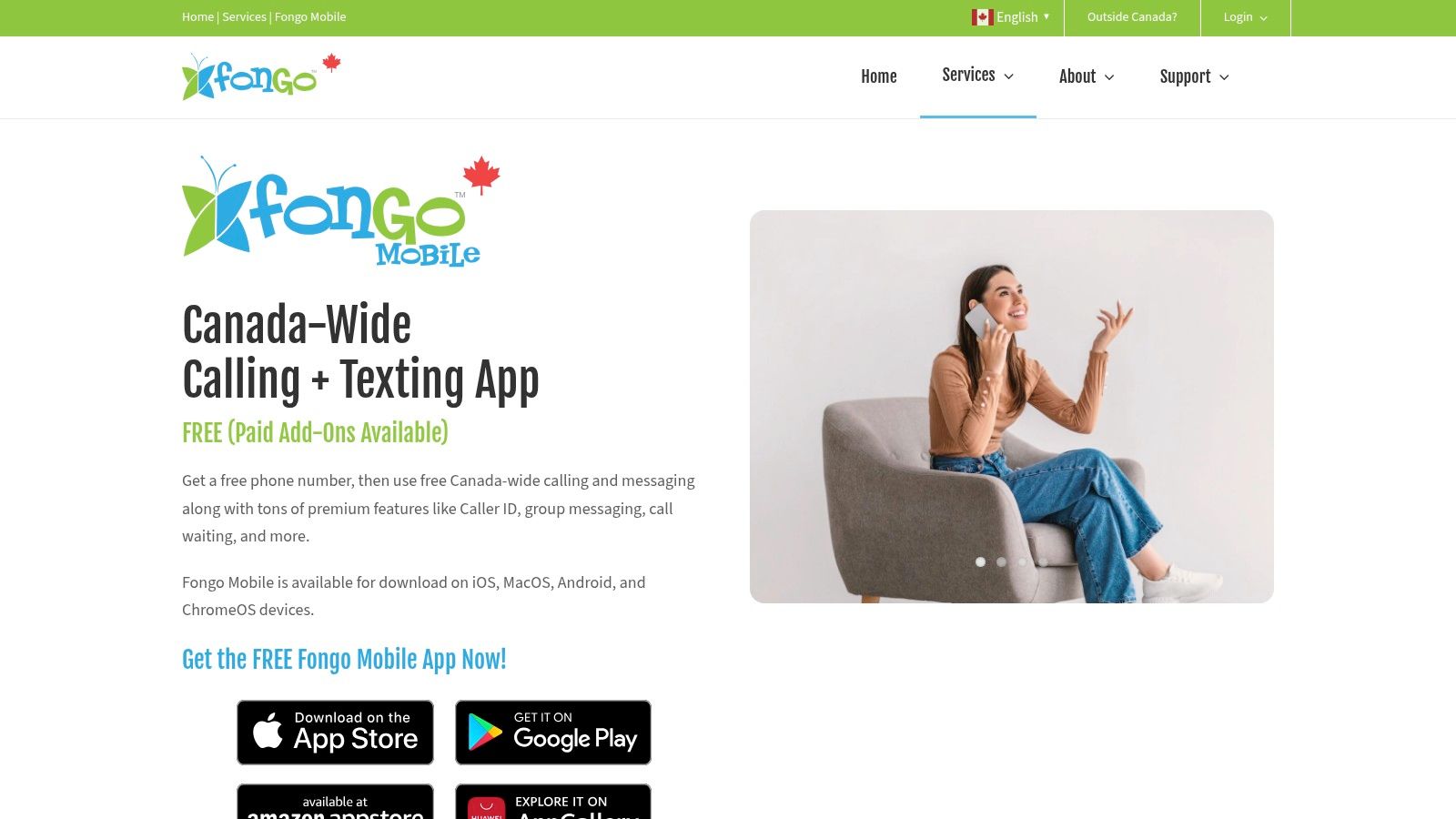
Messaging is where it thins out. Reaching an ordinary Canadian mobile number by text needs a paid add-on, and short-code or verification texts aren't guaranteed. That rules Fongo out for anything that depends on a one-time code arriving.
Canada is a wireless-first market, so a second number is a realistic layer for most households. CRTC-referenced market data reports more than 15 million cellular subscribers, and 67% of Canadian households had at least one wireless subscription in the cited national survey, per the CRTC spectrum and telecommunications materials. That data says nothing about how many Canadians use free second-number apps, so judge Fongo on local number availability, SMS reliability, porting rules, caller-ID consistency and voicemail transcription rather than on adoption claims.
- Free local Canadian number: the main reason to install it.
- Free Canada-wide calling: no monthly charge for core calling.
- Fongo-to-Fongo messaging: free, but only useful inside the app's own network.
- Voicemail, caller ID and call forwarding: included, which is more than most free tiers offer.
Where it fits: a voice-first line. If your inbound is mostly calls and you can live without reliable SMS, Fongo is the least annoying free option in Canada.
Forwarded calls that land on a phone sitting in a drawer end up in voicemail nobody checks, the same trap described in this guide to why phone calls go straight to voicemail. The app itself is free to download from Fongo.
2. TextNow
TextNow hands you a free number with ad-supported calling and texting over Wi-Fi or mobile data. For a daily second line it is the easy pick, mostly because it works on a phone, a tablet and in a browser, so you answer from whichever screen happens to be in front of you.
One caveat for Canadians: TextNow's coverage in Canada has changed, so confirm what the service currently offers before you move anything onto it.
The bigger catch is one no comparison chart mentions. A free number only helps if people answer it. California received nearly 800,000 political and election-related spam calls in August 2026, the highest total reported for any state, according to reporting on the surge, and that reporting notes the FCC's warning that caller ID can be spoofed. Recipients have learned to distrust unfamiliar local numbers, so a spare line can drag your answer rate down while it protects your personal number.
- Free app option: no subscription for basic calling and texting.
- North American calls and texts: included on the free tier.
- Multi-device access: app plus browser, which most rivals lack.
- Number retention tied to activity: a number you stop using can be reclaimed, so keep it warm before you print it on anything.
- Verification: free VoIP numbers are frequently rejected by banks and marketplaces, so leave your real number on accounts that send codes.
A free number that nobody picks up isn't private. It's just quiet.
Start at TextNow and check the retention rules before you publish the number anywhere.
3. TextFree
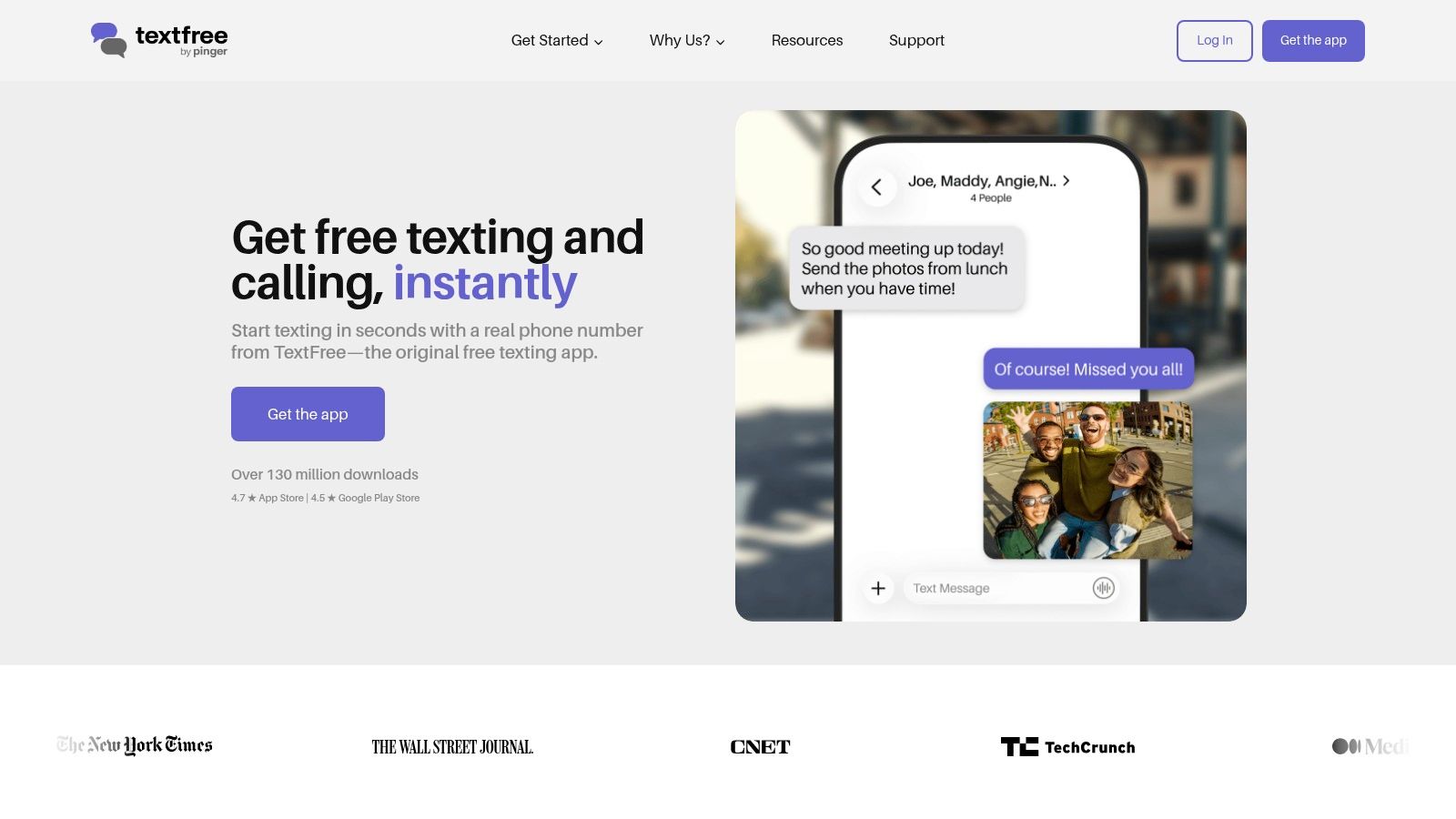
TextFree is the free tier I'd hand to someone clearing out a garage. It issues a dialable U.S. or Canadian number for calls and texts over Wi-Fi or mobile data, and the free level is usable rather than decorative.
The 30-day rule
A TextFree number can expire after 30 days without a call or text. That single rule reshapes how you use it. The app rewards people who message weekly and punishes anyone who signs up for one sale and comes back next season.
Verification is the second snag. Codes sit behind the Plus tier, so a free TextFree number won't reliably receive the text a marketplace or a bank sends you.
What it does well is the unglamorous work of a second line: voicemail transcription, spam recognition, and missed-call or text auto-replies. Those matter more on a spare number than on your primary one, because a spare number is the one you ignore.
- Canadian numbers offered: already ahead of several US-only apps.
- No carrier plan needed: runs entirely over data.
- Conversation tools: auto-replies and spam recognition keep the line manageable.
- Ad-supported free tier: the ads are visible, not hidden.
- Retention risk: the 30-day expiry above.
TextFree is available on the web and in the app stores. If you need codes, budget for Plus or pick a different app.
4. Talkatone
Talkatone gives you a free U.S. or Canadian number inside an app, with calls and texts running over Wi-Fi or cellular data. It's built for everyday communication, not anything resembling a phone system.
Nearly everyone you'd call already carries a device that can receive it. In 2024, 88% of Canadians reported owning a cell phone, smartphone, or another wireless device, according to a CRTC-commissioned national public-opinion study. That doesn't make an app-based line reliable, but it does mean a data-only number is a realistic way to reach people.
- Free U.S. or Canadian number: Canadian numbers are supported.
- No cellular minutes required: everything rides on Wi-Fi or data.
- Group chats: useful if the number is shared with a partner or a co-host.
- International calling at paid rates: fine as an add-on, not a selling point.
- App-only: there's no browser fallback, and VoIP numbers may not work with every verification system.
For an iPhone or iPad user who wants a spare line with almost no configuration, Talkatone does the job. For anything involving codes, contracts or records, look further down this list. Details are at Talkatone.
5. TextMe
Say you've tried three apps and none will hand you a number in your own area code. TextMe is worth one more attempt, because it advertises a second number with calling and texting to U.S. and Canadian numbers, and it gives you extra numbers beyond the first.
Availability is an allocation problem, not a scarcity one. A California Public Utilities Commission report on numbering found the 209 area code held roughly 5.61 million unused numbers out of 7.75 million usable numbers, about 72%, even as the state kept adding area codes. If a giant inventory can sit idle, a thin free pool in your region isn't personal. It's just how the app buys numbers.
- Second number: plus additional numbers if you need more than one.
- Calls and texts to U.S. and Canadian numbers: the core service.
- Voicemail and rich messaging: picture, voice and video messages supported.
- Ads and in-app purchases: expect both.
- Bank codes not guaranteed: free-use limits also vary by account.
Test a verification code before you publish any free number. Send yourself a code from the one service you actually depend on, and do it on day one, not the week your listing goes live.
TextMe runs on iPhone and Android and needs no second device. Start at TextMe and check that a local number is offered before you commit.
6. FreeTone
FreeTone offers a number to eligible sign-ups in Canada, the U.S. and the U.K., along with free North American calling and texting. Setup is straightforward, app-based, and needs no traditional phone plan.
The word "eligible" is doing a lot of work in that sentence. Number assignment can depend on your sign-up location and your settings, which is why two people in the same city get different results. Numbers may also be reassigned after inactivity, and keeping one can require credits.
- Canadian number for eligible users: not guaranteed for every sign-up.
- Free calling to U.S. and Canadian numbers: the strongest part of the offer.
- No traditional phone plan: runs over data.
- Credits for retention: the quiet upsell behind a lot of free apps, where the number is free until you want to keep it.
- International numbers may be available for purchase: useful if you deal with overseas suppliers.
This is a reasonable choice for a throwaway line attached to a classified ad or a form you don't trust. It's a poor choice for a number you plan to print on a storefront, a van or a business card. Check FreeTone for current availability in your region.
7. 2ndLine.ca
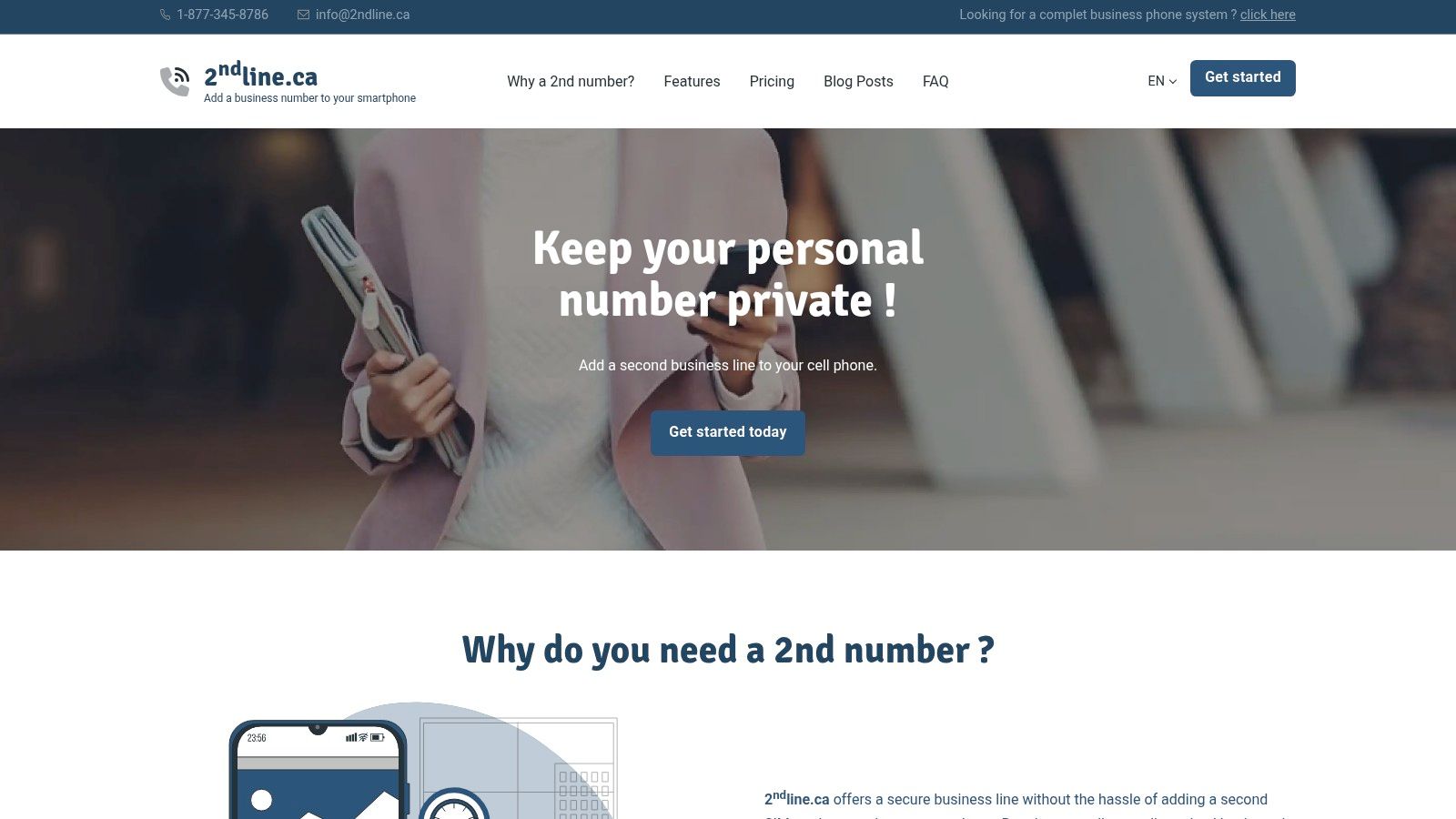
Most spare-line apps stop at calls and texts. 2ndLine.ca adds voicemail through a web portal, call recording, and an optional consent message for recording, which pushes it toward people who work from a desk and need a record of conversations.
What you get
- Calls and texts to U.S. and Canadian numbers: the baseline, delivered over Wi-Fi or mobile data, so no carrier line is required.
- Voicemail in an app or browser: read and clear messages from a laptop instead of dialling in from your phone.
- Call recording with an optional consent message: recording rules differ by province and state, so leave that message switched on until you've checked your own jurisdiction.
What to confirm before you pay
Subscription pricing is not laid out for easy comparison, so check the total cost, including taxes, inside the sign-up flow before you commit. Confirm number availability in the same session, whether you want a local code or a recognizable one like the 410 area code for a market you sell into. Since recording is a headline feature, also check how those recordings are stored and how long they are kept before you rely on them for client records.
The portal and recording features suit a freelancer logging calls more than someone selling a couch once. If all you need is a contact number for a Marketplace listing, the extra machinery goes unused. Start at 2ndLine.ca.
8. 2ndLine
2ndLine is a paid service with a trial, not a free number. It offers U.S. and Canadian numbers, calling and texting, extra numbers, and call forwarding on its paid tiers, all on your existing phone without a second device.
The subscription has one solid argument behind it. Canadians watch wireless prices closely and change plans to get better value, which is what Abacus Data's polling on the Canadian mobile wireless sector covers.
A contact number shouldn't move every time the plan underneath it does. Paying for a line with a support channel beats building a business around a free app that can reclaim your number during a quiet month.
- North American number choices: U.S. and Canadian numbers available.
- Multiple subscription terms: shorter commitments let you test before committing.
- Call forwarding and extra numbers: the reason to pay at all.
- Auto-renewal: it applies, so diarize the cancellation date if you're trialling.
- Billed in U.S. dollars: the Canadian-dollar cost moves with the exchange rate.
Pick this if you want forwarding and multiple numbers without a carrier. Skip it if you need free. Current plans are listed at 2ndLine.
9. Hushed
Hushed sells app-based numbers in Canada and other countries, with calls and texts over Wi-Fi or data, and it's built around temporary and secondary numbers rather than a permanent free line. The trial runs three days, then it's paid.
Three days is enough to test the one thing that decides whether the service works for you: whether the businesses and verification systems you rely on will accept the number. Do it in the first 48 hours, and test with the platform you use, not a friend's phone.
Screening calls is a legitimate reason to pay for a number. Paying for a number you never answer isn't.
- Canadian and other country numbers: more choice than most free apps.
- Multiple numbers: keep projects apart.
- No second device: app-based setup.
- Three-day trial: short. Don't plan a slow evaluation.
- Ongoing service is paid: and some businesses and verification services won't accept the number.
If your goal is a buffer between your personal line and everyone who wants a piece of it, pairing a temporary number with a proper routine for how to screen a phone call works better than a free app that may reclaim the number mid-project. See Hushed for current country coverage.
10. Burner
Burner is the privacy app here. Choose an area code, get calls and texts, then delete or switch the number when the purpose ends, with conversations kept separate and optional premium privacy tools on top. It's available in Canada, it publishes its pricing on the website, and it isn't free after the trial. Trial eligibility varies and subscriptions renew unless you cancel.
The privacy angle deserves a harder look than most second phone number free roundups give it. Compartmentalizing your shopping, listings and inquiries is not the same as anonymity. California's DROP program lets residents submit deletion requests to registered data brokers, with brokers required to check those requests at least every 45 days beginning August 1, 2026, according to a 2026 report on spam-call exposure. That same report notes FCC guidance that caller-ID blocking is a per-line choice, and that telemarketers must generally transmit identifying caller-ID information.
A second number separates your conversations. It doesn't make you anonymous.
If you publish a "free" business number, it still needs a privacy policy, controlled voicemail, and a routine for removing it from directories and broker databases. Poke around at Burner.
Free second phone number apps at a glance
Six of these are free on an ongoing basis. The rest are trials or paid tools wearing a "free" label.
| App | Number availability | Free tier model | Verification codes | Best for |
|---|---|---|---|---|
| Fongo Mobile | Free local Canadian number | Free core calling; regular texting may require a paid add-on | Short-code codes not guaranteed | Canada-wide calling and Fongo messaging |
| TextNow | Free number; Canadian wireless coverage has ended | Ad-supported calling and texting over Wi-Fi or data | VoIP numbers may be rejected | A spare line across app and browser |
| TextFree | Free U.S. or Canadian number | Ad-supported calls and texts; number may expire after inactivity | Requires Plus | A personal second line or marketplace listings |
| Talkatone | Free U.S. or Canadian number | Free calls and texts over Wi-Fi or data | May not work with all verification systems | Everyday app-based communication |
| TextMe | Second number; availability may vary | Ads and in-app purchases; free-use limits vary | Bank codes not guaranteed | Separating personal and other conversations |
| FreeTone | Canadian number for eligible sign-ups | Free North American calling and texting | Not guaranteed for verification codes | App-based calling without a phone plan |
| 2ndLine.ca | Second number; availability and pricing should be confirmed | No confirmed ongoing free tier; check current pricing | Not guaranteed for verification codes | Call management, voicemail, and recording |
| 2ndLine | U.S. or Canadian numbers | Trial rather than ongoing free service; subscription required | Not guaranteed for verification codes | Call forwarding and other paid features |
| Hushed | Canadian and other country numbers | Three-day trial, then paid service | Some services may not accept the number | Temporary or privacy-focused lines |
| Burner | Canadian numbers with area-code choice | Trial may be available; paid after trial | Some services may reject the number | Disposable numbers for a defined purpose |
Verification is the weak spot across the board, so don't rely on any of them for bank or login codes.
A Personal Spare Line vs. a Number That Works for Your Business
The apps above solve a personal problem well. They give you a number you can publish, ignore or delete, and they keep your real cell out of a stranger's contact list. Use TextFree or TextNow for marketplace listings. Use Fongo when you need a Canadian number for voice and can live without SMS. Use Burner or Hushed when the number has a defined lifespan and you want it gone afterwards.
Business use is a different job. An appointment-based business needs a line that answers quickly, takes a name and a callback number, and puts a booking in the calendar. A free app doesn't do any of that. It rings until it doesn't, and the caller who wanted a Thursday slot phones the next salon on the list.
Voice still matters more than most owners assume. In a federal evaluation survey of 306 Canadian small-business owners, a telephone call from the Canada Revenue Agency ranked first or second as the preferred contact method for 50% of respondents, the largest share among the options tested, according to the evaluation report on the CRA small business liaison officer program. It's a government-contact survey rather than a consumer-conversion study, but it shows how firmly the phone still sits in the middle of Canadian small-business life.
That's the gap Heyline fills, and it's a different product from a free second number. Heyline provisions a dedicated number for each business when it goes live, with no setup fee, no charge for the number the receptionist answers on, and no separate fee for a booking it makes. The receptionist answers within two rings and takes the caller's name and callback number first, every time.
You can test it before spending anything. Building and testing the receptionist costs nothing and requires no card, no account and no phone number, and the browser test call is free. Before you go live, no number is attached and no forwarding is switched on, so your business line isn't touched.
For a wider view of what paid call handling should include, the Solomon's Facilities Management call handling guide is a useful read.
So pick one free app for personal use and stop handing out your real number. If missed calls are costing you bookings, test an AI receptionist before committing to anything. Listening to it handle one real caller tells you more than any feature list.
When a free second number can't answer, book or follow up, Heyline's AI receptionist can. It configures itself from your business website in a few minutes, answers callers in a natural voice, and puts appointments straight into your calendar. Visit Heyline to build your receptionist and make a free browser test call, with no card, account or phone number required.