A customer in Baltimore calls your business after seeing a missed-call notification. They recognize the 410 area code phone number on your caller ID, but they're unsure whether to call back. Is it a nearby business, a legitimate customer, or a spoofed number designed to look local?
That hesitation captures the core issue for Maryland businesses. A 410 number can support local identity, but the area code alone can't prove where a caller is located or guarantee that someone will answer. You need to understand the territory, the overlay system, the limits of caller ID, and the call-handling setup behind the number.
Why a Local 410 Number Still Matters for Maryland Callers
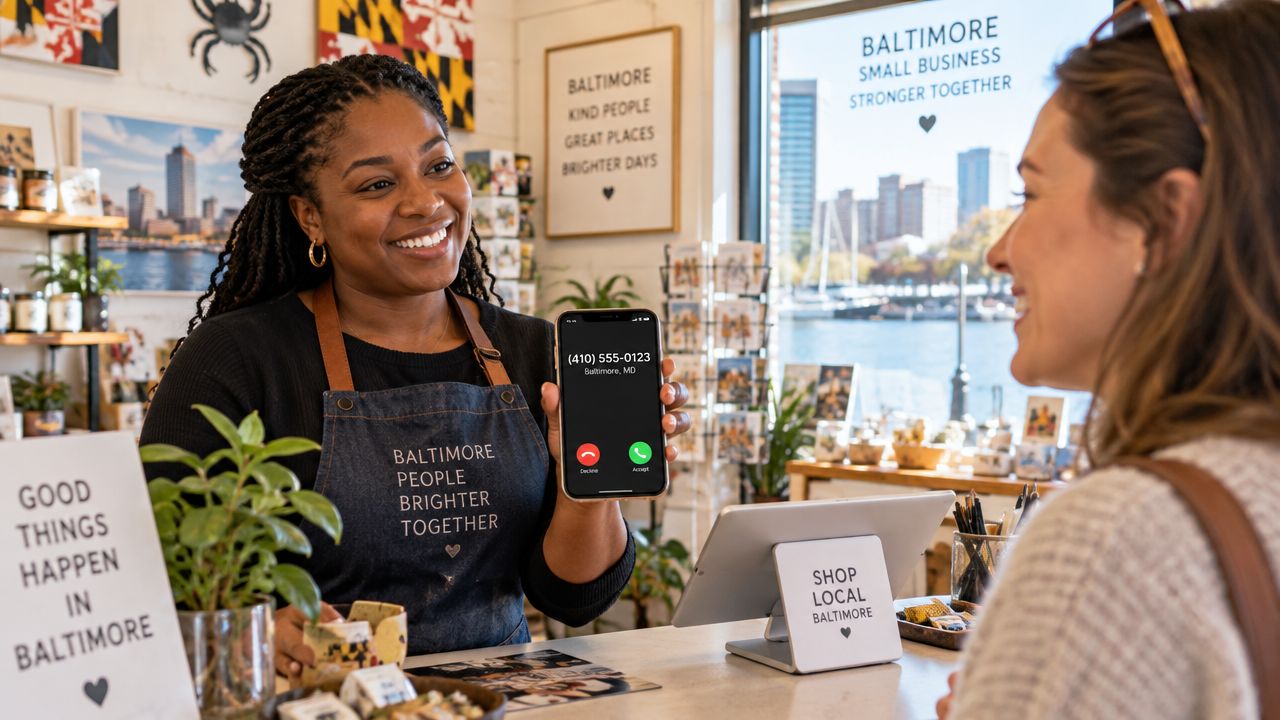
A local caller ID can shape a customer's first decision. Someone looking for a dental office in Baltimore, a salon in Annapolis, or a plumber serving the Eastern Shore may feel more comfortable returning a call that appears connected to Maryland than one displaying an unfamiliar out-of-state number.
That doesn't mean every local-looking call gets answered. People have learned that scammers can imitate nearby numbers, so a 410 identity works best as one trust signal among several, not as proof of legitimacy. Your business name, voicemail, online listing, website, and the way someone handles the call all reinforce or weaken that first impression.
For a small business, the practical question isn't whether 410 belongs to Maryland. The question is whether a Maryland-facing number fits the customers you serve and whether your team can respond consistently when those customers call.
A local identity can be especially useful when your service depends on geographic familiarity:
- Appointment businesses: Clinics, salons, barbershops, and practices often need callers to feel comfortable discussing services and booking visits.
- Home services: HVAC, plumbing, cleaning, and repair companies benefit when customers immediately recognize the service region.
- Hospitality businesses: Restaurants and local venues can use a familiar number for reservations and questions.
- Professional firms: Law offices and other appointment-based firms may want a regional presence before the first conversation begins.
Practical rule: A 410 number may open the door, but reliable answering and clear business verification are what build trust after the call connects.
You can also connect the number to your online presence. For example, businesses reviewing their Google Business listing call strategy should make sure the phone number shown in search results matches the number customers see and use elsewhere.
By the end of this guide, you'll be able to judge whether 410 fits your market, understand why 443 and 667 may appear in the same region, recognize spoofing risks, and plan a call route that doesn't leave local inquiries sitting in voicemail.
What Area Code 410 Covers and Where It Came From
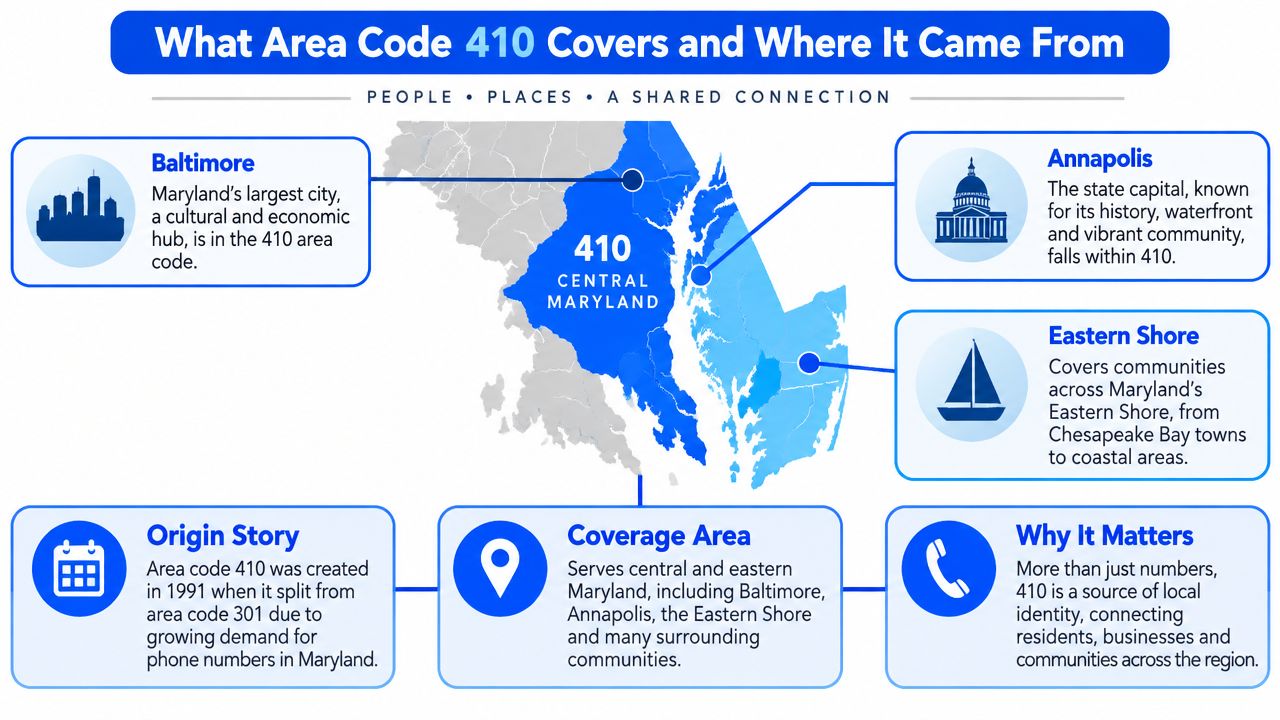
Area code 410 serves eastern Maryland, including Baltimore, Annapolis, and the Eastern Shore. It isn't a code for one city alone. A business using 410 may serve customers in an urban Baltimore neighborhood, near the state capital, or along the Eastern Shore.
The statewide numbering system
Maryland originally used area code 301 statewide beginning in 1947. As phone demand increased across different parts of the state, one code became difficult to use for the entire region. The solution was to divide the map rather than keep every Maryland number under the same three digits.
On October 6, 1991, area code 410 was introduced as a split from 301. The new code was assigned to eastern Maryland, including Baltimore, Annapolis, and the Eastern Shore. Western and other parts of the state continued using 301.
A useful analogy is a large office with one reception desk serving every department. As more people arrive, the organization creates another desk and assigns each department to a specific entrance. The new entrance doesn't change the people or services. It gives callers a clearer route through a busier system.
What permissive dialing meant
The transition didn't happen as an instant switch. Maryland used permissive dialing, which gave callers time to adjust after the new code appeared. During that period, people could still use the older dialing pattern while the telephone network introduced the new arrangement.
Eventually, local calls crossing the new boundary required ten digits, including the area code. That change mattered because the same seven-digit local number could exist in different area-code regions. Without the area code, the network couldn't always identify the intended destination.
For a business owner, the history has a simple takeaway. A 410 number identifies a broad eastern Maryland calling region, not a precise street address. It can communicate regional familiarity, but it doesn't establish that the person or company using it is physically located in Baltimore or anywhere else within the territory.
How 410 Became Part of a Three Code Overlay Region
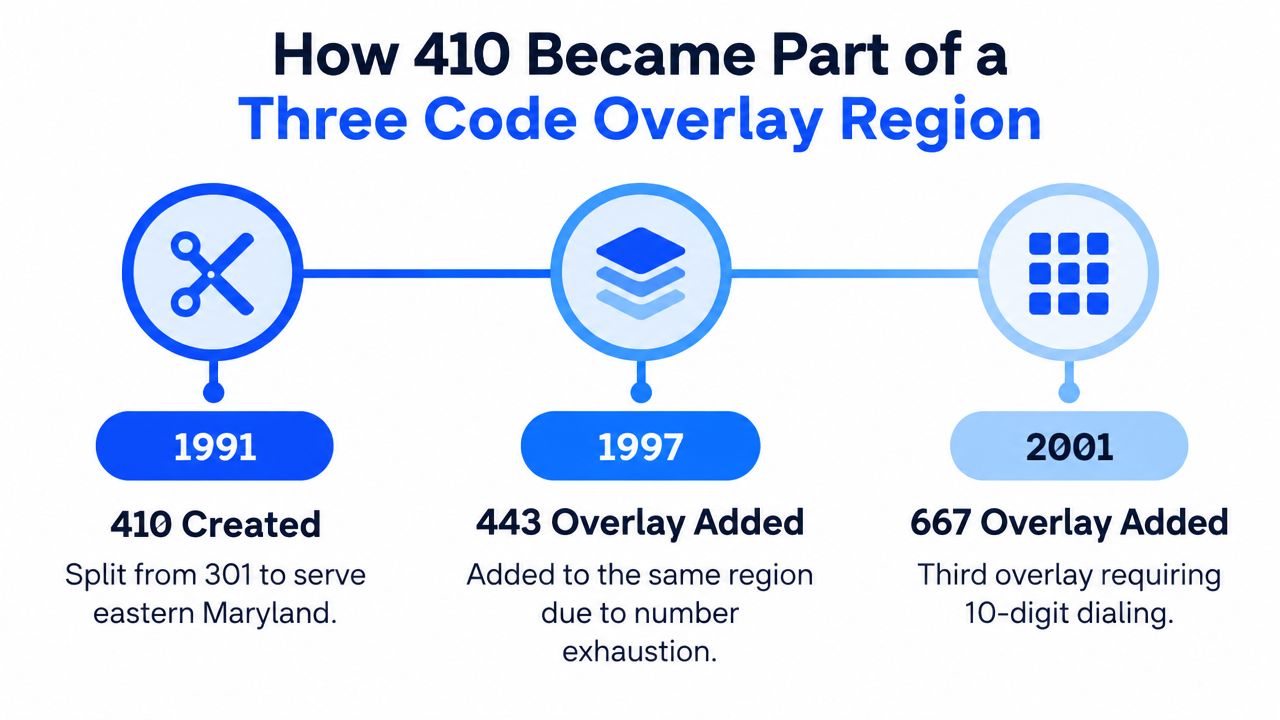
410 is no longer a standalone code for eastern Maryland. The same territory also uses 443 and 667, because Maryland added overlay codes rather than repeatedly dividing the map into smaller pieces.
Split versus overlay
A split assigns different parts of a geographic region to different area codes. That happened when 410 separated from 301.
An overlay adds another area code to the same geographic territory. Existing numbers keep their codes, while new numbers may receive the newer code. In Maryland, 443 was added in 1997, and 667 followed in 2012, according to the Maryland Public Service Commission's telecommunications information.
| Year | Numbering change | Practical meaning |
|---|---|---|
| 1991 | 410 introduced from a split with 301 | Eastern Maryland received its own area code |
| 1997 | 443 added as an overlay | A second code served the same territory |
| 2012 | 667 added as another overlay | A third code became available in the same region |
The overlay arrangement effectively opened access to about 24 million numbers for just over 4 million people, as described in the history of Maryland area codes. That figure reflects numbering capacity, not the number of active customers or available numbers at a specific moment.
What businesses should expect
A new Maryland line may receive 410, 443, or 667. All three codes can represent the same broad eastern Maryland region, so a 443 or 667 number isn't automatically less local than a 410 number.
Overlays also explain why ten-digit dialing matters. Callers need the area code plus the local number because multiple codes share the same map. Your website, printed materials, directory listings, and staff scripts should display the full number consistently.
If you're comparing numbering systems in another market, an area code overlay example for 980 can help illustrate the same basic idea. For Maryland customers, the decision isn't whether 410 is the only legitimate local code. It isn't. The better question is whether your chosen number is recognizable, reachable, and connected to a dependable call experience.
Why Maryland Businesses Choose a 410 Number for Local Trust
A customer choosing between two unknown businesses often looks for familiar signals. A Maryland area code can provide one of those signals before the customer reads your reviews, speaks with an employee, or visits your location.
That signal matters most for businesses where the caller wants a nearby provider. A person booking a haircut, asking about a dental appointment, requesting an HVAC visit, or reserving a table may prefer a number that appears connected to the service area. The area code won't make the decision by itself, but it can reduce one source of uncertainty.
Local identity works as a shortcut
People don't have unlimited time to investigate every incoming call. A local-looking number gives them a quick piece of context. It suggests that the caller may understand the area, serve nearby customers, or have a reason to contact them.
For an outbound call, that context can make a difference when your team follows up on an inquiry. For an inbound call, it can reassure a prospective customer that they've reached the right regional business, especially when the number appears consistently across your website and business listings.
The signal becomes stronger when you pair it with operational details:
- Use a clear greeting: State the business name immediately so callers can verify who answered.
- Match your public listings: Keep the same phone number on your website, profiles, invoices, and appointment reminders.
- Give local context: Mention service areas, neighborhoods, or appointment locations when relevant.
- Make the next step easy: Let callers book, request a quote, ask a question, or reach the right person without navigating a confusing phone tree.
When 410 helps, and when it doesn't
A 410 number makes sense when your customers associate your service with eastern Maryland. It may be less useful if your business serves a national audience and customers rarely care about regional proximity.
It also won't compensate for a poor response process. A caller who reaches a full mailbox, waits through irrelevant menu choices, or receives inconsistent information may lose confidence even if the number looks local.
A local number creates a credible first impression. A prompt, accurate conversation gives that impression a reason to last.
Treat 410 as part of your customer experience, not a standalone marketing trick. The number should lead to a greeting, routing plan, and follow-up process that respects the caller's time.
Understanding Spoofing and Why a 410 Caller ID Is Not Proof of Location
A 410 caller ID doesn't prove that the caller is in Maryland. Caller ID can be manipulated, and scammers use local-looking numbers to make recipients more likely to answer.
This practice is commonly called neighbor spoofing. A scammer chooses a number that resembles the recipient's own area code or nearby prefix. The display looks familiar, even though the call may come from somewhere else entirely.
The issue is especially relevant to Maryland readers because independent reporting identifies 410 as one of the more-reported spam codes in the state. The same analysis says about 57% of spam behavior used neighbor spoofing, according to thisnumber.com's discussion of 410 scams.
How to evaluate an incoming call
Don't reject every 410 call, because legitimate Maryland residents and businesses use the code. Instead, treat the display as an initial clue and look for confirmation during the interaction.
Ask yourself:
- Do you recognize the business name or reason for contact?
- Does the caller provide specific information that matches an existing inquiry?
- Can you verify the organization through its official website or published number?
- Is the caller pressuring you to provide passwords, payment details, or sensitive information?
A genuine local area code can be used by a real company, a remote worker, a customer traveling elsewhere, or a VoIP service. A spoofed code can appear on a fraudulent call. Location and legitimacy are separate questions.
Protecting your own number's reputation
Businesses should also consider how their outgoing calls look. Use a legitimate phone provider, identify the business clearly, and avoid practices that make customers suspicious. If a customer misses your call, leave a concise message with your company name, reason for calling, and a safe way to return the call.
Verification habit: If a call involves money, account access, or urgent action, end the conversation and contact the organization through a number you found independently.
For businesses, the goal isn't to promise that a 410 display guarantees trust. The goal is to combine local identity with transparent communication, consistent listings, and a call process that helps people verify who they're speaking with.
How to Get or Port a 410 Number and Route Calls Smartly
You have three practical ways to build a Maryland phone presence. The right choice depends on whether you need a new number, want to keep an established one, or need help answering calls when staff are busy.
Choose a number source
Get a new number through a VoIP provider. Many business phone services let you request a local number from available inventory. You may receive 410, 443, or 667 because all three codes serve the same overlay region. If the exact code matters, ask the provider about current inventory before signing up.
Port an existing 410 number. Porting moves your current number to a new carrier while preserving the digits customers already know. Before requesting the transfer, confirm that the new provider supports the number, collect the account details, and avoid canceling the old service until the port is complete.
Connect the number to a receptionist system. You can route calls from a business line to a live team, voicemail, answering service, or AI receptionist. The forwarding path should preserve the caller's reason for calling and give the person a clear next action.
Prepare the call flow
Write down the information callers need most. Include services, hours, service areas, appointment rules, pricing details you're comfortable sharing, and escalation instructions for urgent or unusual requests.
Calendar-aware routing can check availability before offering an appointment. A receptionist system can also answer common questions outside staff hours, then route calls according to your rules instead of sending every inquiry to the same voicemail box.
For a plain-language walkthrough of forwarding and call destinations, see this guide to routing a business phone number.
Test before publishing
Call the number from a separate phone. Test the greeting, business-hours behavior, after-hours behavior, appointment booking, transfers, voicemail fallback, and caller identification. Correct any outdated business information before placing the number on signs, profiles, advertisements, or printed materials.
Launch checklist: Verify the number, test every route, confirm the calendar connection, and make one complete booking before sending customers to the line.
If you port a number, monitor the old and new paths during the transition. If you receive a new number, update every public location together so customers don't encounter conflicting contact details.
Choosing and Activating Your 410 Presence With Confidence
A 410 number can be a sensible choice when your business serves eastern Maryland and customers value a familiar regional identity. The overlay system means you shouldn't treat 410 as the only valid local option. A 443 or 667 number can serve the same broad territory, while a 410 number may still be desirable because customers recognize it.
Your decision should combine four checks:
- Coverage fit: Confirm that your target customers are in the eastern Maryland region associated with 410.
- Number availability: Ask providers whether they can offer 410 specifically or whether 443 and 667 are the available alternatives.
- Trust safeguards: Remember that caller ID can be spoofed, so use clear greetings and verifiable business information.
- Answering capacity: Connect the number to staff, voicemail, an answering service, or an AI receptionist that can handle calls when your team can't.
A local number earns attention. A reliable answering process earns confidence.
Before activating the number, call it from outside your office, book a real test appointment, confirm the calendar result, and review the caller experience from start to finish. After launch, keep your hours and service information current so the local signal remains supported by accurate answers.
Heyline provides an AI phone receptionist that can answer business calls, use information from your website, and book appointments through a connected calendar. Visit Heyline to connect your Maryland business line and create a more dependable answering experience for 410 callers.