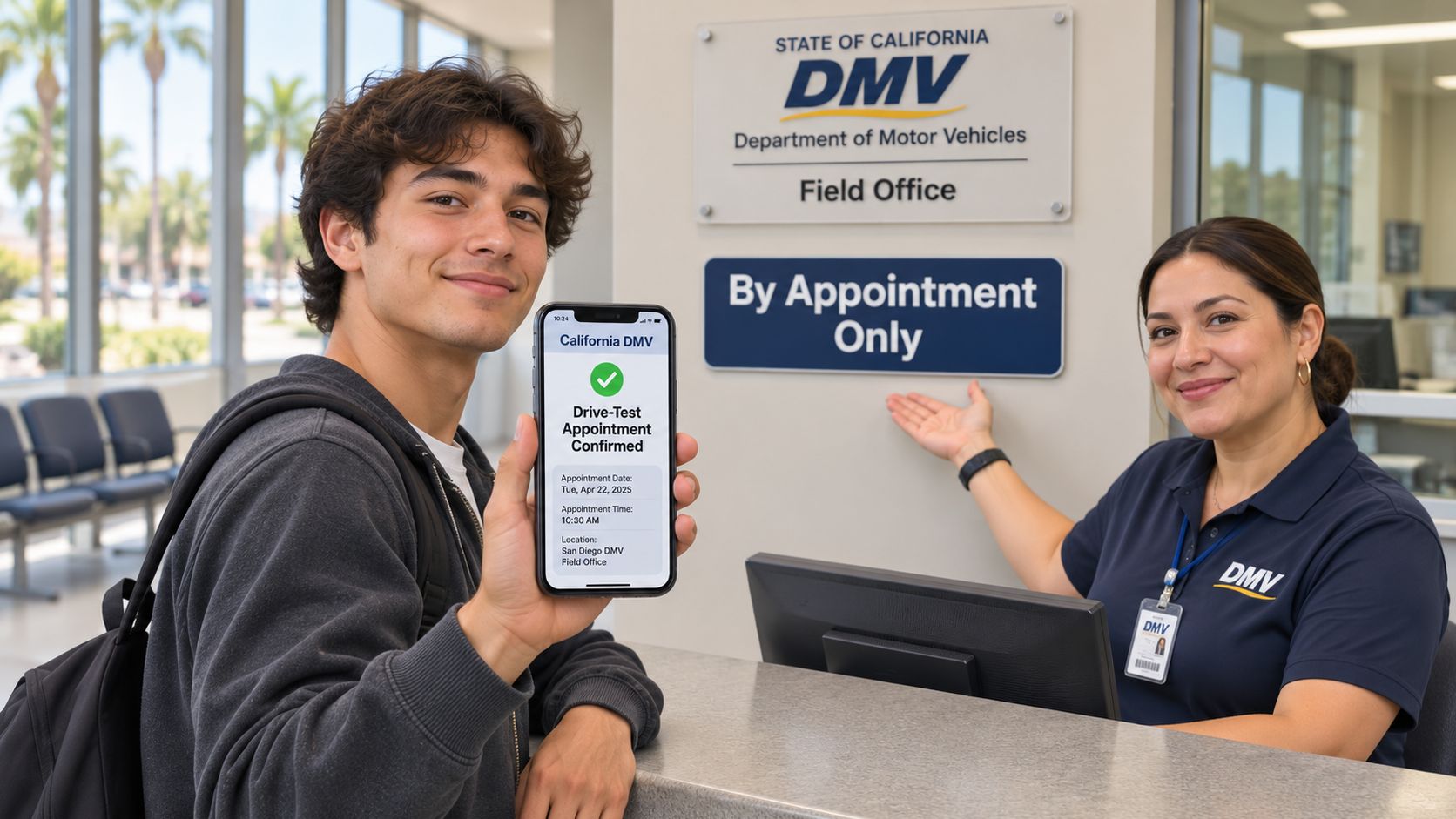
California will not give a behind-the-wheel drive test unless you already hold an appointment, which you book online or by calling 1-800-777-0133. A quiet lobby does not change that rule, and the first date on the screen is not automatically the date worth keeping.
The advice that circulates most is simple. Grab the earliest opening, or show up on a slow morning and hope the office fits you in. Both moves treat the book appointment drive test step like a queue you can jump. California runs it as a reserved exam. The counter, the knowledge-test line, and the road test are different jobs. A slot you cannot reach with a legal car, proof of insurance, and the right accompanying driver is still a wasted morning, even when the confirmation looks perfect.
Drive Tests Are Appointment Only
Say you leave for a field office on a Tuesday at 8:40 a.m. The public page shows a short wait, the parking lot has open spaces, and you have your permit in your pocket. You walk to the window and ask for a road test today. Staff will send you away. The California DMV driver licence guidance states that driving tests are not given without an appointment, and that you schedule online or by telephone at 1-800-777-0133 before you visit.
That short line is real. It covers people who already hold appointments for other transactions, and people waiting for walk-in services the office still offers. It does not create a behind-the-wheel exam. The examiner's day is built from reserved slots, not from whoever happens to be standing at the counter when a car pulls out of the lot.
Treat the booking as a required licence step, the same way you treat the permit itself. It is not a convenience add-on. Without a reserved time, there is no test to take, however early you arrive and however empty the chairs look.
What to gather before you open the scheduler
Write these down before you start the website or dial. A mismatch here is how people book under the wrong record and spend the drive arguing with a screen.
- Legal name: Use it exactly as it appears on the instruction permit, including middle name or suffix.
- Permit or licence number: Copy it from the card, not from memory.
- Date of birth: Match the permit. A swapped day and month will not find your record.
- First-choice office: Pick the field office you can drive to with the car you will test in.
- One nearby backup office: Name it now, so you are not hunting addresses while you are already on the phone.
Check the permit clock before you pick a time
Minors and adults do not share the same permit clock, so eligibility comes before any time is chosen. If you are under 18, do not lock a date that falls before you have held the instruction permit long enough, or before the supervised hours are done. An adult with a valid permit is not on that same wait. Choosing a slot first and "sorting the permit later" is how a confirmation gets issued for a morning the office cannot test.
Practical rule: A confirmation number still fails if the car, the insurance, or the accompanying driver is not acceptable on the day.
Save the office name, the date, the time, and the confirmation in two places before you close the browser or hang up. Then stop. The reservation only holds the examiner. It does not inspect the vehicle, and it does not check who is sitting in the passenger seat.
Wait Times Versus Real Test Openings
If the live office page shows a short wait, can the drive test happen today? Generally no. The live field-office queue and the drive-test appointment book are separate systems. A drive test needs an advance appointment. It is not handled as ordinary walk-in service, so a short line at the counter creates no road test.
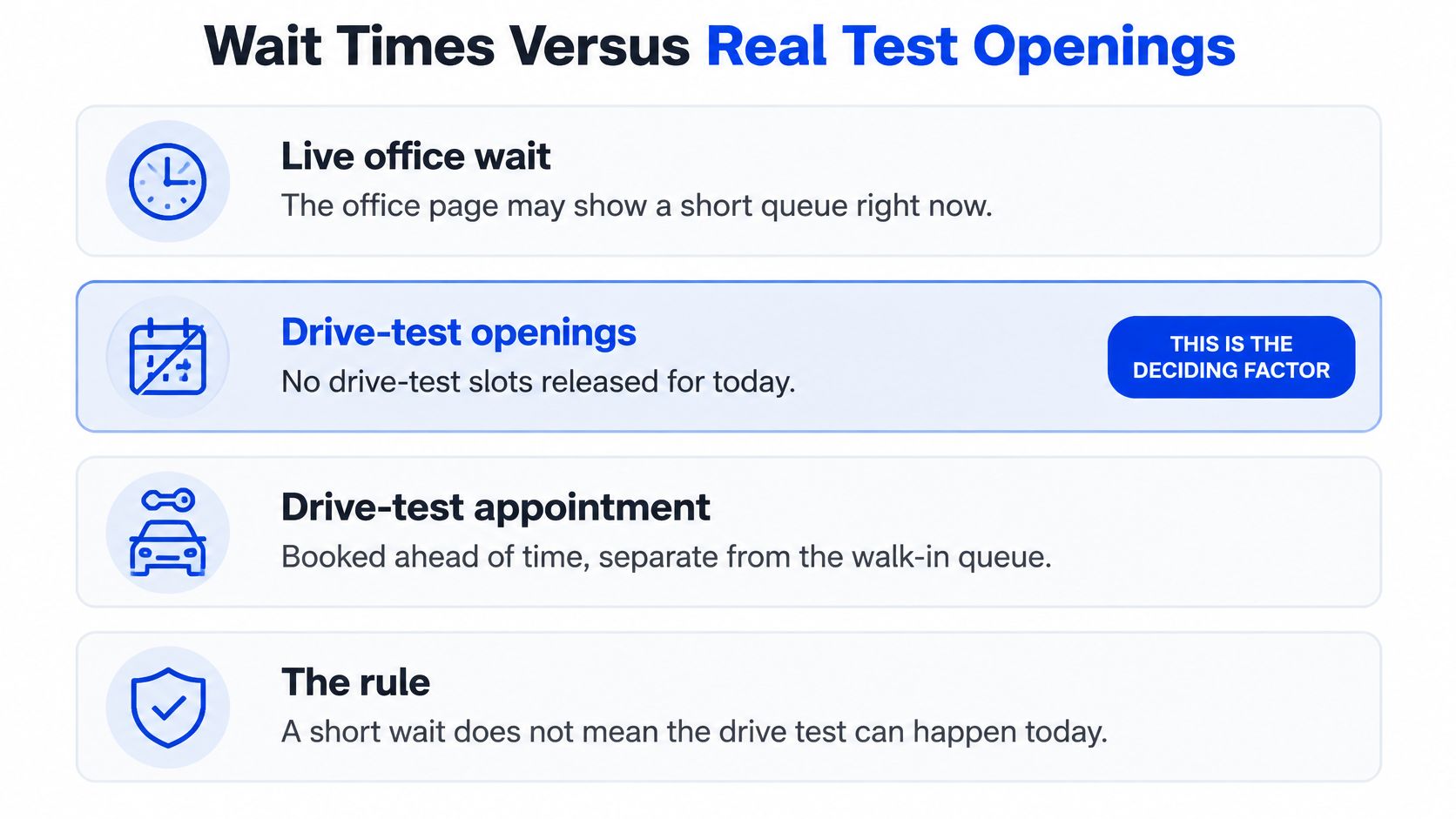
People mix the two pages because both mention the same building. One page tells you how long people are standing around right now. The other is the only place a behind-the-wheel time exists. A low published wait can sit beside zero usable drive-test openings. Optimising for the shortest lobby queue can cost you a morning of work, a borrowed car, and an accompanying driver who took the day off, and still leave you without an exam.
The California DMV has published older figures that show why a scheduled visit feels calmer. They do not show that a short wait produces a test. In its January 2019 field office wait times report, the department reported that customers with appointments waited an average of 14 minutes, against a goal of no more than 15 minutes. Customers without appointments averaged 57 minutes total, made up of 37 minutes in the queue plus 20 minutes before entering the queue, against a queue goal of no more than 45 minutes. That scheduled visit ran about 43 minutes shorter than the reported total for people without appointments. January volume also ran higher than December, which pushed non-appointment waits above the goal.
| Visit type | Reported average wait | DMV goal then | Replaces a drive test |
|---|---|---|---|
| Customer with an appointment | 14 minutes | No more than 15 minutes | No |
| Customer without an appointment | 57 minutes total, 37 in queue plus 20 before the queue | No more than 45 minutes of queue time | No |
Read the 2019 gap as context, not a promise
That report is several years old. It describes field-office visits in January 2019, not today's drive-test inventory. Use it to see the shape of the problem. People who already held an appointment spent far less time waiting than people who did not. Neither row replaces a booking. Current lobby conditions belong on the DMV's live wait-time page, checked the morning you travel, and only for the transaction you booked.
Before you take time off work, ask someone to ride along, or move the car across town, confirm two things. Confirm the office name matches the confirmation. Confirm the service type is the behind-the-wheel drive test, not a general visit. A calm lobby at the wrong office, or at the right office for the wrong service, still ends with you driving home.
The department's own clips on preparing for the exam are worth a look once the date is real, because the test itself is a set of manoeuvres, not a waiting-room problem.
Eligibility and Details to Have Ready
Scan this before you touch a calendar. If a row is not true yet, that applicant should not be offered a time.
| Applicant | Permit timing | Supervised driving | Who must ride along |
|---|---|---|---|
| Adult applicant | Valid instruction permit; no six-month wait is stated for adults | No fixed hour total stated | California-licensed driver age 18 or older |
| Minor applicant | Instruction permit held at least six months | 50 hours, including 10 at night | California-licensed driver age 25 or older |
| Any applicant on test day | Bring the permit or licence | A booking does not prove eligibility | Accompanying driver must meet the age rule for that applicant |
The California DMV guide to preparing for knowledge and drive tests is the source of those thresholds. A minor must generally have held an instruction permit for at least six months, and must complete 50 hours of supervised driving, including 10 hours at night. The accompanying driver is a California-licensed driver who is at least 18, or at least 25 when the applicant is a minor. Adults are not given a six-month hold or a fixed hour total in that guidance. Do not invent one.
Why the rows exist
The permit clock is there so a new driver has had time on the road before an examiner grades them. The night hours are part of that same practice record, not a suggestion you can swap for extra daytime trips. The age split on the passenger seat is easy to miss. A 19-year-old with a California licence can ride with an adult applicant. That same 19-year-old cannot be the accompanying driver for a minor. The office will not waive it because the only other licensed person at home is at work.
On test day the applicant still brings the permit or licence, and the car still has to be properly registered, insured, and roadworthy. A confirmation email does not prove any of that. The DMV can postpone the test if insurance proof is missing, or if the accompanying driver, the permit duration, or the vehicle does not meet the rule.
Write the intake down before you compare dates
Keep a single note with six fields. You will need them whether you book yourself or someone is helping you on the phone.
- Applicant age: This picks the permit clock and the passenger-seat age.
- Permit issue date: Count forward before you look at openings.
- Chosen office: The one you can reach, not the one with the prettiest time.
- Owned or rented car: A rental needs its own check, covered later.
- Insurance in the car: Name the document and where it will sit.
- Accompanying driver: Age, California licence, and whether they can attend.
A slot that falls too soon
Say a 17-year-old's instruction permit was issued five months ago. A parent sees an opening next Thursday at a nearby office and grabs it because "slots disappear." That Thursday still sits inside month five. The applicant has not held the permit for six months, so the office can postpone the test even though the confirmation is genuine. The parent has now used a car, a work morning, and a driver who had to be at least 25, for an exam that cannot start.
Count the permit issue date first. If the lawful day is still ahead, leave the scheduler closed.
Fix every failed row before you open the booking page or dial. A clean booking on top of a failed row only produces a polite postponement.
How to Book the Drive Test Appointment
Book in this order. Each step exists because people lose the morning by skipping it.
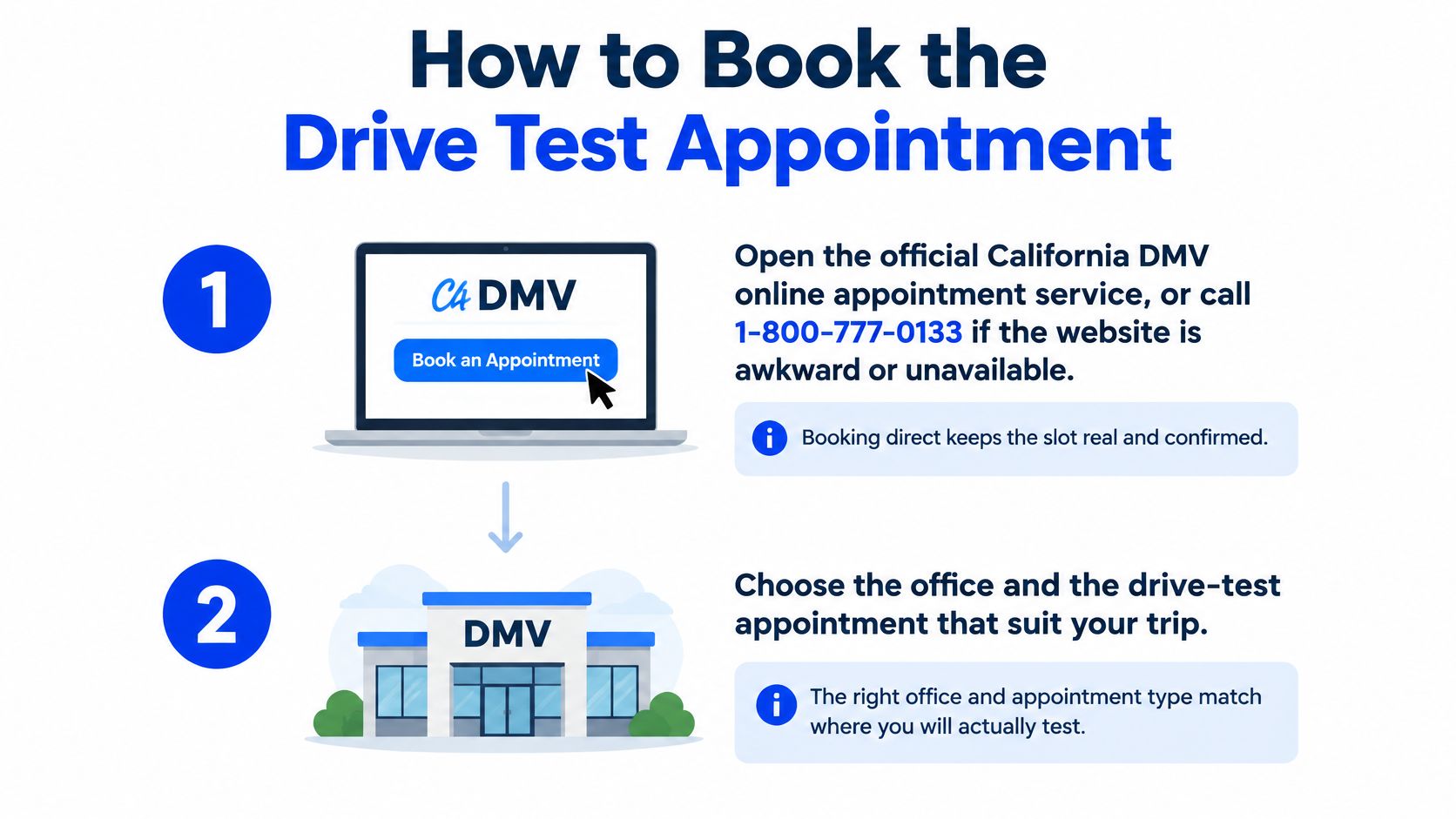
Open the official channel. Use the California DMV online appointment service, or call 1-800-777-0133 if the website is awkward, timed out, or easier to use by voice. Phone booking is the same reservation, not a lesser one. You are still reserving an examiner at a named office.
Choose the behind-the-wheel drive test. Do not choose a general office visit, a knowledge test, or a REAL ID transaction. This is the slip that wastes the most trips. The office will see you for the service on the confirmation. They will not convert a document appointment into a road test because you brought a car.
Enter the record exactly as printed. Legal name, date of birth, and permit or licence number. If the site cannot find you, stop and recheck the card. Do not create a second booking under a shortened name.
Select an office you can reach. The field office has to work for the car and for the licensed accompanying driver, not only for the person taking the test. A 7:30 a.m. slot across two counties fails when the only insured car is a work vehicle that cannot leave until 8.
Compare a few dates, and check one backup office. If the home office is weeks out, look at the backup you already named. Grabbing the first line on the screen feels efficient. It is how people lock a time they cannot staff. Schools that coach new drivers in other states walk through the same habit of matching the office to the trip. A-1 Driving School's notes on how to schedule your driving test are a useful contrast if you want to see how another state's booking chore is organised, then come back and stay inside California's own rules.
Confirm, then write it down twice. Office, day, time, and confirmation number. One copy in your phone, one on paper or in email you can open without a login. Close nothing until those four items are saved.
Name the car plan immediately. Who is bringing the vehicle, and where the insurance card and registration will sit that morning. If you wait until the night before, you discover the registration is in a glovebox you no longer have.
What a usable confirmation contains
A usable confirmation has four pieces and nothing vague. The office, the date, the time, and a confirmation reference. "Sometime Thursday at the DMV" is not a booking. If the email names a different service, treat it as the wrong appointment and rebook the drive test before you arrange the driver.
Read the confirmation back out loud once. If you booked by phone, ask the agent to repeat the office and the service name before you hang up. That ten-second check is cheaper than a trip to the wrong counter.
If the Slot Is Cancelled or You Fail
A booking can fall apart in three ordinary ways. The office cancels, you miss the time, or you fail the drive. Each one calls for a different reset, and the fastest reset is only useful if the replacement appointment can lead to a test.
If you cancel or miss the slot, go back to the same official online service or call 1-800-777-0133. Check the home office and one or two nearby offices. Do not assume the first screen shows every opening. Watch for returned appointments because a released slot can reappear without a public notice. Refreshing once and giving up is how people miss a time that someone else just dropped. The California DMV driver licence pages also confirm the retest rule.
The 14-day gap after a fail
If you fail the drive test, you must schedule again and wait 14 days after the failed drive test before taking it again. Count that earliest lawful date before you look at openings. Reject any time that falls inside the gap, even if the website will display it. Sitting the exam early is not an option the examiner can grant because you drove a long way.
A later slot can be the better hold
Then test each opening against the morning you would have. An apparent slot is useless if the car, the insurance, or the accompanying driver cannot be there. A slightly later appointment at an office you can reliably reach with a compliant vehicle often beats the earliest slot that depends on a borrowed car or a driver who cannot take time off work.
Say the failed test was on a Friday. The earliest lawful retest is 14 days later. Office A shows a time on that exact morning, 40 minutes away, and the only insured car belongs to a shift worker who starts at 6 a.m. Office B, twelve minutes from home, has a time four days after that, when the same car and a licensed adult are both free. Hold Office B. The earlier line at Office A is a second wasted trip waiting to happen.
The earliest appointment is not always the best one to hold.
Before you lock the replacement, confirm the vehicle and the insurance proof will exist on that new morning. A returned slot does not repair a car that failed the walk-around last time.
Papers, Car Checks and Final Go or No-Go
A valid slot still gets postponed when the papers or the car fail the pre-check. The examiner does not start the drive and sort the defects afterward. The California DMV fast facts on preparing for your driving test set the vehicle list, and they state that the test will be postponed if proper proof of liability insurance is not shown.
Bring the permit or licence. Bring acceptable proof of liability insurance. Bring a properly registered, insured, roadworthy car, and bring a qualified accompanying driver. Those are the hard stops. Everything else on the car is part of the same no-go.
What the examiner expects to see
Before the drive begins, the vehicle needs all of the following.
- Two licence plates on the vehicle.
- Front and rear turn signals and brake lights that work.
- A horn that sounds.
- Tires that are not bald, plus adequate brake pressure.
- A driver-side window that opens, and a windshield that is not obstructed.
- Two rear-view mirrors, one of them mounted outside on the left.
- Doors that operate, a permanently attached passenger seat, and working seat belts where they apply.
- A functioning parking or emergency brake.
A rental car adds one more gate. You must be listed as an insured driver, and the rental contract must not exclude drive tests. A contract that bars exams makes the slot unusable, even when the car looks perfect in the lot.
| Check | What must be true | If it fails |
|---|---|---|
| Permit or licence | Applicant brings the permit or licence | Test does not proceed as booked |
| Insurance | Acceptable liability proof is shown | DMV postpones the test |
| Rental car | Applicant is a listed insured driver and the contract allows a drive test | Slot is not usable |
| Licence plates | Two plates are on the vehicle | Examiner does not start |
| Lights | Front and rear turn signals and brake lights work | Test postponed |
| Horn | Horn functions | Test postponed |
| Tires | Tires are not bald | Test postponed |
| Brakes | Adequate brake pressure and a working parking or emergency brake | Test postponed |
| Window and windshield | Driver window opens and windshield is unobstructed | Test postponed |
| Mirrors | Two rear-view mirrors, one outside on the left | Test postponed |
| Doors, seat and belts | Doors work, passenger seat is permanent, belts work where required | Test postponed |
Two checkpoints, then a morning decision
Run the checks in two passes so a dead brake light is not a surprise in the DMV lot.
Right after you book, confirm that registration and insurance documents exist and that you know which folder or glovebox they live in. If the car is a rental, read the contract for a drive-test exclusion and confirm your name is on the insurance. This pass is paperwork only. It takes a few minutes and it kills the bookings that were never going to survive the window.
Then, 24 to 48 hours before the slot, do the physical inspection yourself. Stand behind the car and have someone press the brake. Walk the turn signals front and rear. Sound the horn. Look at the tread. Open the driver window. Check both mirrors, the doors, the belts, and the parking brake. A bulb you can replace at a parts counter on Tuesday is a postponement if you discover it in the examiner's lane.
On the morning of the test, read the saved confirmation aloud. Office, date, time, and the behind-the-wheel drive test as the service. If any of those is missing, or the confirmation names a different service, rebook. Do not drive over and negotiate. Confirm the accompanying driver meets the age rule for this applicant, and confirm the papers are in the vehicle, not on a kitchen table. If you failed a previous attempt, confirm the lawful retest gap has already passed.
Go only when every item above is true. If one item fails, cancel through the official online service or the same telephone line, and take a later slot you can reach with a compliant car. Hoping for an exception is how a convenient time becomes a second wasted trip.
If your front desk is losing booking calls while you are out on lessons, Heyline answers the phone, checks your Google Calendar, and books a real opening during the call. We offer two or three open times, never sooner than one hour out and never more than 14 days ahead, then email you a recap. Try a free browser test call, with no account and no card, at Heyline.