The 626 area code covers most of California's San Gabriel Valley in northeastern Los Angeles County, including Pasadena, Alhambra, Arcadia, El Monte, Monrovia, Monterey Park and West Covina. It has been in service since 14 June 1997.
For callers, the useful distinction is between where a number belongs in the telephone network and where its owner lives or works. For businesses, the practical question is how to stay reachable through a familiar local number without assuming every caller is nearby.
Where the 626 Area Code Is Located
The 626 area code identifies a substantial regional market, not a single town. According to Zip Atlas's 2025 demographic figures, the area-code region has an estimated population of 1,914,659.
Its geographic anchor is the San Gabriel Valley, east and northeast of central Los Angeles. It isn't the code for all of Los Angeles, and it shouldn't be confused with the San Fernando Valley on the other side of the metropolitan region.
That distinction matters when you're looking up a business, checking a delivery address or deciding whether a contractor serves your property. A number can suggest a regional connection without identifying the correct city, neighbourhood or branch.
Major communities in the 626 area code
Use this table as an orientation guide, not a street-level boundary map. City limits and telephone service boundaries aren't identical, so confirm the address when an exact location matters.
| City | Place in the valley | What a 626 number usually signals |
|---|---|---|
| Pasadena | Central civic and commercial centre | A core 626 city, not the San Fernando Valley |
| Alhambra | West valley | A west-valley association near central Los Angeles calling areas |
| Arcadia | Central-east valley | A foothill commercial centre associated with 626 |
| El Monte | South-central valley | An east-of-downtown suburb in the 626 region |
| Monrovia | Foothills | A foothill community within the region |
| Monterey Park | West valley | A west-valley city, distinct from central Los Angeles codes |
| West Covina | East valley | An east-valley city associated with 626 |
| San Gabriel | Central valley | A valley community between Alhambra and Arcadia |
| Temple City | Central valley | A smaller city served alongside neighbouring valley towns |
| Rosemead | South-west valley | A south-west valley community associated with 626 |
| South Pasadena | West foothills | A separate city beside Pasadena |
| San Marino | West foothills | A residential city associated with Pasadena and 626 |
| Sierra Madre | Foothills | A foothill city beside Pasadena |
| Duarte | Foothills | A foothill city east of Monrovia |
| Azusa | Far east foothills | An eastern San Gabriel Valley association |
| Glendora | Far east foothills | An eastern-edge community associated with 626 |
| Covina | East valley | An east-valley city beside West Covina |
| Baldwin Park | South-east valley | A south-east valley community within the region |
A Pasadena dentist, an Alhambra salon, an Arcadia restaurant and a West Covina plumber can all publish local numbers beginning with the same code. Searching only for the area code won't tell you which business location you're about to visit.
For an appointment, match the business name, branch and street address. For a home-service booking, give the dispatcher your city and service address rather than saying you're somewhere in the 626 region.
What the location means in practice
Say an El Monte resident calls a Monterey Park clinic from a mobile phone. Both places belong to the valley market, but the caller should still use the full number and confirm which clinic location holds the appointment.
Now consider a Glendora homeowner calling a Monrovia contractor. The familiar code makes the business look regionally relevant, but it doesn't establish the contractor's service radius. The useful question is whether the company visits the homeowner's address, not whether both phone numbers begin alike.
For someone abroad calling a South Pasadena home, the geographic label doesn't change the international format. The contact should retain the country code and area code, written with +1 626 before the local line.
Address check: Use the area code to orient yourself. Use the street address to plan a visit, quote a job or confirm a service area.
Healthcare searches particularly benefit from this distinction. A person comparing treatment options outside the valley might find Vein and Wound Institute's guide for Ventura County vein patients useful for understanding cosmetic vein treatment in Thousand Oaks, but should confirm the actual clinic location before planning travel.
A wireless customer may also retain a number after moving. Treat the table as a guide to the number's regional association, then ask the location question that your task requires.
How to Dial a 626 Number
Use the complete area code and local number, rather than relying on a saved fragment of a contact. The steps are straightforward, but the international access prefix and any carrier-required prefix need separate attention.
- Read the full number. The area code is 626, followed by the seven-digit local line. Within that local line, the central-office prefix comes before the subscriber number.
- Call from the United States or Canada. Dial the full ten-digit number. If your carrier requires the trunk prefix, dial 1 before it.
- Call from abroad. On a mobile phone, save or enter +1, then 626 and the local number. On a phone that doesn't accept the plus sign, use the originating country's international access prefix before the country code.
- Save a complete contact. Use the full domestic number or E.164 format, which includes the plus sign and country code. Don't save only the local line.
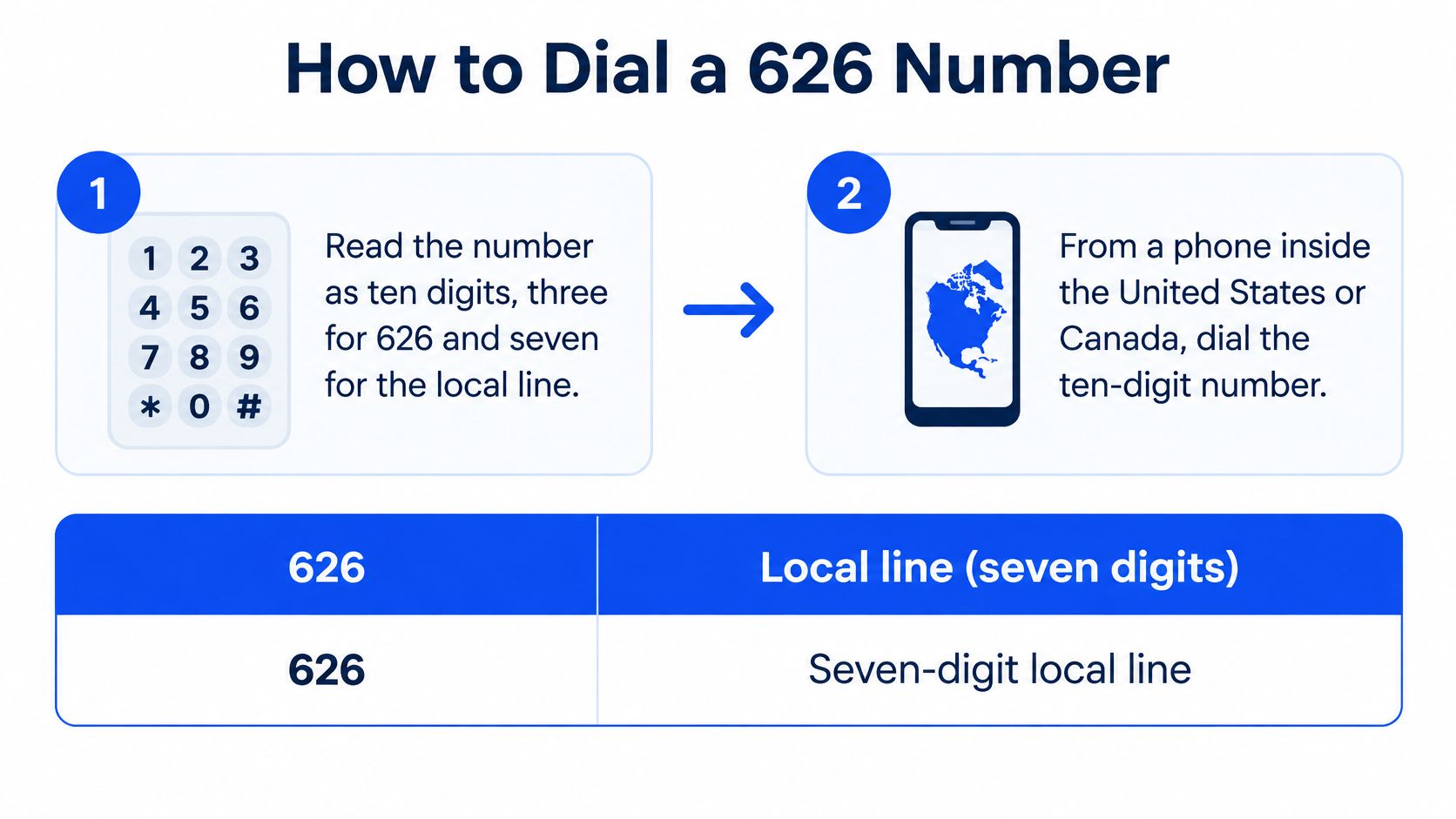
How to dial a 626 number
| Call from | What to dial | When this applies |
|---|---|---|
| Another California, US or Canadian phone, local | 626 plus the seven-digit number | Ordinary calls to a 626 line |
| United States or Canada when a trunk prefix is required | 1, then 626 and the seven-digit number | Long-distance charging or when the carrier expects the trunk prefix |
| Outside North America | International access prefix, then 1, 626 and the seven-digit number, or the mobile equivalent beginning +1 | Calls from countries outside the North American numbering system |
| A saved contact or business system | Full ten-digit number or E.164 | Records that must survive an overlay or code change |
626-555-0148 is a fictional example, not a working contact number. It illustrates the grouping; use the subscriber number when placing a call.
Why complete numbers matter to businesses
A California Public Utilities Commission numbering report estimated approximately 7.7 million telephone numbers within 626 while documenting unused numbering blocks and conservation limitations. That isn't a population estimate: carriers receive numbering resources in blocks, and assignable central-office prefixes can become scarce while individual numbers remain unused.
An overlay would add another code to the same geographic market. Build salon, clinic and contractor intake systems to accept customers with other area codes rather than treating 626 as a mandatory local-address field.
Keep the caller's original display format for staff and a normalized number for matching CRM records, callback lists and consent records. If a call fails after entering only the local line, redial the complete number before assuming the line is disconnected.
Codes Next to 626 and What They Cover
The most useful comparison is San Gabriel Valley versus San Fernando Valley, not east versus west within Los Angeles County. Similar-looking regional names can lead staff to assign a caller to the wrong branch or service team.
Neighbouring codes also have different relationships to 626. Some share its numbering history; others serve adjacent markets. An overlay means codes share a service region, while a split separates a previously shared region.
626 and the area codes around it
| Area code | Main territory | Relation to 626 | Easy mistake |
|---|---|---|---|
| 626 | San Gabriel Valley, northeastern Los Angeles County | The code this article covers | Treating it as all of Los Angeles |
| 818 and 747 | San Fernando Valley and nearby communities | 747 overlays 818, the code from which 626 separated | Assuming Pasadena is still in the 818 region |
| 213 and 323 | Central Los Angeles | 213 is the historical ancestor of this territory | Filing a San Gabriel Valley number as downtown |
| 909 and 840 | Inland Empire, including areas east of the valley | 840 overlays 909 and serves a different region | Automatically assigning eastern San Gabriel Valley cities to 909 |
The southeastern comparison is 562, associated with Long Beach and southeastern Los Angeles County. Don't assign a Rosemead or Monterey Park inquiry to that market just because the customer describes their location as southeast of central Los Angeles.
To the north, 661 is associated with Santa Clarita and the Antelope Valley. A northern location within the wider metropolitan area doesn't make Pasadena part of that calling region.
Use geography to route work, not judge callers
A business near a service boundary can legitimately receive calls from customers with different codes. An appointment calendar should therefore route bookings by the selected branch or service address, not by a rule that sends every unfamiliar prefix elsewhere.
Consider a mobile customer who drives from Arcadia to Pomona. Their number doesn't update at the city boundary. The same applies when someone keeps a long-standing mobile number after relocating permanently.
For a comparison outside California, our guide to the 980 area code offers another regional lookup. Keep each code tied to its own geography rather than applying Los Angeles assumptions to another market.
A neighbouring area code is a routing clue, not an identity check.
For dispatch, ask where the work will happen. For a restaurant booking, confirm the location the guest intends to visit. For a suspicious call, assess what the person wants and how you can verify it, rather than using this comparison as a fraud test.
How 626 Split Away from 818
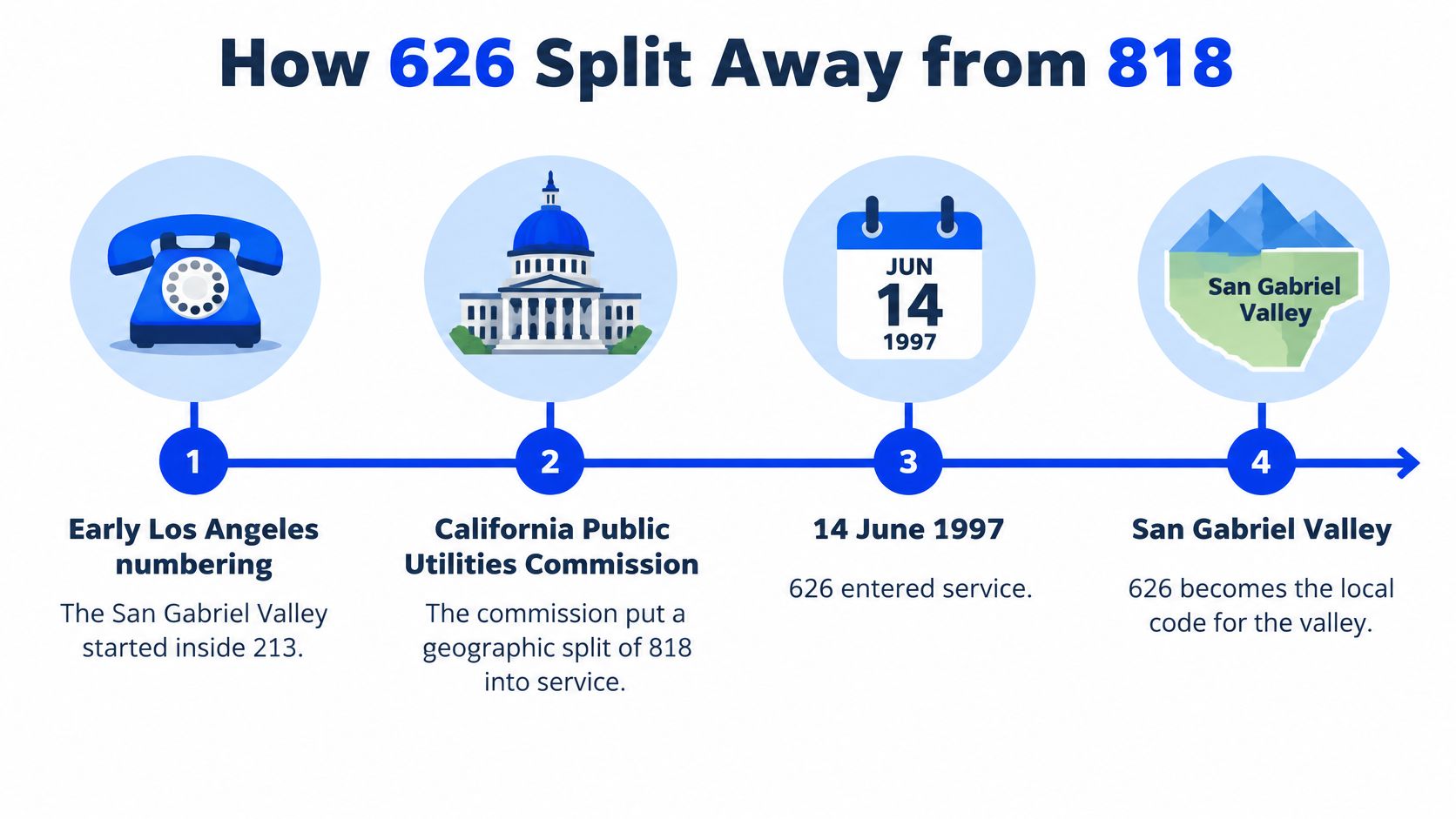
The San Gabriel Valley didn't begin with a separate telephone identity. Its numbering history follows the broader expansion of the Los Angeles telephone network, with regulators dividing an existing service region as demand for numbers increased.
The California Public Utilities Commission's historical record traces the territory from 213 to 818 in 1984, then to 626 on 14 June 1997; it identifies 626 as California's 16th area code. The latter change was a geographic split, with the San Gabriel Valley receiving its own code while 818 continued serving the San Fernando Valley and nearby communities.
A new boundary rather than another shared code
Think of the change as separating a shared regional telephone directory into distinct covers. The regulator assigned a different area code to one geographic portion rather than adding another code throughout the existing territory.
For a business in the newly separated region, the local identity changed at the area-code level. The practical work would involve updating the number wherever customers found it: signs, stationery, supplier records and advertising.
An overlay takes a different approach. Existing customers generally retain their numbers, while another code becomes available in the same geographic service region. The important distinction is separate territories versus shared territory, not whether one code looks more local than another.
What that history means for a business today
The commercial connection is regional. A business can use its local number alongside a clear city name to communicate where it operates, without suggesting that its customers must all come from the same municipality.
For example, a contractor might identify itself as based in Monrovia while listing the communities it serves. That is more useful than expecting a prospective customer to infer the service area from the telephone number alone.
- On the website: Pair the published number with the actual location and service area.
- In customer records: Keep the telephone field separate from the address and branch fields.
- On printed material: Make the complete number readable so customers don't have to reconstruct it.
The historical split explains why 626 and 818 have related origins but different regional associations. It doesn't make a present-day 626 number an extension of the San Fernando Valley market.
For future numbering changes, distinguish an official implementation notice from discussion of possible relief. A proposal isn't an instruction to change your signs, reject a customer's number or rewrite your booking rules.
When a 626 Call Is Not Proof of Place
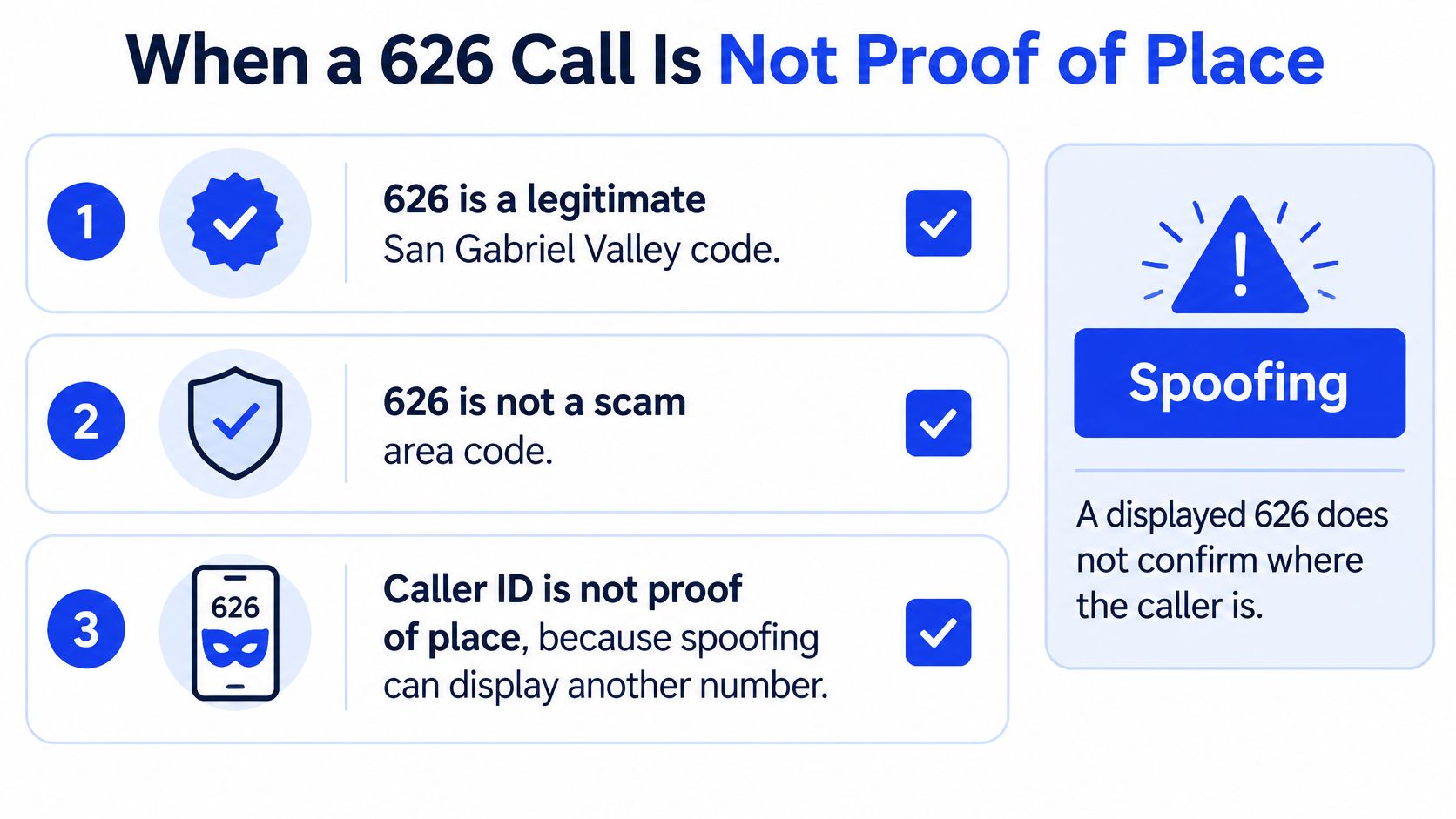
626 is a legitimate San Gabriel Valley area code, not a scam label. As JustCall's 626 area-code guide explains, caller-ID spoofing can display a different number, so the visible code doesn't establish the caller's physical location or trustworthiness.
The code also remains distinct from the 909 and 840 overlay region. Neither a familiar valley code nor an unfamiliar neighbouring one proves a business address or establishes fraud.
Make the decision from the request
A known customer calling about an appointment can receive routine help after your normal identity check. Confirm the name on the booking and the relevant appointment details, without volunteering unrelated information from their record.
An ordinary new inquiry is different. Someone asking for a haircut, cleaning, table or consultation should be able to explain the service they want, their preferred time and how to reach them. Take the callback number and read it back so a misheard digit doesn't break the follow-up.
A high-risk request needs escalation. Urgency, gift-card or wire-payment demands, requests for account access, and instructions to bypass normal procedures are reasons to pause, regardless of the displayed code.
Judge the request and verify the caller, rather than blocking every unfamiliar 626 number or trusting every one.
For that high-risk case, don't disclose customer records, accept unusual payment instructions or collect card numbers. Refer the exception to an authorised staff member and verify the request using contact information the business already trusts.
Protect bookings without dropping safeguards
Blanket blocking creates a problem for salons, clinics, law offices, contractors and restaurants: an unfamiliar caller may be a genuine prospective customer. Unrestricted trust creates the opposite problem, allowing a plausible local number to substitute for verification.
Write the distinction into your reception procedure. Our guide to screening phone calls can help you turn that policy into consistent intake rather than leaving each employee to improvise.
The goal is to make ordinary booking easy while keeping sensitive actions separate. A receptionist can collect the requested service and preferred appointment time without discussing private records or approving an unexpected payment change.
When anything feels wrong, preserve a verifiable callback path. End the questionable interaction and have the appropriate person call back using an independently checked number, not the contact details supplied during the suspicious request.
Keep Your 626 Number and Answer the Missed Calls
Keep the published number if customers already use it. A missed-call problem doesn't, by itself, justify replacing the number on your window, business cards, website and appointment reminders.
The operational choice is who answers when your team can't. You may want staff to handle calls during normal work, with unanswered or busy calls sent elsewhere, rather than routing every caller away from the front desk.
Set up conditional forwarding and test it
Use conditional call forwarding when you want to divert busy or unanswered calls rather than all calls. Carrier codes aren't universal, so use the code for your actual business line.
- Get the correct code: Obtain your carrier's conditional forwarding instructions for the line you're using.
- Activate the route: Copy the carrier's code and dial it once from your business phone.
- Test from another phone: Call the published number and allow the unanswered-call route to engage.
- Check the destination: If the call still reaches the old voicemail instead of the intended answering service, the setup isn't live.
A related guide to the 410 area-code phone number addresses another local-number context. For your business, the important choice remains whether the established number stays public.
Cover the calls staff can't pick up
At Heyline, we provide an AI phone receptionist for appointment-based local businesses. Going live provisions a dedicated number on the spot, with nothing typed in or bought from a carrier, while your published number stays unchanged.
You can publish the dedicated number so we answer every call, or keep your familiar number and forward only the calls your staff don't pick up. We collect the caller's name and callback number first, read the number back, and can book appointments into your connected calendar.
There's no per-call fee, message charge, setup fee or number rental fee. We answer around the clock, including at 2 a.m.
Decide first whether the 626 number on the window will remain your public line. Then activate and test the missed-call route before relying on it during a busy shift.
Keep your familiar San Gabriel Valley number while giving unanswered callers a way to ask questions and book an appointment. Visit Heyline to set up an AI receptionist, connect your calendar and test missed-call forwarding from your existing business line.