About half of law firms charge for initial consultations, while the other half offer them for free. Paid fees typically range from $50 to over $1,000, depending on the practice area and complexity.
You've found a lawyer who appears qualified, but the intake coordinator asks whether you want to reserve a consultation. The next question is usually immediate: “What will it cost, and what do I get for that money?” The answer depends less on a universal legal rule than on how the firm structures its intake process.
A consultation might be a brief screening, a substantive review of your facts, or a focused strategy session that produces a practical action plan. Treating all three as the same product creates confusion for clients and wastes attorney time. The right question isn't only whether lawyers charge. It's what the meeting includes, how the fee is calculated, and whether it leads to useful clarity.
The Reality of Legal Consultation Fees
You call a firm about a contract dispute, family matter, estate plan, injury, or criminal charge. The person answering may ask for basic facts, check whether the lawyer can take the matter, and offer either a free appointment or a paid meeting. Both approaches are normal.
A 2025 legal industry report found that 51% of law firms charge a fee for an initial consultation or case review, while 49% do not. Reported fees in that data set ranged from about $50 to over $1,000, depending on practice area, location, and complexity. That split shows why a simple yes-or-no answer to “do lawyers charge for consultations” is inadequate. The market supports both models. The reported consultation fee range and market split reflect different intake economics, not a reliable ranking of lawyer quality.
Canadian data points in the same direction. Canadian Lawyer's 2025 pricing survey found that 44% of respondents offered initial consultations for free, while the next-largest group, 17%, charged between $301 and $500. The survey also found that 87% still used hourly billing as their primary pricing method, which helps explain why some firms treat the first meeting as an intake step while others treat it as billable legal work. Canadian Lawyer's pricing survey provides useful context for that variation.
Free doesn't mean unlimited
A free consultation usually serves as an economic filter. The firm wants to determine whether the matter fits its practice, whether a conflict exists, whether the facts justify further review, and whether the prospective client is likely to become a viable engagement.
That meeting may be useful, but it often stops short of detailed legal advice. The lawyer might identify broad issues without reviewing a full document set or developing a litigation strategy. A firm offering free consultations can be using the session as lead qualification, marketing, or a preliminary triage process.
Paid doesn't guarantee an outcome
A paid consultation generally signals that the lawyer is selling access to professional judgment from the first substantive interaction. It may include document review, issue spotting, legal options, risk discussion, and recommendations about next steps.
The fee still doesn't guarantee that the lawyer will accept the case, win the dispute, or produce a particular result. It pays for the lawyer's time and analysis. Clients should judge the meeting by the clarity and usefulness of the advice, not by an implied promise of success.
Practical rule: Ask whether the appointment is a screening conversation or a legal advice session before you pay or attend.
Types of Legal Consultations Explained
The word consultation covers several different services. A prospective client who expects a strategy session but receives only a screening call will feel overcharged. A lawyer who prepares a detailed analysis for a person expecting a free introduction will absorb an avoidable cost.
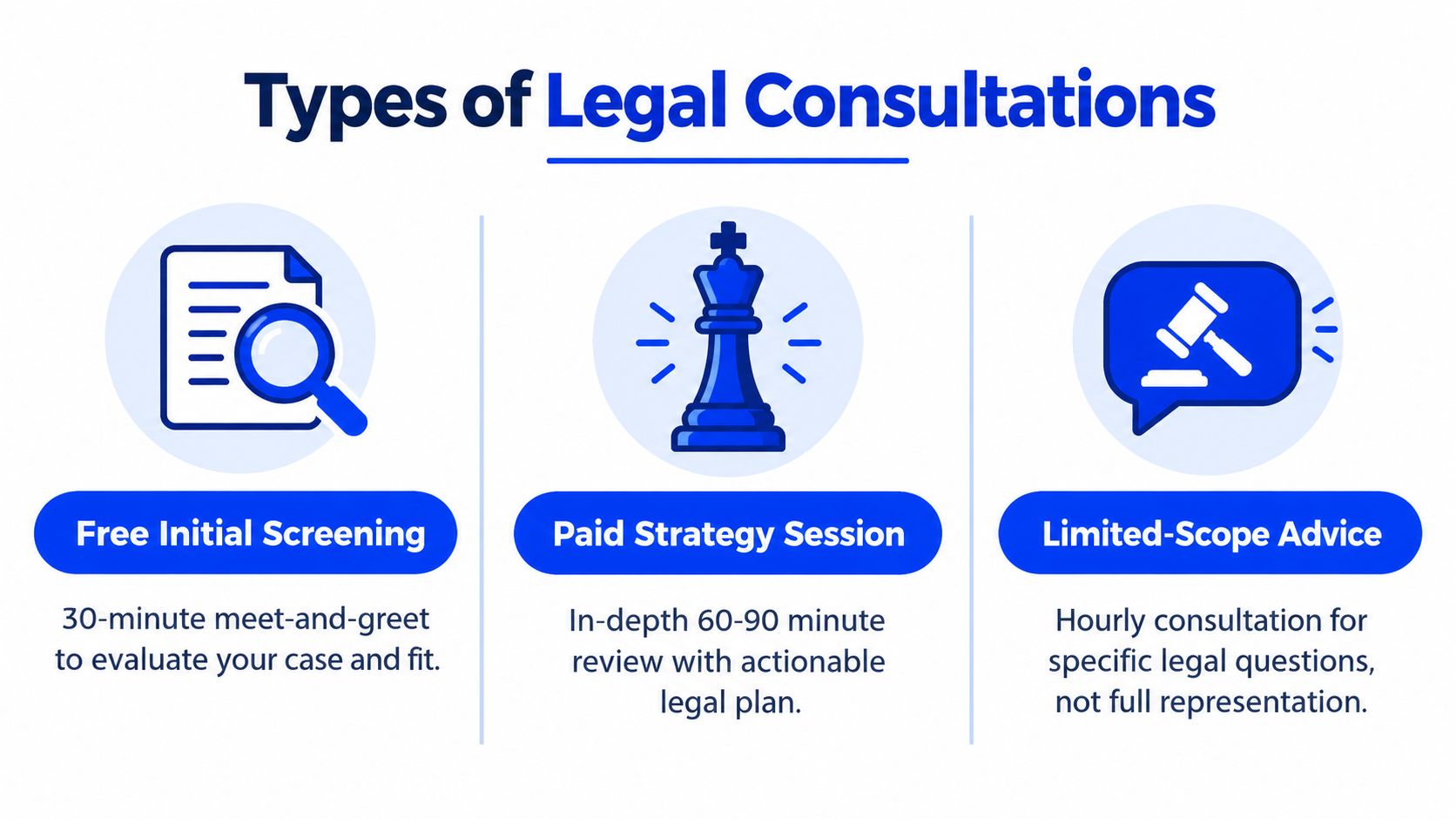
Free initial screening
A free screening is the legal equivalent of a triage desk. The firm gathers enough information to assess basic fit, identify potential conflicts, understand urgency, and decide whether a lawyer should spend more time on the matter.
Expect questions such as:
- Matter type: What happened, and what legal issue do you believe is involved?
- Timing: Are there deadlines, hearings, demands, or imminent filings?
- Parties: Who is involved, and who else may have an interest?
- Documents: Do you have contracts, notices, pleadings, correspondence, or records?
- Representation: Are you already working with another lawyer?
This model makes sense for high-volume practices, contingency-based matters, and firms that need to screen cases before assigning attorney time. For clients, it's useful when the main question is whether the firm handles the matter and whether a longer meeting is appropriate.
Paid strategy session
A paid strategy session is a defined professional service. The attorney may review selected documents, organize the facts, identify legal issues, explain available paths, and recommend a sequence of actions.
This format suits complex disputes, business decisions, estate planning, employment concerns, and other matters where useful advice requires preparation. The client should receive a clear scope before booking, including the meeting length, documents covered, participants expected, and whether any written follow-up is included.
The firm benefits because the attorney's preparation and analysis aren't treated as free sales labor. The client benefits because the conversation is designed to answer a specific problem rather than merely determine whether the firm is interested.
Limited-scope advice meeting
A limited-scope meeting addresses a narrow legal question without creating full representation. A client might ask a lawyer to review a lease provision, explain a demand letter, discuss a procedural choice, or assess a draft agreement.
This option can be efficient when the client needs targeted guidance and can handle implementation independently. It also gives firms a controlled way to serve matters that don't justify a full engagement. The limits must be explicit. The lawyer should state what isn't covered, what work requires a separate agreement, and whether the client may rely on the advice for a broader dispute.
The three models should be priced and described differently. A free screening evaluates fit. A paid strategy session develops direction. Limited-scope advice answers a defined question. Confusing those purposes creates dissatisfaction on both sides.
Factors That Determine Consultation Pricing
Consultation pricing follows the same basic logic as other professional services. The lawyer is pricing time, expertise, preparation, market position, and the complexity of the decision the client needs to make.
A broad industry benchmark places paid consultations around $150 to $1,000 or more per hour, with flat consultation fees often falling between $100 and $500, depending on attorney experience, expertise, and location. Best Lawyers' discussion of consultation and retainer fees makes the important point that these figures are ranges, not a universal schedule.
Practice area changes the work
A lawyer can often assess a straightforward question quickly, while a business dispute involving multiple contracts, parties, or jurisdictions may require substantial preparation. A personal injury firm may use a free screening because its broader business model supports that intake approach. An estate planning, corporate, or complex litigation firm may charge because the first meeting itself involves specialized analysis.
The label on the appointment matters less than the work behind it. Ask whether the fee includes document review, legal research, written recommendations, or only conversation.
Location sets the market context
A firm's geography affects operating costs, competitive positioning, client expectations, and the availability of lawyers with specific expertise. The same consultation format may carry different pricing in different markets because the underlying hourly rates differ.
That doesn't mean a higher fee automatically reflects better legal advice. It means the price should be evaluated against the lawyer's experience, the practice area, the scope of work, and the local market.
Seniority affects access to judgment
Clients often pay more to speak directly with a senior attorney whose experience allows faster issue recognition or more strategic guidance. A junior lawyer may provide excellent work at a different rate, particularly when the firm uses supervision and a defined process.
Firm owners should avoid vague pricing. State whether the consultation is handled by a partner, associate, intake attorney, or nonlawyer coordinator. Prospective clients should ask who will attend and whether the person has authority to answer the questions that matter.
A useful comparison is the cost of the firm's intake infrastructure. Owners evaluating reception, scheduling, and call coverage can also review the economics of an answering service, because consultation pricing only works when qualified prospects can reach the firm and book the right appointment.
Flat fee or hourly billing
A flat fee offers predictability when the consultation scope is consistent. Hourly billing fits matters where the time required varies substantially. Either model can be fair, but neither should leave the client guessing about the maximum exposure.
| Pricing model | Best fit | Client should confirm |
|---|---|---|
| Flat consultation fee | A repeatable meeting with a defined scope | Length, inclusions, and credit policy |
| Hourly consultation | Variable preparation or complex advice | Rate, minimum billing unit, and time estimate |
| Tiered service | Different levels of review | What each tier delivers |
What You Actually Get for Your Money
A paid consultation should produce more than a pleasant conversation. Before booking, define the deliverables you need. The lawyer may not be able to resolve the matter in one meeting, but the session should improve your understanding of the problem and your next decision.
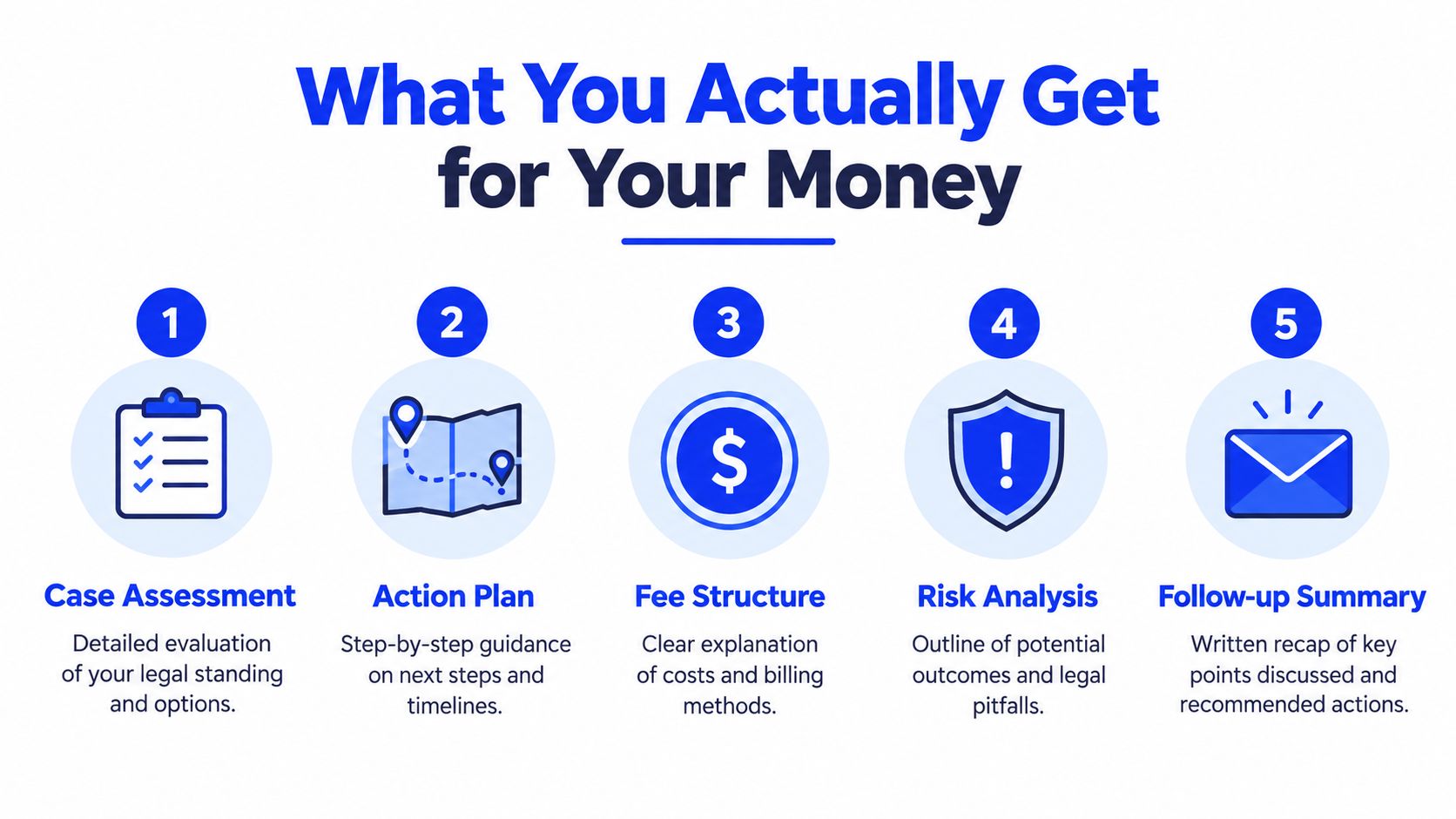
A practical paid-consultation checklist
Case assessment: The lawyer should explain the apparent legal issues, missing facts, and immediate concerns. This isn't a final opinion on every possible issue. It's a focused assessment based on the information provided.
Action plan: You should leave knowing what to do next, what not to do, and which decisions require further legal work. The plan might involve collecting records, responding to a notice, preserving evidence, negotiating, filing, or scheduling a fuller review.
Fee structure: The lawyer should explain how future work will be billed. That may involve hourly billing, a retainer, a flat fee, contingency terms, or a limited-scope arrangement. Ask for the explanation in writing.
Risk analysis: Good advice includes uncertainty. The attorney should identify likely obstacles, practical risks, procedural deadlines, and facts that could change the recommendation. Risk analysis is more valuable than false confidence.
Follow-up summary: A written recap is useful, but it isn't automatic. Confirm whether the fee includes notes, an email summary, a written opinion, or no written follow-up. If the lawyer provides only verbal advice, take your own organized notes.
A free screening usually delivers a narrower result. You may learn whether the firm handles your type of matter, whether a conflict prevents representation, and what appointment or engagement would come next. Don't assume that a free call includes legal advice because a lawyer participates.
The fee buys professional attention, not a guaranteed result. The strongest consultation gives you a clearer decision, even when the recommendation is not to pursue the matter.
Law firm owners should turn these deliverables into a written service description. A consultation page should identify the duration, participants, preparation requirements, document limits, follow-up policy, and whether the fee is credited toward future representation. That clarity protects the firm and gives clients a fair basis for comparison.
Optimizing Law Firm Intake and Scheduling
Law firms lose consultation opportunities before an attorney ever evaluates the facts. A caller reaches voicemail after hours, leaves a message without enough detail, and waits for a return call. Another caller encounters a complicated phone tree and chooses a competitor. Staff then spend time exchanging messages instead of confirming fit, collecting basic information, and placing the appointment on the calendar.
The operational problem is simple: consultation pricing only creates value when the firm can consistently convert qualified inquiries into scheduled meetings. A paid consultation requires a clear payment step. A free consultation still requires conflict-aware intake and an appointment process that protects attorney availability.

Build an intake path around decisions
A strong intake process doesn't attempt to provide legal advice. It captures the information the firm needs to make an informed next decision:
- Identify the matter: Record the caller's issue in plain language, without forcing the person to select an overly narrow category.
- Capture parties: Collect names of opposing parties and related organizations for conflict screening.
- Record urgency: Note deadlines, court dates, threats, injuries, or other facts that change routing.
- Match the service: Direct a screening inquiry to the appropriate appointment type, whether free, paid, or limited scope.
- Confirm expectations: State the fee, meeting length, attorney or team member, preparation instructions, and cancellation terms.
This process protects the lawyer's calendar. It also prevents the intake team from promising advice, availability, or representation before the firm has completed the necessary checks.
Automation should handle logistics, not judgment
An AI phone receptionist can answer inbound calls, ask configured intake questions, use a knowledge base for approved firm information, and book consultations into a connected Google Calendar. Heyline is one example of this approach, with website-based setup, editable knowledge fields, calendar-aware appointment booking, and call transcripts or recaps described for legal intake use.
The right automation boundary is clear. Let software handle availability, basic service information, appointment confirmation, and routine caller questions. Keep legal analysis, conflicts decisions, emergency escalation, engagement approval, and advice with qualified firm personnel.
For firms considering this model, an AI receptionist for law firms should be evaluated against the firm's actual intake requirements. Review what information the system captures, how staff receive the call record, how urgent matters are escalated, and how the firm updates its approved answers.
The goal isn't to make intake feel automated. It's to stop administrative delay from consuming attorney time or sending a qualified prospect elsewhere.
Questions to Ask Before Booking a Consultation
Don't book based on the word “consultation” alone. Ask the intake coordinator or receptionist to describe the appointment in operational terms. A clear answer should tell you what happens before, during, and after the meeting.
Use this script if you're unsure:
“Before I schedule, can you explain the consultation fee, who I'll meet with, what documents you'll review, what advice is included, and whether the payment is credited if I retain the firm?”
Confirm the financial terms
Ask whether the fee is refundable, whether it's earned when paid, and whether it's credited toward future representation. These policies vary by firm and jurisdiction, so don't assume that payment automatically reduces a later retainer.
Also ask what happens if the firm determines it has a conflict, declines the matter, or cannot provide advice after learning more facts. The answer may depend on the firm's written policy and applicable professional rules. Get the response in an email or appointment confirmation.
Confirm the person and scope
You should know who will conduct the meeting. Ask whether it will be a partner, associate, specialist, or intake professional, and whether another lawyer may review the information afterward.
Then ask:
- Meeting purpose: Is this a screening, strategy session, or limited-scope advice appointment?
- Document limit: How many documents can you send, and when must they arrive?
- Written work: Will you receive a recap, opinion, action list, or no written follow-up?
- Future engagement: If you want representation, what happens after the consultation?
- Confidentiality: How does the firm handle information before an engagement is signed?
Don't send a large archive of sensitive records before the firm tells you what it can review. Provide a concise timeline, key documents, names of the parties, and the specific questions you need answered.
Make the booking process predictable
Ask how the firm confirms the appointment, handles rescheduling, and records urgent facts. If you're calling outside business hours, find out whether the message will be reviewed promptly or whether you need to call again.
Law firms can turn these questions into an intake checklist and train staff to answer them consistently. A documented telephone script for answering the phone can reduce contradictory explanations about fees, appointment types, and preparation requirements.
The best booking conversation leaves no ambiguity about the service being purchased. If the firm won't explain the scope or fee policy before taking payment, choose a provider that will.
Final Thoughts on Legal Consultation Strategy
The answer to “do lawyers charge for consultations” is clear but incomplete. Some firms charge, some don't, and both models can work. The meaningful difference is whether the meeting has a defined purpose, a stated scope, and a fair exchange of value.
For prospective clients, prepare a short chronology, identify the parties, gather only the requested documents, and write down the decisions you need to make. Ask about the fee, refund terms, credit toward future work, attorney seniority, document review, written follow-up, and next steps before you book. A free screening can be appropriate when you need basic fit confirmation. A paid session can be worthwhile when you need focused analysis and a strategy you can act on.
For law firm owners, stop treating consultation policy as a minor website detail. Decide which matters deserve free screening, which require paid strategy work, and which fit limited-scope advice. Publish the distinctions, train the intake team, and use scheduling technology to capture qualified calls without turning automated systems loose on legal judgment.
A consultation becomes commercially sustainable when the client understands the deliverable and the firm controls the intake cost. Review your next appointment from both sides: What decision will the client make afterward, and what administrative work can the firm remove before the lawyer enters the conversation?
Heyline provides an AI phone receptionist that answers inbound calls, gathers configured intake information, and books consultations directly into a connected calendar. Visit Heyline to see whether automated call coverage fits your firm's consultation and scheduling process.