The 413 area code is in the Eastern Time Zone, following Eastern Standard Time at UTC−5 and Eastern Daylight Time at UTC−4. Treat every 413 number as Eastern Time for scheduling, call routing, callbacks, and after-hours logic.
A missed appointment call can start with a simple mistake: a booking platform reads the caller's device time, an agent works from another region, or an automated greeting switches at the wrong hour. For businesses serving western Massachusetts, the reliable default is straightforward. A 413 caller belongs to the Eastern clock, even if the answering team, calendar, or phone system sits somewhere else.
The 413 footprint has also remained unusually stable. It has represented western Massachusetts since 1947, when the state was divided between 413 in the west and 617 in the east, and it has never been split or overlaid. That makes the code useful operationally, not just geographically. A 413 number is a strong starting point for identifying the caller's local scheduling time, while carrier or CRM data should confirm the number's current location if it has been ported or masked.
What Time Zone Is the 413 Area Code In
Every 413 phone number is in the Eastern Time Zone, abbreviated ET. The region uses Eastern Standard Time, UTC−5, during the winter and Eastern Daylight Time, UTC−4, during daylight saving time. The 413 area code reference from AT&T also identifies the code as serving western Massachusetts, including Springfield, within Eastern Time.
Treat this as a scheduling rule:
- Book appointments in Eastern Time. A 413 customer expecting a morning appointment is using the same local clock as a business in Boston or New York.
- Set routing schedules to Eastern Time. Your phone system may run on a server in another region, but its business-hours logic should follow the 413 customer's local time.
- Apply the same rule to callbacks and service-level timers. A missed call received from a 413 number should enter the queue according to Eastern Time, not the agent's local clock.
- Review ported and masked numbers. Area codes generally indicate an assigned numbering region, but a customer can keep a number after moving or porting it. Use carrier or CRM metadata when the number's actual location matters.
The code covers western Massachusetts, not the Boston metropolitan area, the South Shore, or a neighbouring time zone. A 413 caller is not on Atlantic Time or Central Time.
Operational rule: Treat 413 as Eastern for routing, callbacks, appointment confirmations, and SLA timers. Let carrier or CRM metadata confirm the location only when the number has been ported or masked.
Eastern Time and UTC Offsets Explained
Eastern Time isn't a fixed offset throughout the year. It's a regional clock standard that alternates between two UTC relationships. The offset tells your system how far the local clock sits behind Coordinated Universal Time.
During standard time, the 413 region uses UTC−5. If the local time in Springfield or Pittsfield is 12:00 p.m., UTC is 17:00. During daylight saving time, the local clock moves to UTC−4, so 12:00 p.m. locally corresponds to 16:00 UTC.
| Period | Local Time in 413 | UTC Offset | UTC Clock Time |
|---|---|---|---|
| Eastern Standard Time | 12:00 p.m. | UTC−5 | 17:00 |
| Eastern Daylight Time | 12:00 p.m. | UTC−4 | 16:00 |
How to handle overseas offices
The offset change matters when a western Massachusetts practice shares a calendar with staff in London or Berlin. A London colleague may use GMT or BST depending on the season, and a Berlin colleague may use CET or CEST. Their local clocks won't maintain one permanent relationship with a 413 appointment because each region applies its own seasonal clock rules.
Use a calendar that stores the appointment as a time-zone-aware event rather than as a plain text time. For a 413 appointment, select an Eastern Time zone such as America/New_York. The calendar can then display the correct local time to the Massachusetts customer and convert it for the overseas employee.
The mistake to avoid is storing “12:00” without a zone. That value is ambiguous. Store 12:00 Eastern, then let the booking system calculate the corresponding UTC and overseas display time.
Cities and Counties Covered by Area Code 413
The 413 footprint is western Massachusetts, including the Berkshire, Hampden, and Hampshire county areas. The region includes well-known communities such as Springfield, Pittsfield, Amherst, Northampton, and Greenfield, and the code has consistently represented the western third of the Commonwealth since its introduction. The area code history reference describes 413 as one of Massachusetts's original codes and identifies its long-standing western Massachusetts coverage.
For a scheduler, the important point is consistency. A caller may appear under a Springfield, Northampton, Amherst, Pittsfield, or Greenfield number, but the appointment system should still interpret the call through the Eastern Time setting. The city name can help a team understand the customer's local context, but it shouldn't create a different time-zone rule.
| City | County or regional area | Common 413 use case |
|---|---|---|
| Springfield | Hampden area | Appointment calls, service enquiries, and local business callbacks |
| Northampton | Hampshire area | Clinic, professional service, and appointment-based enquiries |
| Amherst | Hampshire area | Calendar bookings and customer support calls |
| Pittsfield | Berkshire area | Local service scheduling and follow-up calls |
| Greenfield | Western Massachusetts | Regional appointment intake and callbacks |
The code's geographic stability also simplifies number recognition. Unlike many older area codes, 413 has never been split or overlaid. A 413 caller ID is therefore geographically associated with western Massachusetts rather than with Boston or the state's eastern regions.
That doesn't prove the caller is physically in western Massachusetts. Mobile users can move, businesses can port numbers, and caller ID can be masked. Use the area code as the default routing signal, then rely on verified customer records when the customer's actual location affects service availability.
Daylight Saving Time Rules for 413 Numbers
Daylight saving time applies across the entire 413 footprint because western Massachusetts sits fully inside Eastern Time. The local wall clock moves forward on the second Sunday in March, changing from 2:00 a.m. to 3:00 a.m. It moves back on the first Sunday in November, changing from 2:00 a.m. to 1:00 a.m.
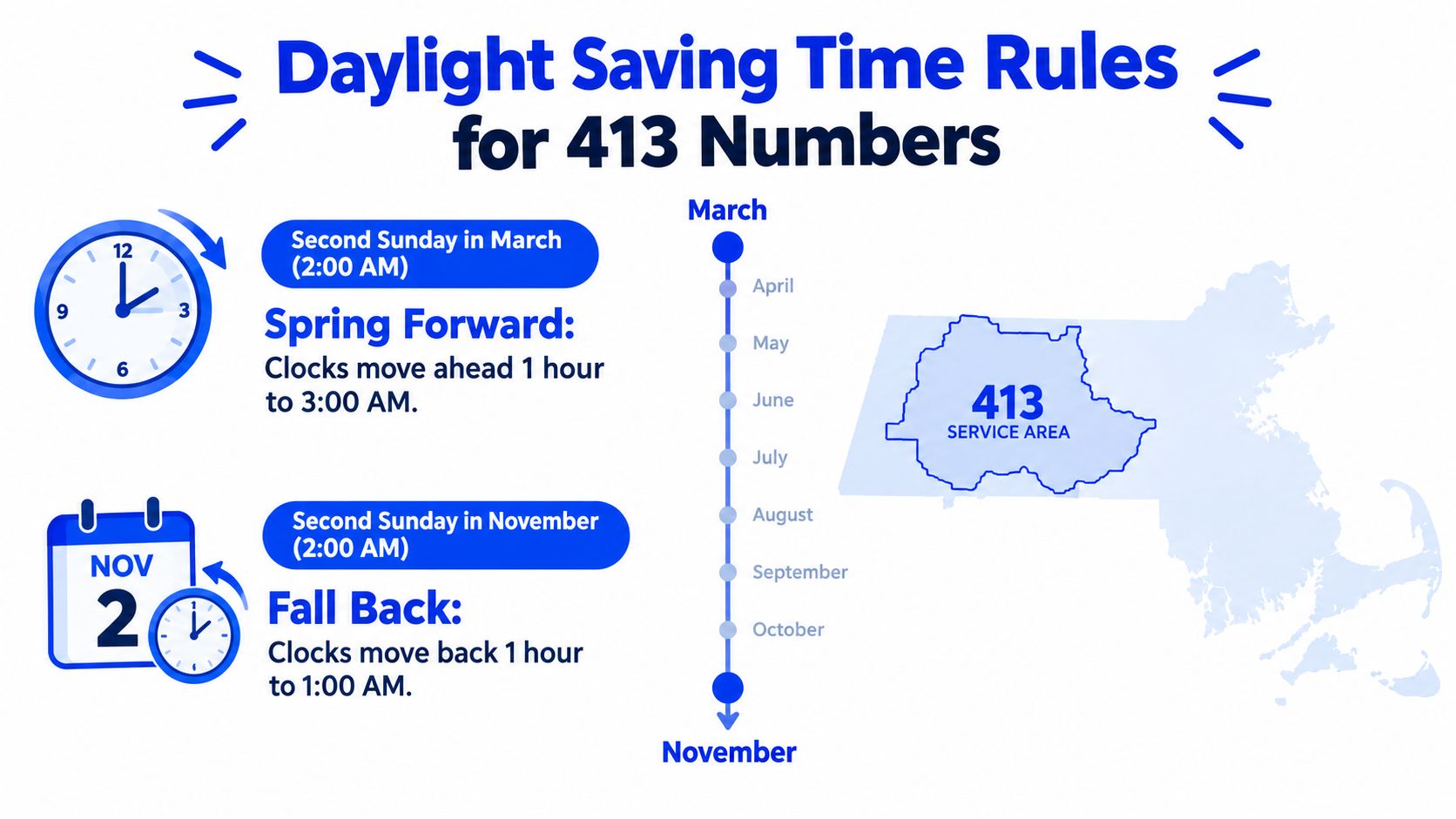
The UTC relationship changes with those clock adjustments:
- Standard time: Eastern Standard Time uses UTC−5.
- Daylight time: Eastern Daylight Time uses UTC−4.
- Customer-facing appointments: A booking at 10:00 a.m. Eastern remains a 10:00 a.m. wall-clock appointment for the customer.
- UTC-stamped records: A system storing UTC must reflect the one-hour offset change when daylight saving time begins or ends.
Businesses should use a time-zone-aware calendar rather than manually editing every appointment. A local appointment should remain attached to Eastern Time, while the software converts it for staff, reporting, and integrations.
There are no separate local time-zone exemptions within the 413 footprint. A business serving Springfield, Pittsfield, or another western Massachusetts community can apply the same daylight saving logic used for Eastern Time numbers in Boston and New York.
Dialing Format and Call Handling for 413 Numbers
For a 413 number, the standard North American format is 413 plus the seven-digit local number, producing a ten-digit dialling sequence. From outside the local region, use 1 plus the ten-digit number where the carrier requires domestic long-distance formatting. International callers generally use the relevant international access method, country code 1, the 413 area code, and the local seven-digit number.
Keep staff instructions simple. Store the complete ten-digit number in the CRM, display the area code in caller records, and avoid relying on seven-digit shortcuts in automated workflows. Full-number storage reduces ambiguity when records move between systems or when staff work outside western Massachusetts.
Operators may also encounter service-specific short codes. 911 is for emergencies, 988 reaches the Suicide and Crisis Lifeline, 711 supports telecommunications relay access, and 611 commonly connects with a carrier. 411 is directory assistance. These codes don't identify a geographic area and should be handled separately from ordinary inbound numbers.
Toll-free prefixes such as 800, 888, 877, and 866 aren't geographic 413 lines. Other toll-free ranges include 855, 844, and 833. A 900 number follows a separate premium-charge rule and shouldn't be treated as an ordinary business callback.
For a practical overview of how calls move between queues, agents, and business-hours rules, see call routing for business phone systems. Configure inbound 413 calls against the customer's Eastern Time schedule, not the answering agent's location. That setting controls greetings, queue closure, escalation, and callback promises.
How 413 Compares to Other Massachusetts Area Codes
Massachusetts has nine active area codes, and 413 is the code assigned to the western region. The Massachusetts area code overview from AT&T identifies 413 as the state's western code and distinguishes it from the other numbering areas.
The practical comparison is regional, not just numerical. 617 and 857 identify Boston and nearby inner-core communities. 508, 774, and 959 cover other parts of central and southeastern Massachusetts. 978, 351, and 726 identify areas north and east of Boston and parts of central Massachusetts. A caller from one of those codes may still be in Eastern Time, but a business should confirm the number's regional handling in its telephony configuration.
| Area Code | Region Covered | Time Zone |
|---|---|---|
| 413 | Western Massachusetts | Eastern Time |
| 617 and 857 | Boston-area region | Confirm in system configuration |
| 508, 774, and 959 | Central and southeastern Massachusetts | Confirm in system configuration |
| 978, 351, and 726 | Northern, central, and eastern Massachusetts areas | Confirm in system configuration |
The key distinction is that 413 has remained a single, non-overlaid code for western Massachusetts. That makes a 413 prefix a particularly clean regional signal for appointment teams. It points toward the Berkshire, Hampden, and Hampshire areas without requiring the scheduler to distinguish between overlapping codes within the same footprint.
For a separate example of how an area code can signal a local operating region, see the 315 area code guide. Don't copy another region's time-zone rules into a 413 workflow. Store the zone explicitly and let the calendar apply the correct seasonal offset.
Scheduling and After-Hours Tips for 413 Businesses
A 413 contact should enter your booking workflow as Eastern Time by default. That applies whether the caller is in Springfield, Pittsfield, Northampton, or another community within western Massachusetts. The customer's local time should control the appointment display, while the team's system converts the event for any remote staff.
Use a clear operating policy:
- Business hours: Set the primary appointment window from 9:00 a.m. to 5:00 p.m. Eastern Time.
- After-hours: Treat 5:00 p.m. to 9:00 a.m. Eastern Time as the closed or limited-service window.
- Same-day follow-up: If your team offers callbacks, allow them until 6:00 p.m. Eastern Time.
- Morning resumption: Resume standard callback handling at 8:00 a.m. Eastern Time.
- Voicemail wording: Say “Eastern Time” in greetings and confirmations instead of showing UTC.
- Calendar storage: Save events with an Eastern Time zone, not as unqualified text such as “10:00.”
These are operating recommendations, not universal opening hours. A dental practice, salon, law office, contractor, or restaurant can adjust the windows, but it should keep the time zone explicit.
Scheduling rule: The caller's area code can help select the default zone. The business's calendar should remain the authority for available appointment times.
When staff work from the West Coast, the offset is straightforward to manage because both locations observe seasonal clock changes. Use calendar invitations with named time zones, and test reminders around the March and November transitions. For teams that need consistent coverage, after-hours answering services can help separate Eastern customer hours from the agent's physical location.
Quick Reference Card for the 413 Area Code
Keep this card beside the scheduling console or add the values to your phone-system documentation.
| Attribute | Value |
|---|---|
| Time zone | Eastern Time |
| Standard offset | UTC−5 |
| Daylight offset | UTC−4 |
| Daylight saving pattern | Second Sunday in March to first Sunday in November |
| Geographic region | Western Massachusetts |
| County areas | Berkshire, Hampden, and Hampshire |
| Principal cities | Springfield, Pittsfield, Amherst, Northampton, and Greenfield |
| Local dialling | 413 plus the seven-digit local number |
| Long-distance format | 1 plus the ten-digit number |
| Emergency service | 911 |
| Crisis support | 988 |
The decision rule is simple: 413 means Eastern Time for scheduling, routing, display, and after-hours handling. Use complete phone numbers in records, keep appointments tied to a named time zone, and verify customer location separately if number portability makes geography uncertain.
Frequently Asked Questions About 413 Time Zone
Does area code 413 follow Eastern Daylight Time?
Yes. Every 413 number follows Eastern Time's seasonal pattern, using UTC−5 during standard time and UTC−4 during daylight time.
What is the current UTC offset for 413?
It's UTC−5 during standard time and UTC−4 during daylight saving time. Check the current calendar date before converting a live appointment.
Are 411 and 911 the same in 413 territory?
No. 411 is directory assistance, while 911 is the emergency line. 988 reaches the Suicide and Crisis Lifeline.
Do toll-free numbers carry a time zone?
No. Prefixes such as 800, 888, 877, 866, 855, 844, and 833 aren't tied to the caller's geographic region. Route those calls according to your office hours and service policy.
Is 413 only western Massachusetts?
Yes. It represents western Massachusetts and the Berkshire, Hampden, and Hampshire county areas. It doesn't overlap with Boston's 617 or 857 numbering area.
Heyline provides an AI phone receptionist that answers incoming calls, handles natural conversations, and books appointments directly to a business calendar, with timezone-aware booking for local appointment schedules. Visit Heyline to configure phone coverage around your 413 Eastern Time hours.