A prospective client calls while your receptionist is at lunch. A second caller arrives while the first occupies the only line. Later, an attorney notices a voicemail from someone who needed an urgent consultation, but nobody knows when the call came in, what the caller needed, or whether anyone followed up.
That situation doesn't mean your team is careless. It means the front desk is carrying more operational responsibility than the job title suggests. A law firm receptionist may be answering calls, screening urgency, collecting intake details, booking consultations, updating records, and protecting sensitive information, often at the same time.
This guide treats reception as an intake and continuity function, not just a greeting station. You'll learn how the role works, where legal phone handling fails, how in-house, virtual, and AI coverage differ, and which controls to establish before you change your staffing model. If your team is already struggling with a flood of calls, this guide to handling high call volumes provides useful context for diagnosing the pressure.
Introduction Why the First Ring Decides Your Next Client
The first ring can reveal whether your firm treats intake as a defined process or as a task handled whenever someone is free.
Consider a California caller who has searched for legal help, selected your firm, and reached out during a busy period. Your receptionist is assisting a visitor, an attorney is in a meeting, and the phone rings until voicemail answers. The caller might leave a message, but an urgent need can also send them to another firm before anyone reviews the inquiry.
California legal intake guidance connects response time with caller abandonment. A 10-second delay can cause 60% of callers to hang up, according to Alert Communications' legal virtual receptionist guidance. The figure does not establish the value of every missed call, but it gives managing partners a practical reason to review answer speed alongside staffing, intake, and risk controls.
Practical rule: Treat the first ring as the start of qualification, not a courtesy before legal work begins.
A receptionist therefore functions as an intake coordinator and a control point. The workflow should welcome each caller, identify urgency, collect usable facts, route the message correctly, and preserve a record. When any step is unclear, attorneys may receive incomplete notes, callers may repeat sensitive details, and time-sensitive matters may wait without an owner.
Coverage also needs a defined design. In-house staff may handle personal interaction well but need backup for meetings, lunch, and absence. A virtual or AI receptionist can extend availability and manage overflow, provided its scripts, escalation rules, and records fit the firm's procedures. Firms dealing with sustained demand can use this guide to handling high call volumes to assess whether the problem is staffing, routing, or intake capacity.
Ask four operational questions:
- Which calls require immediate attention?
- What information must be collected before an attorney responds?
- Who covers lunch, meetings, evenings, weekends, and overflow?
- Which disclosures and routing rules must every person or system follow?
The answer should be the smallest coverage model that reliably protects client access, preserves viable intake opportunities, and keeps phone handling organised.
What a Modern Law Firm Receptionist Really Does
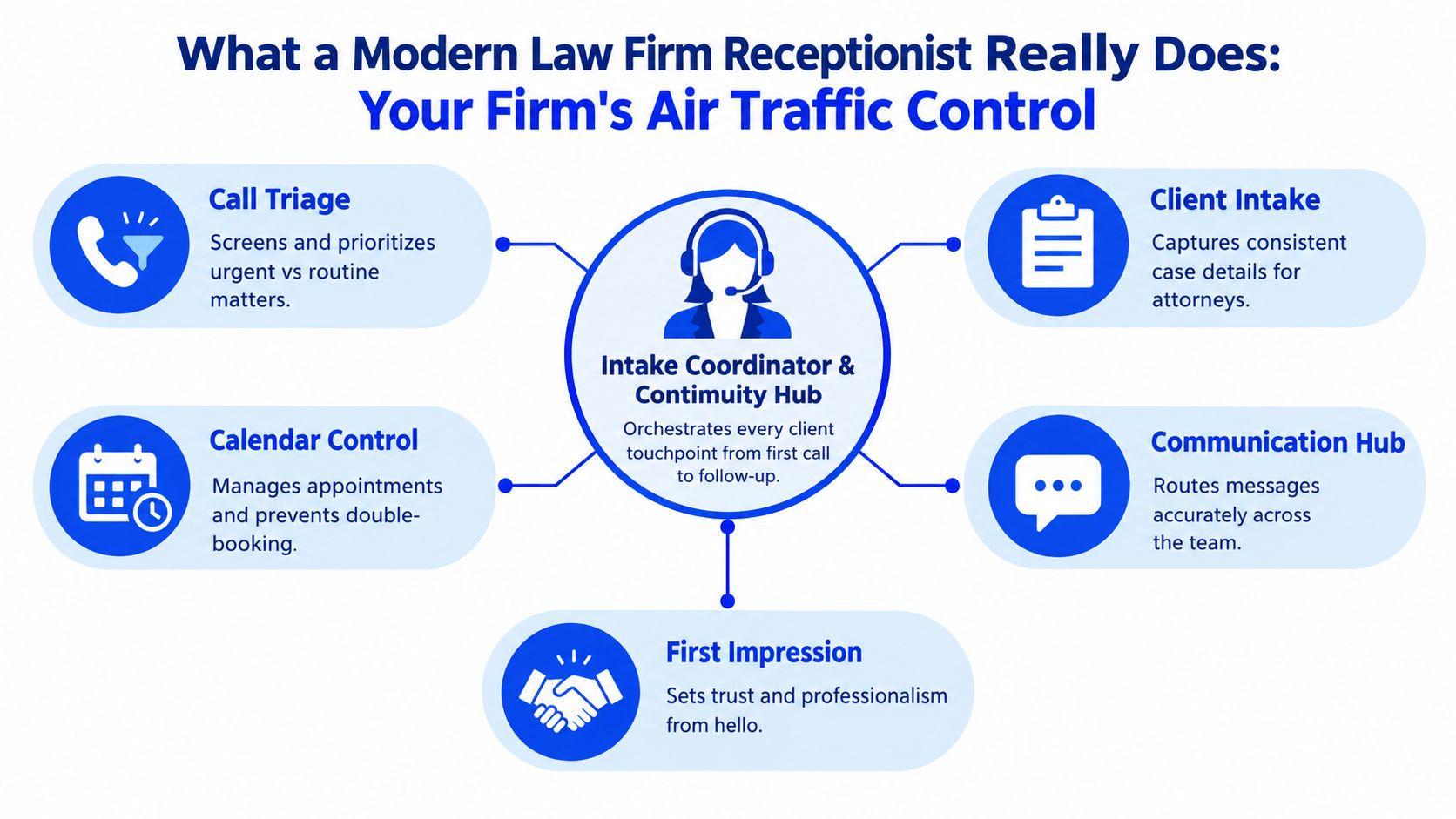
A law firm receptionist works like air traffic control for client contact. Aircraft don't land because someone says hello. They need identification, priority, instructions, a clear destination, and a record of movement. Calls need the same coordination.
Start with the greeting, then add control
The greeting establishes the caller's first impression, but it isn't the whole job. A receptionist should identify the firm clearly, listen for the purpose of the call, and avoid forcing a caller through an unnecessarily complicated menu or transfer chain.
The next layer is call triage. Triage doesn't mean giving legal advice. It means recognising signals that require immediate attention, such as an emergency, a time-sensitive court issue, or a caller who needs an existing attorney. Routine enquiries can follow a different path, while urgent matters should move through a defined escalation route.
California legal receptionist providers describe answering in the firm's exact name within about 20 seconds, with English and Spanish handling and scripted intake for urgent matters, as a practical baseline. San Diego legal answering guidance connects this quick response with smoother qualification and routing.
Build a complete intake record
A receptionist should collect the facts the firm has decided are necessary for the next step. Depending on practice area, that might include the caller's name, contact details, opposing-party information, matter category, relevant timing, and preferred consultation time.
Consistency matters more than conversational flair. If one staff member asks for opposing-party details and another doesn't, the attorney may receive two very different records from similar callers. The receptionist becomes a continuity hub when every call produces a reliable handoff.
California job postings reviewed by Robert Half's legal receptionist listings show that the role commonly combines multi-line phone handling, consultation scheduling, intake detail collection, voicemail management, and client-record updates. That combination changes how managing partners should evaluate the position. You're not assessing a person only on warmth and telephone manners. You're assessing whether the role can keep the intake system moving when attorneys and paralegals are occupied.
Coordinate calendars and messages
Calendar control prevents avoidable friction. A receptionist should know which consultation types belong on which calendars, what information must accompany a booking, and when a request requires human approval instead of automatic scheduling.
Message routing also needs explicit rules. “Call back when free” isn't a complete workflow. A useful message identifies the caller, matter type, urgency, time received, requested action, and destination owner. That record lets the firm respond without asking the caller to start again.
The practical mental model is simple: greet, triage, capture, schedule, route, and record. Any coverage option you consider should perform those tasks reliably, not merely answer the phone.
Comparing Your Coverage Options for Law Firms
Law firms generally choose among three coverage models. The important distinction isn't whether a person or system answers. It's how reliably the model handles the entire path from first contact to qualified handoff.
| Coverage Model | Availability | Cost Structure | Best Fit |
|---|---|---|---|
| In-house receptionist | Usually tied to scheduled working hours, with coverage dependent on staffing and breaks | Salary, wages, benefits, training, and the cost of covering absences | Firms needing a consistent on-site presence and broad administrative support |
| Virtual receptionist service | Often supports overflow, extended hours, or after-hours answering through a remote team | Service fee shaped by usage, coverage, and intake requirements | Firms wanting human answering without adding another on-site employee |
| AI phone receptionist | Can provide continuous automated answering, scripted intake, routing, and appointment handling | Software subscription or usage-based service, depending on the provider | Firms needing consistent first response, scalable coverage, and routine appointment intake |
An in-house receptionist offers proximity. That person can greet visitors, see office activity, coordinate with attorneys, and handle tasks that don't belong on a phone-only service. The trade-off is dependency on one person's availability. Lunch, illness, meetings, turnover, and sudden call spikes can all create gaps unless the firm has backup coverage.
A virtual receptionist service gives a firm a human voice without requiring another desk in the office. It can suit sensitive conversations where callers benefit from a live person, especially when the firm has established scripts and clear escalation rules. Before signing, ask how the service handles practice-area questions, urgent matters, bilingual calls, calendar booking, transcripts or notes, and privacy instructions.
An AI phone receptionist is strongest where the firm wants consistent handling of repeatable tasks. It can answer immediately, hold a natural conversation, follow a defined intake script, and book available appointments when connected to a calendar. It won't replace attorney judgement, complex conflict analysis, or nuanced client counselling. Its value comes from handling the first layer predictably and escalating when the matter falls outside its rules.
Use a hybrid model when the work is mixed
Many small firms don't need to choose one model for every call. An in-house team can handle visitors and complex conversations, while a virtual or AI layer handles overflow, evenings, and routine consultation requests. That arrangement separates presence from availability, two needs that often get confused.
Match the model to your actual workflow. If callers mostly need appointment booking and basic intake, automation may cover a larger share. If calls involve complex existing-client issues, emotional support, or frequent attorney judgement, human coverage may need to own more of the interaction.
Where Legal Intake Breaks and What It Costs
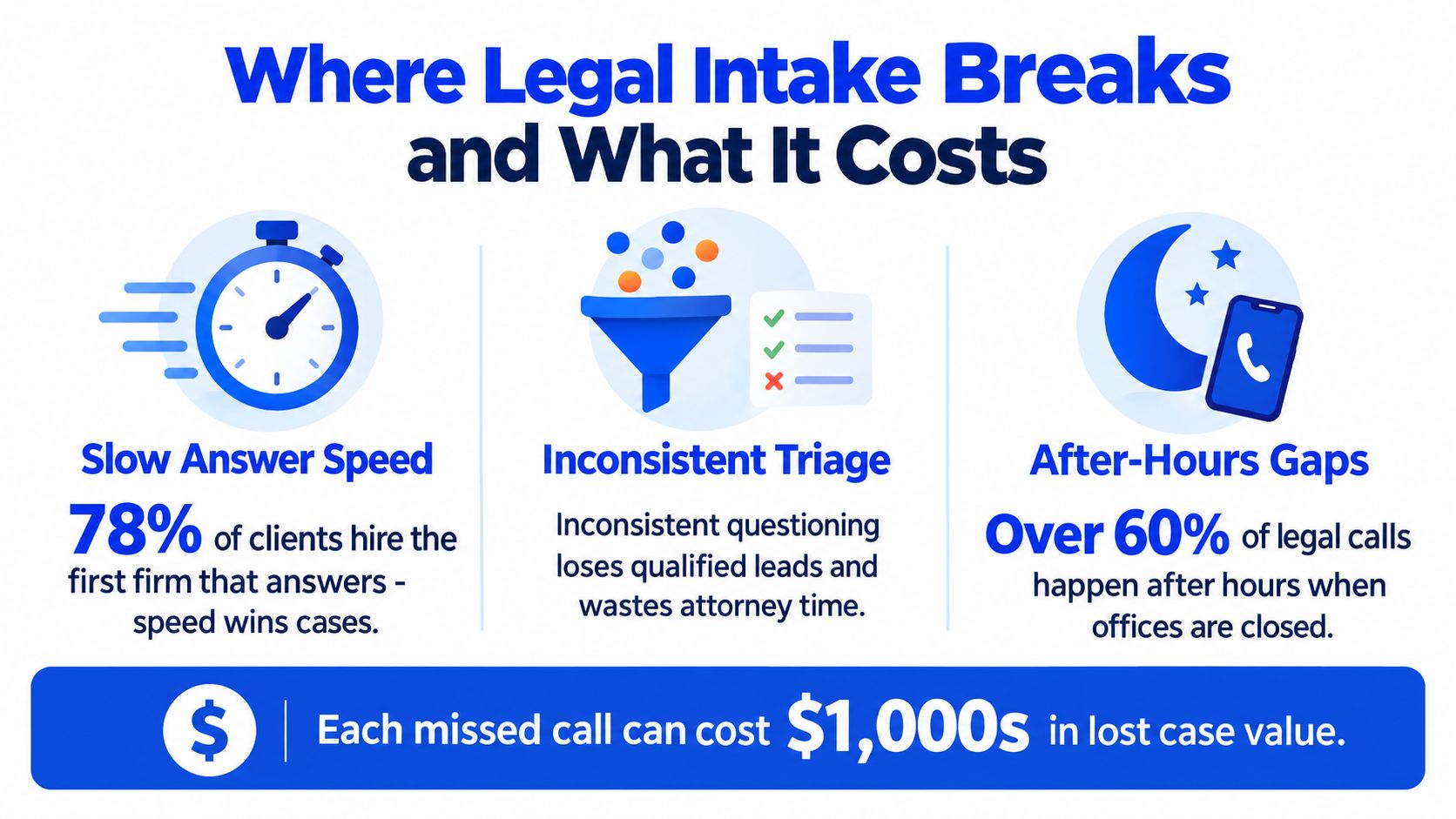
Legal intake usually breaks at three control points: response speed, triage quality, and coverage beyond office hours. Each point affects more than convenience. Together, they determine whether a potential client reaches the right person, receives a useful next step, and remains available for follow-up.
Slow response turns intent into uncertainty
A caller's intent is strongest when they first dial. Silence or repeated ringing creates uncertainty. The caller cannot tell whether the firm is busy, closed, uninterested, or unable to help, so the next action may be voicemail or another firm.
As noted earlier, even brief delays can sharply increase hang-ups. The operational lesson is simple: a law firm needs a reliable first response and a clear route for calls that cannot immediately reach the intended staff member. Answer speed should be audited rather than assumed.
Use an overflow test to see what happens. For example, place calls while the receptionist is serving a visitor, attending a meeting, and already handling another call. Record the time, who or what answered, whether the caller reached a person, and whether a callback or message was created. A result such as “12:04, main line busy, voicemail, no intake record” identifies a control failure more clearly than a general complaint about missed calls.
Check lunch periods, transfers, peak demand, and every internal line being occupied. Overflow is part of the intake design when the primary receptionist also manages visitors, scheduling, and records.
Inconsistent triage wastes leads and attorney time
A caller who provides incomplete information can produce a weak handoff. The attorney then has to reconstruct the matter type, urgency, opposing party, and requested service, while the caller experiences the firm as disorganised.
A short intake script should work like a sorting tray. Branching rules can separate new enquiries from existing clients, routine consultations from urgent matters, and appointment requests from issues requiring attorney review. The script should also identify questions the receptionist must not answer and the point at which a human owner takes responsibility.
After-hours gaps hide high-intent calls
A firm may run an effective daytime desk and still lose opportunities after closing. After-hours coverage should provide more than a generic voicemail. It should capture enough information for follow-up, explain the next step, and route urgent matters according to a defined process.
The cost can include a competitor receiving the first conversation, an urgent issue waiting without appropriate escalation, or an existing client reaching the wrong team member. Audit the full path:
- Answer speed: How quickly does a person or system respond?
- Overflow behaviour: Where does the call go when the main line is occupied?
- Intake completeness: Can an attorney act on the message without repeating the initial interview?
- Urgent routing: Does an urgent call reach a defined human owner?
- After-hours continuity: Does the caller receive useful next steps when the office is closed?
Compliance and Ethics Essentials for Legal Phone Handling
A caller may share personal facts before speaking with an attorney. The receptionist therefore serves two functions: intake coordinator and risk control point. The phone process must collect useful information without creating a confidentiality, consent, or unauthorized-practice problem.
California firms should define how calls are handled under two-party consent rules, CCPA disclosures, confidentiality duties, and the boundary between gathering information and giving legal advice. These requirements also apply when an outside service or automated system answers calls beyond ordinary office hours. California legal answering guidance from LexReception discusses these concerns in relation to legal intake.
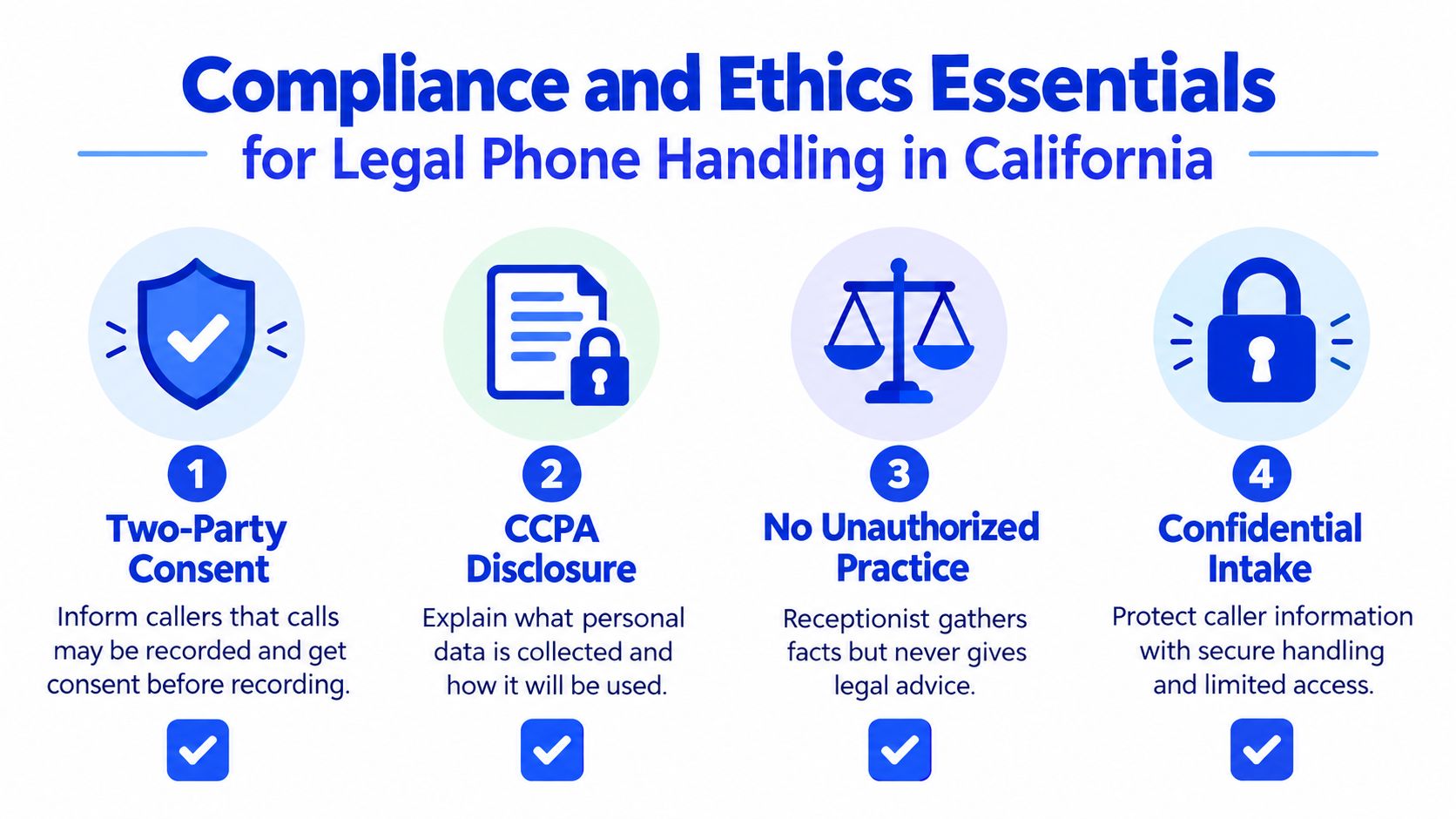
Standardise the opening disclosure
If the firm records calls, the receptionist or system needs approved language that informs the caller and obtains the required consent before recording. Place that language in the script rather than relying on memory. The script should also explain what happens if the caller declines, and vendors should follow the same process.
Privacy notices should be brief and clear. Explain what information the firm collects and how it will use it, without making promises the firm has not approved. A receptionist should not create a new privacy explanation during an urgent or emotional conversation.
Keep intake separate from legal advice
Reception staff can collect facts, describe the next administrative step, and send the matter to the right person. They should not assess legal merits, predict an outcome, recommend strategy, or suggest that the firm has accepted representation.
Approved escalation language protects both the caller and the firm. A receptionist might explain that an attorney must review the information and that collecting details does not create an attorney-client relationship. Counsel should approve the wording for each practice area.
Protect the handoff
An intake record should contain only the information needed at that stage, with access limited to authorised team members. Informal messaging can expose sensitive details, so the firm should approve each channel and set rules for its use.
Language coverage must follow the same controls. If the firm serves English- and Spanish-speaking callers, both paths should use equivalent questions, disclosures, urgency rules, and escalation instructions. A translated script without matching process rules can produce inconsistent treatment.
Before adding receptionist coverage, standardise:
- Recording rules: When recording is permitted, how consent is obtained, and what happens without consent.
- Privacy language: The approved explanation for collecting and using personal information.
- Intake boundaries: The topics staff may address and the topics reserved for attorneys.
- Conflict-aware routing: The information required before a matter moves forward.
- Urgent escalation: The human owner, response expectation, and after-hours instruction.
For a closer look at automated legal call handling, review AI receptionists for law firms. Counsel or compliance leadership should review the proposed script before launch.
How an AI Phone Receptionist Supports Law Firms
An AI phone receptionist is most useful when the firm needs consistent first response, not automated legal judgement. It can answer calls continuously, conduct a natural conversation, follow approved intake instructions, and book appointments when the calendar connection allows it.
The practical advantage is repeatability. A system doesn't forget to ask for a required intake field because the office is busy, and it doesn't stop answering because the receptionist is helping a client in person. It can provide an immediate response, identify the reason for the call, collect approved details, and offer an available consultation slot.
That doesn't make automation appropriate for every interaction. A firm should define which calls the AI can complete, which calls it should transfer, and which calls require a message for human review. Urgent matters, distressed callers, existing-client issues, and questions outside the configured knowledge should have a clear escalation path.
Configure the system around the firm
A useful deployment starts with the firm's public information and approved internal rules. Website content can supply basic practice areas, office hours, service descriptions, and appointment information, but a managing partner should still review what the system says and add exceptions that aren't public.
Calendar integration is another control point. Connecting Google Calendar lets the system check availability before offering an appointment, reducing manual back-and-forth and avoiding double-booking. The firm should decide which calendars are eligible, which appointment types are offered, how much information appears in the booking, and who receives the intake record.
Heyline provides an AI phone receptionist that can use a firm's website information, answer inbound calls, hold a natural conversation, connect with Google Calendar for appointment booking, and support a setup process based on pasting the website, connecting the calendar, testing, and launching.
Test calls matter more than a polished configuration screen. Ask ordinary questions, provide incomplete information, simulate an urgent matter, decline a recording disclosure if relevant, request a language change, and test a calendar booking. Review the transcript or recap, then edit the system's knowledge and routing rules before directing live traffic to it.
The following demonstration shows how a phone receptionist can fit into an appointment workflow.
Use AI as a coverage layer when your staff already handles complex work well but cannot answer every call. Keep human ownership for legal judgement, sensitive escalation, and exceptions. The system should make those handoffs cleaner, not hide them.
Choosing and Deploying the Right Receptionist Solution
Start with the workflow, not the vendor. Write down your call categories, coverage hours, bilingual requirements, appointment types, escalation owners, and privacy rules. Then ask each provider to demonstrate those exact scenarios rather than offering a general product tour.
California wage data provides a useful baseline for the build-versus-buy conversation. ZipRecruiter's California law-firm receptionist data reported an average of $17.62 per hour on June 24, 2025, with a typical range from $15.19 at the 25th percentile to $18.75 at the 75th percentile, while top earners reached $24.67 per hour. The same dataset estimated average annual pay at $36,645, or about $3,053 per month, before considering benefits, absence coverage, training, office space, and management time.
Local hiring conditions vary. ZipRecruiter reported average law receptionist pay of $19.20 per hour in Los Angeles on August 6, 2026, $20.92 per hour in San Jose on August 26, 2026, and $18.35 per hour in San Bernardino on July 3, 2026, where most workers earned between $15.82 and $19.52 per hour. These California city-level figures are dated market snapshots, so use them as context rather than a quote for your own compensation plan.
Apply a short deployment checklist
- Map demand: Review when calls arrive, when staff miss them, and which matters need immediate escalation.
- Define intake: List the required questions, prohibited advice, conflict-related information, and approved disclosures.
- Choose coverage: Decide whether the firm needs an on-site person, a live remote team, automated first response, or a hybrid.
- Connect scheduling: Configure the appropriate calendar and appointment types, then test availability and booking.
- Run test calls: Try routine, urgent, bilingual, incomplete, existing-client, and after-hours scenarios.
- Review handoffs: Confirm that every message reaches the correct owner with enough information to act.
- Measure the workflow: Track unanswered calls, abandoned calls, incomplete intakes, booking errors, and escalation failures.
If you want to compare human answering services with other attorney-focused options, use this guide to answering services for attorneys as a starting point. The right solution isn't the one with the most automation. It's the one that answers the calls your team currently misses, follows the rules your firm has approved, and gives attorneys a dependable next action.
Heyline provides an AI phone receptionist for law firms that answers inbound calls, holds natural conversations, follows configured intake rules, and books appointments through a connected calendar. Visit Heyline to review the setup and decide whether consistent phone coverage can strengthen your firm's intake without adding another front-desk hire.