You're finishing a client appointment when the phone rings. You can't answer it, so the caller leaves a voicemail, sends a message through your website, or tries another local business. By the time you return the call, the available slot may be gone and the customer may already have booked elsewhere.
That's the purpose of telephone answering services. They keep more than a line occupied. They protect booking opportunities when your team is with customers, driving between jobs, handling patients, or away from the business. The right service captures intent, checks availability, books only suitable appointments, and escalates conversations that require human judgement.
The Evolution of Telephone Answering Services
California's outsourced answering market existed long before AI voice systems. The Telephone Answering Services classification recorded 173 private establishments in the second quarter of 2016, employing 2,230 workers and reporting quarterly payroll of $19.406 million, according to California's official employment and wage data. Those businesses primarily answered calls and relayed messages for clients, which is the same commercial problem local owners still face today.
The technology changed. The problem didn't.
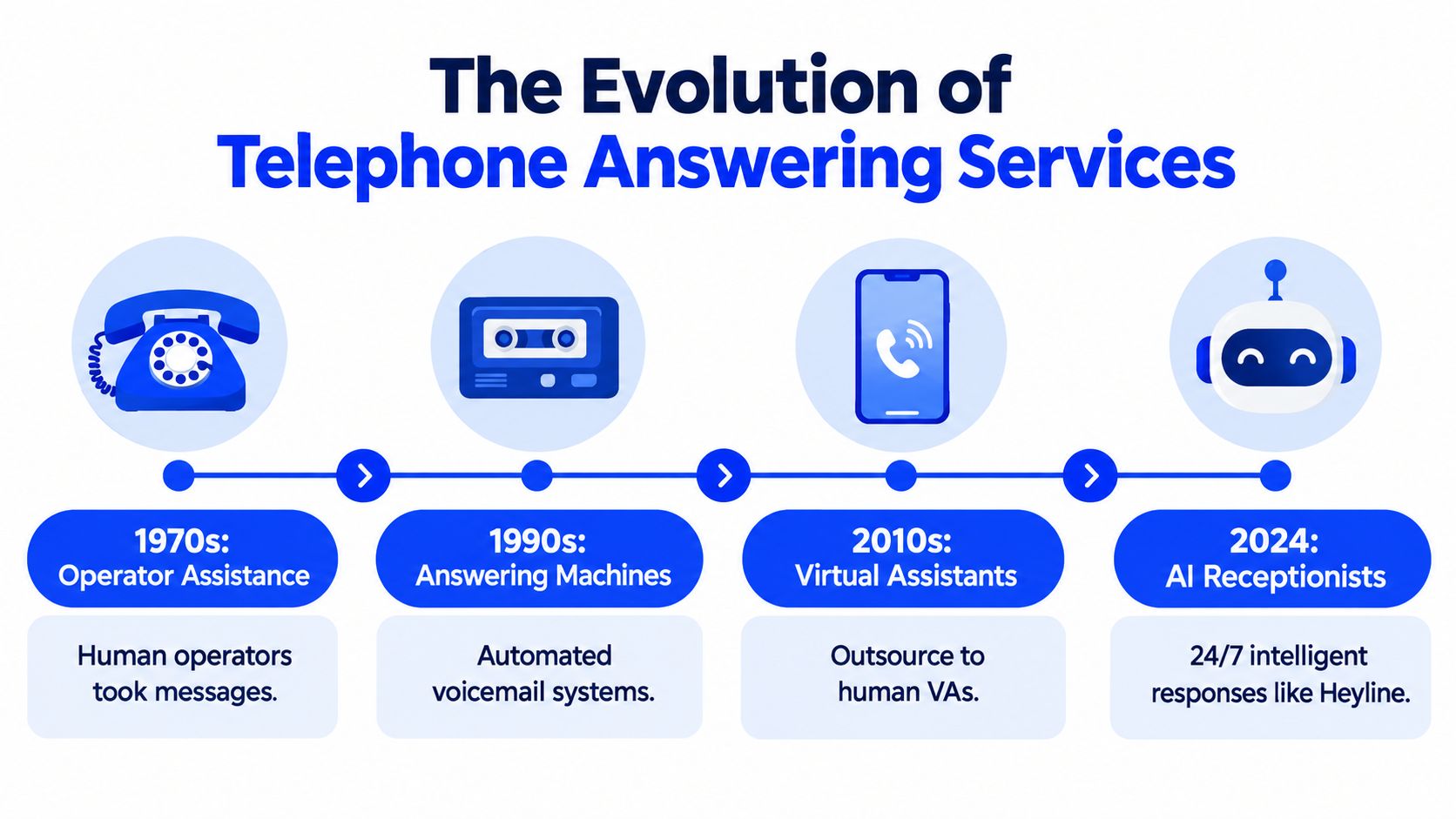
A salon owner once relied on an office employee or an external operator to take a message. Later, answering machines and voicemail captured calls without requiring a person to pick up. Virtual assistants then added remote human support, while modern AI receptionists can hold a conversation, answer routine questions, and connect an appointment to a live calendar.
The customer need stayed constant
Regional industry listings show that California answering providers have operated across several telecommunications eras. Personal Telephone Answering Service in San Jose was established in 1961, while other listed providers began in 1979, 1985, 1986, and 2010, as documented in this regional overview of California answering services.
Those dates matter because they show that outsourced reception isn't a passing trend. A local business has always needed someone to receive enquiries when employees weren't available, record useful information, and pass the message to the right person. What's changed is the expected outcome. A message sitting in an inbox is no longer enough when the caller wanted an appointment they could have booked immediately.
Operational rule: If a caller can safely book without human judgement, the system should offer a real available slot instead of creating another callback task.
Traditional message-taking still has a place for complex, sensitive, or unusual enquiries. But appointment-based businesses need more than coverage. They need a telephone answering workflow that turns a conversation into a clean, confirmed calendar event. For a practical overview of the modern model, see this guide to small business call answering services.
Comparing Live Agents and AI Receptionists
The right choice depends on the type of call your business receives, not on whether the provider advertises human or automated answering. A dental practice handling insurance questions needs a different workflow from a barber shop taking straightforward booking requests. A home-services company may need to separate routine estimates from urgent repair calls before anyone offers a time.
| Feature | Live Answering | Virtual Receptionist | AI Receptionist |
|---|---|---|---|
| Routine questions | Strong, provided agents have current instructions | Strong for scripted information | Strong when the knowledge base is accurate |
| Appointment booking | Can book, but staff must confirm the process and access | Often takes a message or follows a limited booking workflow | Can check calendar availability and book when integrated |
| After-hours coverage | Available through staffing arrangements | Depends on provider hours | Continuous coverage is a core capability |
| Complex caller intent | Best option for judgement, empathy, and unusual situations | Suitable for defined scripts and message-taking | Must use clear transfer and refusal rules |
| Brand consistency | Depends on training and agent continuity | Depends on scripts and team quality | Consistent voice and approved information |
| Escalation | Direct human judgement | Transfer or message workflow | Configured transfer to staff or live support |
| Main risk | Cost and variable agent familiarity | Phone tag and incomplete information | Incorrect assumptions, poor escalation, or stale business data |
Live agents
A live answering service is the strongest option when the caller's emotional state, confidentiality, or situation requires judgement. Law firms, medical practices, and businesses dealing with distressed customers may reasonably prioritise a trained person who can listen, clarify, and decide whether a call needs immediate attention.
The trade-off is operational complexity. You'll need to maintain scripts, escalation instructions, holiday hours, staff contacts, and booking rules. If agents only take messages, your team still has to return calls and complete the scheduling work.
Virtual receptionists
A virtual receptionist usually sits between a basic call centre and a full booking system. The service may answer in your business name, capture the caller's details, provide standard information, and send a written summary.
That model works when your primary problem is missed calls and your customers can tolerate a callback. It's weaker when the caller is choosing between providers based on who can confirm an appointment first. Message-taking may preserve the lead, but it doesn't necessarily preserve the booking.
AI voice agents
An AI receptionist makes the most sense for predictable inbound conversations. It can ask what the caller needs, answer approved questions, check calendar availability, and write the appointment during the call. It can also route a call when the request falls outside its instructions.
The system must not improvise. Before launch, define which services can be booked, how long each appointment requires, which staff members are eligible, and what happens when the calendar has no suitable slot. A natural voice isn't a substitute for accurate business rules.
Pricing Models and Hidden Operational Costs
Price per minute is a poor buying criterion on its own. The useful question is what does a completed, conflict-free booking cost your business, including the work your staff perform after the call?
Live telephone answering services commonly use per-minute, per-call, subscription, or hybrid billing. A per-minute plan can appear attractive when calls are brief, but longer consultations or transfers increase usage. Per-call billing offers a clearer relationship between activity and spend, while a subscription can make monthly planning easier if the included allowance matches your demand.
AI services often use a predictable subscription structure, but predictable billing doesn't guarantee value. A low invoice can still be expensive if the system creates bad bookings, sends incomplete messages, or forces staff to correct its work.
For a useful explanation of answering service cost structures, focus on the work each model removes from your team.
Count the work after the call
A receptionist may answer a call successfully while creating several hidden tasks:
- Voicemail interpretation: An employee listens to an unclear recording and tries to identify the caller, service, preferred time, and urgency.
- Callback coordination: Staff exchange messages with the customer before finding a suitable appointment.
- Calendar administration: Someone manually checks availability, enters the booking, and sends confirmation.
- Conflict correction: The team fixes duplicate appointments or bookings assigned to the wrong provider.
- Information maintenance: Employees repeatedly explain prices, opening hours, parking details, or preparation requirements that the service should already know.
Your evaluation should include these costs. Ask providers to show how they record caller intent, how they confirm calendar availability, and how they prevent a booking from being written twice during simultaneous calls.
Use booking quality as the denominator
Call volume is an activity measure. It doesn't tell you whether the service generated useful outcomes. Track completed appointments per answered call, then separate routine information requests, qualified booking opportunities, transfers, unresolved questions, and calls that ended without a suitable next step.
A service that answers every call but books the wrong service is not efficient. Nor is a live agent who takes polished messages but leaves your staff to do all the scheduling. Choose the model that reduces the most valuable operational work, not merely the model with the lowest headline rate.
Measuring Call Performance and Answer Latency
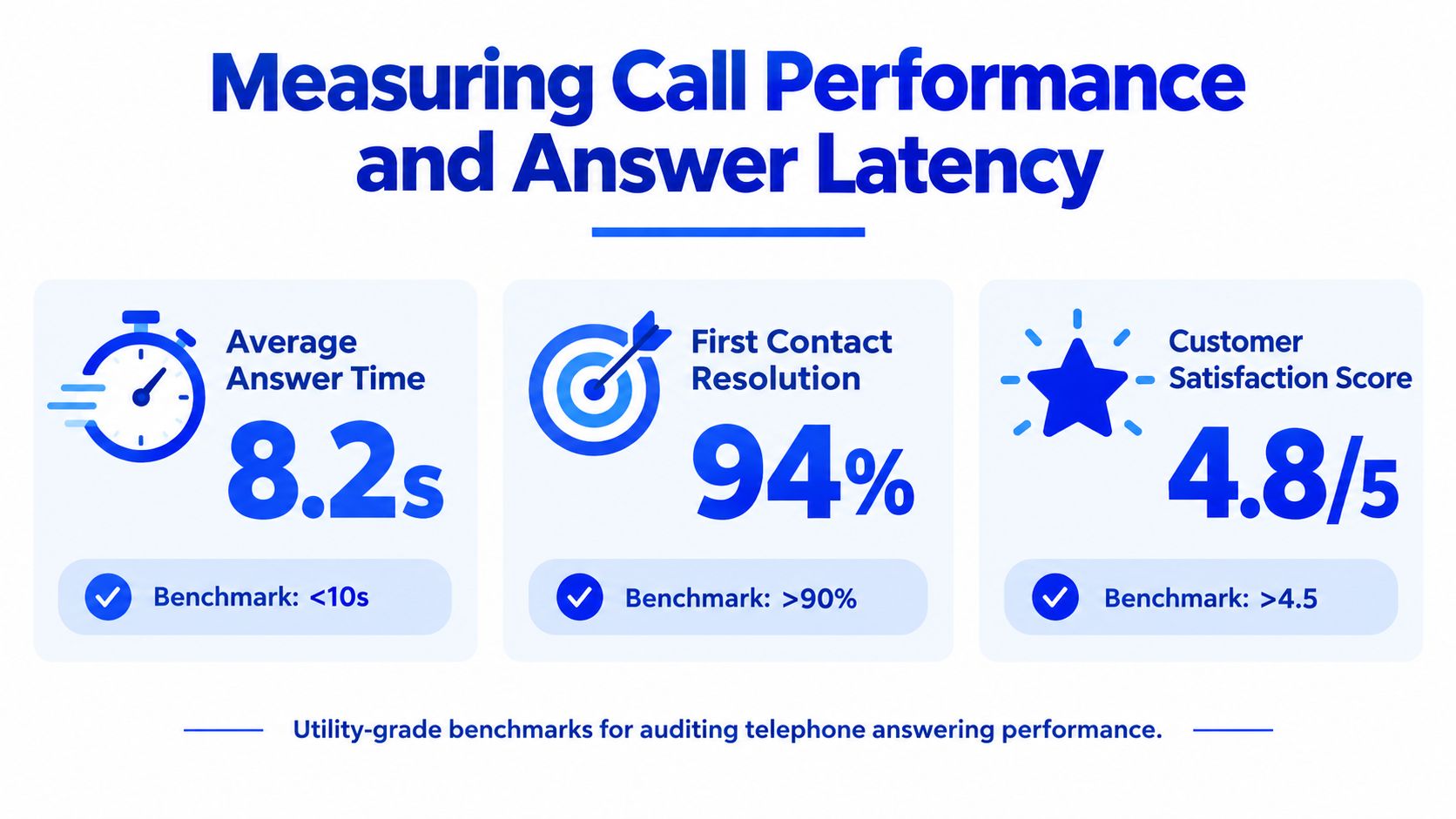
You can't manage telephone answering services from a monthly call total. A monthly average can hide failures during lunch, evenings, weekends, or the first minutes after a promotion goes live. Measure the moments when your team is least available and callers are most likely to abandon the attempt.
California's Public Utilities Commission provides a useful reference point for designing service levels. Its utility benchmarks include an average speed of answer of 20 seconds, Southern California Edison's goal of answering 75% of weekly calls within 50 seconds during at least 90% of weeks, and San Diego Gas & Electric's target of answering 80% of calls within 60 seconds, as recorded in the CPUC decision on telephone service standards. These are utility-specific standards, not universal requirements for salons or contractors, but they offer a defensible engineering reference for California operators.
Build a practical dashboard
Your dashboard should connect telephony events to booking outcomes. At minimum, record:
- Answer latency: Measure the time between call arrival and pickup.
- Abandonment: Identify callers who disconnect before reaching an agent or system.
- Service level: Report the share answered within your chosen threshold.
- Transfer rate: Separate routine calls from those needing staff intervention.
- Booking completion: Record whether the caller received a confirmed appointment.
- Conflict-free booking rate: Check that each confirmed event has the correct service, provider, time, and caller details.
The important metric is not just average speed. Report median and 90th-percentile answer times so a few extreme delays don't disappear inside an average. Segment the results by business hours, lunch periods, evenings, and weekends.
Practical rule: A fast answer that produces an incorrect appointment is a service failure, not a success.
Audit the handoff to your calendar
Review a sample of calls against the resulting calendar records. Confirm that the system captured the caller's name, number, requested service, preferred time, disposition, transfer result, and final appointment status. If calls are recorded or transcribed, restrict access by role and retain the data only for a defined operational purpose.
The customer service survey guidance can help you add caller feedback to the operational dashboard. Use feedback alongside telephony data, not instead of it. Customers may report that a conversation felt smooth even when the booking was assigned incorrectly, so your audit needs both experience and outcome measures.
Evaluating Booking Quality and Caller Intent
Answering every call isn't automatically good for the business. An automated system should refuse to book when it lacks the information needed to fulfil the appointment safely, and it should escalate when the caller describes a situation that requires professional judgement.
A missed haircut appointment is inconvenient. A caller describing a medical symptom, a legal deadline, or an emergency repair needs a controlled path to a qualified person. The system should recognise the limits of its role instead of trying to sound helpful while making an unsafe assumption.
Separate simple bookings from high-risk conversations
Create booking rules by category:
- Routine services: Book only approved services with defined durations, prices, staff eligibility, and preparation requirements.
- Sensitive enquiries: Collect contact details and transfer the caller when the conversation involves confidential legal, medical, or personal information.
- Urgent situations: Give the approved emergency instruction and escalate according to your operating policy. Don't let an automated booking flow delay urgent help.
- Unclear intent: Ask a focused clarification question. If the caller still can't be categorised, send the conversation to a person.
- Unavailable appointments: Offer only genuinely available alternatives, or capture the request for staff follow-up.
A website-based knowledge base can become unreliable when services, prices, holiday hours, providers, insurance rules, or emergency policies change. Assign one person to review those details and test the system whenever a material operational change occurs.
Track the outcome that matters
Use a qualified-booking rate rather than counting every answered call as a conversion. Then monitor cancellation and no-show rates, transfer rate, unresolved-question rate, caller acceptance of any AI disclosure, and time to human escalation.
These measures reveal the trade-off between coverage and quality. A system can increase availability while degrading customer experience if it books unsuitable services or makes callers repeat themselves after transfer.
The best receptionist is not the one that says yes most often. It's the one that knows when yes is safe, when no is accurate, and when a person must take over.
For each business category, write explicit refusal and escalation examples. A salon may transfer a complex colour correction consultation. A clinic may route symptom-related calls to staff. A law firm may collect intake information without offering legal advice. A contractor may distinguish a routine quote from a possible emergency before offering a visit.
Navigating California Compliance and AI Disclosure
California owners shouldn't treat compliance as a vendor checkbox. Before activating an AI receptionist, decide whether calls are recorded, transcribed, analysed, transferred, or retained, then document how the system handles caller notice and objections.
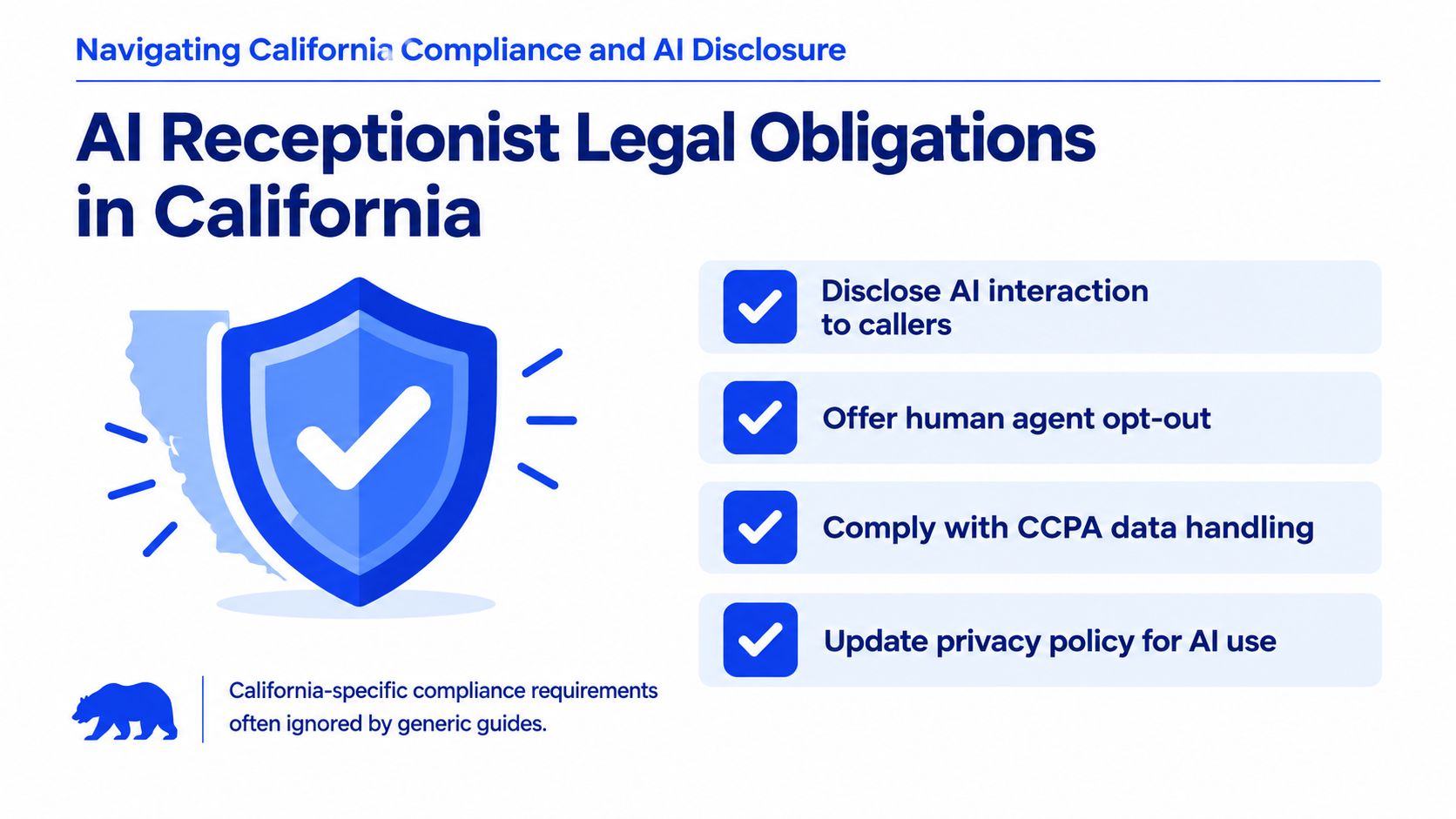
California's AB 2905 took effect on January 1, 2025. It requires automatic dialing-announcing devices using an AI-generated or significantly AI-modified voice to disclose that fact to the called person, with a stated penalty of up to $500 per violation, according to this California AI law update. The rule is especially relevant when a local business uses an AI voice to answer inbound calls and interact with customers.
California privacy exposure also extends beyond a simple disclosure script. A February 2025 Northern District of California ruling allowed claims to proceed under the California Invasion of Privacy Act where an AI voice product allegedly intercepted communications while they were in transit, as discussed in this analysis of AI voice products and CIPA claims.
Use this pre-launch checklist
- Disclose the AI interaction: Tell callers that they're speaking with an AI-generated or significantly AI-modified voice where the requirement applies.
- Explain recording and transcription: Don't hide recording or analysis inside a vague greeting. State what the system does and why.
- Handle objections: Provide a clear route to a human or an alternative process when a caller doesn't want to continue.
- Review consent requirements: Get California legal advice on recording and interception rules, particularly where private communications may be captured.
- Limit retention: Set a defined operational retention period for recordings, transcripts, and caller details. Don't keep data indefinitely by default.
- Restrict access: Use role-based permissions so only authorised staff can review sensitive call data.
- Update privacy notices: Describe relevant AI, recording, transcription, and data-handling practices in the business's privacy documentation.
- Document escalation: Specify when the system must transfer, stop collecting information, or direct the caller to an approved channel.
This isn't a declaration that every inbound AI receptionist is legal or illegal. The facts depend on the call flow, disclosures, recording behaviour, data practices, and business category. Have California counsel review the configuration before launch, especially for medical, legal, and other privacy-sensitive operations.
Implementing an AI Receptionist Without Technical Overhead
A practical launch doesn't begin with a complicated flowchart. It begins with accurate business information and a clear boundary around what the system may book, answer, or escalate.
Use a short implementation sequence:
- Select the service model. Decide whether you need live agents, message-taking, AI booking, or a hybrid workflow. Base the decision on caller risk and booking complexity.
- Prepare the knowledge. Review every service, price, duration, provider, opening hour, holiday exception, location detail, and emergency instruction. Website content is a starting point, not a permanent source of truth.
- Connect the calendar. Ensure the system checks current availability immediately before confirmation and creates a unique event record. This reduces duplicate booking risk.
- Test real scenarios. Call as a new customer, an existing customer, an after-hours caller, a person requesting an unavailable slot, and someone who needs a human. Test both successful and refused bookings.
- Route the number. Use a dedicated number or forward missed calls through the selected service. Confirm that transfers reach the right person during every coverage period.
- Review early interactions. Check transcripts, booking records, escalations, and unanswered questions. Update the knowledge and rules based on actual calls.
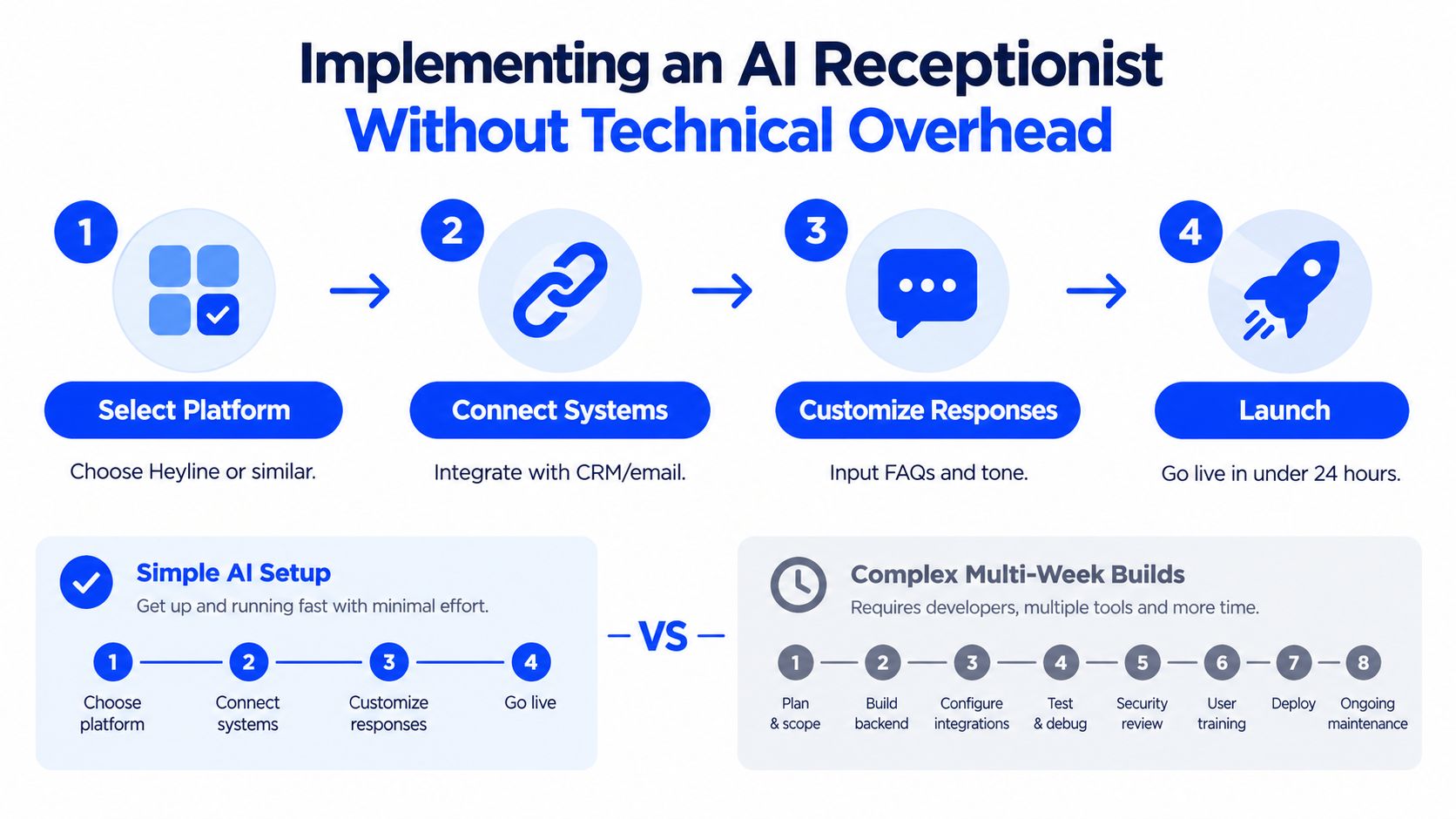
Platforms such as Heyline are designed around this lighter setup model, using a company website as an initial information source, connecting a calendar, allowing knowledge edits, and supporting test calls before launch. That approach suits owners who need a working inbound booking process without building node-based call flows or maintaining a developer-managed telephony stack.
The technology still needs management. Assign an owner for updates, review booking quality, and keep human escalation available for sensitive or ambiguous calls.
Telephone answering services should be judged by qualified bookings, accurate calendar events, safe escalation, and compliant data handling, not by how many calls they technically answer. If missed calls are costing your local business opportunities, visit Heyline to see how its AI phone receptionist handles inbound conversations and calendar-based appointment booking. Start by testing your real services, hours, and escalation rules, then measure completed bookings rather than call volume alone.