Saturday morning is when a phone can become part of the furniture. A stylist is moving between clients, a dental hygienist is finishing a cleaning, or a plumber is working under a sink. The business line rings, shows an unfamiliar number, and rings again while everyone nearby is occupied.
Several hours later, the owner hears the voicemail. A new patient wanted a cleaning next week. A homeowner needed an urgent repair. A salon client was ready to book. By then, the caller has already found another business.
That pattern is the starting point for an AI phone number. The question isn't whether artificial intelligence sounds impressive. It's whether a phone system can answer when nobody is free, understand what the caller needs, and move the conversation toward a booking or a person without creating a new set of problems.
The Call You Wish You Had Answered
The missed call usually doesn't look important when it arrives. It might be one unknown number among several, during the exact moment when the owner is checking a colour formula, assisting a patient, or carrying equipment through a customer's home. Letting it go to voicemail feels reasonable.
The caller experiences something different. They have a question, a schedule to coordinate, or a problem they want solved now. A voicemail greeting asks them to leave details and wait. Many won't. They'll call the next salon, clinic, contractor, or law office that answers.
This is especially relevant in California, where phone use already sits inside a large, heavily filtered call environment. A California-focused report recorded 356.2 million robocalls in November 2024, about 11.9 million per day (California call-screening and AI phone context). People are accustomed to screening calls, automated responses, and deciding quickly whether a phone interaction deserves their time.
The business side is changing too. A 2026 summary of California survey data reported that about 21% of California businesses used AI in at least one business function, compared with roughly 20% nationally (California AI receptionist market context). The same summary estimated that California represented 11.0% of U.S. telephone answering service establishments, with 113 businesses in NAICS 561421. That combination points to a market where AI phone handling isn't merely a novelty. It fits an existing habit of routing, screening, and answering calls through systems.
Practical rule: Treat every unanswered business call as a conversation that may already be moving to a competitor.
An AI phone number is built for this gap. It gives callers a real number to dial, then places a software receptionist behind that number. The receptionist can greet the caller, answer known questions, collect details, and sometimes schedule an appointment. It doesn't eliminate the need for human judgment. It gives the business a way to respond before the opportunity disappears.
What an AI Phone Number Actually Is
An AI phone number is an ordinary phone number connected to a software-based receptionist. A caller dials it as they would any business line. The system listens to natural speech, interprets the request, and replies in a generated voice.
The number itself isn't the breakthrough. The difference is what answers behind it.
A traditional business number rings a desk phone, mobile phone, or shared handset. If nobody picks up, the call follows a voicemail or forwarding rule. A legacy IVR, or interactive voice response system, gives the caller a fixed menu such as “press one for sales” or “press two for hours.” Those systems can route calls, but they often make the caller translate a simple request into the menu's preferred wording.
An AI receptionist works more like a trained front-desk employee who has studied your website. It can learn your services, hours, policies, common questions, and booking rules. A caller might say, “I need to move my appointment,” “Do you do keratin treatments?”, or “Can someone come out today?” The system tries to understand the meaning rather than waiting for a matching button press.
A useful definition to repeat to a business partner is this:
An AI phone number is a regular business line with a conversational software receptionist behind it.
That receptionist may answer questions, take a message, transfer the caller, or connect to a calendar and book an available slot. The quality depends on the information it has received and the actions its phone platform is allowed to take.
The distinction matters when you compare services. Some providers offer a number with simple forwarding. Others provide a menu builder. Developer-first voice platforms may offer powerful components but require someone to design the conversation, connect systems, and maintain the logic. A website-trained receptionist sits between those models. It aims to turn existing business information into a usable phone conversation without making the owner build every branch manually.
How the Technology Works Behind the Voice
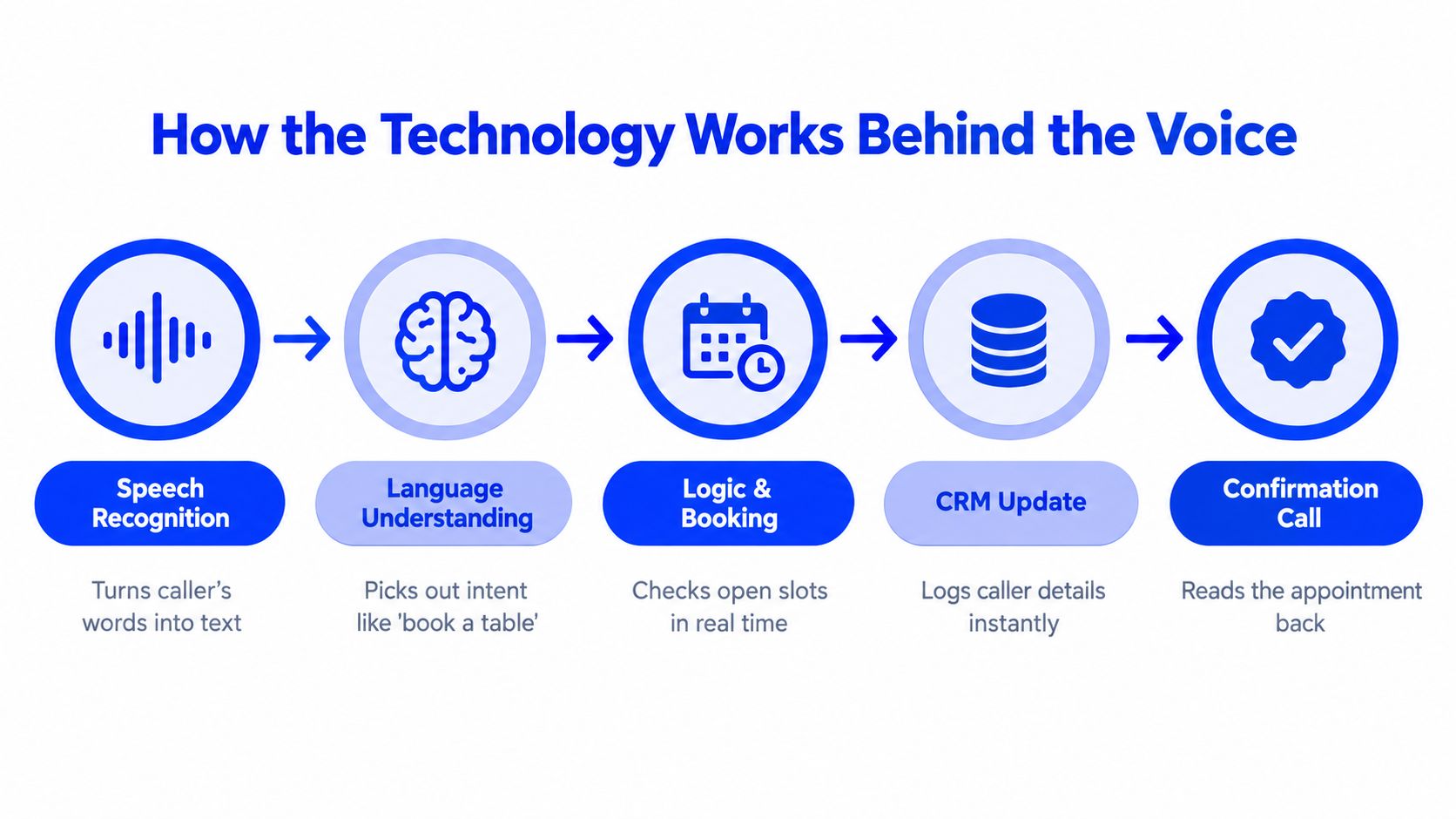
A spoken request becomes a useful phone interaction through several connected layers. The caller doesn't see those layers, but each one affects whether the experience feels smooth or awkward.
First, the system hears the caller
Automatic speech recognition converts the caller's voice into text while the conversation is happening. It has to cope with ordinary phone conditions, including background noise, accents, interruptions, and people who change their wording halfway through a sentence.
The system then uses language understanding to identify intent. “Can I come in Thursday afternoon for a consultation?” isn't just a sentence to transcribe. It contains a service request, a possible appointment type, and a time preference.
Next, the business rules guide the answer
The language model needs reliable business information. That may include the website, service list, FAQs, prices, opening hours, cancellation rules, preparation instructions, and calendar restrictions. If those details are incomplete or outdated, a confident voice can still give a wrong answer.
For a scheduling request, the system checks the connected calendar or booking tool. It may offer an available slot, create the appointment, collect contact details, and read the confirmation back. For a question outside its knowledge, it should take a message or offer a human route instead of guessing.
Phone routing is the layer that connects all of this to a real caller. A business can publish a new number, forward an existing line, or use the AI number for missed calls and overflow. The practical mechanics are explained in this guide to how call routing works.
Finally, the answer returns as speech
The system converts its response into a voice and plays it to the caller. The exchange feels natural only when the whole chain works together. Delays, interruptions, poor pronunciation, repetitive wording, and stale knowledge can make a technically capable system sound unprofessional.
Owners should judge the result by a simple test: can a real caller reach the right outcome without learning how the software thinks? A good system hides the complexity. It answers plainly, checks the right source, takes only the necessary action, and makes a human available when the situation requires one.
Setting Up an AI Phone Number Without a Developer
Setup should feel closer to training a new receptionist than commissioning a custom software project. You provide the business facts, connect the tools the receptionist needs, and test the situations that matter.
Start with the information people already use
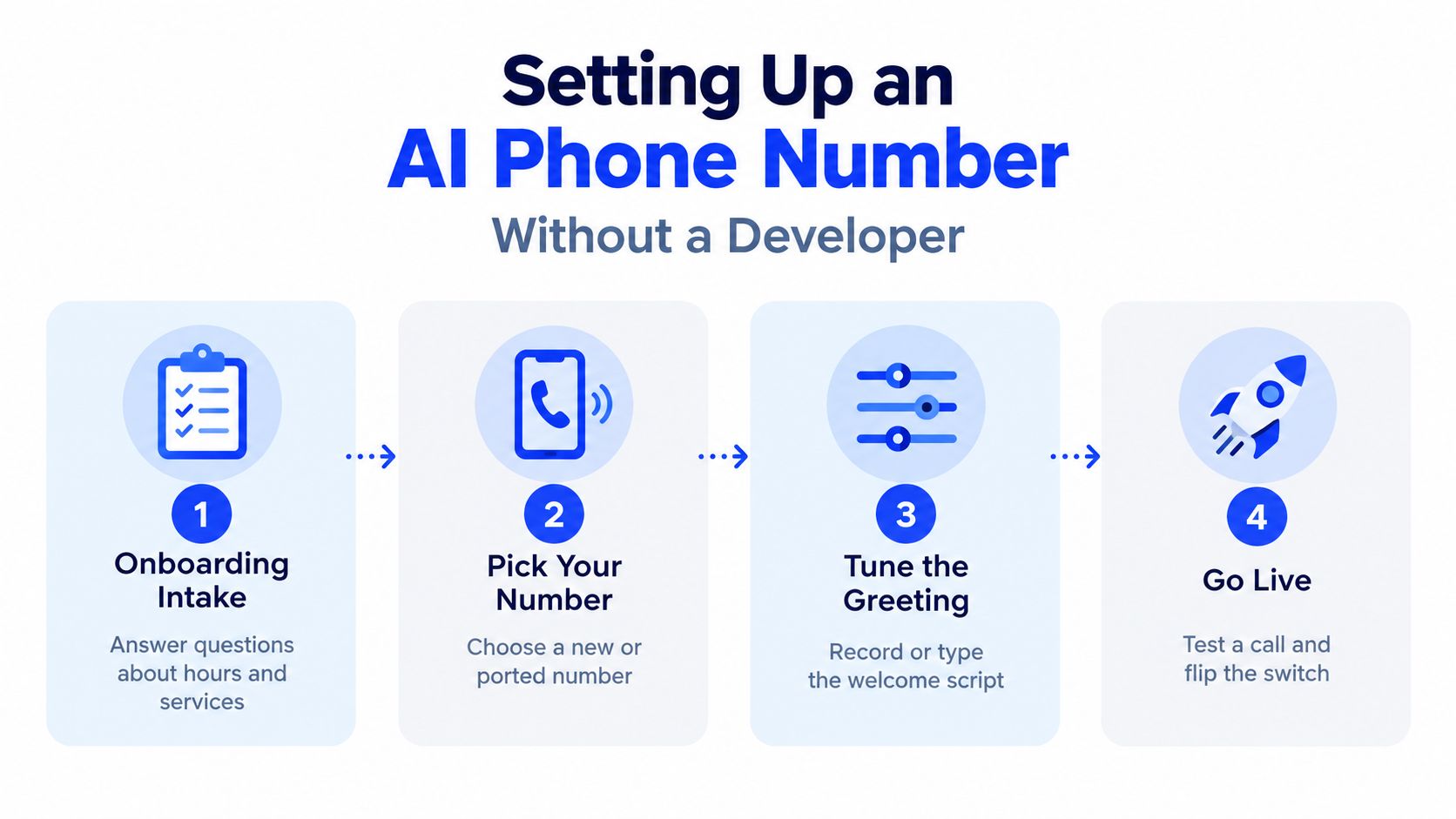
The first step is an onboarding intake. You explain the business's hours, services, locations, appointment types, policies, and preferred greeting in plain language. A website-trained system can use the public site as a starting point, then give you editable fields for corrections and additional notes.
That review is important. Websites often contain old service names, missing holiday hours, or policies that staff explain differently on the phone. Read the generated knowledge as if you were a caller looking for a quick answer.
Connect the actions
The receptionist needs permission to do more than talk. You may connect Google Calendar or another scheduling tool, select which appointment types it can book, and define when it should transfer or take a message. A simple contact form or CRM connection can give staff the caller's name, number, reason for calling, and requested follow-up.
The owner shouldn't need to create custom intents or write a separate rule for every possible sentence. Developer-first voice tools can be useful for specialised workflows, but they often ask for APIs, webhooks, prompt design, and ongoing engineering support. A small business setup should expose the decisions in ordinary language.
Test before replacing voicemail
Make sample calls from different phones. Ask about a common service, request a booking, give an unavailable time, interrupt the receptionist, and ask for a person. Call outside business hours and check what happens when the calendar has no suitable slot.
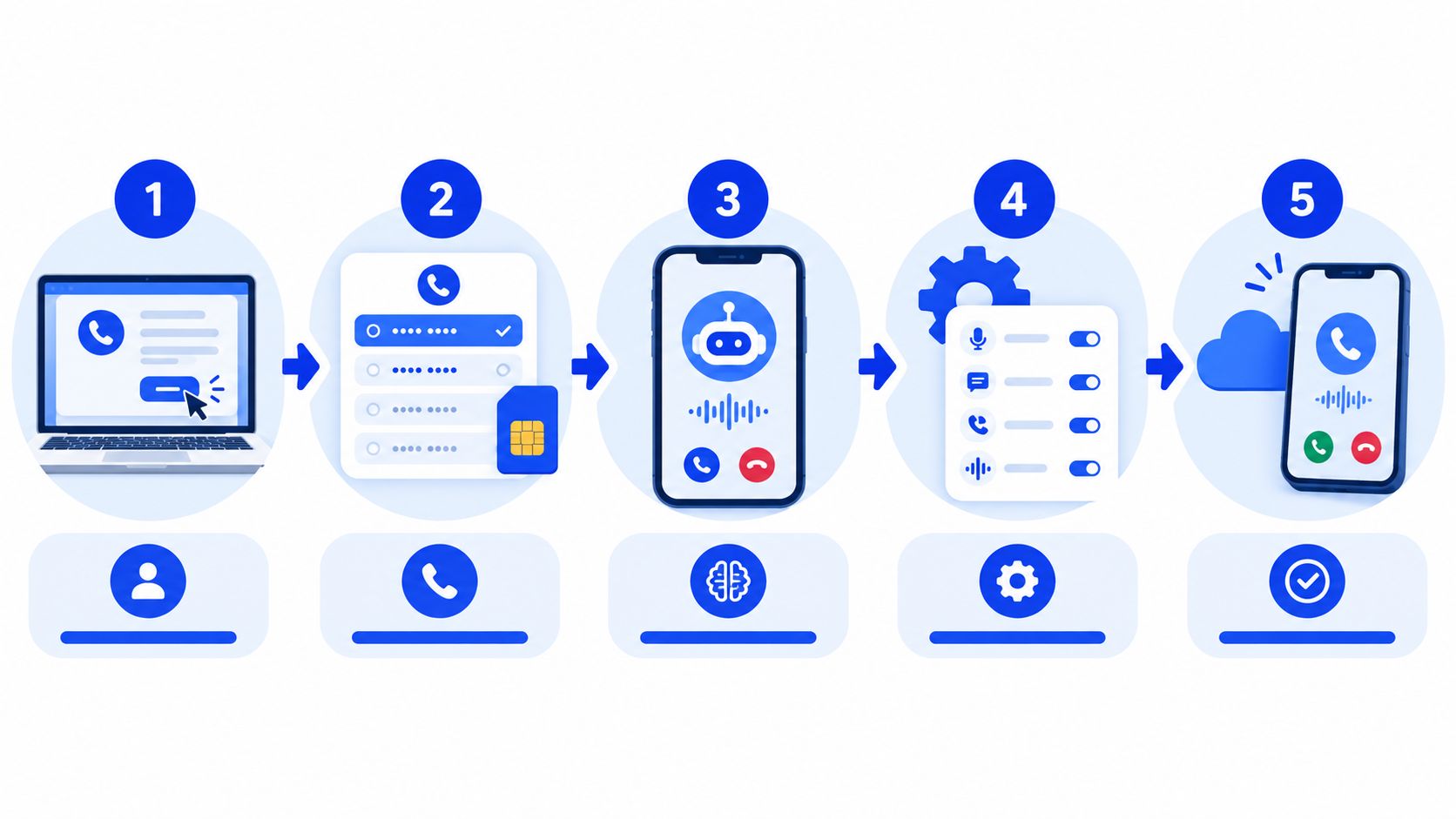
The system should be corrected before launch, not after a caller reports a confusing answer. This practical guide to setting up an AI answering service covers the same owner-led path, from business information to live call testing.
A controlled launch also protects staff. Start with after-hours calls, missed-call forwarding, or overflow during appointments. Review the conversations, update the knowledge, and expand the scope only when the handoff rules work reliably.
What an AI Phone Number Does Best
The strongest use cases are repetitive, time-sensitive, and easy to define. They involve callers who want an answer, a basic intake, or an appointment rather than a negotiation.
| Task | AI Phone Number | Traditional Approach |
|---|---|---|
| Inbound call handling | Greets the caller immediately and asks what they need | Rings staff, then reaches voicemail or forwarding |
| Call routing | Understands requests expressed in ordinary language | Uses fixed menus such as press-one options |
| Appointment booking | Checks connected availability and confirms a slot | Requires staff to pause work or return the call |
| After-hours coverage | Answers questions, captures details, and may book | Collects a voicemail for later follow-up |
| Overflow coverage | Handles calls while the front desk serves someone else | Leaves callers waiting or sends them away |
| FAQs and intake | Answers approved questions and gathers contact details | Depends on staff memory or a form on the website |
| Complex judgement | Escalates to a person | Keeps the conversation with a trained employee |
A salon might use it for service availability, appointment requests, cancellation policies, and directions. A dental practice might use it for basic scheduling and preparation information, while keeping clinical questions with staff. A plumber could collect the address, service type, urgency, and preferred callback time before a human decides how to dispatch the job.
The contrast with IVR is most obvious when a caller doesn't know the business's internal categories. “My crown feels loose” doesn't map neatly to a sales, billing, or appointment menu. A conversational system can recognise that the caller needs a dental team member, then follow the practice's escalation rule.
The limits matter just as much. Complex legal advice, sensitive complaints, unusual medical details, price negotiations, emergencies, and situations requiring licensed judgement shouldn't be forced through automation. The useful boundary is not “AI handles everything.” It's “AI handles the predictable first part and moves the consequential part to the right human.”
Benefits That Matter to Small Businesses
The first benefit is recovering conversations that would otherwise end at voicemail. If a stylist can't answer while working with a client, the receptionist can at least identify the caller's need and offer the next available booking path. If the system can't resolve the request, it can capture useful details instead of leaving staff with a vague message.
That changes the owner's workload. Staff can focus on the person already standing in front of them without treating every ring as an emergency. The receptionist absorbs common questions, basic intake, and calendar checks, while employees handle the work that needs hands, attention, or professional judgement.
Consistency is operational, not cosmetic
A business often gives different answers depending on who picks up, how busy they are, and whether they remember the latest policy. A central knowledge source gives callers the same approved explanation of hours, services, preparation, and booking conditions.
That consistency also exposes weak information. If the AI can't answer a question because the website is unclear, the owner has found a documentation problem. The fix isn't always a better voice system. Sometimes it's a clearer service page or a single written cancellation policy that staff can follow.
Coverage creates a more predictable routine
After-hours calls and busy-period overflow no longer depend entirely on whether one person notices a notification. A calendar-aware receptionist can handle eligible bookings while the business is closed, and staff can review messages or transcripts during normal working hours.
Cost comparison should remain practical. A business should compare an AI phone number with the cost of missed opportunities, staff interruptions, a dedicated receptionist, or an answering service that may only take messages. The right choice depends on call complexity and required coverage, not on a feature list.

The trade-off is straightforward. These benefits appear only when the system has accurate information, limited permissions, and a clear escalation path. An automated answer that sounds polished but gives the wrong preparation instruction can create more work than a missed call.
Privacy, Disclosure, and Human Handoff
The moment software answers a call, the owner has to understand what happens to the conversation. Callers may share names, contact details, payment information, health information, legal details, or other facts they didn't intend to place in a reusable transcript.
Start with the vendor's data practices. Ask direct questions before connecting the number:
- Audio storage: Where are recordings stored, and can the business disable recording?
- Transcript access: Which employees or contractors can read transcripts?
- Retention: How long do audio files, transcripts, call summaries, and contact records remain available?
- Model use: Are conversations used to train a shared model, or kept within the business account?
- Sensitive fields: Can the system avoid, redact, or limit payment and health information?
- Deletion: Can the owner delete a recording, transcript, or caller record on request?
Recording consent also needs a real operational answer. The greeting should match the jurisdictions where the business receives calls and the way the vendor processes audio. Don't copy a generic sentence without checking whether it accurately describes recording, transcription, and storage.
California adds a human-access question. A 2026 summary of AB 1609 reported that large businesses must clearly disclose when callers are interacting with a customer-service chatbot, provide a simple request for a human, and make a good-faith effort to connect the caller within 15 minutes or schedule an appointment within one business day (California chatbot disclosure and human-handoff requirements). The same source describes the law as preserving automated systems while adding expectations around disclosure and escalation.
That means a business shouldn't hide the handoff behind repeated prompts. Give the caller a clear spoken option, such as asking for a person, and define what happens next if nobody is available.
A short disclosure before the greeting may work for some workflows. An explicit spoken statement is clearer when the system is collecting information, booking appointments, or operating in a setting where the caller needs to know who is responding. The appropriate approach depends on the business, the call content, the vendor's implementation, and applicable rules.
Human access should be a designed path, not a promise buried in a menu.
Review a sample of transcripts regularly, especially after changing services, policies, or calendar rules. Keep a written internal policy that tells staff how to explain the AI receptionist, how to locate a caller's record, and when to take over immediately.
Deciding If an AI Phone Number Fits Your Business
Start with your own phone reality, not a product demonstration. Track how many calls go unanswered during a normal week, how many arrive after hours, and what a typical lost booking or delayed enquiry is worth to the business.
Three profiles often have a strong reason to test the model:
- Appointment-heavy service businesses: Salons, barbershops, spas, dental practices, aesthetics clinics, and similar operators receive requests that a calendar can often resolve.
- Small teams working with their hands: A plumber, cleaner, HVAC technician, or mobile service owner can't safely stop work for every ring.
- Multi-location or shared-front-desk businesses: A common answering layer can collect intent and route callers before staff decide which location or specialist should respond.
Two profiles need more caution. A high-touch consultancy may lose trust if an initial conversation requires subtle discovery, negotiation, or relationship-building. A regulated practice may need licensed staff to handle intake from the first sentence, particularly when the caller could disclose sensitive or urgent information.
The deeper question is whether the phone is actually the bottleneck. If appointments are unavailable, prices are unclear, service areas are too broad, or staff lack capacity, an AI phone number may only hide the underlying problem. Better call coverage can't create a slot that doesn't exist or make an unsuitable service profitable.
Before choosing a system, review the practical guidance on a small business call answering service, then define a narrow pilot:
- Record unanswered calls and after-hours enquiries for a normal operating period.
- Choose one call type, such as new appointment requests or missed-call follow-up.
- Connect only the calendar, service information, and escalation rules needed for that type.
- Test real questions, incorrect assumptions, cancellations, and requests for a human.
- Review whether callers reach the intended outcome and whether staff receive usable information.
Set the success criteria before launch. You might measure completed bookings, qualified messages, appropriate transfers, inaccurate answers, and staff corrections. If the system reduces phone pressure without compromising trust, expand it carefully. If it only produces more conversations for an already overloaded team, fix the business process first.
Heyline provides a dedicated phone number or forwarding route with an AI receptionist that answers common business questions and books appointments through a connected calendar. If you want to test whether that approach fits your call coverage gap, visit Heyline and review the setup for your business.