416 is the area code for the City of Toronto, Ontario, Canada, not the United States, and a 416 number is always dialed as ten digits. If a number uses the same +1 country code and the same three digit area code format as a number in New York or Texas, why shouldn't you file it under the USA?
That gap in logic causes most of the trouble behind searches for the 416 Area Code in USA. The format looks American, so people assume the place must be American too. In reality, the shared format tells you which numbering system the number belongs to, not which country the phone is in. Once you separate those two ideas, 416 becomes much easier to read, dial, and judge when it shows up on caller ID.
What the 416 Area Code Covers and Where It Is
416 isn't a United States area code. It's the Toronto area code, serving the City of Toronto in Ontario, Canada. If you're sorting contacts, checking a directory listing, or deciding whether a caller is local, classify 416 under Canada from the start.
The mix up is understandable because Canada and the United States share the North American Numbering Plan. That shared plan gives both countries the +1 country code and the same ten digit layout, three digits for the area code followed by seven digits for the local number. A 416 number can therefore sit beside a U.S. number in a phonebook and look identical in structure, even though Toronto's Canadian telecom rules and local dialing practices apply to it.
Quick Reference for 416
| Item | Detail |
|---|---|
| Location | City of Toronto |
| Province and country | Ontario, Canada |
| Numbering plan | North American Numbering Plan |
| Country code | +1 |
| Dialing rule | Ten digits, including the area code |
| Codes sharing the territory | 437 and 647 |
The table gives you the answer in one place, but the territory line needs care. 416 covers Toronto's core municipal area, not the whole Greater Toronto Area. Communities in the surrounding suburbs generally use other codes, so a caller from the wider region won't necessarily show a 416 prefix. Treating every part of the metropolitan area as 416 territory leads businesses to draw their service maps too broadly.
416 also doesn't stand alone inside Toronto. It shares its territory with 437 and 647, which means three different Toronto numbers can belong to neighbours on the same street. The code alone won't tell you which part of the city someone is in, and it won't tell you whether a newer Toronto number will start with 416 at all.
If the number starts with 416, treat it as a Toronto, Ontario, Canada number before you draw any other conclusion.
That one line test prevents the commonest error. You can still ask where the caller is located, because a prefix isn't proof of a person's present location. But your starting point for geography, time zone expectations, and country classification should always be Toronto, not a U.S. state.
How to Dial a 416 Number From Anywhere
Dial all ten digits every time. Since Toronto moved to an overlay system, the area code isn't optional, even if you're calling across the street. Dropping 416 and dialing only the seven digit local number is the fastest way to make a local call fail.
How to Dial a 416 Number
| Calling From | Dial |
|---|---|
| Within Toronto | 416 plus seven digit number, ten digits in total |
| Elsewhere in Canada or the United States | 1 plus 416 plus seven digit number |
| Outside North America | +1 plus 416 plus seven digit number |
| From the United Kingdom | 00 plus 1 plus 416 plus seven digit number |
Take a sample Toronto number written locally as 416-555-0142. Within Toronto, you dial those ten digits exactly as written. From elsewhere in Canada or from the United States, you add the leading 1, giving you 1-416-555-0142. That leading 1 works because both countries sit inside the same numbering plan, so you don't add a separate Canadian country code on top of it.
From outside North America, write the same number as +1 416 555 0142. The plus sign tells the phone to insert whatever international access code your location requires. From the United Kingdom, where that access code is 00, you'd dial 00 1 416 555 0142 if you're entering the number manually instead of using the plus form.
Why Calls Fail
- Seven digits only: The call is rejected or doesn't connect because Toronto requires the area code on every call.
- Missing country code in contacts: A number saved without the leading 1 or +1 can fail when you travel or switch phones.
- Extra country code: Adding another code after the 1 creates a string the network can't route.
Save Toronto contacts in full international format, +1 416 followed by the seven digits. That format works at home, works while you're travelling, and survives a move to a new handset. It's the same habit that helps with other North American codes, as shown in our guide to the 315 area code, because the underlying dialing logic doesn't change at the border.
Failure check: Count the digits first, then confirm the leading 1 or +1. Most failed 416 calls are fixed at one of those two steps.
Don't troubleshoot the number itself until you've done that check. A correct Toronto number entered with the wrong dialing format looks broken, when the only problem is how you're asking the network to reach it.
Toronto Area Codes Compared by Role and Territory
| Code | Role | Territory | Practical Meaning |
|---|---|---|---|
| 416 | Original Toronto code | City of Toronto core | Toronto proper |
| 647 | Overlay on 416 | Same territory as 416 | Toronto proper, not a separate area |
| 437 | Overlay on 416 and 647 | Same territory as 416 | Toronto proper, not a separate area |
| 905 | Geographic split | Outer suburban region around Toronto | Surrounding suburbs |
| 519 | Geographic split | Part of former 416 territory, outside Toronto | Outside Toronto |
Read the first three rows as one group. 416 is the original Toronto code, and 647 and 437 were layered over exactly the same territory later. A person with a 437 number isn't in a different district from a person with a 416 number. They could be in the same building.
The last two rows work differently. 905 and 519 came from geographic splits, where a piece of territory was separated and given its own code. In a split, the boundary matters. In an overlay, it doesn't, because every code in the overlay covers every address in the shared area.
Overlay Versus Split in Plain Terms
An overlay adds numbers without moving boundaries. Existing customers keep their numbers, and new numbers draw from whichever code has supply available. That's why an overlay code can't reveal a neighbourhood, the age of a business, or whether a line is mobile or landline. Any of those guesses would be reading information into the prefix that isn't there.
A geographic split divides the map instead. Each resulting code covers its own distinct area, so the prefix does point to a broader region. That's the useful contrast for Toronto. A 905 caller is most likely in the surrounding suburbs, while a 416, 647, or 437 caller belongs to Toronto proper as far as numbering is concerned.
Say a clinic near the city centre receives enquiries from all five codes in one morning. The 416, 647, and 437 callers should all be handled as Toronto numbers, with no ranking among them. The 905 caller is probably travelling in from the suburbs, which may affect appointment timing. The 519 caller is outside Toronto altogether, so staff should confirm whether the person meant to contact a Toronto location.
That kind of side by side reading is useful beyond Ontario, and our overview of the 410 area code phone number shows the same overlay logic at work in a U.S. market. The country changes, but the rule doesn't. Codes that share territory should be treated as the same place.
Before you use a number in a local search or directory listing, check whether its code belongs to the Toronto overlay family or to a neighbouring split region.
That check takes seconds and prevents a common listing error. Businesses sometimes reject a 437 number as not local enough, or accept a 905 number as a Toronto address. Both mistakes come from treating each code as its own city, when the table shows three codes sharing one city and two codes sitting outside it.
How 416 Shrank to Toronto's Core
Is 416 an American area code that crossed the border? No. It signals Toronto, Ontario, in Canada. It never belonged to the United States, and a call showing 416 tells you nothing about a US city or state. What it does tell you is that the number was assigned inside Toronto's numbering area, although that area itself used to be much larger.
Early in the numbering plan, 416 covered a wide stretch of Ontario, far beyond the present city limits. As Toronto and surrounding communities added households, businesses, and mobile lines, one code could no longer supply enough numbers for the whole region. Planners answered that pressure the way they often did in that era. They divided the map.
In one early stage, the western portion was cut away to form 519, which gave that part of Ontario its own code and left 416 smaller. In a later and more decisive stage, the suburban ring around Toronto was cut away to form 905. That second split is the reason the current map looks familiar. The outer suburbs moved into their own numbering area, while 416 remained with the municipal core.
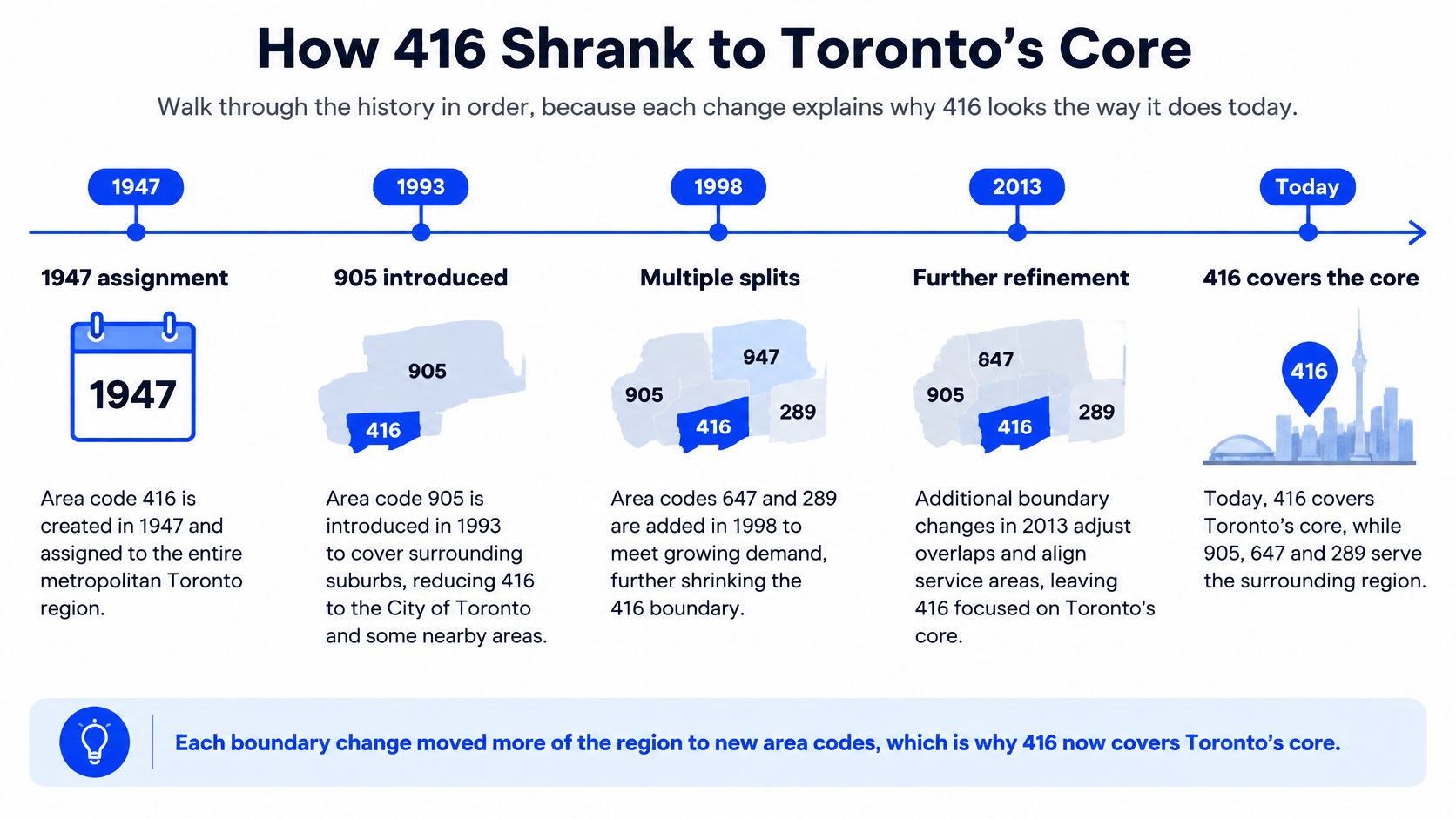
Read the timeline from left to right and the method stays consistent. Growth creates demand. Demand forces a division. Each division draws a boundary instead of layering a second code over the same streets.
By the end of those splits, 416 had its modern meaning. It no longer described a broad region of Ontario. It described Toronto's core, which explains why callers still hear it as a downtown Toronto marker. Later growth was handled by adding codes on top of that core rather than cutting it again, so the boundary fixed by the 519 and 905 splits still shapes how Toronto numbers read today.
The 2001 Overlay and Mandatory Ten-Digit Dialing
Toronto stopped splitting and started stacking. Instead of cutting the map again, planners placed a new code directly over the same 416 ground. From that point two codes shared one territory, so the network could no longer tell which code a seven digit number belonged to.
That overlap is why ten digit dialing became mandatory throughout Toronto. The area code turned into part of the local number itself. You dial it for a call across the street. You store it in every contact, dialer, and printed advertisement, because seven digits no longer identify a Toronto line on their own.
A later 437 overlay joined the same territory. What matters for everyday use is simple. The three codes work like three doors into one room. The 416, 437 and 647 numbering plan area functions as a single exchange area covering Toronto, so callers should handle all three as one Toronto unit.
What Businesses Should Do With That
- Classify by country correctly: Put 416 under Canada and the province of Ontario in geographic and customer analysis, not under a U.S. regional market.
- Store full numbers: Keep the area code in every record, since seven digits cannot identify a Toronto line.
- Treat the family equally: Handle 416, 437, and 647 as Toronto prefixes with identical local meaning.
Other overlay markets raise the same storage and dialing questions, which is why readers comparing systems often consult resources such as our guide to area code 980. The city differs, but the data hygiene lesson is identical.
The reason for the change was supply. Households, firms, mobile users, and connected services kept consuming the available numbers. An overlay added supply without forcing existing 416 customers to change numbers. The tradeoff was permanent. Toronto callers gave up seven digit dialing, and the original numbers stayed exactly as they were.
Where to Verify a Toronto Area Code
Guessing from memory is how a 437 number gets labelled as non local or a 905 number gets listed as a Toronto address. Verification takes less time than correcting a published listing. It also settles arguments inside a business about whether a number belongs in a Toronto campaign.
Use the official records for the 416, 437 and 647 complex when the answer matters. The CRTC relief decision for these codes and the Canadian Numbering Administrator's numbering plan documents are the authoritative sources for which codes cover Toronto and how they relate to one another. General area code lookup sites are fine for a first glance, but they shouldn't be your final word for a directory, an advertisement, or a customer database.
A Quick Verification Method
- Write down the first three digits exactly as they appear, without the leading 1.
- Check those digits against the official list for the Toronto complex.
- Confirm the city before you use the number in a directory or local search listing.
That method also protects you from a subtler error. A number can share Toronto's +1 country code and still belong somewhere entirely different. A 212 number, for example, belongs to New York. It carries no Toronto meaning at all, even though it sits in the same North American plan and follows the same ten digit pattern. The shared plan connects many cities in two countries, so the country code alone never identifies the place.
Keep the code family in mind as your cross check. If a number starts with 416, 437, or 647, you're looking at the Toronto overlay. If it starts with 905, you're looking at the suburban ring. Anything else needs its own lookup before you assign it a city.
Verify the three digits against an official list, then confirm the city with the caller or customer. The prefix starts the check, it doesn't finish it.
Once you've confirmed what a number is, a different question follows. What should you do when that number calls you, especially when you weren't expecting it? That decision depends less on geography and more on how much trust a displayed number deserves.
Spotting Spoofed and Unexpected 416 Calls
A 416 display on your screen doesn't prove the call comes from Toronto, and it doesn't prove the caller works for the company named on the display. Caller ID can be faked, and fraudsters use familiar local prefixes precisely because people are more likely to answer them. Treat the number as a claim to be checked, not as identification.
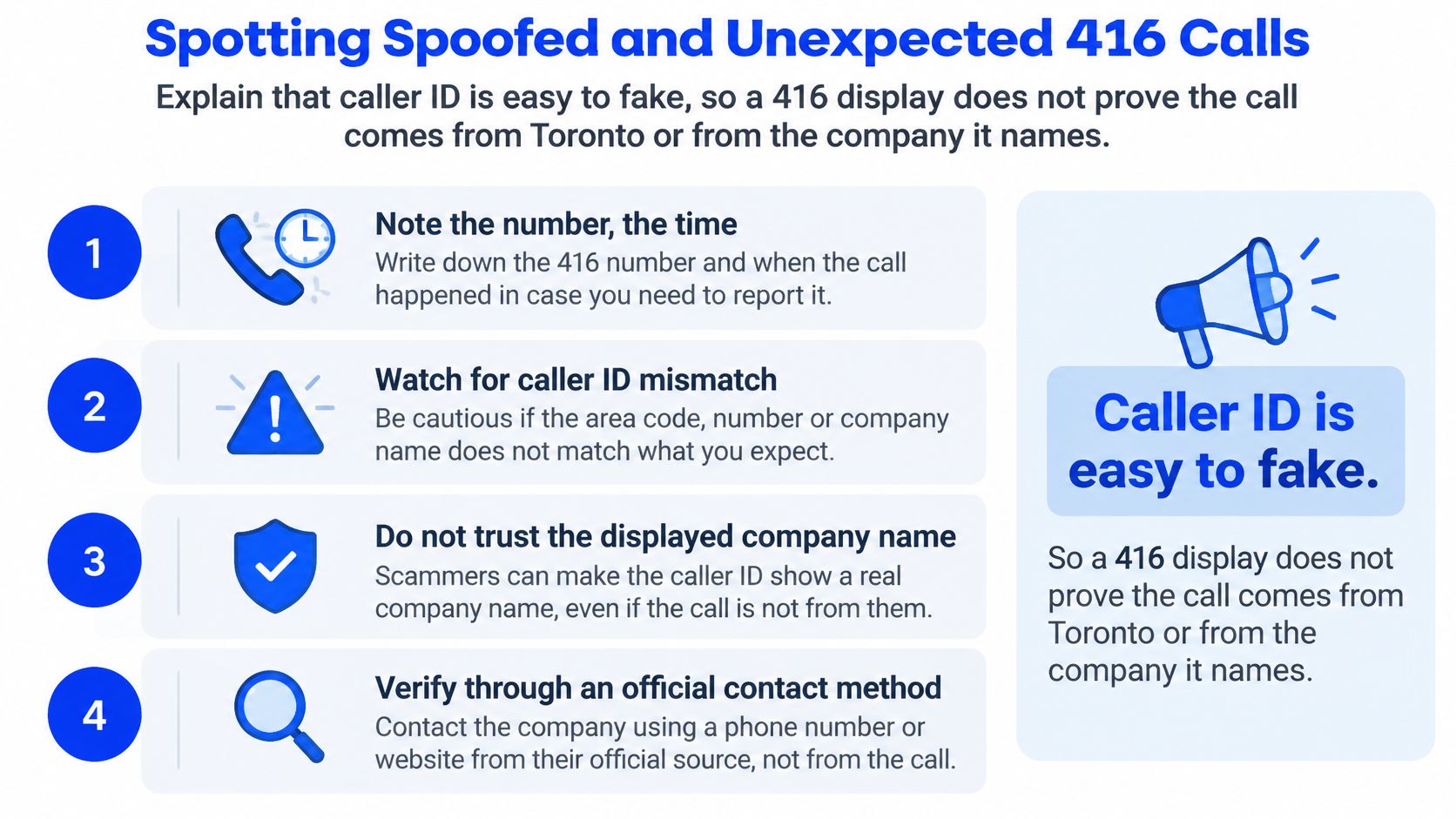
A Six Step Routine
- Note the number, the time, and exactly what was asked. A written record helps you compare the call against real invoices and report it accurately later.
- Don't read out card numbers, passwords, one time codes, or ID numbers on an inbound call. A legitimate business doesn't need you to prove yourself to a number you didn't dial.
- Hang up and call back using the number on your own invoice, contract, or the official website. Dialing a number you already trust defeats spoofing, because the fraudster controls only the display, not that real line.
- Ask for a full name, a department, and a reference you can check. Vague answers are a warning sign, and a real representative can supply details that match your records.
- Treat any demand for urgent payment or gift cards as a warning sign, even when the number looks local. Pressure is designed to stop you from doing the call back in step three.
- Report suspected fraud to the Canadian Anti-Fraud Centre if the caller is in Canada, or to the Federal Trade Commission if the calls target U.S. residents. Reports help carriers and investigators spot the same number being used against other people.
Say a caller claiming to be from your bank rings from a 416 number and asks you to confirm a one time code. The local prefix makes the request feel routine, but the routine above breaks it at step two. You hang up, dial the number on the back of your own card, and ask whether the bank contacted you. If it didn't, you've lost nothing but a minute.
A legitimate caller can accept a call back through a number you already hold. A fraudulent one usually can't.
That callback test is the whole defence in one sentence. It works no matter which area code is displayed, because it doesn't depend on trusting the display at all. For unknown 416 calls, let the prefix tell you where the number was assigned, and let the call back tell you whether the caller is real.
Deciding Whether a 416 Call Is Local
Start with the geography, then question it. The CRTC relief decision for the Toronto area codes identifies 416, 437, and 647 as the Toronto area code complex and confirms that these codes cover Toronto, Ontario, not the United States. So a 416 prefix points to Toronto proper more reliably than to the broader Greater Toronto Area, where surrounding suburbs commonly use different codes such as 905.
That signal has real limits, and businesses get into trouble when they treat it as proof. A 416 number can be ported, which means a mobile customer can keep the number after moving to another city or province. The prefix records where the number was assigned, not where the phone is sitting today. Caller ID adds a second limit, because a displayed 416 number can be spoofed by someone who isn't in Toronto at all.
Five Steps for Judging a 416 Call
- Read the code and treat 416 as Toronto, Ontario, Canada. This sets the right country, province, and city as your starting assumption.
- Ask the caller for a city or postal code. Toronto postal codes begin with M, which confirms a Toronto address faster and more precisely than the area code does.
- Check the time zone before calling back. Toronto is on Eastern Time, the same as New York, so schedule return calls accordingly, especially if your business is on the west coast.
- Decide whether to return the call based on the stated need and the confirmed location, not the prefix alone. A genuine enquiry from a confirmed Toronto address deserves a different response from an unexplained missed call.
- Set intake questions that ask for location in the first minute if your business takes many calls from Toronto and the United States. One early question prevents a full consultation with someone outside your service area.
Say a salon receives a booking enquiry from a 416 number. Staff shouldn't treat the call as confirmed local just because of the prefix. The caller might be a former Toronto resident who kept the number after moving away, or a visitor who'll be in town next month. Asking for the city and postal code at the start tells the salon whether to offer its Toronto location, suggest another branch, or explain that it can't serve the caller.
The same reasoning applies to clinics deciding whether a patient can attend in person, contractors quoting work that depends on travel distance, and professional firms checking whether a matter falls inside their Ontario practice. In each case, the prefix is a useful first clue and a poor final answer. Geographic intake questions convert that clue into a fact the business can act on.
Businesses handling cross border call volume face this problem in both directions. Heyline serves customers in the United States and Canada, so a receptionist answering for a firm near the border can't assume that a familiar +1 format means a domestic caller. The location question has to come before service promises, pricing in a particular currency, or directions to an office.
Similar judgement calls arise with unfamiliar U.S. prefixes that turn out to be spam sources, and the Gini Help guide to 320 calls from Gini Help walks through how to assess those numbers before returning them. The habit transfers directly. Read the code for what it tells you, then verify the rest instead of guessing.
Use the three part test. Check the area code, check the stated location, and check the caller's own answer. When they conflict, the caller's answer wins.
That ordering matters because each element corrects the one before it. The area code tells you the number was assigned in Toronto. The stated location, ideally with a postal code beginning with M, tells you whether a Toronto address is involved. The caller's own answer tells you where they are and what they need, which is what your business will act on.
A 416 call is therefore best described as Toronto assigned, not Toronto proven. That phrasing keeps staff from making two opposite mistakes. They won't dismiss a genuine Toronto customer whose number starts with 437 or 647, and they won't promise local service to a 416 caller who moved away years ago. For salons, clinics, contractors, and professional firms, that distinction decides whether a returned call becomes a booking, a wasted trip, or a polite referral elsewhere.
Ask the location question early, record the answer beside the callback number, and let the prefix do only the job it can do. It identifies the numbering area the phone came from. Everything after that is a conversation.
If your Toronto or U.S. business is missing calls while staff are with clients, Heyline answers in a natural voice around the clock, asks the location and intake questions your callers need, and books confirmed appointments straight into your calendar. You can keep your existing number and go live in minutes by connecting your website and calendar. Visit Heyline to set up your AI receptionist and hear how it handles your next 416 caller.