Friday dinner service has started, the host is seating a table, and the phone is ringing behind the bar. A server sees it but can't step away from a full dining room. The caller hangs up, tries again later, and may never reach anyone who can take the reservation, answer a menu question, or explain the wait.
That scene is familiar because restaurant phones compete with the work that keeps guests happy in person. The problem isn't that calls go to voicemail. A missed call may represent a reservation, a takeout order, a private dining inquiry, or a complaint that needs a calm response.
An AI answering service for restaurants acts like an extra front-of-house coordinator. It answers in a natural voice, identifies why the person is calling, uses approved restaurant information, takes appropriate action, and sends complicated requests to the right team member.
This guide will help you decide whether that approach fits your operation. You'll learn what the system does, why missed calls affect revenue, how it compares with voicemail and manual answering, what real conversations can sound like, and how a nontechnical owner can set it up. The later sections focus on reservations, menu and dietary questions, takeout, large parties, private events, complaints, integrations, and launch decisions.
Introduction to Smarter Restaurant Phone Coverage
The restaurant phone is easy to underestimate because it looks like a small operational detail. In practice, it can be one of the first places a guest asks to buy from you. Someone calling about a table may be ready to book. Someone asking about takeout may be choosing between your restaurant and another option. Someone calling about a private event may be exploring a valuable future occasion.
One industry analysis reports that 43% of restaurant phone calls go unanswered, with the average venue losing up to $292,000 annually in missed revenue. The same analysis estimates roughly 65 to 86 unanswered calls per week at that miss rate and places the average call value at about $85 to $120, depending on whether the caller wants a reservation or takeout order. See the restaurant missed-call revenue analysis for the full assumptions behind those estimates.
Practical rule: Treat every unanswered call as an unresolved customer request, not as a harmless interruption.
An AI receptionist doesn't replace hospitality. It handles the first phone conversation so your host, manager, or server can stay focused on the dining room. The system can greet the caller, listen for intent, answer known questions, check availability where connected, and escalate matters that need human judgment.
The important distinction is intent-aware routing and recovery. A voicemail box records a message and waits for someone to call back. A basic phone tree asks the caller to select an option. A capable AI service holds a conversation and tries to complete the next useful action immediately.
By the end, you'll have a practical way to assess coverage. Look for the explanation of the virtual host stand first, then the revenue reasoning, the comparison table, and the sample call flows. The setup section covers website information, calendars, phone routing, testing, and ongoing accuracy. The final section turns those ideas into a launch checklist.
What an AI Answering Service Does for Restaurants
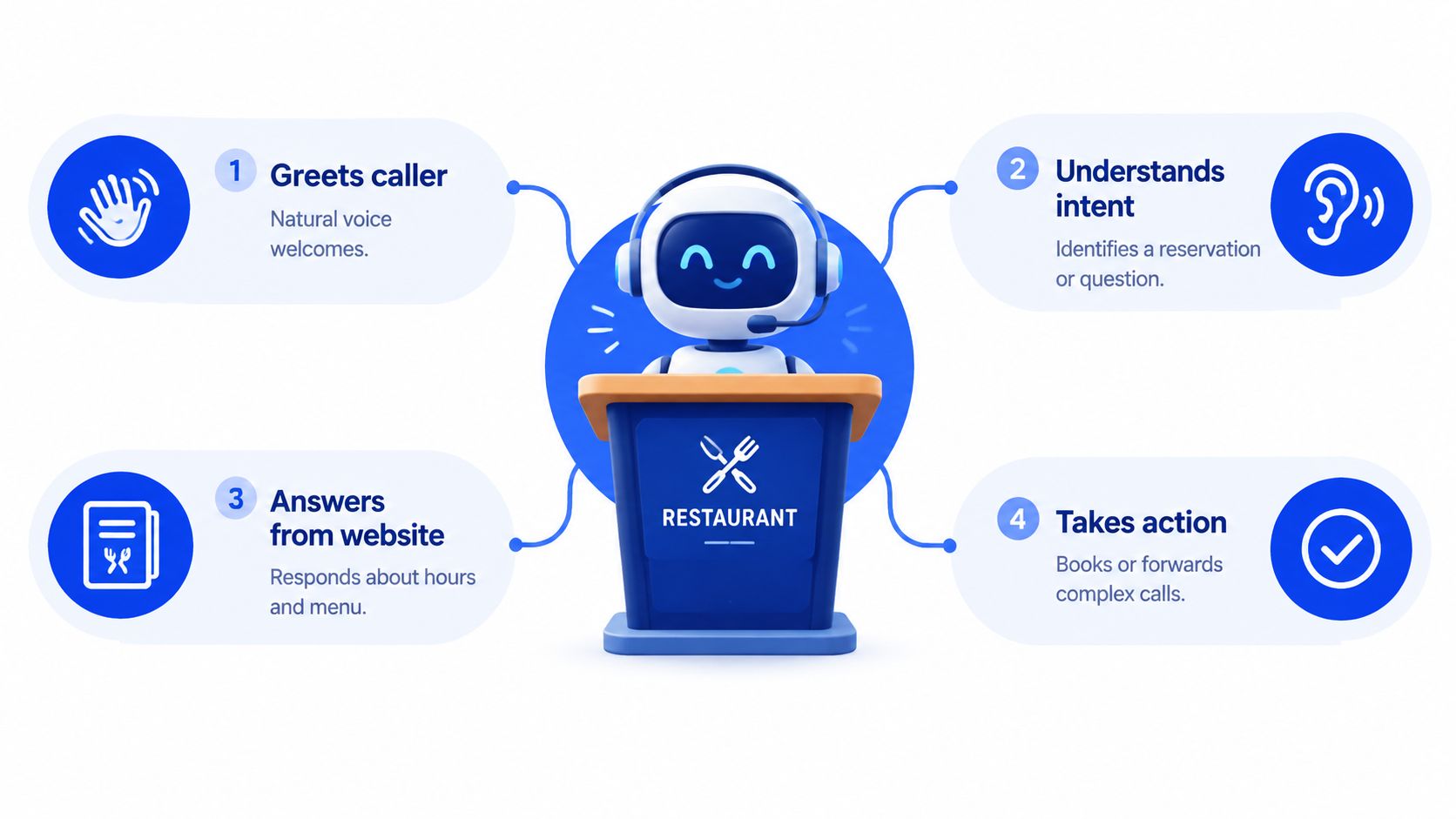
Think of the system as a virtual host stand, not as a robot hidden behind a voicemail greeting. A human host listens, identifies what a guest needs, checks the restaurant's tools, and either completes the request or finds the right person. An AI answering service follows the same broad pattern through a phone conversation.
The conversation starts with intent
First, the AI greets the caller in a natural voice. It then listens for the purpose of the call instead of forcing the person through a long list of keypad choices.
A caller might say, “Can I get a table for six tomorrow night?” Another might ask, “Are you open on Monday?” Someone else may want to know whether a dish contains a particular allergen. These are different intents, even though they all arrive through the same phone number.
The service uses your approved business information to answer common questions. That information can include hours, address, menu details, dining options, reservation rules, and other facts you choose to provide. If the answer isn't clear or the request falls outside its rules, the system should avoid guessing and route the call appropriately.
The next step is an action
For a reservation, the AI can collect the date, time, and party size, then check connected availability before confirming. The useful part is the direct action. The caller shouldn't have to leave a message and hope somebody enters the booking later.
Other calls need different outcomes:
- Reservations: Check live availability, collect guest details, and confirm the booking.
- Takeout questions: Explain approved ordering information or route the caller to the correct ordering process.
- Menu requests: Answer supported questions about dishes, ingredients, hours, or dining policies.
- Large parties: Capture the occasion, group size, preferred date, and contact details before escalation.
- Complaints: Listen respectfully, record the issue, and follow a defined callback or manager-transfer rule.
This is why the strongest restaurant use case isn't voicemail replacement. It's a routing and recovery layer that separates routine requests from matters requiring a manager, event coordinator, or service team.
Escalation protects the guest experience
A good workflow includes boundaries. The AI may answer a straightforward menu question, but it shouldn't improvise about an allergy or promise a private-event arrangement it can't verify. Owners should define which calls transfer immediately, which create a callback request, and which can be completed automatically.
The system becomes valuable when it gives each caller a clear next step. It might book a table, explain where to place a takeout order, or send a detailed event inquiry to a human. That keeps the phone connected to operations instead of making every call someone else's future task.
Why Missed Calls Cost More Than You Think
Restaurant phone demand is closely tied to buying intent. An independent industry report says 71% of restaurant calls are directly tied to revenue, including reservations, orders, private dining, and catering. The same report says 66% of calls happen during business hours, while 26% occur simultaneously or after hours, so callers can reach the restaurant when staff are already occupied or unavailable. Read the restaurant call demand report for that breakdown.
The operational mistake is to think of the phone as a distraction from revenue. During a rush, it may feel that way because the call arrives at the worst possible moment. But the caller often isn't interrupting a sale. They may be initiating one.
Busy hours create a coverage problem
A restaurant can be open and still effectively unavailable by phone. The host may be seating guests, servers may be carrying dishes, and managers may be resolving issues on the floor. A caller who reaches several rings and then gives up doesn't experience your staffing reality. They experience silence.
After-hours calls create a different gap. A guest may be planning ahead, checking availability, or asking about a private event when the dining room is closed. If the only response is voicemail, the restaurant has deferred the conversation without knowing whether the person will call again.
That makes 24/7 coverage relevant even for a small venue. The purpose isn't to make the phone feel busy. It's to give high-intent callers an accurate answer or a clear path to follow whenever they reach out.
Revenue leakage appears across call types
Reservations are only one category. A caller may be asking about a takeout order, catering, a group dinner, or a special occasion. Each request has a different value and a different handling rule, so a single “press one for reservations” menu won't solve the whole problem.
The figures above also show why owners should measure more than answer rate. Ask what happened after the call:
- Was a reservation created?
- Was an order question resolved?
- Was a private-event lead captured?
- Was a complaint routed to a manager?
- Did the caller receive a usable next step?
The phone becomes a sales channel when the restaurant measures completed outcomes, not just ringing volume.
An AI answering service can help recover those outcomes by responding immediately, using current information, and connecting the caller with the right process. It won't make every call valuable, and it shouldn't pretend to know what it doesn't know. Its role is to reduce avoidable loss while preserving human involvement where judgment matters.
Key Benefits and How AI Compares to Traditional Handling
Restaurant phone coverage usually falls into three familiar choices. Staff answer when they can, voicemail collects missed calls, or a phone tree directs callers through recorded options. Each approach can work in limited situations, but each leaves a gap when the caller needs a real answer during a busy period.
An AI service adds a conversational layer. It can respond immediately, recognize the reason for the call, and connect booking actions to availability instead of creating a list of callbacks for later.
In a restaurant call dataset of more than 500,000 calls, AI-powered phone concierges increased peak-hour answer rates from 64% to 97% and raised reservation conversion from 45% to 70%, according to the restaurant voice AI call dataset. The reported pattern connects faster answering with direct booking integration, rather than with a simple voicemail substitute.
Restaurant phone handling compared
| Handling Method | Answer Rate | Booking Action | Coverage |
|---|---|---|---|
| Staff answering | Depends on who can leave the floor | A host or manager enters the booking | Strongest when staff are available |
| Voicemail | The caller leaves a message, if they choose | Staff must return the call and book later | Limited by callbacks and opening hours |
| Basic phone tree | The caller selects recorded options | Usually provides instructions or routes the call | Useful for simple directions, limited for conversation |
| AI answering service | Responds during busy periods and after hours | Can check connected availability and complete supported bookings | Continuous coverage with escalation rules |
What changes for the team
Manual answering keeps control with staff, but it also forces them to switch attention between guests and callers. Voicemail reduces the interruption but transfers the work into an uncertain callback queue. A basic phone tree handles predictable information, yet callers can become frustrated when their question doesn't fit an option.
An AI receptionist handles repetitive conversations without requiring the host to stop service. It can also keep the experience consistent, because the same approved information and escalation rules guide each interaction.
The right comparison isn't “AI or hospitality.” It's unstructured interruption versus defined phone coverage. Staff should still handle sensitive complaints, unusual requests, and decisions that require discretion. The AI should handle the routine path quickly and make the handoff clear when the routine path ends.
Operator test: Ask whether a caller can reach the correct outcome in one conversation. If the answer is usually “leave a message,” the system is recovering too little value.
Real Call Flows You Can Expect in Action
The difference between a phone bot and an intent-aware service becomes clear in the conversation. A useful system doesn't just repeat hours. It recognizes what the caller wants, asks only for the details needed, checks the right source, and confirms what happens next.
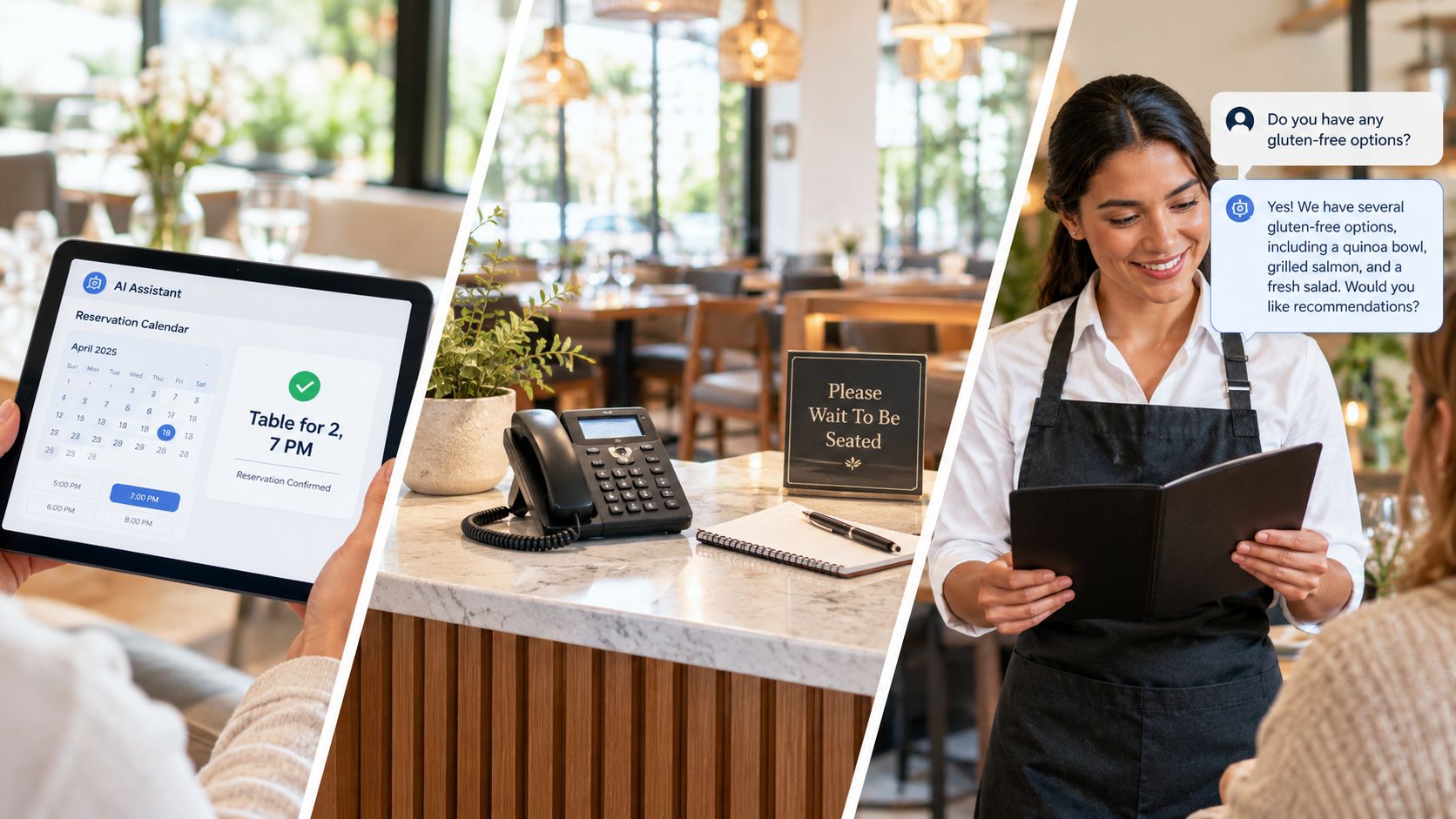
A reservation request
Caller: “Do you have a table for four this Saturday at seven?”
AI: “I can check that. Is the reservation for four guests, and may I have the name for the booking?”
Caller: “Yes, it's under Morgan.”
AI: “I found an available table at that time. I've booked it under Morgan and can send the confirmation using the contact details you provide.”
The AI identifies a reservation intent, confirms the party size, checks connected availability, and completes the booking only after the caller agrees. If the requested time isn't available, it can offer approved alternatives or route the request according to the restaurant's rules.
Modern deployments increasingly connect voice workflows to live table availability, allowing a booking and confirmation to happen during one call. A 2026 report also discusses mature deployments with about 95% booking-capture accuracy and an 87% reduction in missed calls after adoption, as described in UrbanPiper's restaurant call analysis.
A menu or dietary question
Caller: “What can I order if I can't have dairy?”
AI: “I can share the dietary information listed in the restaurant's current menu. I can't guarantee an allergy-free preparation, so I'll explain the stated ingredients and connect you with the team if you need confirmation.”
The important behavior is restraint. The AI should use the restaurant's maintained information, distinguish a preference from a serious allergy concern, and avoid making a safety promise it can't verify.
A menu question may also be simple: hours, address, parking, outdoor seating, or whether takeout is available. Those answers can be immediate when the knowledge source is accurate and the workflow gives the caller a clear next action.
A large party or complaint
Caller: “I need a private room for a company dinner.”
AI: “I can collect the event details for the private dining team. What date, group size, and contact information should I include?”
Caller: “I also had a problem with my last visit.”
AI: “I'm sorry the visit didn't go as expected. I'll record the concern and follow the restaurant's manager callback process.”
Large parties, private events, takeout complications, and complaints need escalation rules, not forced automation. The AI can collect structured information, identify urgency, and send the request to the correct human without making the caller repeat everything.
For practical guidance on connecting business listings with incoming calls, see Google Business listing call handling. The point is to make the next step visible, whether that step is a confirmed reservation, an order path, or a human follow-up.
The video below provides another visual way to understand how restaurant AI can fit around the host stand and service team.
Integration and Quick Setup for Nontechnical Owners
You shouldn't need to build a phone system from scratch. For a small restaurant, setup should feel closer to updating a listing and connecting a calendar than configuring a software project.
Start with the information callers already need
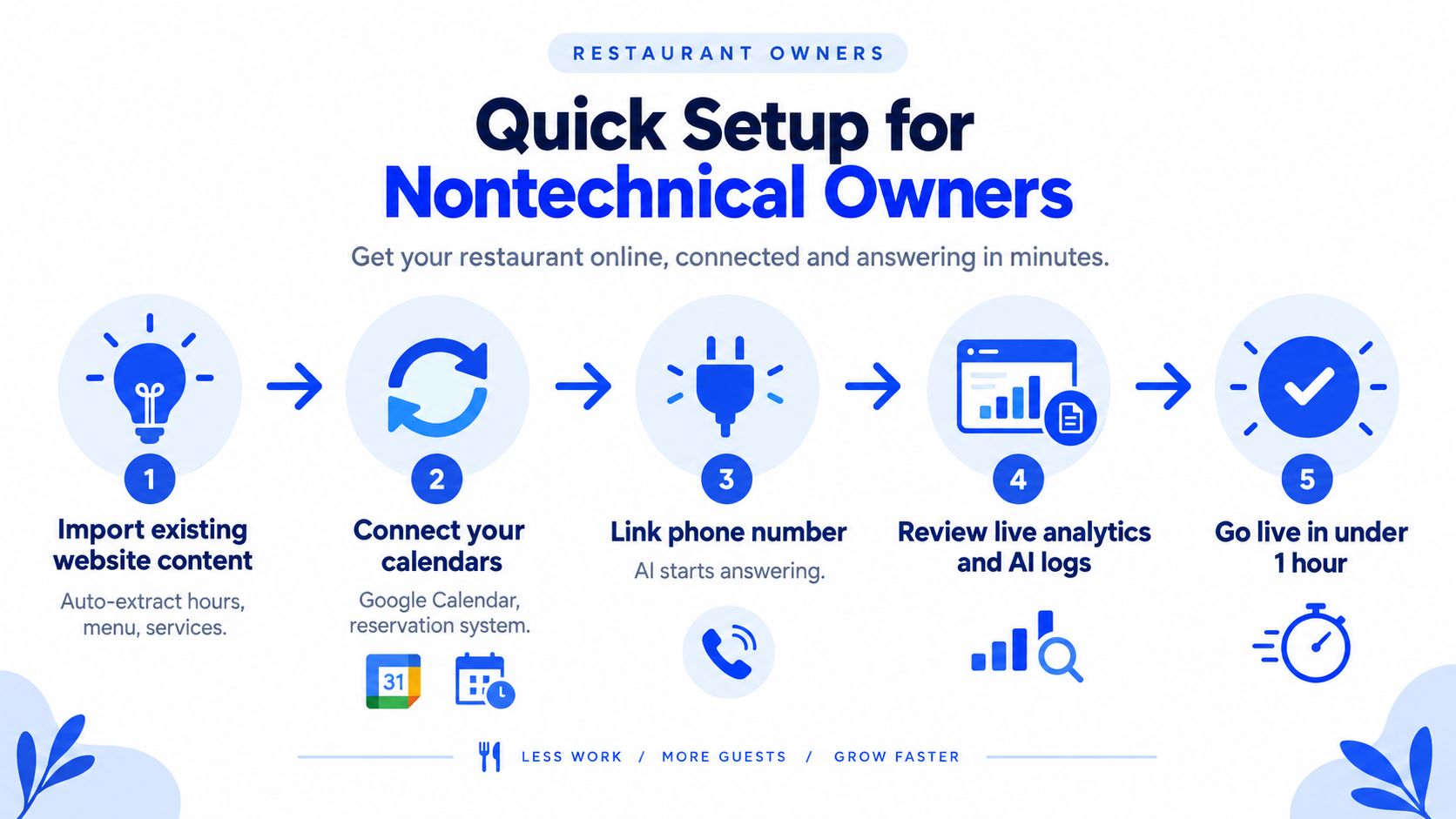
The first screen can use your public website as the starting point. The service reads available details such as hours, location, menu information, services, and pricing, then gives you editable fields for corrections.
Review this information carefully. A changed holiday schedule, a new menu item, or a revised reservation policy should appear in the AI's knowledge before callers rely on it. Treat the knowledge panel like a digital version of the binder your host keeps behind the stand.
Connect availability before accepting bookings
The next step is connecting a calendar or reservation system that reflects actual availability. A calendar-aware service can check open times before confirming, which helps prevent the AI from promising a table that the restaurant can't provide.
The connection also determines what the AI is allowed to do. You might permit standard reservations but require human review for large parties, private events, or special requests. Set those boundaries before launch rather than relying on the system to infer them.
A plain-language AI answering service setup guide can help owners work through the basic configuration without technical terminology.
Route the number and test like a guest
After connecting the information and availability, route your restaurant number through the service or use the chosen call-forwarding arrangement. Select a voice that fits the brand, then make test calls from outside the system.
Test the situations that cause real trouble:
- Busy-service test: Ask for a reservation while the team is occupied.
- Availability test: Request a time that should be unavailable.
- Menu test: Ask about a dish, dietary detail, or policy.
- Escalation test: Request a private event or report a complaint.
- After-hours test: Call when staff aren't available and check the promised next step.
Listen for incorrect answers, awkward transfers, and unnecessary questions. Owners should also decide who receives alerts, how callback requests are tracked, and how quickly staff review them.
Maintenance is simple but not automatic. When your menu, hours, reservation rules, or event process changes, update the AI's knowledge and run a test call. Accuracy depends on treating the system as part of daily operations, not as a one-time installation.
Choosing and Launching the Right Service With Confidence
The best fit isn't necessarily the service with the longest feature list. It's the one that handles your actual call mix without making callers work harder.
Start by listing the requests your staff hear repeatedly. Include reservations, takeout, menu questions, dietary concerns, large parties, private dining, complaints, directions, wait times, and requests for a manager. Then mark which calls the system may complete, which it should route, and which require an immediate human response.
Use these decision criteria
- Natural conversation: The AI should understand ordinary speech, interruptions, and differently phrased questions.
- Live availability: Reservation workflows should check the connected source before confirming a table.
- Clear escalation: Large parties, complaints, allergy-sensitive questions, and unusual requests need defined handoffs.
- Editable knowledge: Managers should be able to correct hours, menu details, policies, and special instructions.
- Useful records: The restaurant should know what happened after a call, not just that the phone rang.
- Simple launch: Owners and staff should be able to test and adjust the experience without specialist help.
- Transparent pricing: Compare the service cost with the operational value of recovered calls and reduced interruptions. The AI receptionist pricing guide can help frame that review.
Launch in a controlled way
Begin with the core information and the most common reservation workflow. Add takeout, event inquiries, complaint routing, and other paths after you confirm that the first conversation sounds accurate.
Make several test calls before redirecting the main number. Ask a manager who didn't configure the system to try it, because unfamiliar phrasing often reveals gaps the owner won't notice.
Then monitor the early calls. Review whether the AI understood intent, whether bookings reached the right system, whether escalations went to the right person, and whether callers received clear confirmations. Adjust the knowledge and rules as real questions reveal what the website doesn't state clearly.
The central decision is straightforward. If your restaurant treats the phone as a source of reservations, orders, event leads, and guest recovery, choose a system that can route and complete those different intents. A booking-only bot or voicemail replacement won't cover the full opportunity.
Heyline provides an AI phone receptionist that answers restaurant calls, uses website information, supports natural conversations, and can book into connected availability while routing complex requests for human follow-up. Visit Heyline to review the service and decide whether it fits your restaurant's phone coverage needs.