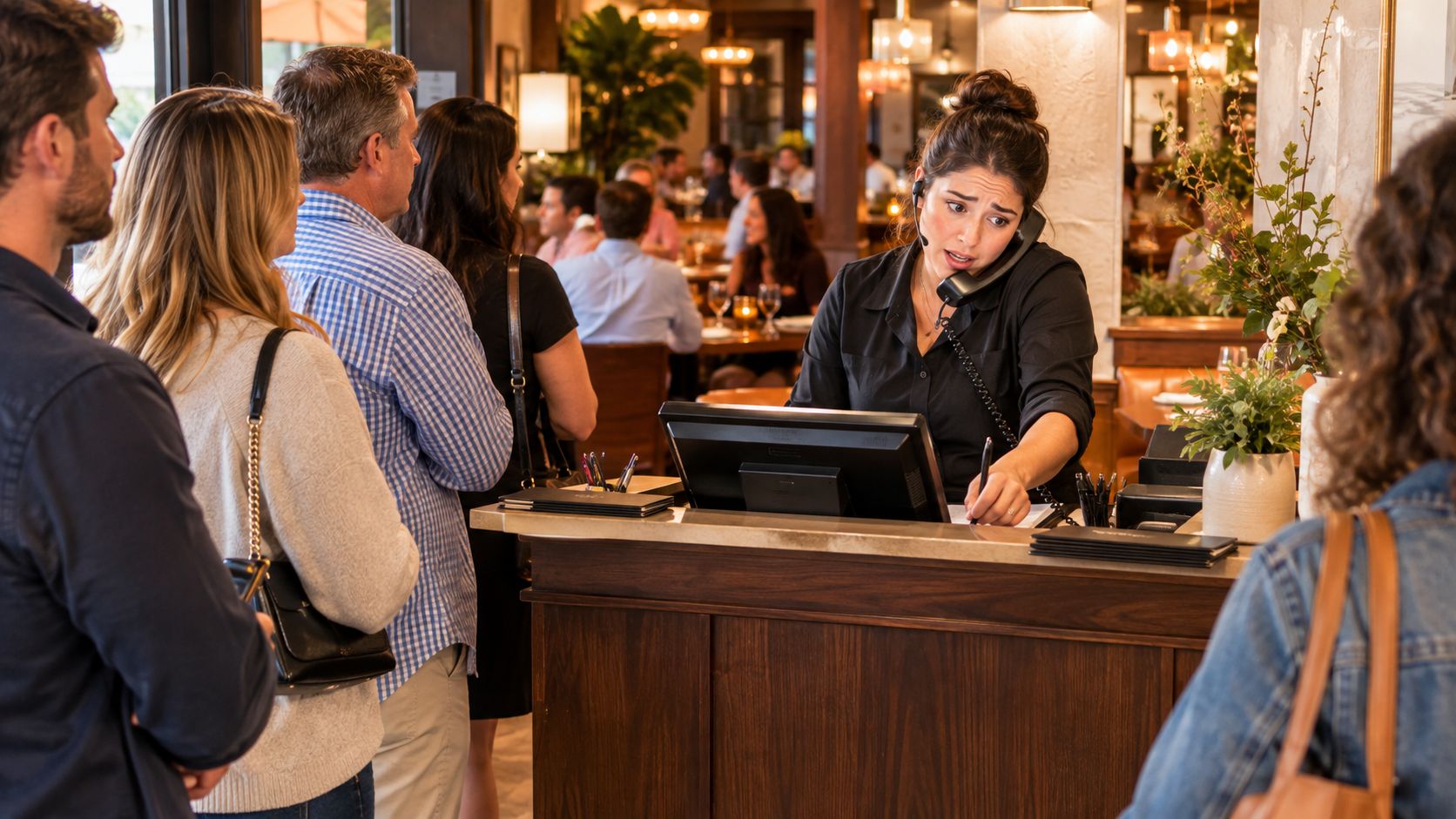
Friday dinner service is underway. The host is seating a family, a server is carrying hot plates, and the phone keeps ringing at the desk. By the time someone reaches it, the caller may already have chosen another restaurant, especially when they wanted a table for that evening or needed a quick answer about hours, parking, or dietary options.
That problem is larger in California than many operators can afford to ignore. The state has roughly 90,000 to 100,000 restaurant establishments, making it the largest restaurant market in the United States, while reservations fell 5% since February 2023 even as restaurant spending rose 13% since November 2022, according to this California restaurant industry statistics summary. Demand and booking behaviour can move in different directions, so every recoverable call matters.
Why Restaurants Miss Calls and How an AI Receptionist Helps
A restaurant phone competes with the dining room at exactly the wrong time. During a rush, the team has to prioritise guests already in front of them, food leaving the pass, table resets, payment issues, and safety. The phone is still important, but it rarely receives attention quickly enough.
California operators also face substantial staffing pressure. One industry summary reports 78% average turnover in 2022 and labour costs averaging 34.2% of total restaurant expenses in 2023. National figures in the same restaurant staffing analysis put full-service turnover around 73% annually, with quick-service turnover often exceeding 100%. Those conditions make consistent phone coverage difficult to maintain with people alone.
What the system actually handles
An AI receptionist for restaurants answers in a natural conversational voice rather than forcing callers through a long phone tree. It can provide approved information about opening hours, menu basics, location, parking, dietary options, and large-party policies. Depending on the integrations and configuration, it can also take reservation requests, record takeout details, send callers to the right person, or create a message for staff follow-up.
The useful distinction is completion. A basic answering service may collect a message that someone must return later. A properly configured AI receptionist can complete straightforward requests during the original call, while escalating requests that require judgement or information it doesn't have.
Practical rule: Automate predictable information and structured bookings. Escalate anything involving uncertainty, exceptions, complaints, or a safety-sensitive decision.
The guide to handling high call volumes is useful background for identifying where phone coverage is breaking down. Before choosing a system, listen to real calls and separate missed reservations from questions that could have been answered instantly. That distinction determines whether automation will reduce interruptions or create another channel for staff to manage.
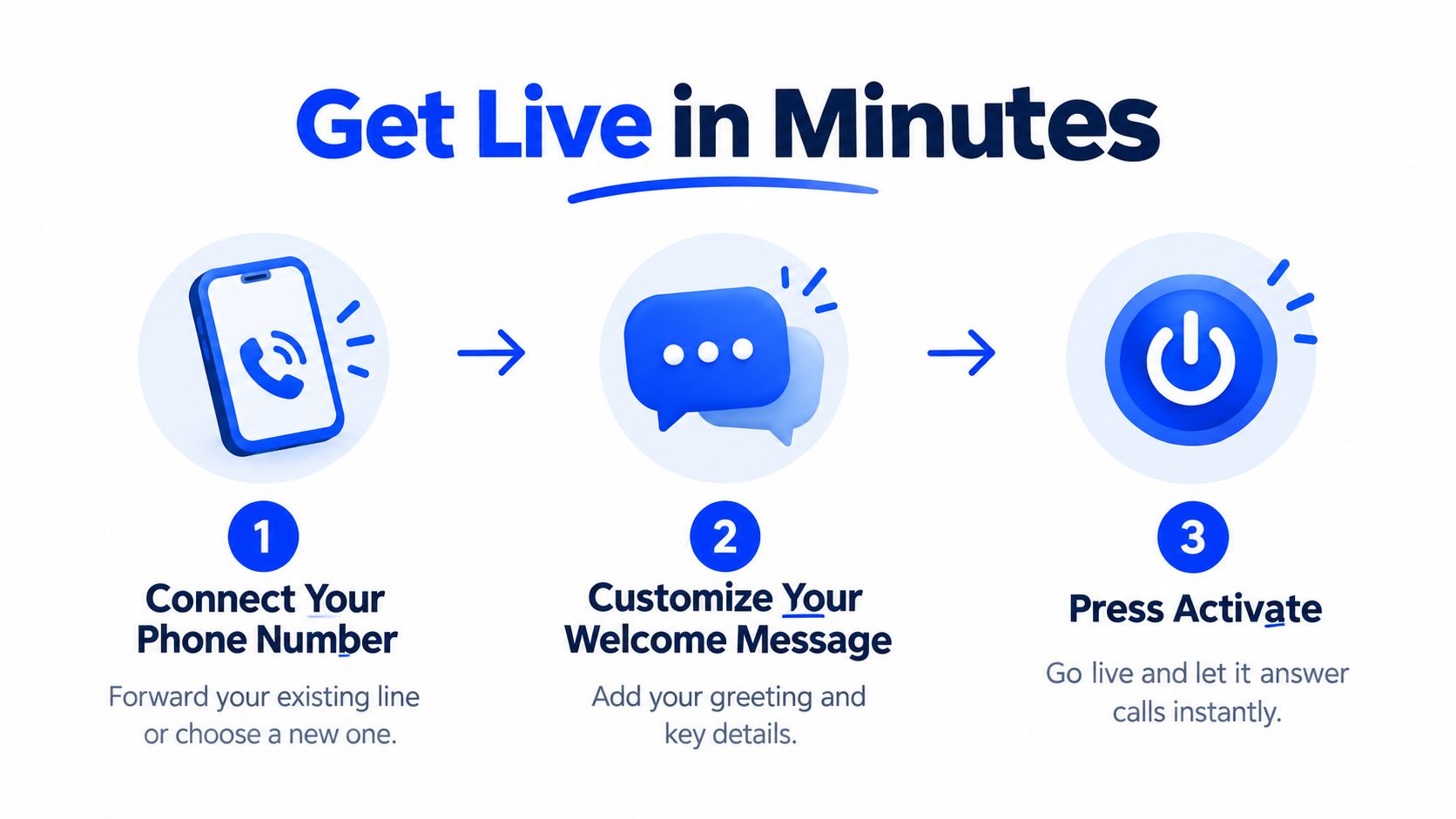
Getting Your AI Receptionist Live in Minutes
Restaurant owners shouldn't need to build a call tree, write webhooks, or manage a technical phone project to test an AI receptionist. A practical setup starts with the information your restaurant already publishes, then adds the availability rules that protect your booking system.
Start with the website intake
Paste the restaurant website into the setup screen. The system can use the published pages to capture operating hours, service descriptions, menu information, location details, and other public answers. Treat that first capture as a draft, not as a final knowledge base.
Review every important field. Check holiday hours, kitchen closing times, brunch availability, patio details, cancellation rules, accessibility information, allergens, and large-party policies. If the website is old or vague, add direct notes so the receptionist won't fill gaps with assumptions.
Connect availability before taking live calls
Connect the calendar or reservation availability that should govern bookings. A calendar-aware system can check openings during the call, which is safer than allowing the AI to promise a time based on static instructions.
Keep the first launch narrow. Start with reservations, basic FAQs, and a clear staff handoff. Add takeout ordering only after the menu, modifiers, pricing, pickup timing, and confirmation process have been reviewed.
Test before forwarding the line
Connect the existing number by forwarding calls or use a new number for a controlled pilot. Place test calls from different phones and speak naturally. Interrupt the receptionist, change the party size, ask about a closed date, request a patio table, and deliberately provide incomplete information.
Use the AI answering service setup guide as a reference for the basic configuration sequence. Don't launch until the system repeats dates, times, party sizes, names, and phone numbers accurately, confirms what it has booked, and hands off cleanly when it reaches a boundary.
Mapping Reservations Takeout and Common Questions to Call Flows
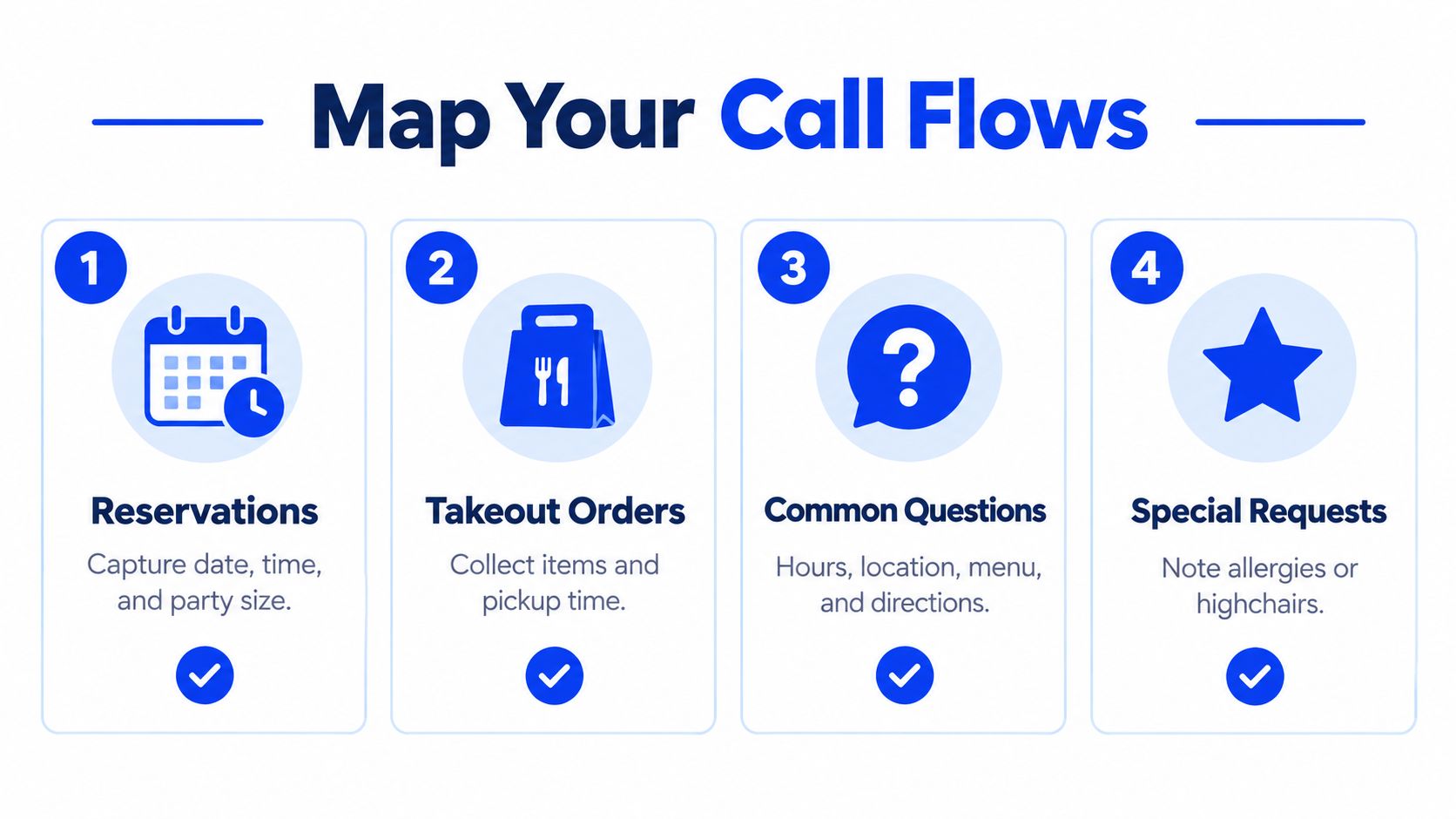
A restaurant call becomes manageable when the receptionist knows which details belong to which request. A reservation isn't the same workflow as a takeout order, and neither should be treated like a question about closing time.
Reservations need capacity logic
For a booking, capture the date, requested time, party size, caller name, contact number, and relevant notes. Then check actual availability and repeat the final details before confirmation.
Reservation spacing is where many deployments fail. If the system only knows that a table is technically empty, it may stack bookings too closely, ignore table size, or create a sequence that overwhelms the kitchen and floor. Encode table capacity, expected dining duration, turn-time assumptions, and spacing between arrivals. A San Francisco bistro deployment reduced peak-hour missed calls from 40% to 3% and increased daily reservations from 45 to 58, while specifically optimising reservation spacing to avoid overbooking and improve table-turnover management, as documented in this table-turnover case study.
For a caller asking for a patio table for six tonight, the AI should check patio capacity rather than offer any available table. If the patio isn't available, it should present an approved alternative or escalate the request.
Takeout requires confirmation
Takeout calls need item-level accuracy. The flow should collect the order, modifiers, allergy notes, pickup time, name, and contact details, then read the order back slowly. If the system can't verify an item or a special preparation request, it should stop and involve staff rather than improvise.
A caller asking about wait time may only need the current approved estimate. If the estimate changes during service, staff should update the knowledge or the escalation instructions instead of allowing a stale answer to circulate.
FAQs should be short and controlled
Build a concise answer set for hours, directions, parking, menu availability, dietary choices, highchairs, private dining, waitlist policy, and large parties. Every answer should state what the restaurant knows and what it doesn't.
For example, an after-hours caller asking about brunch hours can receive the published schedule and a reservation link or booking option. A caller describing a serious allergy should be transferred or told to speak directly with the restaurant, according to the restaurant's approved policy.
Tuning Voice Tone and Prompts to Sound Like Your Restaurant
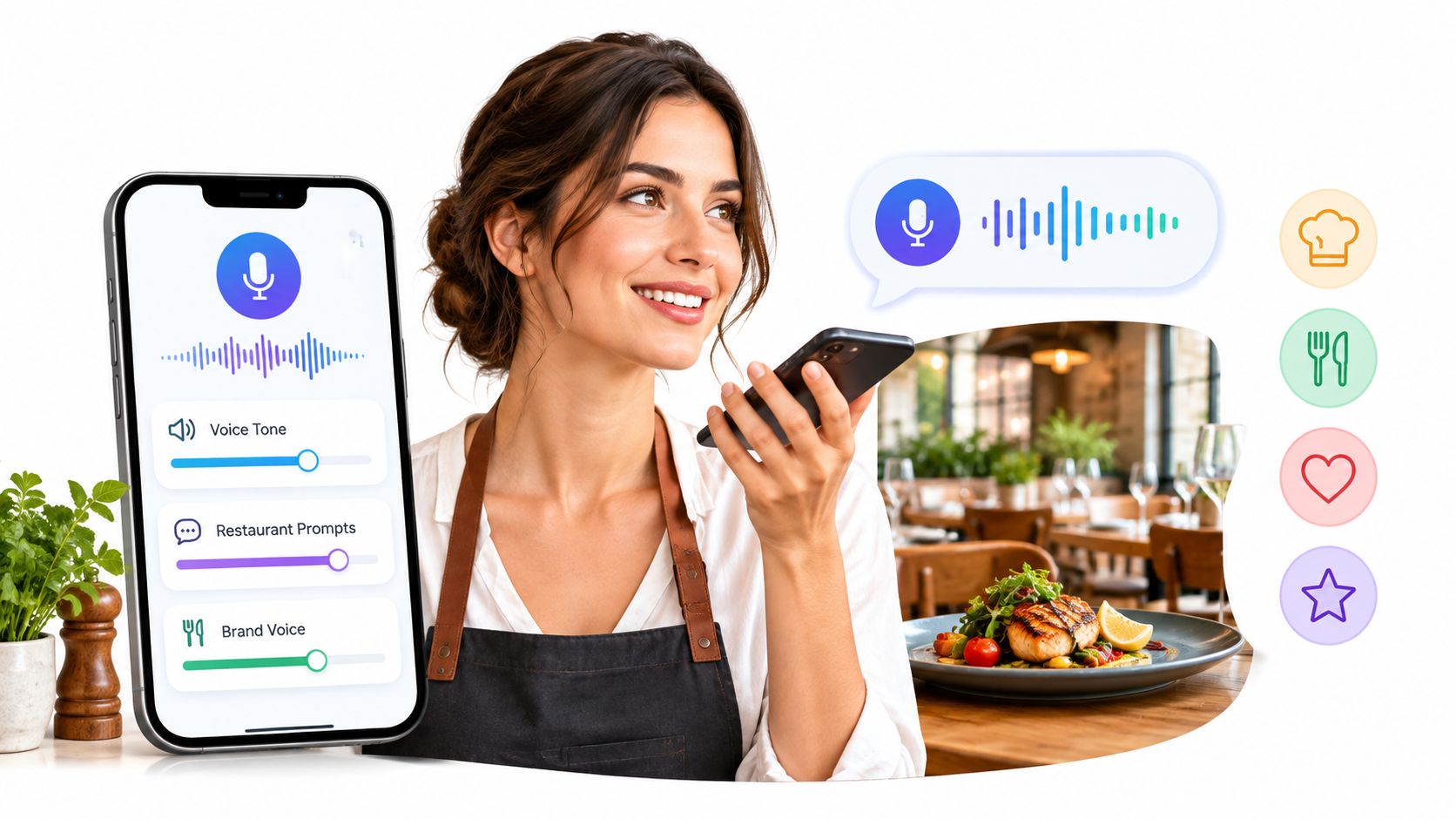
A technically correct receptionist can still sound wrong for the concept. Fine dining generally needs a warm, measured manner that gives guests room to explain themselves. Fast casual may benefit from a brisker greeting, direct questions, and shorter confirmations. The voice should support the service style, not perform an imitation of a staff member.
Write prompts around behaviour
Weak instruction: “Be helpful and answer restaurant questions.”
That wording leaves too much room for long replies, invented details, and overconfident promises. A tighter instruction might be: “Greet callers warmly, ask one question at a time, use the approved menu and policy notes, repeat all reservation details, never guess about allergens, and offer staff escalation when information is missing.”
The second version defines observable behaviour. It also protects the guest experience by keeping answers brief and giving the AI a clear boundary.
Make the greeting compliant and human
The first sentence should identify the restaurant, explain that the caller is speaking with an AI voice assistant, and continue naturally. Don't hide the disclosure in a later menu or wait until the caller asks.
California's AB 2905 created a specific disclosure requirement for inbound AI voice calls effective January 1, 2025, with reported penalties of up to $500 per undisclosed call, according to this state-by-state AI voice compliance guidance. Have counsel review the final wording, particularly if calls are recorded or transferred.
Hospitality standard: Disclosure should be immediate, understandable, and brief. Compliance shouldn't sound like a warning that makes the guest fight through the greeting.
After test calls, edit the knowledge notes based on actual confusion. If callers repeatedly ask whether the kitchen can accommodate a specific ingredient, add the approved answer. If the AI mishears a neighbourhood name or menu item, add pronunciation guidance and alternate terms.
Handling Peak Hours Without Losing Bookings or Overloading Staff
Peak-hour automation works only when the restaurant decides what counts as recoverable. Independent reporting says restaurants can miss 33% of incoming calls during peak hours, while other restaurant-call analyses report 43% unanswered calls and as much as 58% missed during lunch and dinner rushes, as compiled in this restaurant phone communication analysis. The figures vary by dataset and operating context, but the operational lesson is consistent: the rush is when phone coverage is weakest.
Use a short baseline period to classify calls by outcome. Track reservations, cancellations, modifications, takeout, basic questions, complaints, supplier calls, job applicants, and requests that needed a manager. Then configure the AI around the calls it can finish reliably.
Peak Hour Call Triage for Restaurants
| Call Type | AI Handles Fully | Escalate to Staff | Why |
|---|---|---|---|
| New reservation | Capture date, time, party size, contact details, and approved notes, then check availability | Unusual seating requests, private events, or exceptions | Structured bookings are recoverable when capacity rules are accurate |
| Reservation change or cancellation | Apply the published policy and update the booking | Disputed charges, late-arrival exceptions, or sensitive complaints | The system can follow rules, but staff should own judgement calls |
| Hours, location, menu basics, and directions | Provide approved information | Conflicting website information or a question outside the knowledge base | Short answers keep the line moving without guessing |
| Takeout order | Collect standard items and repeat the order | Unclear modifiers, allergy concerns, unavailable items, or payment problems | Item accuracy matters more than speed |
| Complaint or service recovery | Record the concern and offer the approved contact path | Refunds, serious complaints, safety concerns, or angry callers | A human can assess context and protect the relationship |
| Large party or event | Capture requirements and contact details | Pricing, contracts, room availability, or negotiation | These requests need operational and commercial judgement |
The automated phone booking system overview can help owners evaluate the difference between answering calls and completing bookings. Keep staff escalation selective. If every call transfers during the rush, the system has only moved the queue from the phone to the host stand.
Launch Checklist and California Compliance Tips for a Smooth Start
Treat launch as a controlled service change, not a switch you flip and forget. Before forwarding the live number, verify that the reservation calendar shows the correct services, seating areas, hours, blackout dates, and party-size limits. Place test reservations, changes, and cancellations, then confirm that guest messages and internal notifications contain the right details.
Pre-launch verification
- Test the opening line: Confirm the AI identifies itself as an AI voice assistant at the start of every inbound call.
- Check recording language: If calls are recorded, have the consent wording reviewed for California and for any other applicable jurisdiction.
- Audit capacity rules: Test small parties, large parties, patio requests, restricted times, and closely spaced bookings.
- Confirm staff handoff: Make sure escalated calls reach the right person or produce a usable message when nobody can answer.
- Review confirmations: Check that the guest receives the correct date, time, party size, name, and contact details.
During the first week, listen to transcripts and review failed calls every day. Correct one knowledge gap at a time, especially around menu changes, holiday hours, sold-out items, and reservation exceptions. Measure whether the AI is capturing useful calls without creating duplicate bookings or avoidable work for the host.
California operators should take AB 2905 seriously. The requirement applies to disclosure at the beginning of inbound AI voice calls, and reported penalties can reach $500 per undisclosed call, so the opening sentence, recording approach, transfer language, and consent process deserve a documented review. The system also needs a clear escalation path for allergy questions, complaints, and anything the restaurant hasn't approved.
The best deployment is deliberately limited at first. Let the AI answer predictable questions and structured reservation requests, then expand into takeout or more complex changes only after real call reviews show that it can do so accurately.
Heyline provides an AI phone receptionist that can use a restaurant's website information, answer incoming calls in a natural conversation, connect to availability, and book reservations while routing complex requests for human follow-up. Visit Heyline to test a phone coverage setup built around your restaurant's call types, capacity rules, and California disclosure requirements.