A homeowner calls after dinner because the furnace has stopped working. You're finishing another job, your office is closed, and the caller wants to know whether someone can come tonight, what the visit will cost, and what to do next. A voicemail greeting doesn't answer any of those questions.
The same pressure shows up with a leaking pipe, a broken lock, or pests discovered before guests arrive. The caller needs clear next steps, while the contractor needs enough information to accept the right job without promising an appointment the crew can't keep.
A useful home services list connects those needs. It explains what each provider handles, which requests deserve urgent attention, and what a dispatcher should collect before booking. For owners, the practical distinction is between answering a call and accepting responsibility for a service visit.
- Establish the basics: Capture the address, ZIP code, callback number, requested work, and existing-customer status.
- Set an honest expectation: Separate a confirmed appointment from an emergency dispatch request or technician callback.
- Protect the schedule: Check availability against job length, service area, and the skills required.
An AI phone receptionist can support that process when its instructions match the business's actual services and policies. It shouldn't diagnose hazards, invent prices, or treat an empty calendar slot as proof that any technician can handle any job.
These common service categories show how to turn a conversation into a useful work order without making the customer repeat everything later.
1. HVAC (Heating, Ventilation, and Air Conditioning)
HVAC providers install, repair, maintain, and replace heating, cooling, and ventilation equipment. Their work can include furnaces, heat pumps, central air conditioners, ductwork, thermostats, and indoor air quality equipment.
A service visit starts with understanding the equipment and the complaint.

Consider an after-hours caller whose furnace runs but doesn't produce warm air. The receptionist should record the system type, approximate age if known, symptoms, property address, and whether the customer has an existing maintenance agreement. Unknown equipment details shouldn't prevent intake.
Separate urgent requests from maintenance
A loss-of-comfort call and a reported hazard need different handling. Configure the receptionist to follow approved emergency instructions for gas smells, smoke, or other danger signals, rather than troubleshooting or booking the next opening.
For ordinary repairs, explain the approved diagnostic fee and whether the request is confirmed or awaiting dispatch review. For tune-ups, offer an available maintenance appointment without consuming capacity reserved for urgent repairs.
Dispatch rule: Never promise an arrival time just because the calendar shows an opening. Confirm that the slot is suitable for that service and location.
An HVAC answering service workflow should distinguish repair visits, maintenance, and replacement estimates. An AI receptionist can capture those categories and book approved appointment types while leaving technical decisions to the technician.
The accompanying video provides additional HVAC context.
2. Plumbing
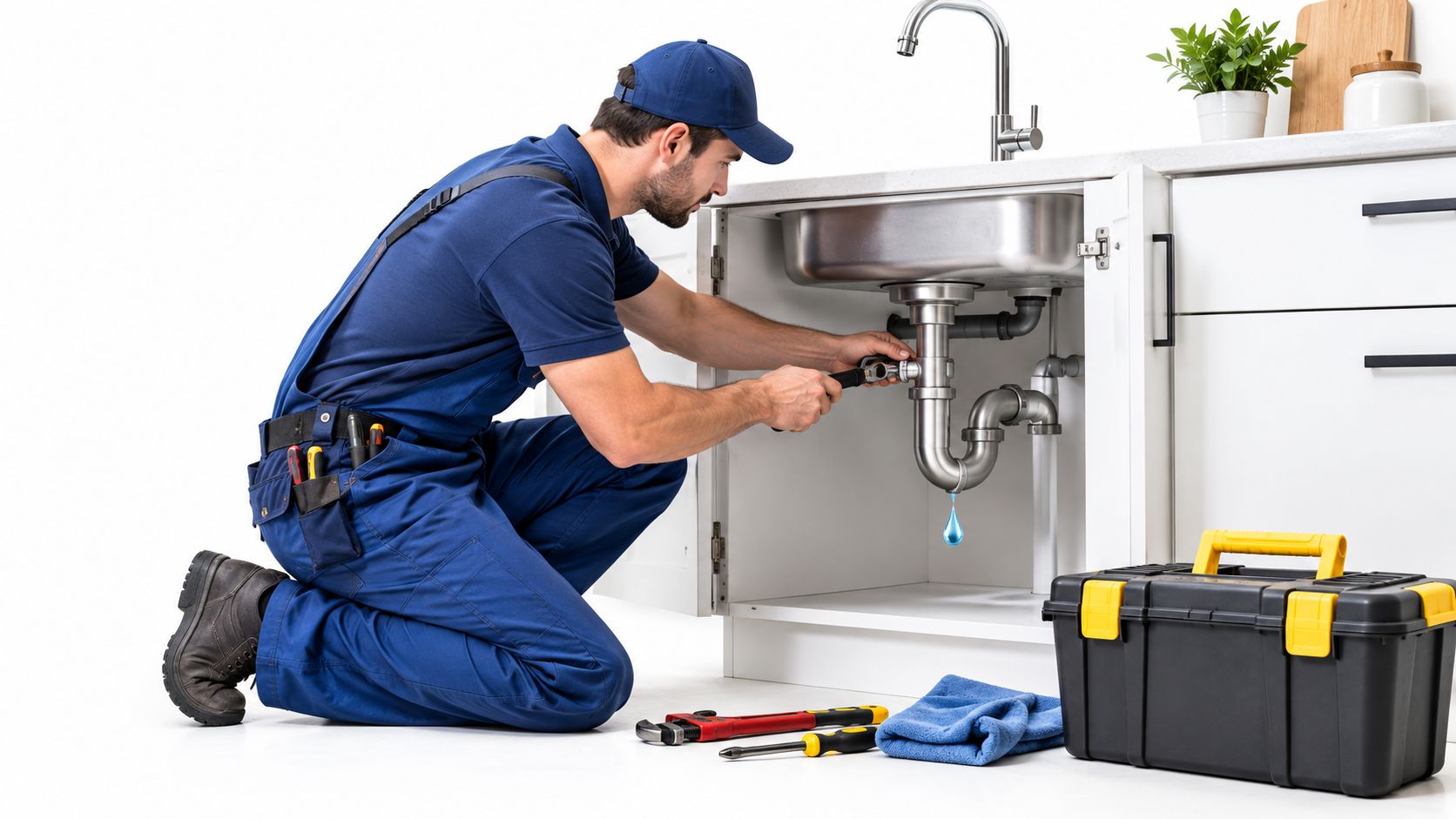
Water is collecting under the kitchen sink, and the homeowner isn't sure whether it's a loose connection or a larger leak. Before discussing appointment preferences, establish whether water is actively escaping and whether the caller reports an immediate safety concern.
Plumbing providers handle water supply lines, drains, fixtures, water heaters, and sewer connections. A blocked sink, failed water heater, and suspected sewer backup require different preparation, even when the customer describes each as a plumbing emergency.
The affected fixture and surrounding area belong in the call record.
- Problem and extent: Ask which fixtures are affected, when the issue began, and whether it's getting worse.
- Location and access: Collect the full address, unit details, parking restrictions, and contact for entry.
- Previous work: Note recent repairs or an earlier visit without assuming they caused the problem.
Make the appointment promise precise
An AI receptionist can collect these details while the plumber is working, explain an approved call-out or diagnostic fee, and offer an eligible appointment. Only quote a fixed service price when the business has explicitly authorised it for that scope.
A plumbing answering service setup should distinguish active leaks from routine fixture replacements and estimate requests. Repeat the appointment window and callback number before ending the conversation.
If urgent dispatch requires a human decision, say so. A recorded request isn't the same as a plumber being on the way.
3. Electrical Services
A homeowner calls about an outlet that sparked when an appliance was plugged in. Another wants an EV charger installed. Both need an electrician, but they shouldn't enter the same booking flow.
Electrical services include circuit troubleshooting, wiring, lighting, outlets, panel work, and planned installation projects. Safety-related language should trigger an approved escalation process, not an automated diagnosis or instructions to inspect energised equipment.
The technician needs a clear description before assessing the work.

Book a service call or an assessment
For troubleshooting, capture which areas are affected, whether the issue is ongoing, and what the caller observed. Ask about the property and panel only when the customer can answer without touching equipment or entering an unsafe area.
For an EV charger or renovation enquiry, collect the installation location, equipment details if known, and whether other electrical work is planned. Book an assessment rather than implying that installation can proceed unseen.
- Safety escalation: Flag reported sparks, burning smells, shocks, or smoke under the business's approved protocol.
- Scheduling category: Separate repair appointments from project estimates.
- Scope verification: Confirm that the contractor handles the requested work before offering availability.
California's consumer guidance advises checking a contractor's licence status, classification, bond, insurance, workers' compensation coverage, and disclosed disciplinary information, rather than relying on a directory listing alone (California contractor guidance).
An AI receptionist can explain the company's documented services and capture the request. It shouldn't claim qualifications that haven't been verified or guarantee permit requirements before review.
4. Residential House Cleaning
A move-out clean with a key handover deadline is a different job from maintaining an occupied home. Treating them as interchangeable creates the wrong quote, appointment length, and crew expectations.
Residential cleaning can include standard housekeeping, deep cleaning, move-in and move-out work, and post-construction cleaning. For recurring customers, consistency matters as much as finding the next available opening.
Define the clean before offering a time
Suppose a caller asks for a deep clean before family arrives. Ask about the home's approximate size, bedrooms and bathrooms, current condition, pets, and priority areas. Establish whether the request includes tasks such as appliance interiors or work outside the standard service.
- Scope: Record the requested cleaning type and any exclusions that need explaining.
- Access: Confirm who will provide entry and how pets will be managed.
- Timing: Ask whether the deadline is flexible or tied to a move, inspection, or event.
- Repeat service: Offer a recurring arrangement only after confirming that the initial scope fits.
An AI receptionist can collect these details and book an approved cleaning category. It shouldn't squeeze a substantial first clean into a routine maintenance slot because the customer prefers that time.
A cleaning service scheduling workflow should also address changes to existing appointments. Moving a recurring visit requires the same attention to crew availability and duration as creating a new booking.
Don't promise every requested task at intake. Record unusual conditions for review, explain what the standard service includes, and make any provisional quote clearly conditional on accurate property information.
5. Lawn Care and Landscaping
An open afternoon on the calendar doesn't necessarily make a distant mowing job a sensible booking. Lawn care scheduling needs to account for travel, property access, equipment, and the rest of the crew's route.
Services may include mowing, hedge trimming, weed management, seasonal cleanup, irrigation maintenance, and garden installation. Routine maintenance can fit a repeat schedule, while design and construction work usually need a separate assessment.
A typical caller wants recurring lawn care but also mentions an irrigation problem and an overgrown hedge. Capture each request separately instead of placing everything under mowing.
Keep route work separate from project work
Ask for the address, approximate area requiring attention, access width, slopes, pets, and whether debris needs removal. If the caller doesn't know the property size, record that uncertainty rather than forcing a guess.
A convenient appointment for the customer still needs to be a workable stop for the crew.
An AI receptionist can collect property details and offer booking windows approved for that service area. Larger landscaping requests should enter an estimate calendar, not a maintenance route.
- Recurring care: Confirm the desired frequency and what each visit includes.
- Irrigation concerns: Record the visible problem without promising a diagnosis.
- Project enquiries: Capture the intended changes, access constraints, and preferred assessment window.
Weather-related changes also need a clear policy. The receptionist should communicate the company's approved rescheduling information, not independently promise that a crew can work through unsuitable conditions.
Keep specialist work distinct. If a caller adds tree work, chemical treatment, or substantial construction, verify that the business accepts that scope before booking it.
6. Pest Control
The caller has found insects near a bed and wants treatment immediately. They're worried, embarrassed, and unsure what they're looking at. Calm, neutral intake is more useful than an instant identification.
Pest control providers investigate and address problems involving insects, rodents, and other unwanted animals, depending on their service scope. Work may involve inspections, treatment, exclusion, and preventive visits.
Ask what the caller has observed, where they found it, how long it's been happening, and whether there has been previous treatment. Record their description without turning it into a confirmed pest identification.
Offer a clear inspection path
An AI receptionist can book an available inspection and explain what the company has approved for that appointment. It shouldn't select a treatment, promise elimination, or recommend applying products based on a phone description.
- Observed activity: Capture sightings, droppings, damage, sounds, and affected rooms.
- Household considerations: Note children, pets, access restrictions, or concerns the technician should discuss.
- Service history: Record earlier visits, treatments, and whether the caller is an existing customer.
For the anxious caller, explain whether the appointment is an inspection, treatment, or follow-up. Those labels matter because the technician may need to assess the property before deciding what to do.
Don't bury the immediate concern under a maintenance-plan pitch. Once the initial visit is arranged, the receptionist can mention any approved ongoing service options without presenting them as necessary before an assessment.
Preparation instructions should come from the provider's documented guidance. If the caller asks a question that isn't covered, capture it for the technician rather than improvising.
7. Roofing
Roofing calls range from planned replacement enquiries to water entering a bedroom during bad weather. The first needs an assessment; the second needs urgent review, honest availability, and clear boundaries around what can safely happen next.
Roofing services can include inspections, repairs, replacement, storm-damage assessment, and related gutter work. Intake should distinguish a request to stop immediate damage from a request to price permanent work.
An inspection is the point at which observations can become a defined scope.

Record damage without promising coverage
For a caller reporting a leak, collect where water is appearing, when it started, the property address, roof type if known, and any access restrictions. Ask whether an insurance claim is involved, but don't predict coverage or approval.
An AI receptionist can offer approved inspection appointments and collect information during a surge in calls. If temporary protective work requires dispatch review, make that distinction explicit.
Set expectations early: An inspection booking isn't a guarantee that repair work will happen during the same visit.
California's guidance identifies disaster rebuilding as subject to home-improvement contract and payment rules, rather than automatically treating it as exempt new construction (CSLB accomplishments and activities report). Contractors should explain who will address permits, documentation, and coordination before work begins.
Don't advertise an inspection as free unless that's the company's actual policy. Similarly, don't ask callers to climb onto a roof for photographs or measurements. Capture what they can describe safely and leave assessment to the professional.
8. Handyman Services
The caller has a sticking door, damaged drywall, shelves to install, and a light fitting they'd like replaced. That sounds like a convenient grouped visit, but the final task may fall outside the provider's accepted scope.
Handyman services cover varied smaller repairs and maintenance tasks, including assembly, patching, minor carpentry, and door adjustments. A handyman label doesn't establish permission or competence for every trade task.
Build a task list, not a vague booking
Ask the caller to describe each job, the materials involved, approximate dimensions where useful, and whether replacement parts are already available. Record high ceilings, difficult access, or work that may require another person.
- Accepted work: Match each task against the business's documented service boundaries.
- Materials: Clarify who supplies parts and whether collection time requires approval.
- Charges: Explain the approved minimum charge or hourly arrangement without promising a final total.
- Appointment length: Allow for the complete task list, not just the first repair mentioned.
An AI receptionist can collect the list and book a suitable slot for accepted work. For a solo operator, Google Calendar availability is useful, but the owner still needs realistic durations and travel allowances.
The practical trade-off is between efficiently grouping jobs and accepting an undefined day of work. A detailed request lets the operator decide what fits before arriving.
If the customer adds tasks after booking, require a scope review rather than extending the appointment without notice. Refer specialised or uncertain work for human assessment, especially when licensing, permits, or safety responsibilities may be involved.
9. Appliance Repair
A refrigerator has stopped cooling, and the caller wants the earliest visit. Fast intake matters, but booking a technician who doesn't service that brand or appliance type won't solve the problem.
Appliance repair providers diagnose and repair equipment such as refrigerators, washers, dryers, dishwashers, and cooking appliances. The useful intake details are the appliance identity, observed symptoms, service history, and coverage status.
Collect identifying details without delaying the call
Ask for the brand and model number if the caller can obtain them safely. If the label is inaccessible, record the missing detail and follow the company's process for collecting it later.
A concise intake record should include:
- Symptoms: What happens, when it began, and any displayed error message.
- Installation: Whether the appliance is built in, stacked, or otherwise difficult to access.
- Coverage: Any warranty or service-plan information requiring review before a paid booking.
- Visit terms: The approved diagnostic fee and whether the business credits it towards repair.
An AI receptionist can check eligible appointment availability and explain those terms. It shouldn't promise a completed repair merely because it has booked a diagnostic visit.
For the refrigerator caller, confirm whether the company services that equipment before discussing an appointment. Leave food-safety questions to appropriate guidance rather than making guarantees about stored food.
Avoid promising parts availability without confirmation. Capturing the model helps the technician prepare, but it doesn't establish the fault or prove that a replacement component is in stock. A clear diagnostic appointment is better than an unsupported promise of an immediate fix.
10. Locksmith Services
Being locked out creates a narrow decision window. The caller wants access, but the locksmith also needs a legitimate service request, accurate location details, and a clear understanding of the lock.
Locksmith work can include residential lockouts, rekeying, lock replacement, key services, and smart-lock installation. Vehicle work should remain a separate service category where offered, rather than being assumed from a general locksmith listing.
Establish access authority before dispatch
Consider a tenant outside a rental property after hours. The receptionist should collect the address, callback number, whether the caller is at the property, and the nature of the access problem.
It should also explain the business's identity and authorisation requirements without treating the phone conversation as final verification.
- Lock details: Capture the lock type or available description and whether a key is lost, broken, or not operating.
- Authority: Ask whether the caller is the owner, tenant, or authorised representative.
- Charges: State the approved service fee and explain which additional work requires assessment.
- Urgency: Escalate reports of immediate danger through the approved emergency process.
An AI receptionist can answer an after-hours enquiry and offer an eligible booking, but an appointment time isn't automatically a confirmed technician arrival estimate. Real-time emergency dispatch needs a separate operational process.
For planned smart-lock installation or rekeying, use a routine appointment category and capture the requested scope. Don't fill an emergency slot with planned work unless that's how the business operates.
Trust depends on accurate claims. The greeting should reflect the company's actual location, qualifications, insurance, and service area, without implying credentials or proximity that haven't been established.
Top 10 Home Services Comparison Matrix
The sections above cover each trade on its own terms. This matrix answers a different question: what should happen in the first sixty seconds of the call. Use it as an intake checklist for a dispatcher, or as configuration guidance for an AI phone receptionist such as Heyline, which can collect these fields before offering a booking.
| Service | Typical incoming call | Intake fields to capture | Appointment type to book | Hand to a person when |
|---|---|---|---|---|
| HVAC | No heat overnight or AC out during a heat wave | System type and age, symptoms, thermostat reading, whether occupants are vulnerable | Emergency repair dispatch for total loss; estimate slot for replacement quotes | Caller reports gas smell, a carbon monoxide alarm, or at-risk occupants |
| Plumbing | Burst pipe, failed water heater, clogged main line | Leak location, whether the shutoff is closed, fixture or heater type, property age | Emergency repair for active water; standard repair for contained issues | Active flooding, sewage backup, or anything involving the gas line |
| Electrical Services | Partial power loss or a smell at the panel | Symptoms, panel location, affected circuits, any recent electrical work | Urgent repair for hazards; estimate for upgrades like panels or EV chargers | Burning smell, sparking, exposed wiring, or repeated breaker trips |
| Residential House Cleaning | Caller wants weekly service or a move-out clean | Home size, bedroom and bath count, pets, access method, preferred frequency | Recurring slot for maintenance plans; one-time visit for deep cleans | Jobs needing a custom quote, such as post-renovation or heavy buildup |
| Lawn Care and Landscaping | New customer asking for weekly mowing | Lot size, gate and pet access, services wanted, current turf condition | Recurring route slot or one-time cleanup; site-visit estimate for garden design projects | Anything priced by site inspection rather than description |
| Pest Control | Caller spots termites, rodents, or roaches | Pest type, where activity appears, children and pets in the home, prior treatments | Inspection first, treatment scheduled after findings | Wildlife removal, fumigation scope, or health-related concerns |
| Roofing | Ceiling stain appears after a storm | Roof age, where damage shows, insurance claim status, attic access | Inspection or estimate slot, kept separate from urgent leak review | Active interior water entry or suspected structural damage |
| Handyman Services | Caller has a list of small repairs | Task list, photos if available, materials on hand, rough scope per task | Half-day or hourly booking block matched to the task count | The list includes work reserved for a licensed trade |
| Appliance Repair | Refrigerator or washer stops working | Brand, model, age, exact symptom, warranty status | Diagnostic visit, typically same-day or next-day capacity | Parts availability is unclear or the unit is a gas appliance |
| Locksmith Services | Locked out of a home after hours | Lock type, whether the caller is at the property, owner or tenant status, location | After-hours service call, or a scheduled slot for rekeying and hardware work | Identity or authorisation questions, or any report of immediate danger |
The pattern worth noticing: urgent trades book a repair, consultative work books an estimate, and relationship work books a recurring slot. Getting that routing right at intake is what separates a booked job from a callback that never happens.
Turn Service Calls into Booked Jobs
The best home services list is useful beyond naming trades. It helps an owner decide what to ask, what to promise, and where a request belongs. A cleaning enquiry needs scope and access details; an electrical hazard needs an approved escalation path; a roofing estimate needs a different appointment from urgent leak review.
Clear intake is part of customer service, not just administration. California's Contractors State License Board reported 20,527 complaints in 2022, which reinforces the importance of documented expectations without proving that phone handling caused those complaints (CSLB accomplishments and activities report for 2022). Keep the customer's request, appointment details, promised response, and unresolved questions together so the technician isn't reconstructing the conversation on arrival.
Define the rules before automating calls
Start with the information an experienced receptionist would need. Document accepted services, exclusions, service areas, appointment types, approved fees, and situations requiring human review. Include what happens when there's no suitable availability.
- Separate appointment types: Give repairs, estimates, inspections, and recurring visits appropriate booking rules.
- Protect capacity: Allow for travel, preparation, and work that may need a particular technician.
- Control promises: Distinguish confirmed bookings from requests awaiting dispatch approval.
- Test difficult calls: Include uncertain symptoms, out-of-area addresses, pricing questions, and callers who change their request.
Heyline is one option for owners who need phone coverage without building a custom call-handling system. It imports business information from the company's public website, lets the owner edit that knowledge, answers incoming calls, and books appointments against Google Calendar availability.
Review imported information before launch. An outdated service page or unclear pricing description shouldn't become the receptionist's answer. Test whether the system explains your appointment categories correctly and handles unanswered questions according to your policy.
Measure completed outcomes, not just answered calls
Track answer rate, abandoned calls, booked-call conversion, missed appointments, and complaints separately. Review whether bookings contain useful job notes and whether technicians arrive prepared. More answered calls aren't enough if the office must undo unsuitable appointments.
Automation also needs boundaries. Keep technical diagnosis, uncertain pricing, unusual scope, and emergency dispatch decisions with the people responsible for them. Calendar-aware booking works best when the owner has defined what each available appointment can accommodate.
The practical aim is straightforward: answer consistently, capture the right details, and give the caller a next step the business can honour. That's how phone coverage supports better-qualified work without adding avoidable pressure to the crew.
Heyline offers an AI phone receptionist that answers calls, captures service requests, and books available appointments directly into your business calendar. Visit Heyline to connect your website and calendar, review your service information, and test a call using the jobs your customers request.