
Most advice on how to find clients for a cleaning business starts with the same list: create a website, post on social media, ask for referrals, and run ads. Those channels can help, but they don't solve the problem that costs cleaning companies the most money. A prospect calls while you're on-site, leaves a voicemail, and hires someone else before you return it.
Client acquisition isn't finished when someone fills out a form or asks for a quote. You need a system that attracts the right prospects, qualifies them, answers them when you're unavailable, books a walkthrough, and turns that first job into recurring revenue. In California, the opportunity is substantial, but so is the competition, so broad visibility without a disciplined appointment process usually creates more admin work than profitable contracts.
Why Broad Prospecting Fails Cleaning Businesses
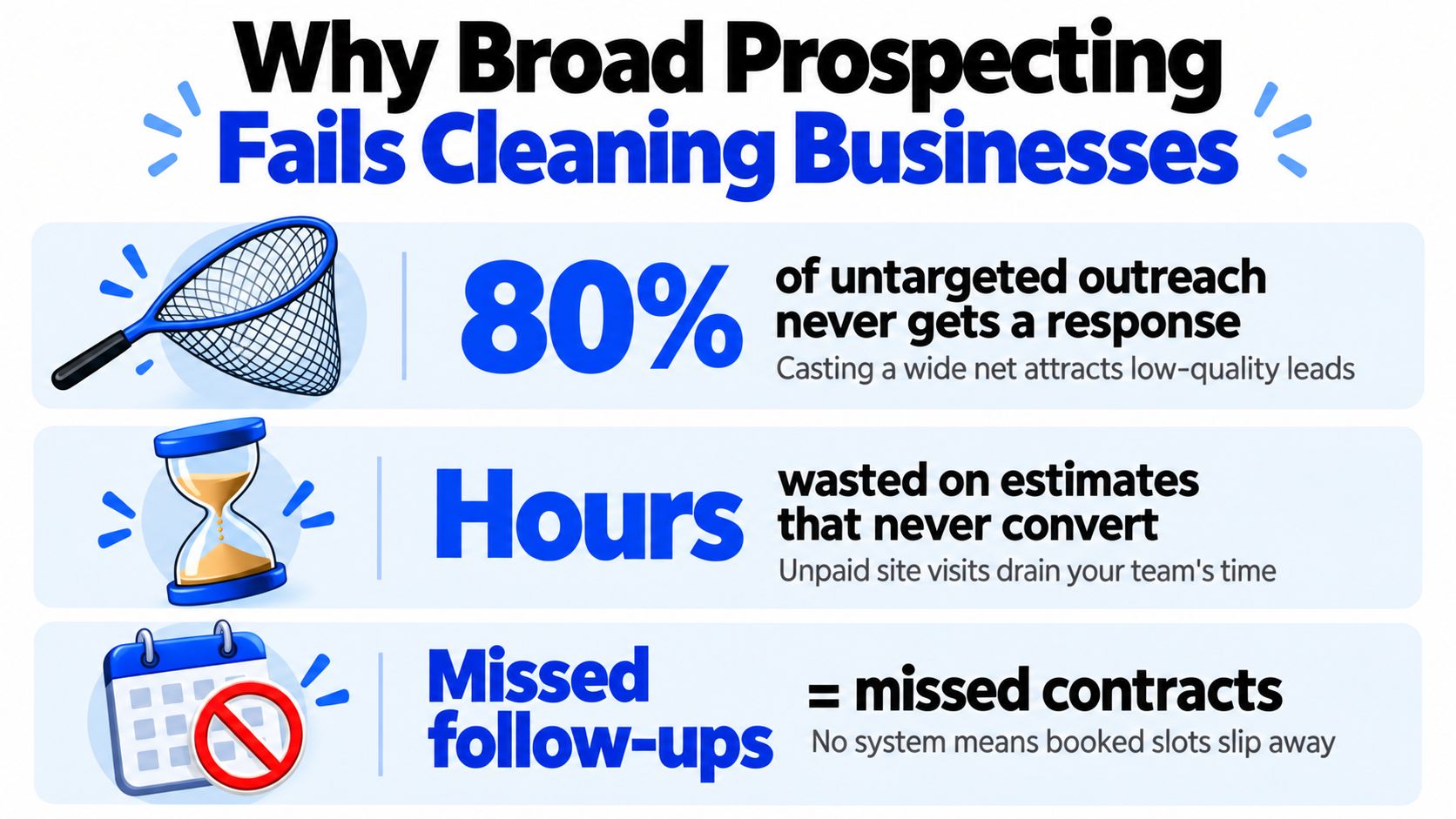
Broad prospecting can make a cleaning company busier while making its pipeline less profitable. Accepting every enquiry means chasing small one-time deep cleans across town, office contracts, residential requests, and medical facilities without deciding which work suits the crew. The result is scattered travel, unpaid estimates, and qualified prospects waiting while the owner is working.
A focused offer gives each outreach effort a clear purpose. A team equipped for documented sanitation procedures should approach medical practices differently from a crew providing after-hours office cleaning. A company serving property managers can build a turnover-cleaning process, while a smaller residential operation may prioritise recurring homes along a compact route. The goal is a lead that can become a scheduled appointment and, when suitable, a recurring contract.
Choose a client profile before choosing a channel
Define the conditions that make a lead worth pursuing:
- Property type: Choose whether to prioritise homes, offices, clinics, restaurants, salons, builders, or managed properties.
- Service pattern: Recurring work should outrank a one-time job when it matches your capacity and route.
- Location: Set a practical driving radius. A wide service map can create scattered appointments and erode margin.
- Decision-maker: Identify who controls access and budget, such as a facility administrator, property manager, office owner, or homeowner.
- Operational fit: Reject work requiring equipment, staffing, insurance, or hours you cannot reliably provide.
California's small-business base supports a focused approach. The U.S. Small Business Administration's 2025 California profile reports approximately 4.3 million small businesses, representing 99.8% of businesses in the state. That creates a large prospect pool, but every business still needs to pass your property, route, service, and capacity checks.
Practical rule: A lead is only valuable when the property, location, timing, budget, and service requirements fit the business you can operate.
Broad prospecting also exposes a follow-up gap. An owner sends a quote, returns to cleaning, and loses track of the next contact. The lost opportunity often comes down to ownership, not service quality or pricing. Assign a next step and due date for every qualified enquiry. A defined segment also makes follow-up more relevant, helping the prospect understand why your company fits the work.
Building a Local Outbound Pipeline
A local outbound pipeline works when it follows buying signals, not a random list of businesses. Choose one city or nearby cluster, then organise prospects by neighbourhood, property type, and likely decision-maker. A group of offices near your current route can produce better opportunities than a larger list scattered across the metropolitan area.
Use several local sources to build that list. Business-license databases can reveal new firms. Commercial real-estate announcements can point to new tenants, relocations, and building changes. Chamber-of-commerce directories, neighbourhood groups, and property-management listings can provide names and contact details. As noted in the SBA profile referenced earlier, business openings and closures create a changing pool of local prospects. The useful question is whether each new lead matches your route and service capacity.
Build the list around buying signals
A useful spreadsheet should include:
- Business name and address: Group records by route so one sales visit can cover nearby opportunities.
- Industry and property type: Separate offices, clinics, restaurants, salons, contractors, and property managers.
- Contact role: Record the owner, office manager, facilities contact, or property administrator.
- Trigger: Note a new opening, relocation, renovation, tenant change, or visible need for recurring service.
- Next action: Add the call date, email date, response, and promised follow-up.
Your first message should show why the prospect belongs on your list. Mention the property type you serve, the service window you can cover, and the next easy step. Offer a site walkthrough and a written scope based on floor area, operating hours, and sanitation needs. Avoid quoting before you see conditions that affect labour, supplies, access, and cleaning time.
The pipeline also needs a call-handling plan. If you are cleaning when a prospect responds, use a brief voicemail or text that confirms when you will call back. Log that commitment immediately. A qualified lead can disappear just because nobody owns the next contact. Set a follow-up date for every enquiry and prepare two or three questions that identify urgency, service frequency, access, and the person approving the work.
Public procurement deserves a separate lane. Register in California's Cal eProcure system, complete Department of General Services small-business certification where eligible, and monitor opportunities from Caltrans, the University of California system, DGS, and Los Angeles city and county agencies. A California janitorial opportunity snapshot identified 78 open janitorial and cleaning opportunities, including 50 added during the preceding 30 days. It also listed 12 open postings for Los Angeles County and six for DGS.
Large contracts can still be poor fits. Check route density, staffing, insurance, bonding, licensing, after-hours requirements, prevailing-wage terms, task frequency, square footage, and the submission deadline. Your bid tracker should show quickly whether an opportunity can support reliable delivery and a profitable recurring relationship.
Choosing Between Residential and Commercial Contracts
The right client type depends less on market size than on your crew, route, sales patience, and ability to deliver consistently. Residential recurring work can be easier to explain and sell locally, while commercial contracts often require a more formal proposal, proof of insurance, documented procedures, and reliable coverage outside normal business hours.
California market data provides useful context. The state's residential cleaning market is reported at roughly $40 per hour, with a typical recurring customer generating about $420 per month. At that value, 40 recurring customers would represent approximately $16,800 in monthly gross revenue, based on the California cleaning-business market reference. Those figures aren't a promise of profit. They show why route density, repeat frequency, labour cost, and travel time matter more than the number of enquiries.
Commercial work has a different shape. One industry estimate places California's commercial cleaning market at $9.8 billion in 2024, projected to reach $13.2 billion by 2028. The estimate divides the market among offices at 35%, healthcare facilities at 20%, educational institutions at 15%, retail at 12%, industrial sites at 10%, and other segments at 8%, as reported in this California janitorial business market guide.
| Factor | Residential Recurring | Commercial Contracts |
|---|---|---|
| Sales cycle | Often shorter, especially when the service and area are familiar | Usually longer, with walkthroughs, proposals, approvals, and procurement steps |
| Decision-maker | Homeowner or household decision-maker | Owner, property manager, facilities administrator, or procurement contact |
| Scheduling | Daytime access, recurring household slots, and route planning | After-hours, early morning, scheduled building access, and service windows |
| Proof required | Reviews, trust, clear communication, and consistent results | Insurance, staffing, scope control, quality checks, and professional documentation |
| Operational risk | Travel spread and cancellations can reduce margin | Underestimating labour, supplies, access, and contract obligations can damage margin |
| Best fit | A small crew building dense local routes | A team able to support recurring coverage and formal account management |
Match the model to your current capacity
Choose residential first if you need faster feedback, can serve a compact neighbourhood, and have a process for recurring appointments. Prioritise commercial work if you can maintain consistent staffing, handle proposals, and support the service standards expected by offices, clinics, property managers, or public buyers.
San Diego illustrates why local testing matters. Available market data reports approximately 2,800 cleaning businesses, an average cleaner rate of $38 per hour, and an estimated recurring residential-client value of about $400 per month, according to this San Diego cleaning-business market overview. Use those figures as planning context, not as a guaranteed outcome. Calculate acquisition cost against monthly gross margin, then stop lead sources that create calls but no qualified walkthroughs.
Local Marketing Tactics That Actually Work
Local marketing performs best when it gives a specific prospect a credible reason to contact you. A generic social post may keep your name visible, but it rarely replaces a direct offer, a trusted referral, or a complete local profile. Choose one or two channels that match your crew size and execute them consistently.
Compare the main local options
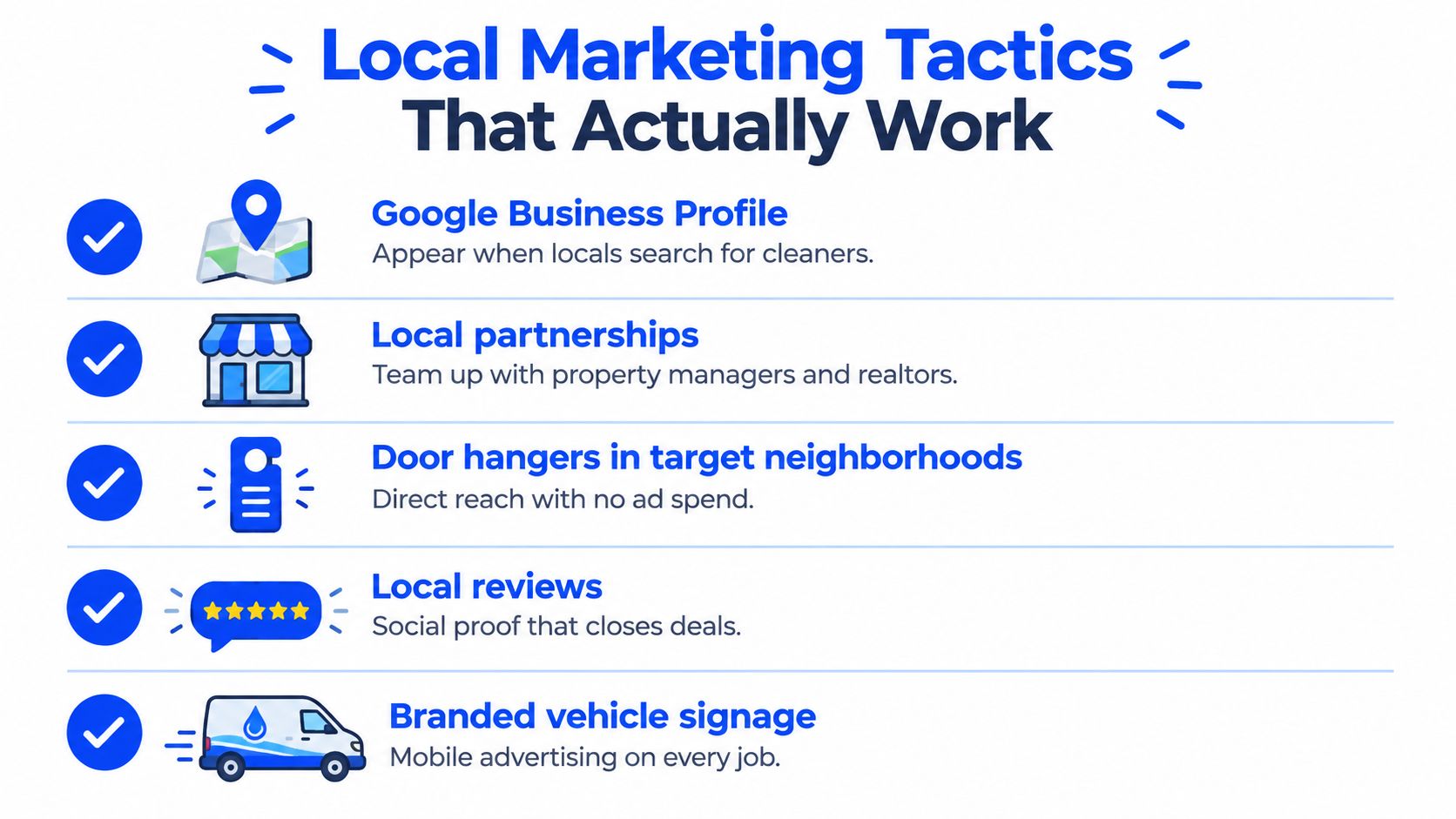
Google Business Profile is the foundation for high-intent searches. Keep your phone number, service area, hours, photos, and service descriptions accurate. Ask satisfied customers for honest reviews and respond professionally to both praise and complaints. A profile that matches the service you provide will support trust better than a broad list of services you can't staff.
Partnerships can produce warmer opportunities than paid reach. Property managers may need recurring common-area or turnover cleaning. Realtors and contractors may need dependable cleaning at handover points. Bring a concise service sheet, explain your response area, and make referrals easy by stating exactly which jobs you accept.
Targeted direct outreach gives you control. Door hangers can work for a defined residential area, while short email sequences can reach offices, salons, restaurants, and medical practices. The message should name the property type, describe the recurring problem you solve, and invite a walkthrough rather than forcing a quote from incomplete information.
Paid advertising can generate demand quickly, but it also exposes weak phone handling. If nobody answers, qualifies, and schedules the enquiry, the advertising budget produces expensive missed opportunities. Small operators should test one tightly bounded service area before expanding spend.
Vehicle signage and community presence help reinforce recognition while you work. Branded vehicles, local events, chamber relationships, and neighbourhood sponsorships won't replace a sales process, but they can make your company familiar when a prospect checks your name.
For practical guidance on turning local search visibility into phone enquiries, use this Google Business Profile call-handling guide. Track each source separately. A referral, profile enquiry, flyer response, and paid lead shouldn't sit in one undifferentiated contact list because each channel has different costs and follow-up requirements.
Answering Leads and Booking Appointments
A missed call is often a missed appointment, not merely a missed message. Cleaning owners work inside homes, offices, and facilities, drive between sites, manage staff, and handle supplies. The prospect doesn't know whether you'll call back in ten minutes or tomorrow, so they often contact another provider.
Start with a short intake script that captures the information needed to decide whether an estimate is appropriate:
- Service requested: Recurring cleaning, deep clean, move-out, post-construction, turnover, or another service.
- Property details: Home, office, clinic, restaurant, salon, managed building, or contractor site.
- Location: Address or service area, including access and parking constraints.
- Timing: Preferred start date, service window, urgency, and ongoing frequency.
- Scope: Floor area, rooms, restrooms, occupancy, current condition, and special sanitation requirements.
- Decision process: Who approves the work and whether a walkthrough is required.
Don't turn the call into a long interrogation. Ask enough to separate a qualified estimate from work outside your route, schedule, or capabilities. If the request needs manual review, record the caller's name, number, question, and promised response time.
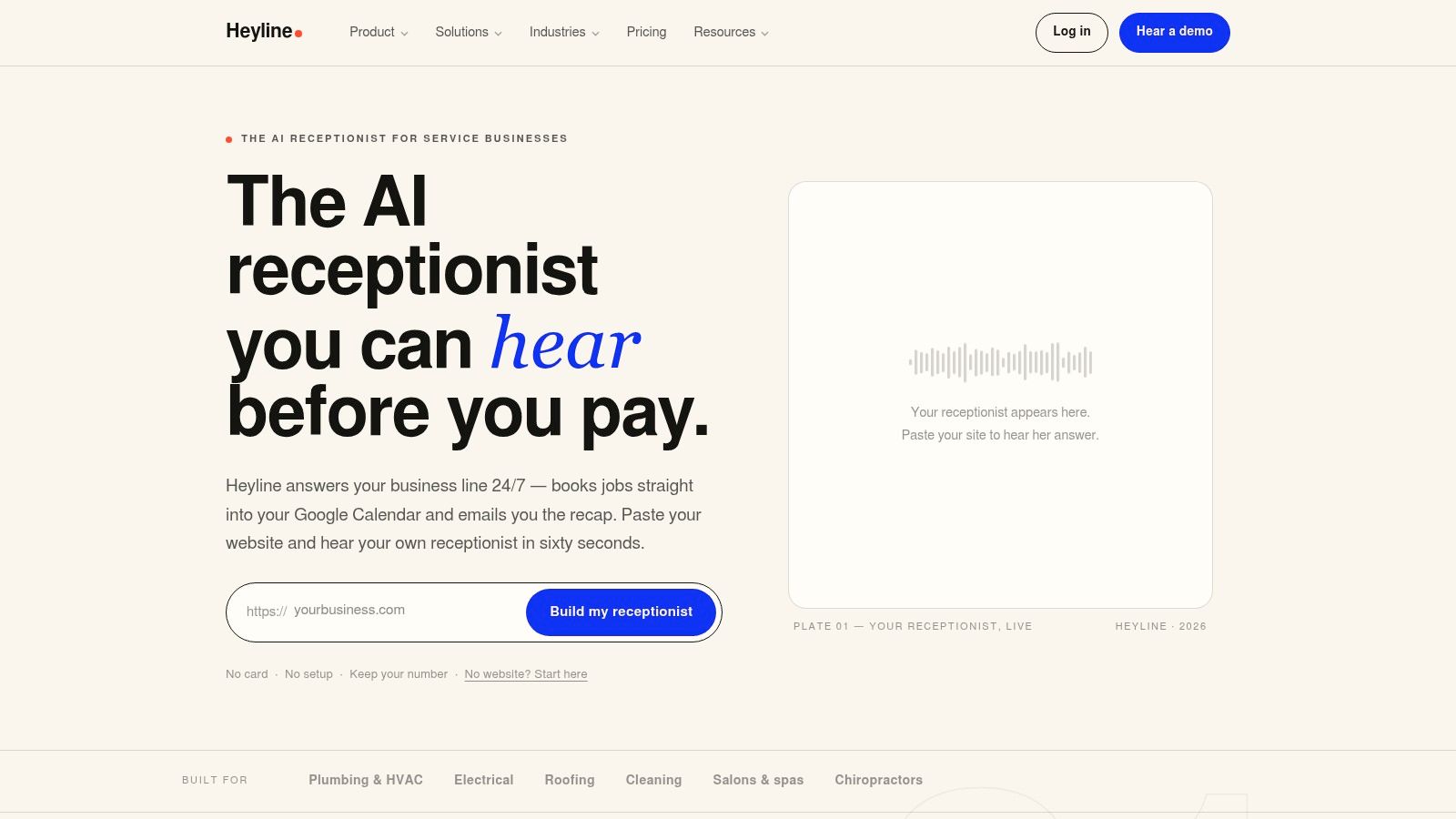
A receptionist, answering service, or AI phone receptionist can cover calls while the team is occupied. Heyline is one option that answers incoming calls, uses information from a cleaning business's website, captures service details, and books a first visit into Google Calendar. The important point is not the tool itself. The process must give the caller a clear next step and give you a complete record of what was requested.
Make booked estimates harder to lose
Confirmation should happen immediately after scheduling. Send the appointment time, address, contact name, preparation instructions, and a way to reschedule. For commercial walkthroughs, remind the prospect to provide access details, floor plans if available, and the person responsible for approving the scope.
Objections usually signal missing information. If a caller says the price seems high, don't discount before understanding the property. Explain that labour, frequency, access, supplies, and sanitation requirements affect the proposal. If the caller wants an instant price for a site with unknown conditions, offer a walkthrough and a written scope instead.
A booked appointment still needs ownership. Review new bookings at the start and end of each day, confirm that the route makes sense, and mark the outcome after the visit. Your numbers should separate qualified opportunities, completed estimates, and signed recurring contracts. California-specific material doesn't establish a reliable close rate, so calculate your own conversion benchmarks from consistent Heyline customer data rather than copying an unrelated industry figure.
Creating a Daily Acquisition Workflow
Lead generation becomes manageable when it has a place on the calendar. A small crew doesn't need to spend the entire day selling. It needs a repeatable rhythm that protects service quality while keeping new opportunities moving.
Use short blocks with clear ownership
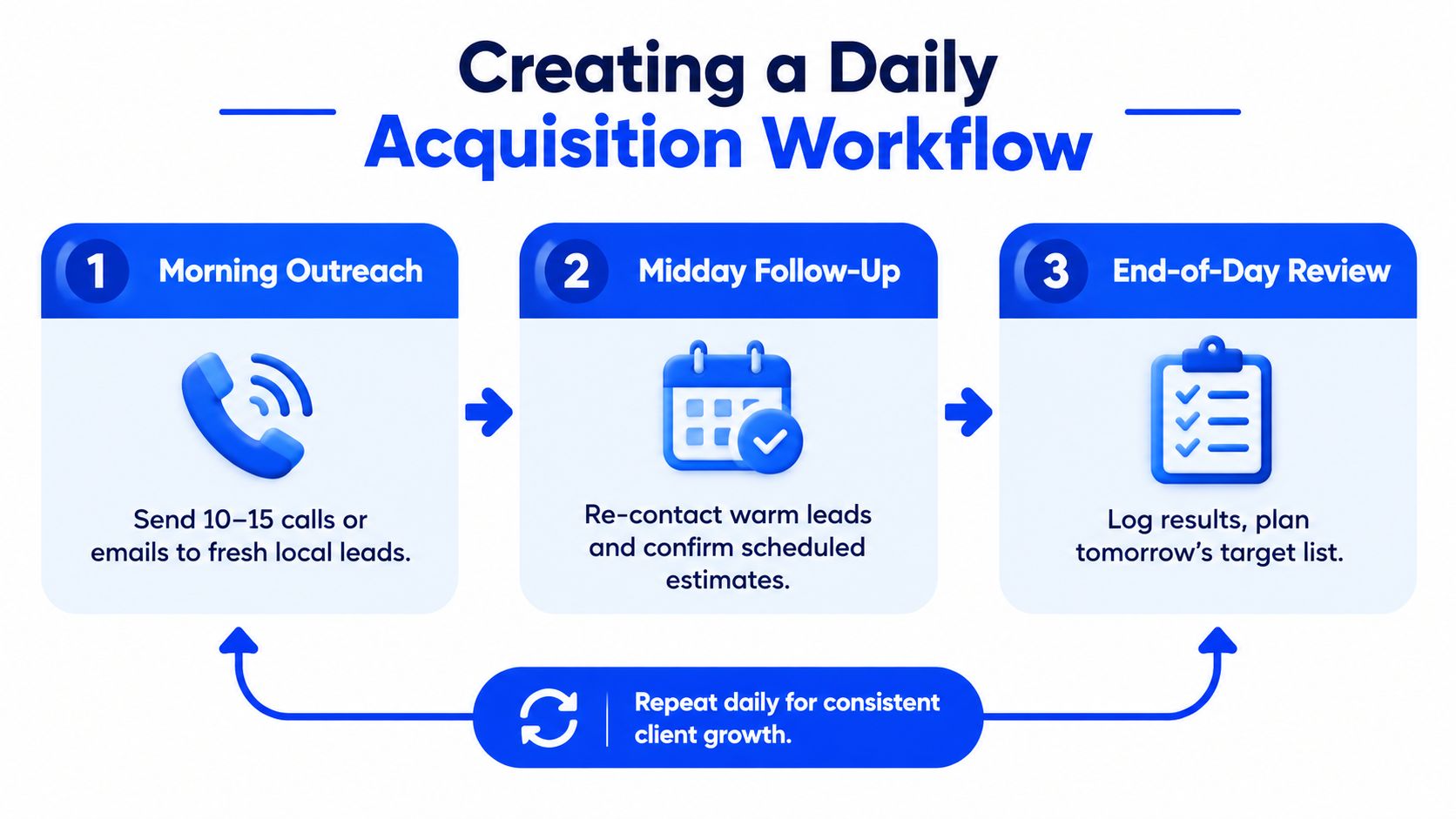
Morning outreach: Review fresh local leads, call businesses near existing routes, and send concise follow-ups to prospects who requested information. Prioritise new openings, property changes, and companies that match your chosen segment.
During the workday: Let the person responsible for incoming calls capture qualification details. If you're the owner and can't answer, use a defined coverage process rather than relying on memory. Every lead should have a status, next action, and owner.
Midday follow-up: Confirm walkthroughs, contact prospects who received proposals, and ask one direct question about the decision timeline. A follow-up should advance the conversation, not just repeat the original pitch.
End-of-day review: Record calls, conversations, walkthroughs, proposals, signed accounts, lost opportunities, reason for loss, and next follow-up date. Use this information to remove weak channels and improve the offer.
A simple weekly pattern can keep the pipeline balanced. Use one day for building the target list, several days for outreach and walkthroughs, and a fixed review period for proposals and procurement opportunities. Don't measure success by calls alone. Measure whether calls become conversations, conversations become completed walkthroughs, walkthroughs become proposals, and proposals become recurring accounts.
For a practical look at software that organises incoming enquiries and follow-up tasks, see this lead-capture software guide. The tool matters less than the discipline of recording every handoff. If a prospect has no next action, that prospect is already drifting out of the pipeline.
Turning One-Time Cleaners Into Recurring Revenue
The first clean is a sales opportunity, but it should also be a proof-of-quality visit. Arrive on time, confirm the scope before starting, document issues that fall outside the agreed work, and finish with a clear summary. A client who sees reliable communication and controlled execution has a reason to discuss ongoing service.
Your recurring proposal should remove uncertainty. State the areas covered, tasks by frequency, service window, supplies, quality checks, payment terms, and the process for requesting additional work. Offer a recurring plan that reflects the client's actual operating pattern rather than forcing every customer into the same package.
Commercial lesson: A lower price wins only when it still funds the labour, travel, supplies, supervision, and follow-up needed to deliver the contract.
Don't negotiate against yourself. If the prospect wants a lower price, adjust scope or frequency transparently instead of promising the same work for less behind the scenes. For commercial accounts, job costing should compare actual labour and supply use with the proposal so renewal decisions protect the business.
Ask for the next step before the first job disappears into the past. That might be a recurring-service proposal, a review request, or an introduction to another property manager or business owner. Reviews should reflect genuine customer experience, and referral requests work best after you've delivered the result you promised.
Scheduling software can help keep recurring appointments, changes, and follow-ups organised. A resource on cleaning service scheduling software can help you evaluate that operational layer. The acquisition model is simple: attract a defined client, respond quickly, qualify carefully, deliver consistently, and ask for a recurring commitment. A smaller number of well-fitted accounts is usually more useful than a constant stream of scattered one-time jobs.
Heyline answers cleaning-business calls when you're on-site or unavailable, captures the caller's service details, and can book qualified first visits into your calendar. Visit Heyline to see how continuous phone coverage can close the gap between a new lead and a scheduled appointment.