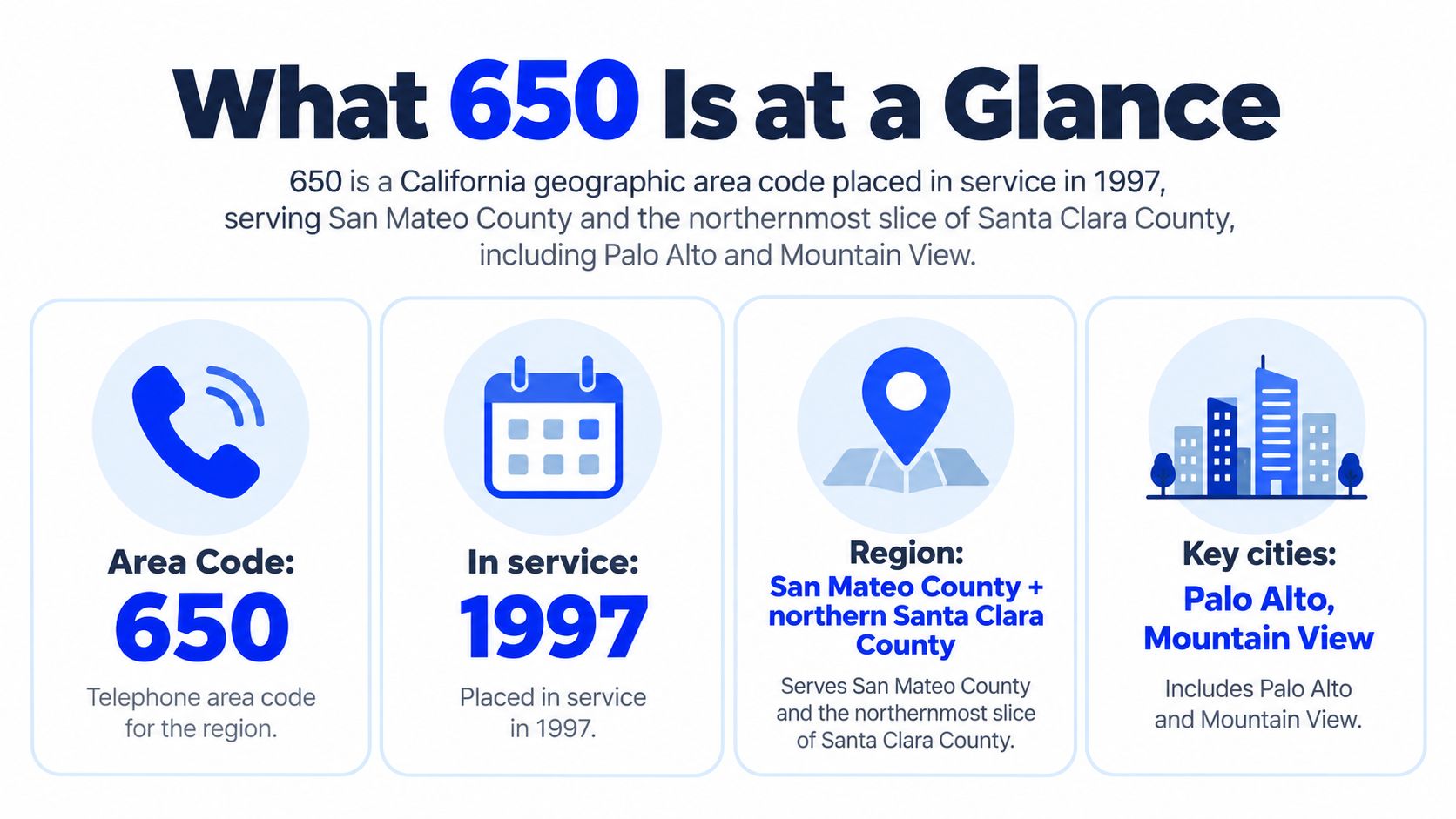
Phone number 650 is a California area code serving San Mateo County and the northern Silicon Valley slice of Santa Clara County, including Palo Alto and Mountain View, in the Pacific time zone. It was created in August 1997 as a geographic split from 415.
You may be checking an unfamiliar caller ID, deciding whether a local business number fits your service area, or trying to understand why a Peninsula phone call requires the full area code. The answer starts with geography. A 650 number points to a specific part of the San Francisco Bay Area, but it doesn't prove where the caller is physically located today, because people and businesses can keep numbers when they move or change providers.
What 650 Is at a Glance
650 is a geographic California area code for the San Mateo County portion of the Peninsula and the northern edge of Santa Clara County. That includes well-known communities such as Palo Alto and Mountain View, placing the code across part of Silicon Valley rather than in San Francisco proper.
To locate it mentally, start at San Jose and look northwest along the Peninsula toward San Francisco. The 650 footprint sits between the San Francisco side of the Bay Area and the South Bay. 415 is to the north, while 408 is toward the southeast. The 628 code overlays 415, but 650 remains a distinct geographic code rather than a code layered over by 628.
The region uses Pacific Time, and callers generally need to use ten-digit dialing, including the area code, for calls within the affected local calling area. The California Public Utilities Commission's area-code guidance explains that California adds codes when existing number blocks approach exhaustion, using tools such as geographic splits and overlays.
Practical rule: If a caller gives you a 650 number, save all ten digits. That avoids confusion between local calling rules, mobile contacts, business systems, and calls placed from outside the region.
The code itself is relatively young compared with California's original numbering plan. It has existed for just over 29 years as of October 2026, yet the geography it identifies is now closely associated with the Peninsula and northern Silicon Valley.
How the 650 Area Code Was Created
Before 650 existed, 415 covered the entire Bay Area, including the San Francisco Peninsula. As population, workplaces, homes, and telephone lines expanded, the available number supply in the Peninsula became harder to manage. The practical solution was a geographic split, not a new identity for the communities receiving the code.
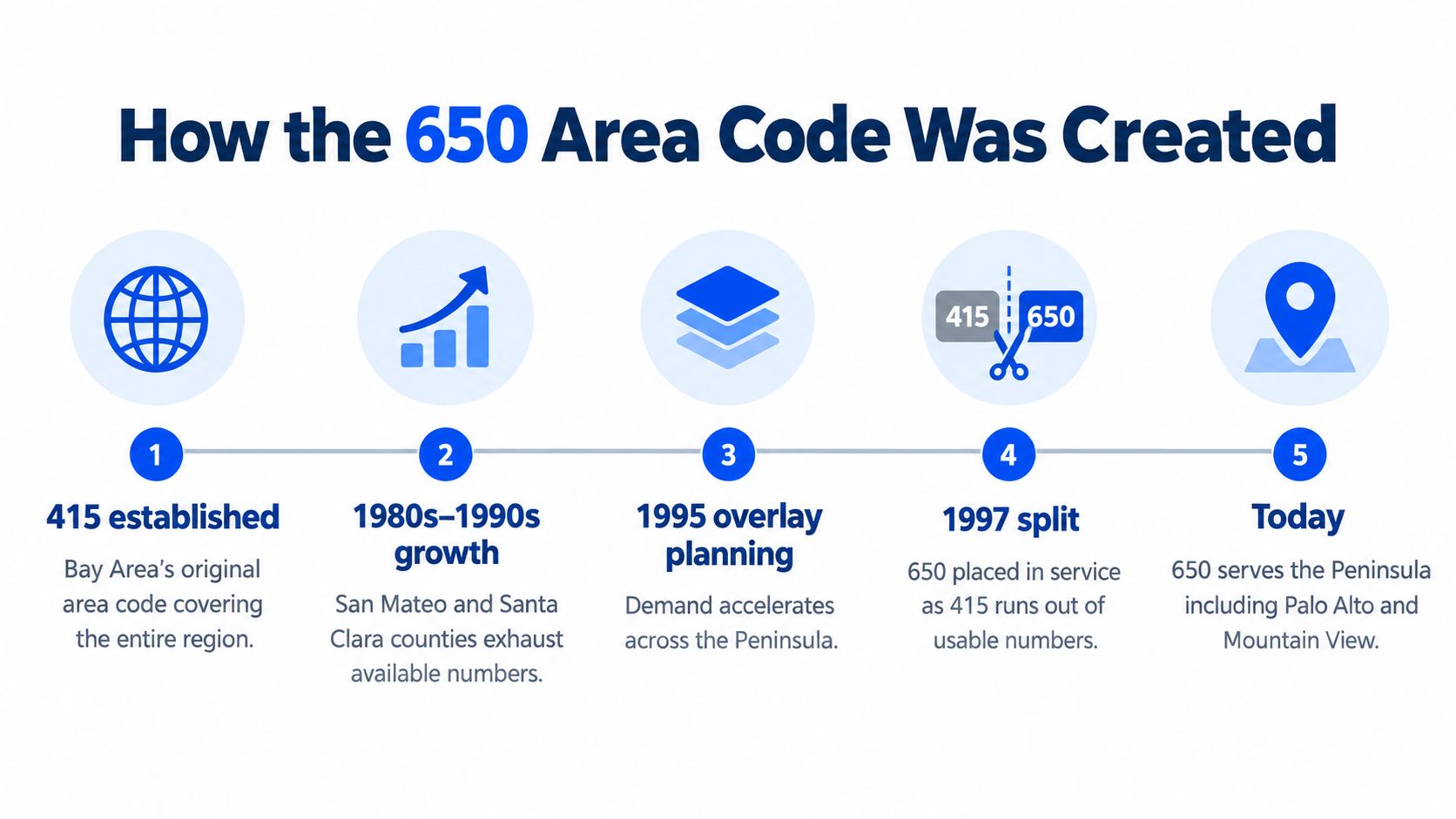
The California Public Utilities Commission records that 650 was created in August 1997 from a split of 415. The new code covered San Mateo County and northern Santa Clara County north from Mountain View, while San Francisco retained the 415 identity. The change responded to number exhaustion on the Peninsula and created more room for new telephone assignments.
That distinction matters if you're trying to understand what a 650 number means. It wasn't introduced because the region suddenly became a separate city or because 415 callers were being reclassified. The split changed the digits used by part of the Bay Area so telephone administrators could continue assigning numbers in a dense business and residential corridor.
The same CPUC record describes about 7.6 million telephone numbers available for consumer use in the code and discusses an earlier overlay proposal that would have required ten-digit dialing. That history shows why area-code changes involve more than choosing a memorable prefix. Regulators must balance number conservation, customer instructions, switching equipment, and emergency-call access.
Today, the useful takeaway is simple: 650 is the Peninsula code that grew out of 415, with its strongest geographic association in San Mateo County and northern Silicon Valley.
Geographic Footprint Across Two Counties
The 650 region crosses a county line, but it isn't divided evenly. San Mateo County accounts for 91% of the area code's population coverage, while Santa Clara County accounts for 9%, according to the 650 coverage summary and population table. The table lists 718,451 San Mateo County residents and 1,781,642 Santa Clara County residents in the broader county populations, although 650 covers only portions of those counties.
| County | Approx. Share | Key Cities |
|---|---|---|
| San Mateo County | 91% | Redwood City, South San Francisco, San Bruno, Daly City |
| Santa Clara County | 9% | Palo Alto, Mountain View |
San Mateo County forms the core of the footprint. The coverage records identify Redwood City, South San Francisco, and San Bruno at 100% coverage, which makes those places especially clear examples of the code's local identity. Daly City is listed at 84% coverage, so a city name alone isn't always enough to predict the area code for every individual line.
Northern Santa Clara County supplies the southern technology corridor. Mountain View is listed at 99% coverage, while Palo Alto is listed at 91% coverage, making both familiar 650 locations even though their counties contain areas outside the code's footprint.
This is why a 650 number usually signals Peninsula or northern Silicon Valley geography, not San Francisco itself and not the whole South Bay. A number can identify the original assignment area, but it doesn't guarantee that the person or company still operates there.
Major Cities and Communities Served
A caller seeing a 650 number can usually place it within the Peninsula or northern Santa Clara County, but the city name still needs careful interpretation. The code follows telephone assignment areas, which do not always align neatly with municipal borders.
Redwood City is a useful central Peninsula reference point. Its position between northern San Mateo County and Palo Alto makes it common in local business directories, service listings, and customer records. South San Francisco and San Bruno extend the same 650 identity through the northern and central Peninsula, where a business may serve several nearby communities from one number.
Daly City requires more caution. It lies beside San Francisco and near the San Mateo County boundary, so nearby callers may use different area codes even when they are only a short distance apart. A city label can therefore suggest a location without identifying the telephone assignment area for every line.
In northern Santa Clara County, Palo Alto and Mountain View are familiar 650 communities. Their inclusion connects the code with the technology corridor, while the surrounding county contains places served by other codes. A company based in one of these cities may also serve customers across the Peninsula, so the number gives regional context rather than a complete service map.
For a local company, the number can shape the first impression. An AI receptionist answering a 650 line might greet a Bay Area caller with the business name and service area, then handle the request without claiming that the caller or company is physically in a particular city. The area code supports local recognition, while the greeting provides the useful context.
Use the complete ten-digit number in a directory, invoice, website, or contact record. Number assignments can follow exchange boundaries, and people may keep their numbers after moving. The full number is more reliable for calling and record matching than an inferred location based only on the city name.
A 650 number suggests Peninsula and northern Silicon Valley geography. It does not function as a live location tracker.
Time Zone and Business Hours Context
A 650 number belongs to Pacific Time in California. That makes the local clock relevant whenever a customer, supplier, or appointment caller is outside the Bay Area.
A business that answers calls during ordinary daytime hours in Redwood City or Palo Alto may be unavailable to someone calling from another U.S. time zone, even when the caller considers it a reasonable hour. The reverse is also true. A New York caller reaches the Peninsula later in the local day because the East Coast is ahead.
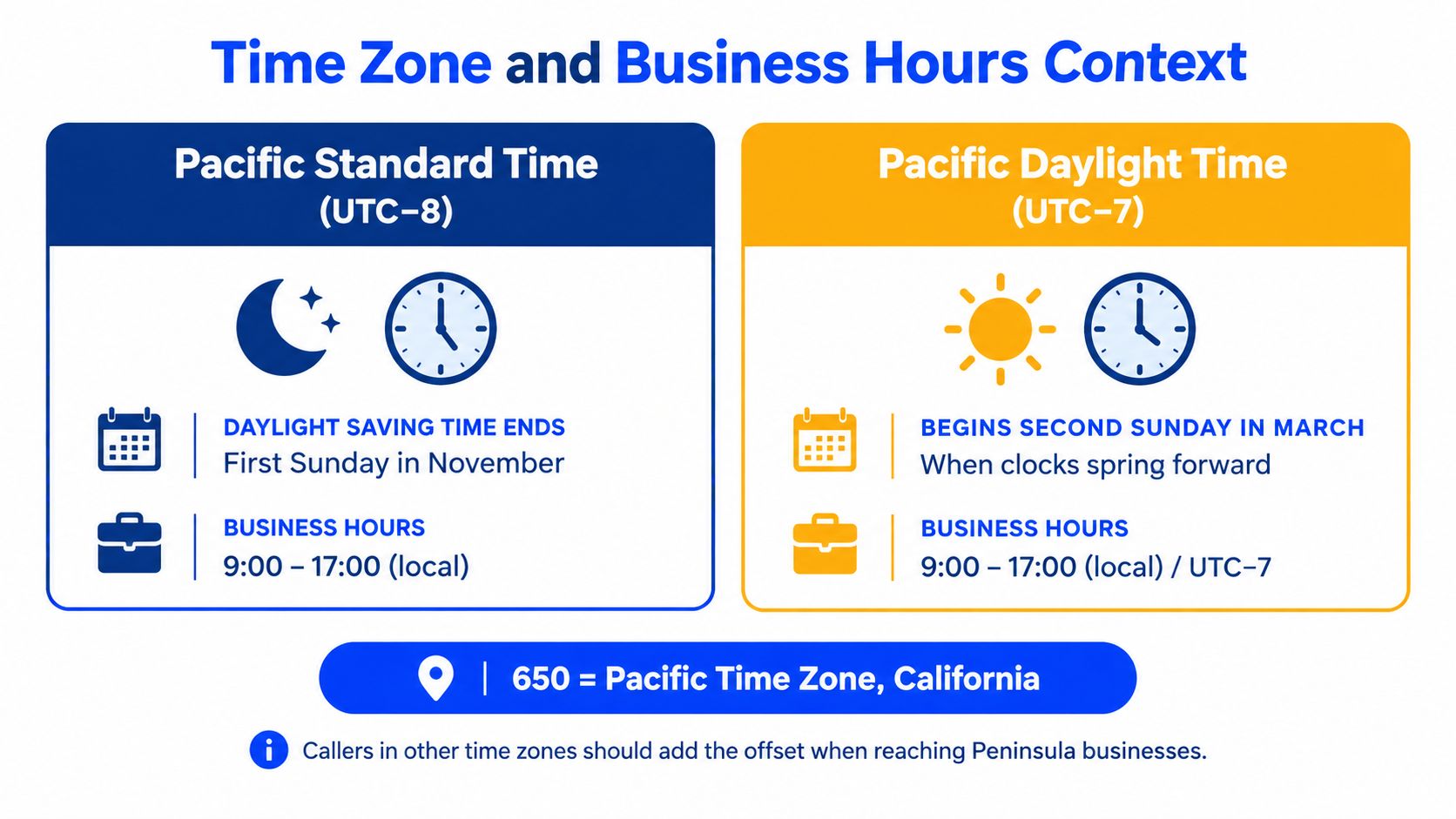
For practical planning, write business hours as local Pacific hours first, then convert them for the caller's location. A dental practice, salon, legal office, or home-services company can reduce missed connections by stating “Pacific Time” beside its opening and closing hours instead of listing times without a zone.
Daylight saving changes the relationship between Pacific businesses and callers elsewhere during part of the year. Calendar software and modern phone systems usually handle the shift, but a manually maintained voicemail greeting or appointment page can still display outdated information.
An AI receptionist on a 650 line should follow the business's published Pacific hours when it decides whether to answer, take a message, or offer an appointment. It can also state the time zone directly during scheduling, which helps avoid an appointment being recorded at the wrong local time. For related guidance on handling calls connected to a local listing, see Google Business listing calls.
Dialing Rules for Phone Number 650
The safest habit is to dial the full ten-digit number whenever you call a 650 line from within the local region. Even if you remember older seven-digit local calling, California's affected area-code rules require the area code for ordinary calls in the relevant calling area.
Use these patterns:
| Caller Location | Number to Dial | Example |
|---|---|---|
| Within the 650 calling area | 650 plus the seven-digit number | 650 + seven-digit number |
| Elsewhere in the United States | 1 plus the full ten-digit number | 1 + 650 + seven-digit number |
| Canada | 1 plus the full ten-digit number | 1 + 650 + seven-digit number |
| Outside the North American Numbering Plan | Exit code, 1, 650, then the seven-digit number | exit code + 1 + 650 + seven-digit number |
The ten-digit requirement is connected to nationwide dialing changes associated with the 988 lifeline transition. It prevents a seven-digit call from being interpreted ambiguously when the same seven-digit pattern may be associated with more than one area code or service arrangement. The CPUC materials discussed earlier identify 650 among California codes affected by those dialing changes.
Don't remove the area code because the call feels local. Save contacts in the complete format, and configure business directories, printed materials, and voicemail systems the same way. Consistent formatting also helps call-routing systems identify the destination correctly. For a plain-language explanation of how a call can be directed between numbers or teams, read what call routing means.
Emergency and service short codes such as 911, 988, and 211 are handled as short codes, so callers don't add 650 before them.
Why a 650 Number Matters for Local Businesses
For a local business, an area code is part of the first impression created by caller ID. A customer who recognises 650 may understand that the business serves the Peninsula or northern Silicon Valley, which can make the number feel more relevant than an unfamiliar out-of-region line.
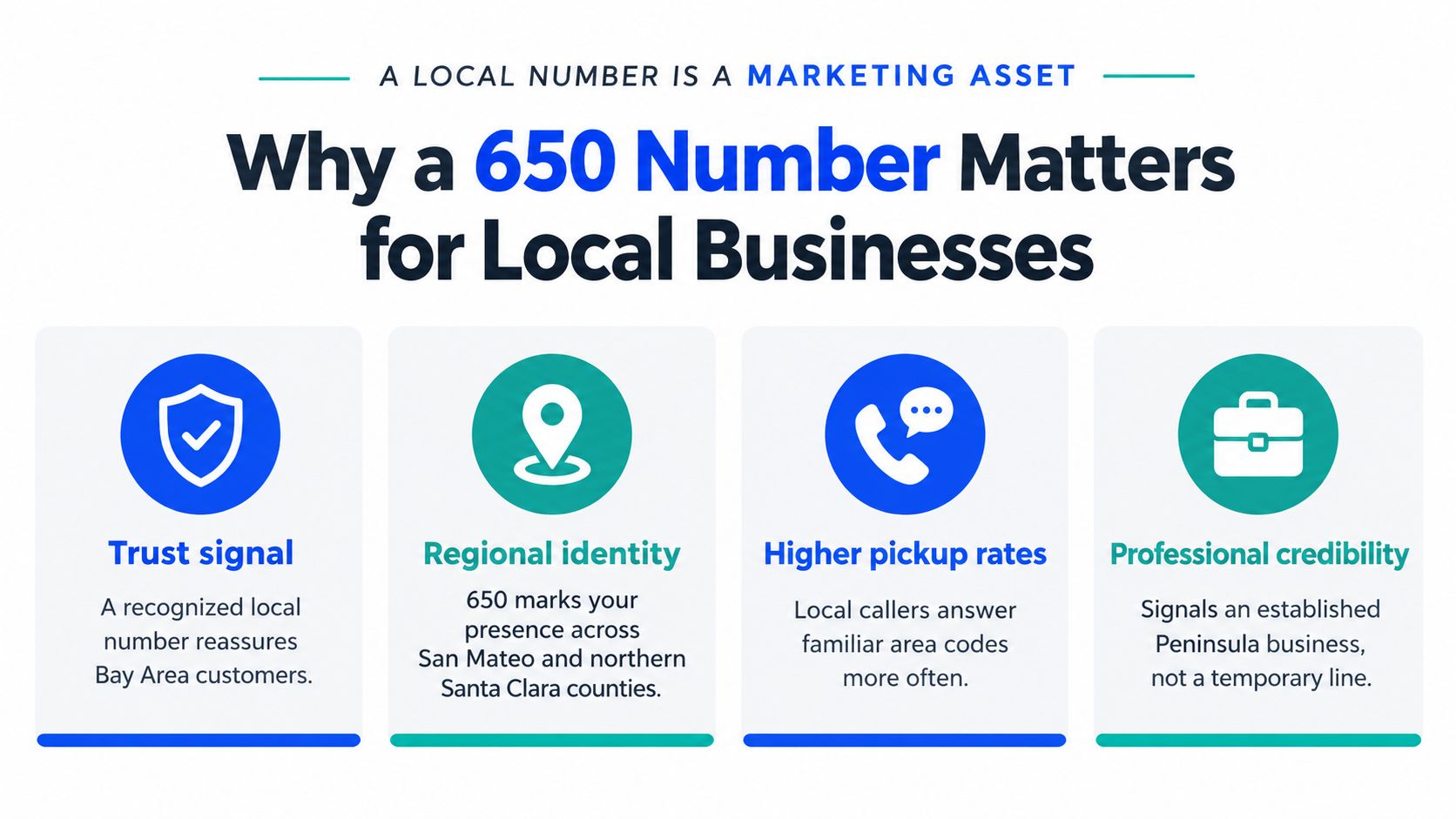
That signal is useful for businesses whose reputation depends on local relationships. A salon, clinic, contractor, restaurant, law office, or appointment-based professional may want customers to see a number that matches the communities they serve. It doesn't guarantee that a caller will answer, and it shouldn't replace accurate business information, but it can make the line easier to recognise.
What callers hear
An AI receptionist answering on a 650 line can introduce the company by name, use a greeting suited to Bay Area customers, and state the business's Pacific-time hours. It can collect the reason for the call, answer routine questions from the company's approved information, and offer an appointment when the calendar shows availability.
The voice and wording still matter. A local number paired with a vague greeting can feel impersonal, while a clear introduction that names the business and service area sets expectations immediately. Business owners should review the greeting, hours, services, and escalation instructions before routing customer calls to an automated receptionist.
When the number fits
A 650 number makes the most sense when the business primarily serves San Mateo County or northern Santa Clara County. A company serving a wider region may choose a local number for one office and publish additional contact options for other locations.
The number also needs to remain accurate in directories and advertising. If a business changes its call destination, customers should still reach the same reception experience when they dial the familiar number. For another example of how regional identity can shape business-number decisions, see this guide to an area code 410 phone number.
Quick Reference for 650 Phone Numbers
Use this table when you need the essential details without revisiting the geographic explanation.
| Field | Value |
|---|---|
| Area code | 650 |
| State | California |
| Main coverage | San Mateo County and the northern Santa Clara County portion of Silicon Valley |
| Recognisable cities | Redwood City, South San Francisco, San Bruno, Daly City, Palo Alto, Mountain View |
| Time zone | Pacific Time |
| Local format | Full ten-digit number, including 650 |
| U.S. long-distance format | 1 plus the ten-digit number |
| International format | Exit code, 1, 650, and the seven-digit number |
| Origin | Created in August 1997 from a split of 415 |
| Number type | Geographic area code |
The quickest interpretation is that 650 identifies a Peninsula and northern Silicon Valley numbering region. It doesn't prove that the caller is currently in that region, because phone numbers can remain with people and businesses after a move.
For a local company, the code can support a recognisable Bay Area identity. Pair it with clear Pacific-time hours, a complete ten-digit contact format, and a receptionist workflow that tells callers what happens after they connect.
If your business serves the Peninsula or northern Silicon Valley, Heyline provides an AI phone receptionist that can answer calls, use information from your website, and book appointments through a connected calendar. Visit Heyline to see whether a dedicated local number or call-forwarding setup fits your customer service needs.