A plumbing customer calls while you're under a sink. An HVAC homeowner reaches out after the crew has left for the day. A cleaning prospect wants the next available appointment while your office staff are already handling another caller. In each case, the customer needs one of three things: a live answer, a booked appointment, or fast triage for an urgent job.
The best contractor answering services handle those workflows differently. Some use AI receptionists that answer and book directly. Others rely on live agents who qualify leads, schedule appointments, collect payments, or dispatch emergencies. Pricing also varies, from per-call billing to per-minute plans and low-cost overflow coverage.
This comparison focuses on booking capability, urgent-job triage, dispatch depth, calendar and CRM integrations, billing structure, after-hours coverage, seasonal cost control, and setup effort. The right choice depends less on the longest feature list than on what should happen after your next call is answered.
1. Heyline
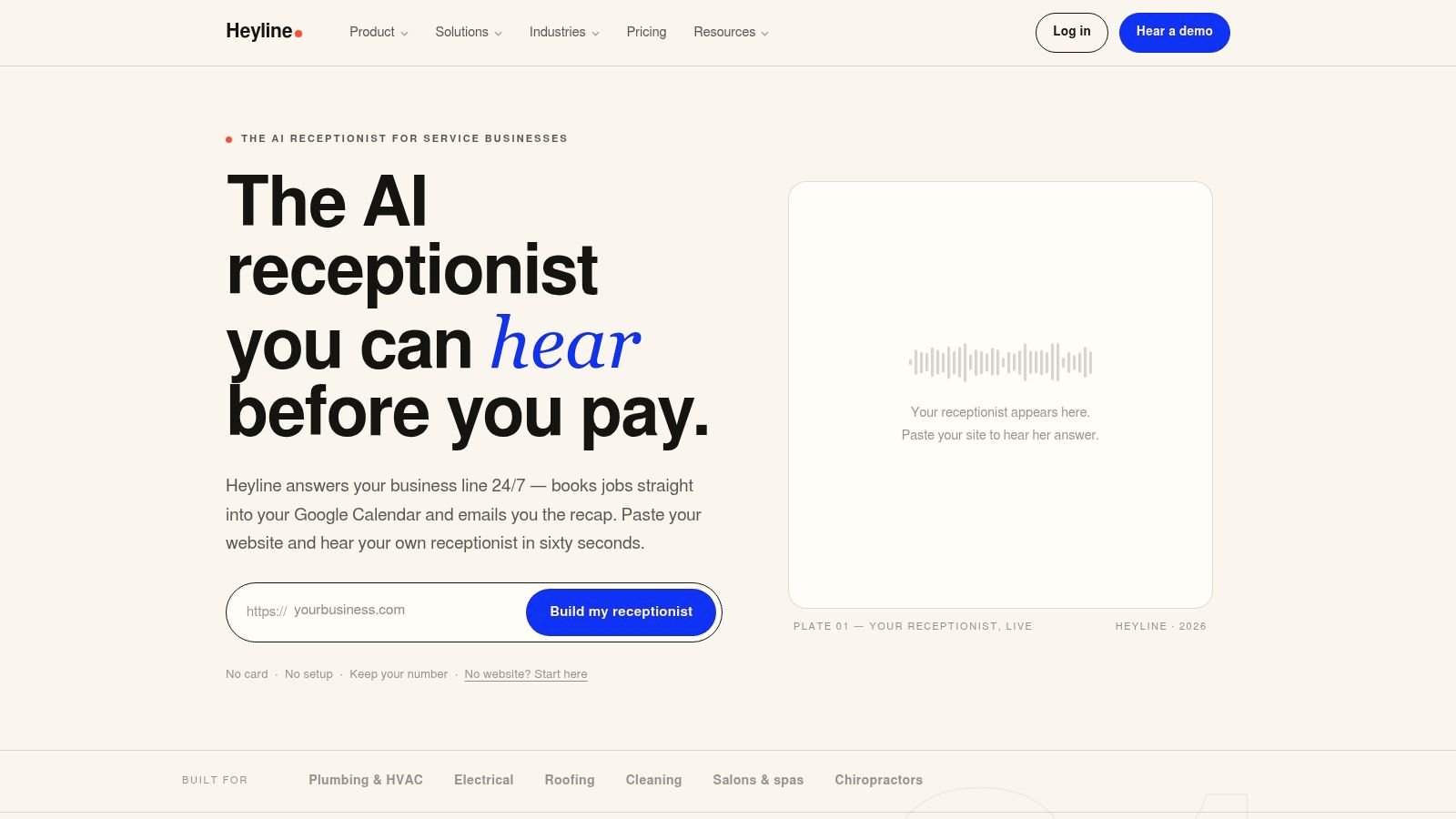
A contractor can miss a qualified lead while driving between jobs, then lose the appointment because nobody calls back quickly. Heyline addresses that gap with an AI receptionist that answers routine calls, qualifies basic requests, and books available appointments during the conversation.
Setup is designed for small teams. Paste in your website, connect Google Calendar, and test the receptionist in a browser. You do not need to build phone trees, webhooks, or developer-managed call flows. Keep your existing number through call forwarding, while Heyline maintains the phone configuration.
Heyline reads your public website for services, hours, pricing, and service areas. You can edit that information and adjust the receptionist's voice and wording. It answers around the clock, handles common questions, and checks live Google Calendar availability before placing an appointment.
That workflow matters for lead capture and scheduling. A caller receives an answer and a confirmed time instead of a message that still requires office follow-up. Contractors should still set clear rules for urgent jobs, safety concerns, unusual requests, and work that requires human judgment. AI booking is useful for available appointments, not a substitute for dispatch decisions.
Best fit and trade-offs
Heyline suits appointment-driven HVAC, plumbing, electrical, cleaning, landscaping, and similar businesses. It works well when the owner or crew is on-site and the office needs consistent coverage. The vendor maintains the phone system and configuration, which makes the service practical for teams without technical staff.
The main operational constraint is calendar compatibility. Real-time booking requires Google Calendar, so contractors using another scheduling platform should confirm whether their current process can connect or be adapted. The public site does not display independent HIPAA, SOC, or ISO certifications. Businesses handling protected or regulated information should verify data-handling requirements before deployment.
Heyline's billing also supports seasonal cost control. The 14-day free trial includes 60 minutes. Listed plans are $99 per month for Starter, with one line and 200 monthly minutes, $199 per month for Growth, with 500 pooled minutes and up to three businesses, and $499 per month for Scale, with 1,500 pooled minutes, up to five businesses, and concierge setup. Annual billing includes two months free. Automatic extra-minute purchases are listed at $10 for 20 minutes, with monthly caps available to limit unexpected charges.
For setup guidance, read how to set up an AI answering service. Use Heyline when your priority is answering routine calls, booking open slots, and keeping overflow coverage predictable without hiring a live receptionist.
2. Smith.ai
Smith.ai combines US-based live receptionists with AI-guided workflows, making it a strong option for contractors that want people handling calls without giving up structured intake. Its receptionists can screen leads, collect job details, route calls, schedule appointments, and support English and Spanish conversations.
The clearest advantage is per-call billing. Contractors pay according to answered calls rather than the exact length of every conversation, which makes budgeting easier when agents spend time gathering project details or explaining next steps. That model can work well for businesses with fairly stable call volume and calls that vary widely in length.
Smith.ai also supports CRM and calendar integrations, so the service can fit into a more developed office or dispatch operation. Appointment booking and payment collection are available as add-ons, however, and those charges can increase the effective cost of each completed intake.
Where Smith.ai fits best
Choose Smith.ai when you want flexible scripts and human judgment for lead screening, routing, and dispatch preparation. It's a better fit than a basic message service when callers need to answer several qualification questions before the office decides whether to send a technician or schedule an estimate.
The trade-off is that per-call pricing doesn't automatically mean low pricing. Included calls are limited by plan, and overages apply when volume exceeds the allowance. Appointment booking and other enhanced workflows can also carry per-call charges, so review the complete rate structure rather than comparing only the base subscription.
Smith.ai lists no setup fees and a 30-day money-back guarantee. Contractors should use the onboarding process to define emergency categories, service areas, appointment rules, transfer destinations, and the information dispatchers need before accepting a job.
3. Ruby
Ruby is a well-established live receptionist service for contractors that want a human voice answering calls around the clock. It offers published minute tiers, local and toll-free numbers, app notifications, robocall filtering, bilingual support, and options for intake, scheduling, and payment collection.
Ruby's strength is operational familiarity. A small contractor can provide a script, define which calls should transfer, and have receptionists gather the essential details without building an AI knowledge base or maintaining a complex call workflow. That straightforward model suits owners who want a dependable front-office layer rather than a technology project.
Watch the minute meter
Ruby's per-minute billing is easy to understand, but it can become less predictable during seasonal demand. A long conversation about a replacement system, insurance-related restoration work, or a multi-property maintenance request consumes more billable time than a short appointment request. Busy months can therefore cost more even when the service performs exactly as expected.
Scheduling and intake are optional services, so confirm what the selected plan includes. Contractors should also specify whether receptionists may book directly, offer only a callback request, transfer to an on-call technician, or escalate based on a defined emergency script.
Ruby provides HIPAA-compliant options for businesses that need them, but contractors should still confirm the applicable configuration and information-handling terms. For ordinary home-service calls, its strongest use is consistent live coverage with a recognizable service model and published minute tiers.
4. PATLive
PATLive is the best live-service choice for contractors that want a trades-oriented answering operation and a clear way to test it. The service provides 24/7/365 coverage, bilingual support, lead capture, appointment scheduling, and emergency dispatch workflows, with a dedicated focus on home services and trades.
Its dispatch orientation matters. A general receptionist may record a caller's name and number, but a trades-focused service can be configured around the questions your crew needs. For an HVAC business, that may involve the equipment issue, property location, and urgency. For a plumber, it may involve active water damage and whether the caller needs immediate escalation.
A practical live-agent option
PATLive publishes a plan ladder that includes pay-as-you-go and bundled minute options. That transparency makes it easier to compare expected usage before forwarding your main line. The service also offers a 14-day free trial, giving contractors a chance to test scripts, appointment rules, transfers, and emergency handling with representative calls.
The main cost risk is still per-minute billing. Peak seasons, long troubleshooting conversations, and callers who need extensive explanation can increase usage quickly. Set expectations around what agents should answer, when they should transfer, and when they should stop gathering information and alert the on-call team.
PATLive is a strong match when a human should answer every call, but the team still needs home-service language and structured dispatch support. It's less suitable if your primary goal is a simple fixed-cost AI receptionist that books directly into a calendar without agent involvement.
5. AnswerConnect
AnswerConnect combines people-powered phone answering with live chat, appointment scheduling, a web and mobile portal, and CRM integrations. That combination makes it useful for contractors that receive leads through both phone calls and website conversations, especially construction companies, builders, property managers, and service providers with multiple inquiry channels.
The service provides 24/7 answering, after-hours coverage, and bilingual options. Its published plan tiers and downloadable pricing information give buyers more visibility than a fully sales-led service, although per-minute overages still apply and some plans include setup charges.
Phone and chat under one roof
AnswerConnect makes sense when a prospective customer may start with website chat, ask a question, and then call to schedule. Keeping those channels with one provider can reduce the handoff between a chat operator and a phone receptionist. It also gives managers one portal for reviewing communications and connecting intake with CRM processes.
The trade-off is that combined channel coverage can complicate cost forecasting. Contractors should separate phone minutes from chat usage, identify which plan includes scheduling, and confirm how setup charges affect the first invoice. A low starting price may not reflect the full cost of the workflow you need.
For plumbing businesses assessing round-the-clock coverage, this guide to a 24/7 plumbing answering service offers useful context for thinking about after-hours intake. AnswerConnect is the right pick when live chat is a meaningful lead source, not merely an extra feature listed on a service page.
6. Nexa
Nexa is the strongest option for contractors that need specialized emergency dispatch, triage, and home-services workflows. It serves trades such as HVAC, plumbing, electrical, and restoration, with industry-trained operators, 24/7/365 coverage, bilingual answering, live chat and text options, appointment scheduling, and integrations aimed at home-service tools and calendars.
Nexa's value comes from the depth of the handoff. A routine caller may need an appointment. An emergency caller may need a priority classification, an on-call transfer, and a clear record of what happened at the property. Those workflows require more than a receptionist reading a generic script.
Built for dispatch-heavy operations
Nexa fits contractors with established emergency rules, multiple technicians, restoration obligations, or a team that needs operators to understand trade-specific situations. It's particularly appropriate when the answering service must distinguish urgent damage from routine maintenance and send the right information to the right destination.
The main drawback is price opacity. The public site lists plan names, but current dollar pricing isn't shown. Contractors must contact sales for rates, included usage, and overage details. That makes Nexa harder to compare quickly against per-call or published per-minute providers.
Before signing, request a written explanation of billing units, seasonal volume changes, transfer charges, scheduling depth, CRM compatibility, and escalation response. Test flooded-basement, no-heat, electrical hazard, and routine-estimate scenarios separately. Nexa is the right recommendation when dispatch accuracy matters more than immediate price transparency.
For HVAC businesses comparing intake requirements, this practical guide to an HVAC answering service can help define the questions and routing rules your team should provide.
7. ReceptionHQ
ReceptionHQ is the budget-oriented option for contractors that need a dependable overflow or after-hours safety net. It offers 24/7 US-based reception, local and toll-free numbers, call transfers, and a choice between per-call and per-minute billing.
That billing flexibility is its clearest advantage. A contractor with predictable call length may prefer per-minute billing, while another business may value per-call predictability. ReceptionHQ also bills per-minute plans by exact seconds, which gives owners a more precise view of usage than rounded billing.
Start simple, then add workflow depth
The entry tiers focus on basic message-taking. Appointment scheduling through MyDiary and CRM updating through MyAssistant are available as higher-level workflows, so contractors should avoid choosing a plan based only on the lowest advertised price.
ReceptionHQ works well when the immediate problem is coverage, not complex dispatch. Forward calls during lunch, evenings, weekends, storm events, or technician-heavy periods, then upgrade the workflow if message-taking leaves too much manual follow-up. That staged approach can keep initial costs controlled while revealing how much scheduling support the business needs.
The service advertises a seven-day free trial, no lock-in contracts, and transparent billing. Before launch, define the exact point at which an agent should transfer an emergency, create an appointment, update the CRM, or send a message. ReceptionHQ is the best fit for a contractor that wants a low-cost entry point and the ability to choose how the bill is calculated.
Top 7 Contractor Answering Services Comparison
| Service | 🔄 Implementation complexity | ⚡ Resource & pricing | ⭐ Expected outcomes | 📊 Ideal use cases | 💡 Key advantages |
|---|---|---|---|---|---|
| Heyline | Low, auto-configures from your website; no dev work | Subscription tiers $99–$499/mo; pooled minutes; free in-browser test + 14-day trial; Google Calendar required | ⭐⭐⭐⭐, real-time calendar bookings, fewer missed leads | Appointment-driven local services (salons, clinics, HVAC, law firms, restaurants) | Fast setup, calendar-aware booking, consistent brand-matched voice |
| Smith.ai | Moderate, setup of workflows and integrations required | Per-call pricing; bilingual US agents; add-ons (booking/payment) can add cost | ⭐⭐⭐, predictable per-call costs, strong intake/qualification | Contractors needing intake, routing, payment collection, bilingual support | US-based human agents with AI-guided workflows and deep CRM integrations |
| Ruby | Low–Moderate, straightforward onboarding and published plans | Published per-minute tiers; optional add-ons (scheduling, payments); HIPAA option | ⭐⭐⭐, reliable live coverage and consistent service | Small businesses and contractors wanting well-known live-reception brand | Clear minute tiers, bilingual support, robust reputation |
| PATLive | Moderate, custom scripts and standard onboarding | Published per-minute plans; 14-day free trial; pay-as-you-go options | ⭐⭐⭐, steady 24/7 coverage tailored to trades | Home services/trades needing lead capture and emergency dispatch | Transparent pricing, trade-focused workflows, free trial |
| AnswerConnect | Moderate, integrates phone + chat; portal setup needed | Published tiered plans (Entry/Growth/Standard); some setup fees apply | ⭐⭐⭐, combined phone + chat improves contact coverage | Service providers, property managers, construction/builders | Phone + live chat in one vendor, clear starting prices |
| Nexa | Moderate, tailored scripting and industry training; sales-led pricing | Quote-based pricing (no public rates); integrations for home-service tools | ⭐⭐⭐⭐, strong dispatch/triage and industry-specific handling | Contractors in home services (HVAC, plumbing, restoration) needing dispatch | Industry-trained operators, emergency dispatch & triage expertise |
| ReceptionHQ | Low, simple onboarding; flexible billing options | Very low published entry prices; per-call or per-minute choice; 7-day trial | ⭐⭐, cost-effective overflow/after-hours coverage | Contractors seeking low-cost overflow or basic after-hours answer | Low entry cost, exact-seconds billing, no long contracts |
Choose the Service That Matches Your Call Flow
Start with the outcome you want after the caller answers. If the caller needs a routine appointment and your calendar is the source of truth, Heyline is the best recommendation for a non-technical, appointment-driven business that wants fast AI setup and direct Google Calendar booking. Its website-based configuration, browser test call, transcripts, and clear trial make it easy to validate before forwarding calls.
Choose Smith.ai when you want per-call billing, bilingual live reception, flexible intake, CRM connections, and optional scheduling or payment collection. Choose Nexa when emergency dispatch and contractor-specific triage are central to the operation. It's the strongest fit for restoration, HVAC, plumbing, electrical, and other businesses where the wrong routing decision can delay a critical response.
PATLive is the best trades-focused live service with a free trial and published plan options. AnswerConnect is the right choice when live chat matters alongside phone answering. Ruby fits contractors that prefer an established live-receptionist model with published minute tiers and broad small-business support. ReceptionHQ is the practical low-cost overflow option, especially when choosing between per-call and per-minute billing matters.
Before subscribing, map a typical week of calls. Separate new leads, existing customers, routine bookings, estimate requests, cancellations, urgent jobs, spam, and calls that require a human decision. Then define exactly which categories should be booked, transferred, escalated, or summarized for callback.
Before forwarding your main number: Confirm calendar and CRM compatibility, model seasonal usage under the actual billing unit, write emergency routing rules, and test representative calls during both staffed and unstaffed periods.
Don't judge an answering service by answer rate alone. Measure whether the service captures the caller's details, books the right appointment, routes urgent work correctly, and keeps your invoice predictable when demand rises. Test first, document the workflow, and expand coverage only after the service performs reliably in the situations your crew handles every week.
If missed calls are costing you appointments while your team is on the job, Heyline can answer your existing number around the clock, learn your services from your website, and book available appointments directly into Google Calendar. Visit Heyline to test the AI receptionist before you commit your contractor calls to it.