A live call number routes incoming phone calls directly to a real person or an AI receptionist that answers immediately, unlike voicemail, which requires a return call. For a California business, that number sits within a telephone system with 40 area codes, including 14 overlay area codes added since 2006. California Public Utilities Commission numbering information
A patient calls a dental clinic during lunch. The receptionist is reviewing records, the hygienist is with another patient, and the phone rings until the call reaches voicemail. The caller leaves no message, searches for another clinic, and books elsewhere. A plumber can face the same problem while working under a sink, and a salon can lose a new client while every stylist is serving someone in the chair.
A live call number changes the sequence. Someone answers straight away, collects the caller's reason for calling, and either completes the next step or sends the conversation to the right member of staff. That responder can be a human employee, an answering team, or an AI receptionist configured for the business.
The important shift isn't just replacing voicemail. It's turning the telephone from a passive contact detail into an active appointment intake channel. The caller gets an immediate response, while the owner gets a clearer process for handling availability, routine questions, urgent requests, and follow-up.
The Missed Call Problem and the Live Solution
A missed call usually creates more work than the ring itself suggests. Someone must notice the notification, identify the caller, find the relevant details, return the call, and hope the person is still available. If the caller has already contacted another business, the later callback may have no opportunity to recover the enquiry.
For appointment-based businesses, the timing matters. A dental practice may need to match a treatment type with the right calendar slot. A beauty salon may need to answer questions about service length and preparation. A home-services company may need to distinguish a routine quote from an urgent problem. Voicemail stores the request, but it doesn't perform that sorting while the caller is ready to talk.

Availability is the product
A live call number is best understood as an always-ready routing point. It directs an incoming call to a person or an AI receptionist that can respond immediately. The number might be published on a Google Business Profile, website, vehicle, signage, or booking page, or it might receive calls forwarded from an existing business line.
That distinction matters because a number alone doesn't guarantee a live experience. A phone can ring into an empty office, a generic call centre, or a mailbox. The operational question is simpler: what happens to the caller at the moment they need help?
Practical rule: Treat every published phone number as the entrance to an intake process, not as a standalone piece of contact information.
An AI receptionist can handle the first layer of that process by greeting the caller, answering questions drawn from approved business information, collecting details, and booking an available appointment where the configuration permits it. Human staff still have an important role when a caller needs judgement, reassurance, specialist advice, or an exception to the normal process.
The result is business continuity during the moments owners usually find difficult, such as lunch breaks, treatment times, site visits, evenings, and sudden staff shortages. A live call number doesn't promise that every call should be automated. It ensures that every caller reaches a defined next step instead of an uncertain wait.
Live Call Numbers vs Virtual Numbers and Voicemail
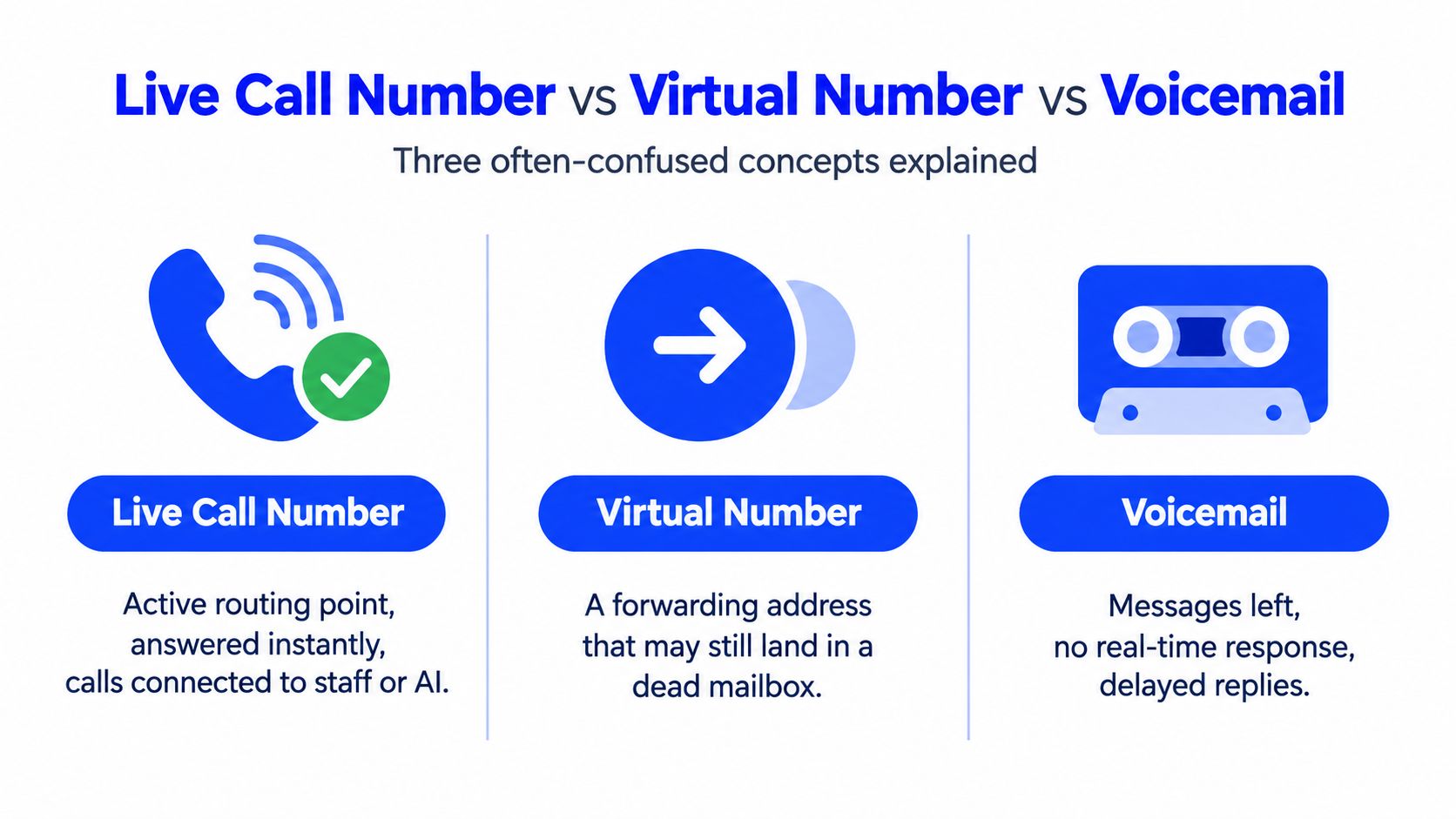
These terms often appear together, but they describe different parts of the telephone experience. A live call number describes what happens when someone calls. A virtual number describes how the number exists and routes calls. Voicemail describes a message-storage function.
A virtual number can be useful because it separates the public business number from a personal mobile or office handset. Yet it may still forward to a mailbox. “Virtual” says little about whether anyone answers. The caller's experience depends on the destination and the rules attached to the number.
| Option | What it does | Caller experience | Operational result |
|---|---|---|---|
| Live call number | Routes calls to staff or an AI receptionist | Immediate conversation | Questions, qualification, transfers, or bookings can happen during the call |
| Virtual number | Provides a forwarding address or additional business line | Depends on where the call lands | Can support flexible routing, but may still end in voicemail |
| Voicemail | Records a message for later review | Delayed response | Staff must return the call, and the caller must wait or try again |
Look past the label
Suppose a salon buys a virtual number and forwards it to the owner's mobile. During an appointment, the owner can't answer, so the caller reaches voicemail. The business has a virtual number, but it doesn't yet have a live call operation.
By contrast, a live arrangement can use an existing number, a new local number, or a virtual number as its front door. The key is the response layer behind it. Good call routing should account for business hours, staff availability, caller intent, and escalation rules rather than just forwarding every ring to the same destination.
Choose the outcome first
A business that only needs messages after hours may find voicemail adequate. A firm that receives sensitive enquiries may want a human receptionist for every call. An appointment-based practice may use AI for routine scheduling and information, with a clear handoff for clinical or complex matters.
Ask these questions before choosing a number:
- Who answers first? Is the caller reaching staff, an external team, or an automated system?
- What can the responder complete? Can it answer common questions, schedule appointments, collect contact details, or transfer the call?
- What happens when the request falls outside the rules? A reliable process should identify when a human must take over.
- How are records maintained? Caller details, booking outcomes, and follow-up tasks should move into the business's normal workflow.
The most useful comparison isn't live versus virtual. It's immediate conversation versus delayed recovery.
Why Local Presence Still Matters in California
California's phone system has a long history of adapting to demand. The North American Numbering Plan was established in 1947, and California initially received three geographic area codes: 213 for Southern California, 415 for the central coastal region, and 916 for northern California. The history of California area codes
As communities and businesses expanded, the state reorganised numbering through geographic splits and overlays. Area code 408 was split from 415 in 1959, 310 was created in 1992, and 562 was split from 310 in January 1997. Those changes show why a phone number isn't merely a string of digits. It's part of a communication system that has been repeatedly adjusted to preserve access while adding capacity.
A local number can still support trust for a salon, clinic, law firm, contractor, or restaurant. A caller in San Jose may feel more comfortable contacting a business with a number associated with the region. A firm serving San Francisco may want its published number to reinforce its local presence, even when the receptionist is remote or automated. A Google Business Profile call strategy should therefore consider both discoverability and what happens after a searcher taps the phone button.
The technical detail owners need
California numbers follow the NPA-NXX-XXXX format. The NPA is the three-digit area code, the NXX is the three-digit exchange, and the final four digits identify the subscriber. The CPUC manages area-code relief and conservation measures under authority delegated by the Federal Communications Commission. California area-code guidance
Overlays complicate assumptions about geography. Since 2006, California has added 14 overlay area codes, meaning multiple area codes can serve the same region. The area code alone may no longer identify a caller's precise locality, so phone systems should support mandatory 10-digit dialling and consistent number formatting.
For a business, that means selecting a local number is only the first decision. The system must also preserve caller ID, map the line to the correct business location or calendar, and avoid routing logic based only on the first three digits. Local presence builds familiarity, while reliable configuration makes that presence useful.
How AI Receptionists Solve Specific Business Gaps
An AI receptionist is most useful when it handles repetitive intake work that regularly interrupts staff. It can greet callers, answer approved questions, collect details, and manage routine appointment requests. It shouldn't be treated as a universal substitute for a clinician, solicitor, technician, or manager.
Four common gaps
After-hours coverage is the obvious starting point. A caller who needs to book a consultation may not want to leave a message and wait. An AI receptionist can provide approved information and capture or schedule the next step outside the hours when staff are available.
Scheduling errors create a different problem. When an employee checks a calendar manually while speaking to a caller, interruptions can lead to mistaken availability or duplicate bookings. A calendar-connected receptionist can check the configured schedule during the conversation and offer an available slot.
Inconsistent reception often appears when one employee knows every service detail and another is new to the role. A controlled knowledge base gives the answering system consistent information about services, hours, prices, preparation, and booking rules. Owners still need to review that information, especially when services change.
Telephony maintenance can overwhelm a small team. Developer-first systems may require flow editors, integrations, and specialist upkeep. A plain-language setup reduces the number of technical decisions that an owner has to make before testing the line.
Human handoff remains part of the design. Automation should absorb predictable enquiries, not conceal uncertainty.
The practical model is simple. Provide the business website, connect the calendar, test the call, and correct any knowledge gaps before launch. For a barber, that might mean answering questions about appointment types and duration. For a contractor, it might mean collecting the property location and service category before transferring a complex enquiry.
A short demonstration can help owners judge the experience more accurately than a feature list.
The best workflow gives callers a clear answer, gives staff a usable record, and gives the owner a way to inspect what the system couldn't resolve.
Setting Up Your AI-Powered Live Line
A live line becomes manageable when the setup follows the order in which the business operates. Start with the information callers need, then define what the receptionist may do, then connect availability and test the result.
Step 1, prepare the business knowledge
The system can ingest the public website to identify services, hours, pricing, location details, and common explanations. Treat that first pass as a draft, not a final authority. Review wording for seasonal hours, appointment requirements, cancellation rules, accessibility information, and any details that shouldn't be guessed.
Step 2, configure the call behaviour
Set the greeting, routing rules, business hours, transfer conditions, and boundaries. Decide which questions the receptionist can answer and which ones require a human. A medical practice may allow routine booking but escalate symptom descriptions. A law firm may collect an enquiry without offering legal advice. A contractor may gather project details before sending the call to an available team member.
Step 3, connect the calendar
Link the calendar used for appointments, such as Google Calendar, and confirm which appointment types, staff members, buffers, and working hours are available. Calendar integration only works well when the underlying schedule reflects reality. Remove old placeholders and clarify whether the system should book, request approval, or transfer.
Step 4, choose and test the voice
Select a voice that fits the brand, then make test calls using realistic questions. Ask about prices, availability, directions, cancellations, and an unusual request. Listen for incorrect assumptions, awkward transfers, and moments where the caller might not know what to do next.
Step 5, edit and monitor
Use knowledge editing to correct details found during testing. After launch, review call outcomes, unanswered questions, transfers, and booking records. Small corrections can make the experience more dependable than adding complex branching logic.
The process should feel closer to configuring a receptionist's handbook than building a telecommunications project. Owners don't need to understand every underlying system. They do need to define the facts, permissions, and escalation paths clearly.
Navigating California AI Compliance and Privacy
California AI compliance isn't one single consent question. The practical risk changes depending on whether the call is inbound or outbound, whether the conversation is recorded, why the business is calling, and what information the caller shares.
California's AB 2905 took effect on January 1, 2025 and requires disclosure when an automatic dialing-announcing device uses an artificial or AI-generated voice. The law provides for penalties of up to $500 per violation. California AI legal developments
The distinction between outbound marketing and inbound answering matters. A business that calls people to promote a service faces a different situation from a receptionist that answers a person who chose to contact the business. Even where a particular rule is focused on outbound activity, transparent inbound practice is sensible because callers should understand who or what is answering.
Build disclosure into the greeting
Use plain language that doesn't create confusion. A business might disclose that the caller is speaking with an AI receptionist and explain that a human can be requested where appropriate. If the call may be recorded, provide the required notice before recording begins and obtain the consent required for the business's circumstances.
Avoid presenting the AI as a human employee. Don't let it invent professional credentials, clinical conclusions, legal advice, or technical diagnoses. Its role should be narrow enough that staff can review and improve it.
Escalate sensitive conversations
Medical, financial, and legal information needs careful handling. A clinic should create a path for urgent symptoms rather than relying on automated reassurance. A law firm should separate basic intake from advice about an active emergency. A contractor should escalate safety concerns or technical situations that the system cannot assess reliably.
Trust grows when the boundary is visible. Tell callers what the system can do, what it can't do, and how to reach a person.
Businesses should review recording, retention, access, and privacy practices with qualified legal counsel. Compliance isn't a checkbox added after launch. It's part of the greeting, knowledge rules, escalation design, and staff workflow.
Measuring the Real ROI of Answered Calls
The number of calls answered is a useful operational measure, but it isn't a complete return-on-investment calculation. A call can be answered without producing a qualified enquiry, a suitable booking, or revenue. Owners need to follow the caller through the process.
One commercial contractor-support source claims contractors miss 62% of calls during business hours and estimates an average job value of $847, implying approximately $525 in potential revenue per missed call. That source presents a commercial estimate, not a neutral statewide benchmark, so it shouldn't become a universal promise. Contractor call-answering context
Track the complete call path
Use a simple record for each inbound call:
- Answered-call rate: How many calls reached a person or AI receptionist?
- Qualified enquiries: How many callers matched the services and locations the business serves?
- Bookings completed: How many appointments were scheduled during the call?
- Callback completion: How many messages became successful conversations?
- No-shows and cancellations: Did booked calls produce attended appointments?
- Escalation outcomes: Did a transferred call reach the right staff member?
- Revenue by source: Which published number, listing, campaign, or referral generated the appointment?
This framework separates coverage from commercial value. A receptionist might answer many routine questions but produce few bookings, while a smaller set of calls could represent high-value consultations. A business should examine service type, caller intent, time of day, language needs, and escalation quality before deciding whether automation is working.
The system also needs a failure log. Record questions it couldn't answer, appointments it couldn't schedule, transfers that went unanswered, and callers who requested a human. Those events show where the business knowledge, calendar rules, or staffing plan needs adjustment.
For owners comparing an AI receptionist with a traditional AI answering service, the right question is not whether one option sounds more advanced. Ask which one produces cleaner records, faster follow-up, stronger booking completion, and fewer avoidable handoffs.
Getting Started with Your Live Call Strategy
Start with the current phone journey. List every published number, identify where each call lands, review how staff handle voicemail, and note when callers most often wait for a response. You don't need a complicated report. You need a clear picture of the gap between a ring and a completed appointment.
Then define the line's job. A salon may want routine booking and service information. A clinic may need appointment intake with careful escalation. A law firm may want structured enquiry collection before a human review. A contractor may need location, service category, and urgency captured before transfer.
Use a local number where it supports the service area, but don't assume the area code alone proves locality. California's overlay system means routing and reporting should use complete, consistently formatted numbers and explicit business-location settings.
A sensible pilot has a narrow scope:
- Choose one call path: Start with scheduling or routine questions rather than every possible request.
- Connect one calendar: Confirm that availability and appointment rules are accurate.
- Write escalation rules: Specify when the system must transfer, collect a message, or stop.
- Test real scenarios: Include ordinary questions, ambiguous requests, and sensitive situations.
- Review outcomes: Compare bookings, qualified enquiries, callbacks, and escalations rather than call volume alone.
The phone line should become a measurable operating channel, not another inbox for staff to check. With a clear local presence, an immediate response, calendar awareness, and privacy-conscious boundaries, an AI receptionist can support coverage without removing human judgement from the moments that need it.
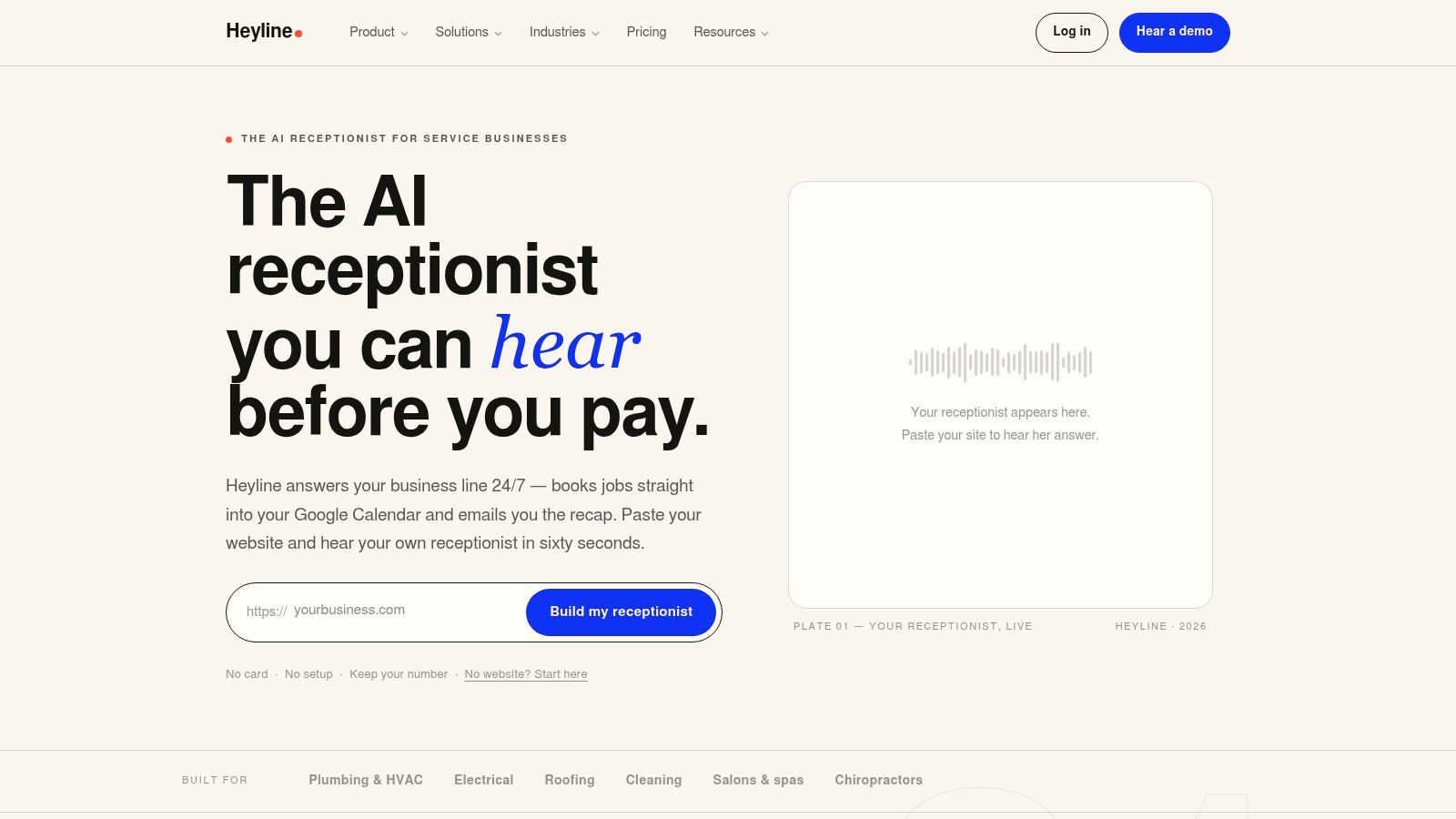
Heyline provides an AI phone receptionist that answers incoming business calls, uses information from your website, and can schedule appointments through a connected calendar. Visit Heyline to explore a live call setup for your appointment-based business and test how it could fit your current phone workflow.