You printed a phone number for a business on the window, the website, and the appointment card. Did anyone answer when a customer called at 7:15 p.m.?
That question is the gap most number guides skip. A line is not a digit string to stamp on a sign. It is a reachability choice and a privacy choice. For a salon, a clinic, or a contractor, the call only earns its keep when it becomes a confirmed booking, and the notes you keep should stay limited to what scheduling needs.
I would not start by shopping prefixes. I would ask who answers when the chair, the operatory, or the job site is busy, who answers after close, and what the caller hears before any recording starts. Overlapping California area codes and consumer-privacy rules sit on that same line.
Local, Toll-Free and Virtual Numbers Compared
Match the number to the way customers already find you, before you buy anything.
| Type | What It Looks Like | Best For | Watch Out For |
|---|---|---|---|
| Local number | Ten digits with your local area code | Storefronts, clinics, contractors serving a town or region | Callers outside the area may see it as less established |
| Toll-free number | An 800, 833, 844, 855, 866, 877 or 888 prefix | Businesses serving a wide area or running call-centre style intake | Some callers perceive it as less local; confirm the prefix is available |
| Virtual number | Any area code, managed in a hosted phone platform | Remote teams, multi-location firms, businesses without a desk line | Needs a working internet connection; confirm emergency calling support |
| Mobile number as business line | Your personal mobile number | Solo operators in the early stage | Mixes personal and work calls and makes handoffs hard |
A local number is ten digits with an area code your neighbourhood clients already recognise. Walk-in salons, dental offices, and town contractors usually win trust with that familiar prefix. Callers from far outside the exchange can read it as a smaller shop, which is fine if you do not want statewide traffic.
A toll-free number opens with 800, 833, 844, 855, 866, 877, or 888. It suits a wide service area and a call-centre style intake desk, because the caller is not paying long-distance on a traditional line. It can sound less local, and you should confirm the prefix is available before you print it.
A virtual number can carry any area code and lives on a hosted phone platform. Remote teams and multi-location firms use it when there is no desk phone to ring. Confirm the platform supports emergency calling, because a pretty area code does not replace a working 911 path.
A mobile number used as the business line is the fastest start for a solo operator. It also blends personal texts with booking calls, and handing the line to a new hire means handing over your private number.
California dialling makes the full number essential. The California Public Utilities Commission notes that the Federal Communications Commission designated 988 as the nationwide three-digit Suicide & Crisis Lifeline on 16 July 2020, which forced area codes 209, 530, 562, 626, 650, 707, 925, 949, and 951 from seven-digit local dialling to 1+10-digit dialling. Print the area code on every listing, site, and sign. The same habit helps if you also publish a number for callers in another region, which is the point of an area code 410 phone number used outside its home exchange.
If most customers search for you locally, choose a local number. If they travel to you or call from elsewhere, consider toll-free or virtual.
Routing Calls to Your Team or an AI Receptionist
A number is useful only if the right person or system answers it. Choose routing based on who can reliably take calls and what should happen when they cannot.
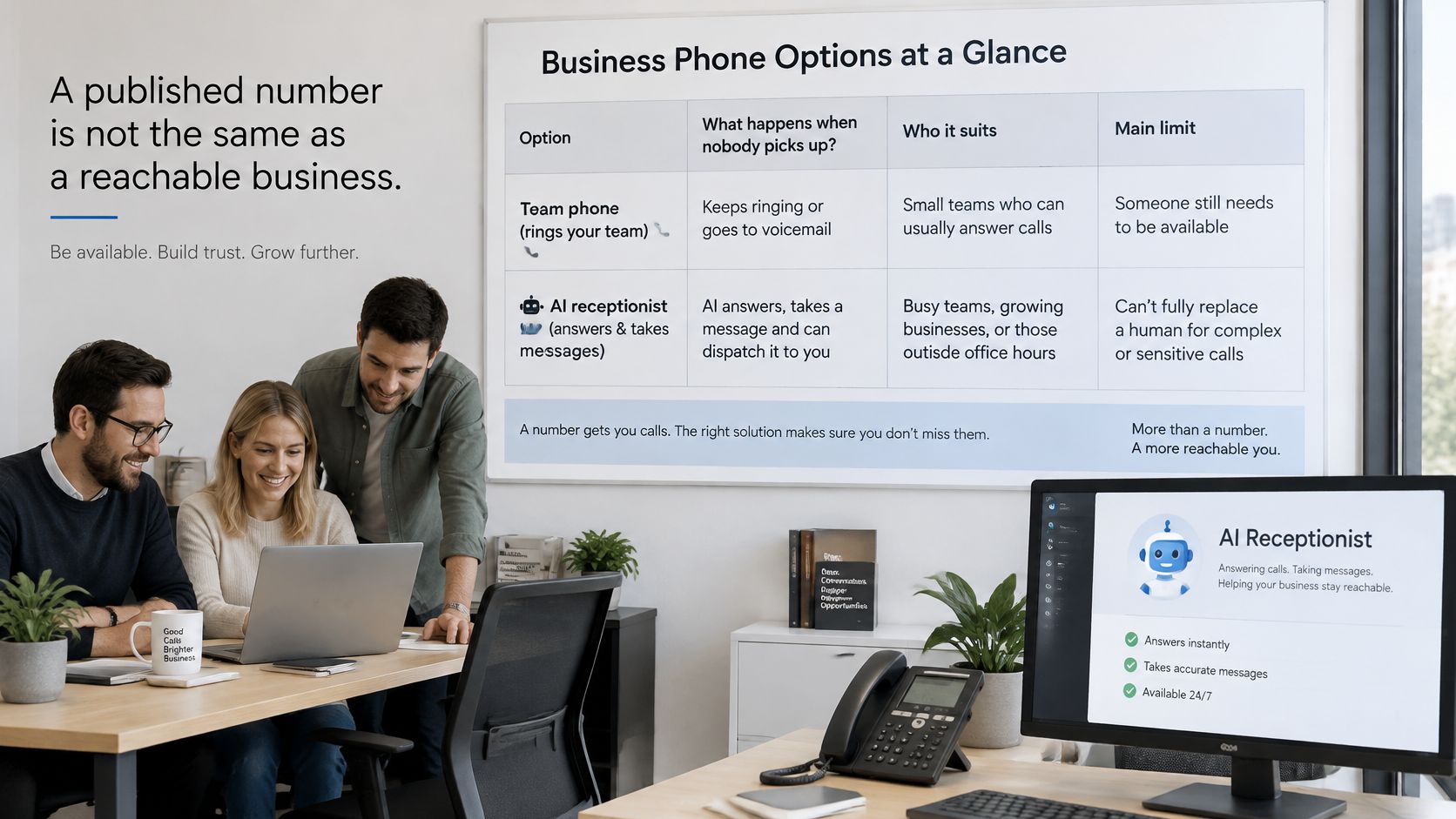
| Routing Option | When Nobody Answers | Best For | Main Limit |
|---|---|---|---|
| Ring your mobile | Voicemail or a missed call | Solo operators | Calls depend on your availability |
| Hosted business phone system | Ring group or voicemail | Teams with several staff | A team member still needs to answer |
| AI receptionist on the business line | Answers around the clock, books appointments, takes messages | Salons, clinics, law firms, contractors | Cannot transfer live callers to the owner |
| Forwarded overflow to an AI receptionist | Answers calls the main line misses | Businesses keeping an established number | Callers who reach a person on the main line do not speak with the receptionist |
Visibility is not a booking
A search result or tap on a phone number is only the start. A completed conversation, a qualified intake, and a booked appointment are separate outcomes. Track answered calls, abandoned calls, bookings, and calls recovered after a missed ring to see whether your routing is doing its job.
Practical rule: Judge the line by the conversations and bookings it produces, not by how often someone taps the number.
Heyline offers two setups: publish its dedicated number so the receptionist answers every call, or keep your existing number and forward calls the business does not pick up. The call-routing options for business phone lines determine whether calls ring a team, reach voicemail, or go to an AI receptionist.
Heyline does not transfer live callers to the owner's cell phone. If a caller needs the owner, the receptionist explains that and takes a message with the caller's name and number. That avoids relying on a personal phone being available during an appointment or job, while leaving the business with a callback request.
The after-hours test
Call the business line after closing and check what the caller hears. Heyline answers around the clock, tells callers when the business next opens, and can book the first available slot within the business's real hours. Try a request that needs an answer from the business's website, then check that the call summary and transcript are saved. If the receptionist does not know an answer, it asks for the caller's name and number and files a message.
Set Up, Test and Publish Your Number
Do the tests before the paint dries on the sign. A dead line on day one loses the caller who will not try twice.
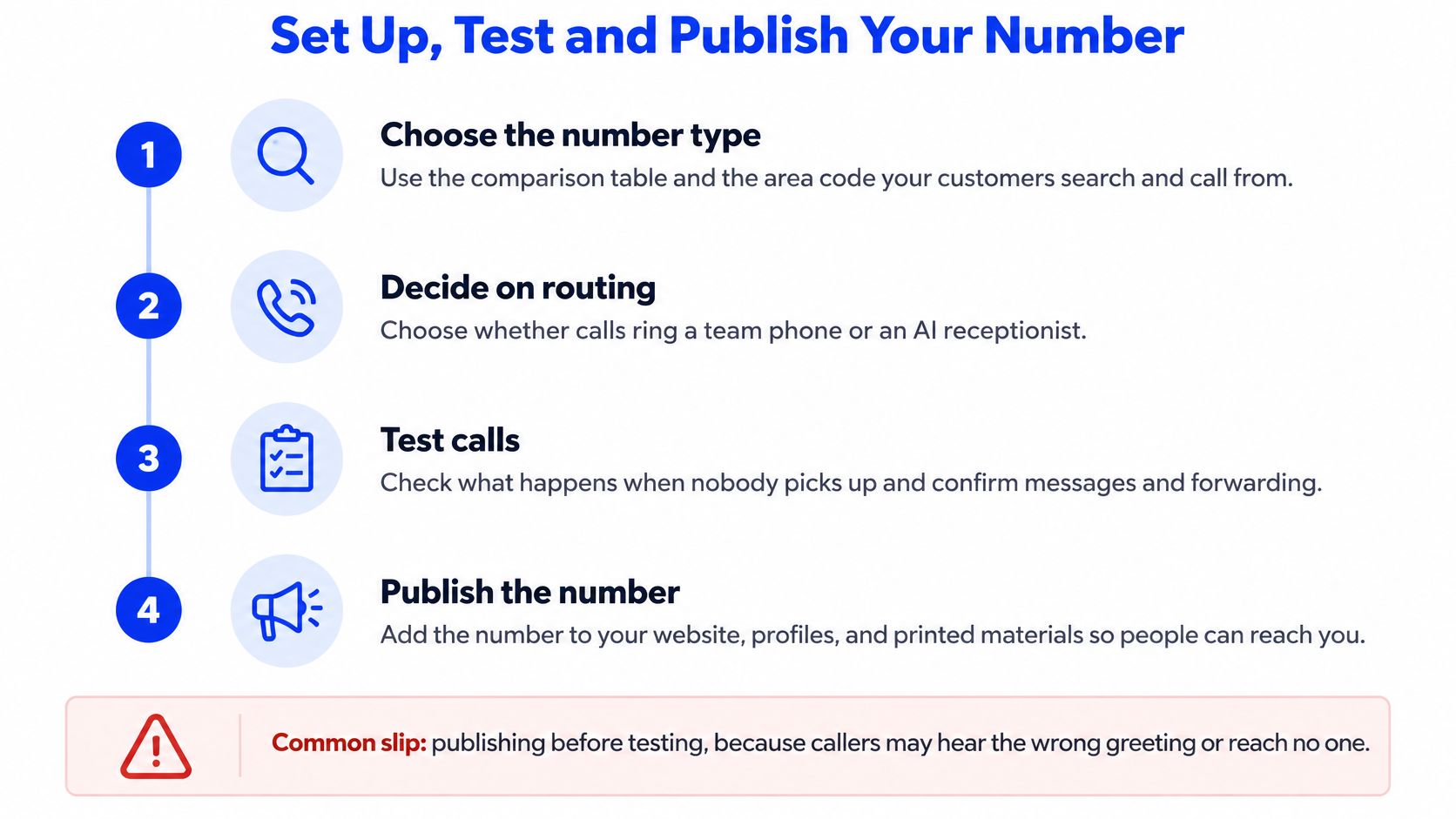
Choose and connect
- Choose the number type from the comparison above, and pick the area code your customers search and call from. A clinic in the 626 region should not advertise a prefix its patients do not recognise.
- Decide whether to port your current number, forward it, or start new. If you port or forward, finish the checklist in the next section before you order anything else, because a half-moved line drops calls.
- Order the number through your phone provider, or let the receptionist platform provision it. Heyline provisions a dedicated phone number for each business when it goes live, so a separate carrier purchase is not required first. You can try the receptionist for free in the browser by pasting your website and talking to it, and that browser test is not attached to any live line.
- Connect the number to the routing you chose: a hosted system, your mobile, or the receptionist. Set business hours in the platform so after-hours callers hear when you open, not a generic beep.
Prove it before you publish
- Run the go-live test. Ring the number from a different phone during opening hours and again after hours. Confirm the greeting, the hours, and that a missed call leaves a usable message with a name and a callback number. A wrong voicemail here is how you lose the customer who will not call back.
- Check the escalation path with a complicated request, such as a medical question or a job outside your service area. Confirm the retention rule for call notes and recordings at the same time, so you are not storing audio you have no reason to keep.
- Only after every test passes, update listings, receipts, and signage with the full ten-digit number. Early callers who reach a dead line are gone. Put the same digits on your Google Business listing call button, because that is often the first tap.
To check a Heyline setup, ring your business number from another phone. When the call reaches Heyline instead of voicemail, the setup is live.
A working setup plays the right greeting, shows the right hours, and saves a message you can act on the next morning.
The common slip is publishing before that second after-hours call. Owners update the website while the greeting still says the old shop name, or while forwarding still points at a cancelled mobile. Run the after-hours test this week. The number works only if that test ends in a booking, not a beep.
Keeping Your Existing Number Through Porting or Forwarding
If the number is already on the van, the Yelp page, and last year's receipts, do not throw it away. You have two routes, and they solve different problems.
Porting moves the existing number to a new provider. Listings stay correct because the digits never change. Forwarding leaves the number with its current carrier and sends busy or unanswered calls to a new dedicated line. You can keep the existing number, and the dedicated number can either be published as the business line or receive only forwarded missed calls.
What to gather before a port
Collect these from the current bill, not from memory.
- Account holder name and service address: Copy them exactly as the bill prints them, including abbreviations and suite numbers.
- Account number and any PIN: The losing carrier uses these to authorise the move.
- Every number on the account: List the main line and any extras you intend to move, so a fax or alarm line is not dragged along by accident.
A mismatch in the name or the service address is the usual reason a port is rejected. Read the bill out loud against the port form before you submit it. Porting takes several business days, and the old service must stay active until the transfer completes. Cancel too early and calls fall into a gap nobody owns.
When forwarding is the better move
Keep the existing number with the current carrier. Turn on busy and no-answer forwarding to the new line, then place a test call while you are already on the main line and another while nobody answers. Carrier menus label this differently, so follow that carrier's forwarding steps rather than guessing a star code.
Port when the number already appears on signage, listings, and receipts. Forward when you only want overflow coverage and you are not ready to move the billing relationship.
Listing and Privacy Rules for California Businesses
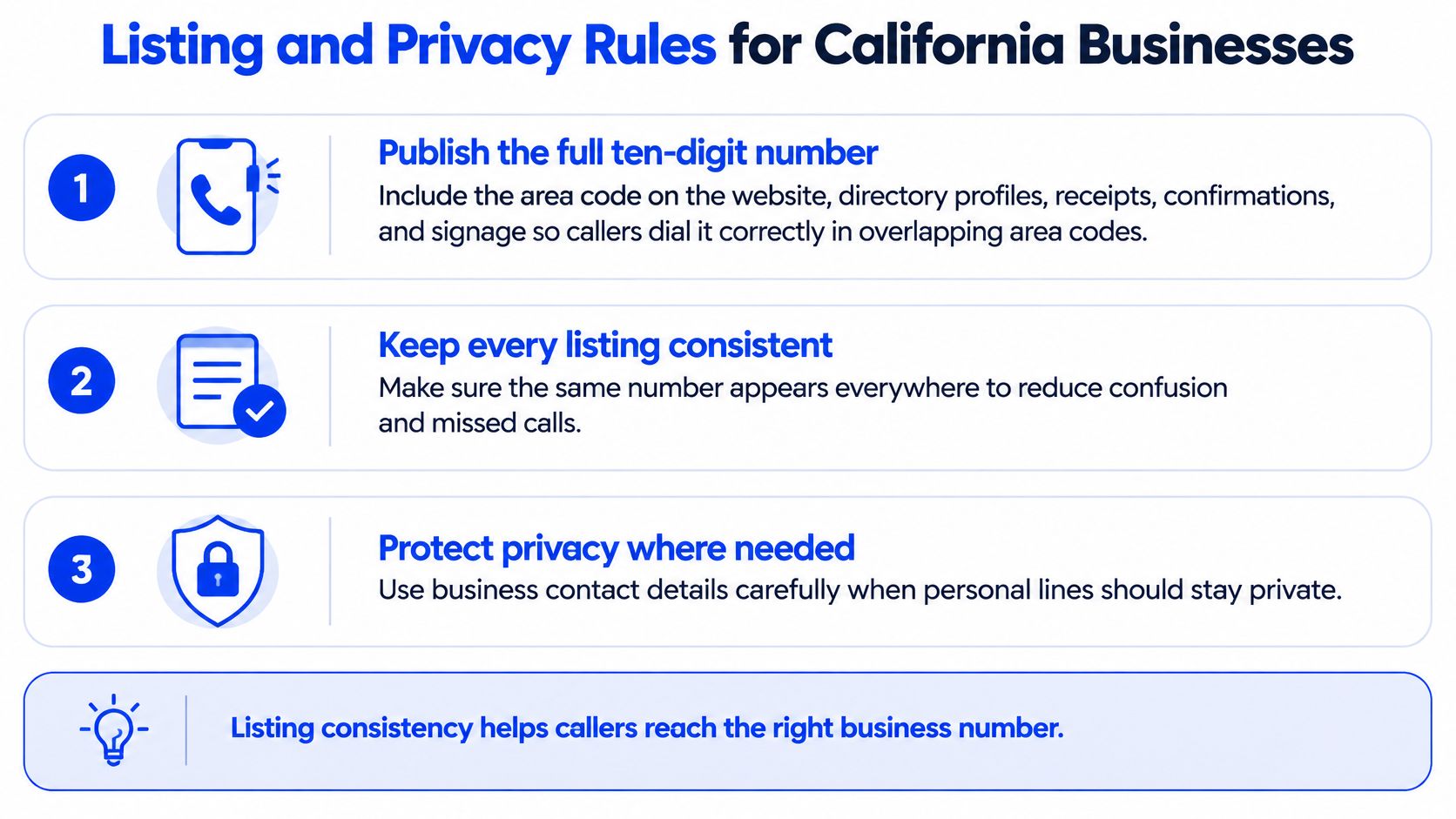
Publish one full ten-digit number, area code included, on the website, directory profiles, receipts, confirmations, and signage. Callers in overlapping area codes misdial a seven-digit fragment, and a second "office" number on the receipt splits your bookings.
The California Privacy Protection Agency statute treats the line as a regulated consumer-contact channel, not only a sales channel. If you are subject to the CCPA, you must offer at least two designated methods for privacy requests, including a toll-free telephone number, and the people who take those calls need the knowledge to process them. Guidance also calls for an accessible online privacy policy written in plain language.
Collect only what the booking needs
Use this minimisation checklist on every intake script, human or automated.
- Disclose what caller information you collect before or at the moment you collect it.
- Record only what scheduling needs: name, callback number, service requested, and preferred time.
- Set a retention period for call notes and recordings, and delete on that date.
- Document whether any of that information is sold or shared.
Compare every captured field with the booking goal. If a field cannot change eligibility, availability, confirmation, or follow-up, drop it or make it optional. A salon does not need a caller's workplace. A contractor does not need a date of birth to quote a faucet.
The step owners miss most often is the recording notice. A recording or transcript that contains names, phone numbers, or addresses can count as personal information, so the caller should hear a notice before recording or transcription starts.
Do not let the main booking number be the only privacy channel, and do not leave an automated receptionist to decide a deletion request.
Route privacy requests to a person who can process them. Review the recording disclosure, the privacy notice, and opt-out handling with counsel before you go live. Then judge the line by answer rate, completed bookings, and how fast a deletion request is handled, not by raw call volume.
Heyline answers a phone number for a business around the clock, books appointments on your real calendar, and can sit on a new dedicated line or on the calls your current number misses. Paste your website, talk to the receptionist, and run the after-hours test before you change a single listing. Visit Heyline when you want that line to end in a booking instead of a missed call.